Organizations everywhere routinely gather and use people’s private information. Under the General Data Protection Regulation (GDPR) Compliance Services, businesses must manage customers’ private data fairly, openly and safely. One of the many mandates laid out in this legislation is to conduct a Data Protection Impact Assessment, or DPIA. A DPIA can help organizations identify privacy risks before they escalate and become major problems. Under the GDPR DPIA is not required for every type of data processing activity; however, it is mandatory if there is a high risk to an individual’s rights and freedoms due to processing. Many organizations continue to have difficulty determining when a DPIA is required under GDPR, what requirements must be met for a DPIA, and how to complete the steps necessary to conduct a DPIA. This article provides a clear explanation of these issues, as well as how to conduct a proper GDPR risk assessment with practical guidance.
DPIA Explained: GDPR Compliance
A Data Protection Impact Assessment (DPIA) is a methodology utilized to systematically analyze how a company may handle an individual’s personal information (sensitive & non-sensitive). The purpose of conducting this type of assessment is to mitigate the probability of any negative impacts on the rights and freedoms of individuals that are caused by the company’s proposed data processing actions.
DPIA’s primary objectives include:
- Assessing the level of risk of the particular processing activity;
- Decreasing or eliminating risks associated with the use of personal information
- Increasing privacy and security.
Assessing compliance with the General Data Protection Regulation (GDPR): Therefore, while a DPIA will not stop an organization from continuing to perform a specific processing activity, it will provide the organization with accountability for how that processing is undertaken in a responsible manner.
When Is DPIA Mandatory under GDPR?
According to Article 35 of the General Data Protection Regulation (GDPR), prior to commencing to process individuals’ personal data, a Data Protection Impact Assessment (DPIA) must be carried out if there is a serious risk of damage to individuals’ rights and freedoms. Whenever an organization’s Project or System creates a new organisational project, typically a DPIA is performed as a part of the organisation’s overall compliance to the Data Protection Legislation when the Organisation has developed the Project/Sys-GGG. The DPIA must be used for instances of physical processing of sensitive Personal Data (massive volume of cc), instances of intrusive processing of Personal Data, and instances in which the Organisation employs Technology or Techniques that can have an effect on the way in which individuals within society are monitored, profiled or evaluated.
Wherever a DPIA must be performed, it is important to consider the potential Vulnerability of a Data Category or the number of Data Subjects that will be affected by an Organization’s Data Processing method. Also, it is important to note, Regulatory Agencies generally outline several examples for Organizations to utilize to determine the types of processing activities that would require conducting a DPIA.
Common High-Risk Processing Activities
These types of processing often require a DPIA:
- Large-scale monitoring of public areas (e.g., CCTV in public spaces)
- Large-scale handling of sensitive data (e.g., patient health data)
- Profiling or scoring individuals for decisions or behavior analysis
- Use of new or emerging technologies with privacy impact
- Tracking individuals online for targeted advertising or analytics
High-Risk Data Types
The following types of data will often require the performance of a Data Protection Impact Assessment (DPIA):
- Biometric Information, such as fingerprinting or facial recognition technologies
- Health or Medical Records (diagnostic procedures, test results, etc.)
- Financial / Credit Records (scoring, account activity, etc.)
- Data Identifying A Person’s Religious (i.e., race, ethnicity, etc.), Interest (i.e., political party affiliation)
Example Sectors in Which DPIA Will Be Required
- Certain sectors within an industry are considered “high-risk” because of how frequently they’re subjected to the use of high-risk types of data:
- Healthcare Organizations / Hospitals that maintain patient records
- Banks / Financial Institutions that utilize credit profiles on their customers
- Retail / E-Commerce business operations that track the online purchasing habits of their customers
- Telecom Companies that monitor and analyze their customers’ communications records
- Technology Companies that utilize facial recognition technology, machine learning, and/or artificial intelligence to analyze their customers’ data.
Regulatory Guidance
EU supervisory authorities publish blacklists and whitelists to help organizations understand which processing activities require a DPIA. If a processing activity appears on a regulator’s blacklist, performing a DPIA becomes mandatory. Whitelists, on the other hand, help identify activities that may not require one.
Benefits of Conducting a DPIA
Organizations can gain a variety of tangible and ongoing advantages through the completion of a Data Protection Impact Assessment. DPIAs help bolster privacy settings, reduce security incidents and continue to demonstrate ongoing compliance with the General Data Protection Regulation (GDPR). These benefits can be further elaborated on as follows:
Lower Risk Levels
Through conducting a DPIA, organizations can identify potential privacy and security risks at the development phase of the process. Examples of these risks include weak security settings, high-risk data types, third-party usage of an organization’s systems or data, and improper usage of personal data. Once a risk has been identified prior to the implementation of a new system, the organization can resolve these risks before they produce any data breaches, investigations, and/or fines. Therefore, performing a DPIA leads to a more secure systems and reduced future surprises.
Improved GDPR Compliance
The General Data Protection Regulation (GDPR) places accountability for how organizations process personal information onto the respective organizations. A DPIA provides evidence that the organization has performed a risk assessment, implemented appropriate measures to mitigate risk, and documented their rationale for implementing protective actions or safeguards. This additional evidence supports the principle of accountability, as defined in the GDPR. Furthermore, having a DPIA available will facilitate the audit, inspection and/or regulation review of an organization as it will be clear that the organization has complied with the law.
Confidence and Openness
Advanced technology such as artificial intelligence (AI), biometric technology, analytics and the Internet of Things (IoT), along with Cloud Computing, all have some aspect of utilizing sensitive information and processing it with great complexity and sophistication. A Data Protection Impact Assessment (DPIA) allows for a structured methodology when implementing new technology through identifying what type of data moves through each area of a particular system; noting where there may be potential risks; and providing recommendations on how to mitigate those potential risks. Therefore, organizations can continue to innovate while ensuring they do not interfere with the rights of consumers or create a legal issue for themselves.
Seamless Utilization of the Latest Technology
Recent technological advances have resulted in increased creation of highly sensitive data; these advancements include Artificial Intelligence (AI), Biometrics, Analytics, Internet of Things (IoT), and Cloud Computing. To effectively implement and utilize the above-stated technology, the Data Protection Impact Assessment (DPIA) allows an organisation to create a clear, actionable roadmap for using such technology in a secure manner. The DPIA will identify every possible manner of personal data flowing through an organisation’s information systems, as well as highlight any potential conflicts with respect to processing personal data and provide recommendations on how to avoid those conflicts. Therefore, organisations can innovate freely while protecting their customers’ and their own rights to privacy and reducing the potential risk of legal action.
How to Conduct a DPIA: A Stepwise Approach
GDPR does not force companies to follow one fixed DPIA format. However, regulators and privacy specialists recommend a structured approach to keep the assessment clear and complete. Below is an easy way to understand how to conduct a DPIA step by step, with brief explanations for each stage.
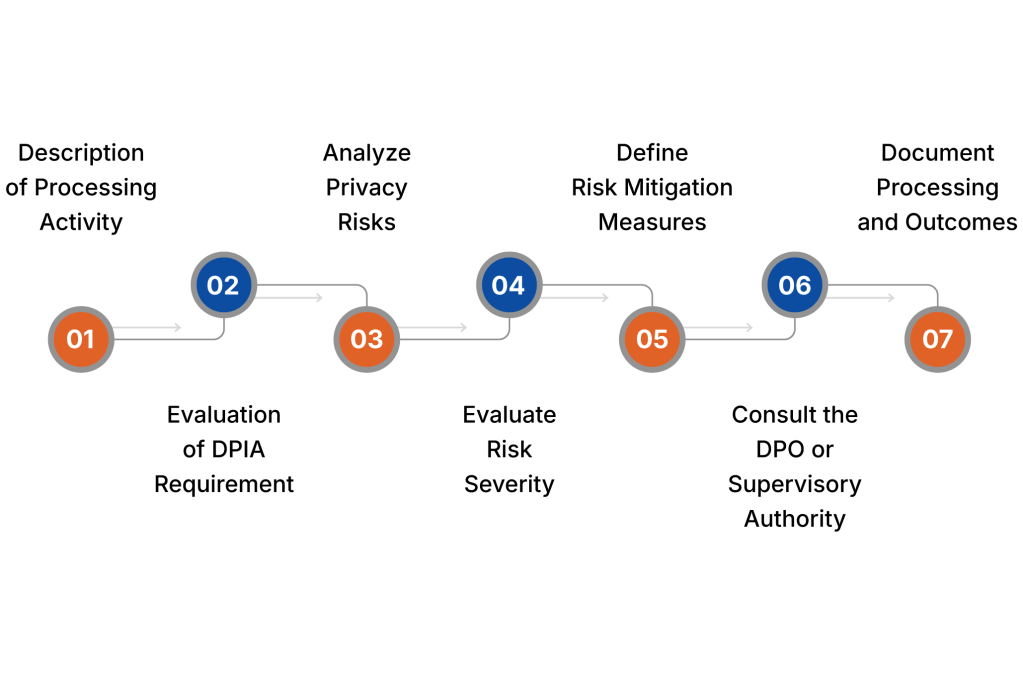
Step 1: Description of Processing Activity
In step 1, the organization will provide a detailed description of how it is going to process an individual’s personal Information. This process will provide visibility into the full life of the data. A description of this processing must include:
- Data collected (e.g. name, email, medical data)
- Purpose(s) for the collection of the data(e.g. business/legal)
- How the data will be Processed (e.g. stored, analysed and shared).
- Who Will have Access to the data (e.g. internal team members, members of a third-party).
- Total Length for Which the Data Will Be Stored.
- Systems, Tools, And/or Platforms Used to Implement this Process.
Providing this information allows decision makers to understand the scope of this effort.
Example: A retail organization is Installing CCTV camera Systems with facial recognition technology to Monitor the activity within Sounds to Help Prevent Theft.
Step 2: Evaluation of DPIA Requirement
In step 2, the organization will Assess whether processing activity under GDPR requires a Data Protection Impact Analysis (DPIA). The assessment will identify
- whether each type of processing includes any of the following High-Level Risks:
- Processing of high risk or sensitive personal data.
- Monitoring large scale individual activity.
- Automated/agreement processing and profiling
- Processing of vulnerable individuals (e.g., patients, children, etc.).
- A new and/or experimental technology.
If one or more high-risk factors are found, the DPIA must proceed. This step prevents unnecessary DPIAs for low-risk activities and ensures the focus stays on areas that truly need attention.
Step 3: Analyze Privacy Risks
At this stage, the organization performs a GDPR risk assessment to identify possible privacy and security risks linked to the processing. This includes risks such as:
- Unauthorized access to personal data
- Misuse or overuse of data beyond the original purpose
- Data leakage, breach, or accidental exposure
- Profiling that creates unfair or inaccurate results
- Algorithm bias or discrimination in automated decisions
The goal is to understand how the processing could negatively affect individuals and where gaps exist in the system.
Step 4: Evaluate Risk Severity
Once risks are identified, their severity is evaluated. Organizations assess:
- Likelihood of the risk happening (low / medium / high)
- Impact if the risk occurs (low / medium / high)
A high-likelihood, high-impact risk needs stronger controls compared to a low-likelihood risk. This helps prioritize which risks must be fixed first. Risks that could cause serious harm to individuals’ rights require immediate attention and stronger safeguards.
Step 5: Define Risk Mitigation Measures
After evaluating risk severity, the organization selects measures that can reduce or eliminate risks. Common risk mitigation measures include:
- Access control (limiting who can view or modify data)
- Data minimization (collecting only what is necessary)
- Encryption (protecting data in transit and storage)
- Anonymization or pseudonymization (removing personal identifiers)
- Staff awareness and training programs
- Vendor or third-party risk management procedures
These measures should reduce the risks to an acceptable level before the processing begins. If risks cannot be reduced enough, the processing might need redesign or additional justification.
Step 6: Consult the DPO or Supervisory Authority
If the organization has a Data Protection Officer (DPO), this person must be involved in reviewing the DPIA findings. The DPO provides expert guidance on privacy controls and compliance. If high risks remain even after mitigation, GDPR requires the organization to consult the relevant Supervisory Authority (such as the national Data Protection Authority). This ensures that regulators are aware of serious privacy concerns before the system goes live.
Step 7: Document Processing and Outcomes
The final step is to prepare clear DPIA documentation. The documentation should include:
- Description of the processing activity
- Purpose of processing and lawful basis
- Risks identified during the assessment
- Mitigation measures selected to reduce risk
- Final processing decision (approve, modify, or avoid)
- DPO recommendations or regulatory feedback (if applicable)
This documentation is important because it proves compliance during audits, regulatory investigations, or future reviews. DPIA documents must be kept up to date if the processing continues.
DPIA Documentation Requirements
A DPIA must be well-documented, clear, and accessible during audits. Key DPIA documentation requirements include:
- Description of processing operations
- Purposes of processing
- Legitimate interest or lawful basis
- Nature and type of personal data
- Categories of data subjects
- Data flow and storage locations
- Risk analysis findings
- Mitigation measures and controls
- Final decision on processing activity
- Sign-off from relevant authorities or stakeholders
Documentation must be retained if the processing activity continues.
Typical Errors Businesses Make
Companies often make some common errors, including considering DPIAs as an optional activity, using inconsistent or incomplete forms, misunderstanding what constitutes high-risk processing, and not considering any risks that may come from their vendors’ or third-party tools. Other errors include not properly documenting and updating the DPIA and not including the Data Protection Officer in the process of creating and updating the DPIA. All these practices greatly weaken compliance and increase the risk of regulatory investigation for the companies.
Conclusion
The purpose of carrying out a Data Protection Impact Assessment (DPIA) as per GDPR Consulting is to assist all organisations in establishing Privacy, Trust and Compliance. A DPIA will need to be conducted when an organisation processes personal data and poses a high risk to individuals. A properly completed DPIA allows organisations to identify Privacy issues early, implement appropriate measures to mitigate them and create documentation to demonstrate due diligence for Auditors and Regulators. While some people may see DPIA’s as being complex, with the right checklist and clear method to follow, they can be undertaken as part of the ordinary operations of an organisation. Many organisations will require assistance from experts to determine whether a DPIA is necessary, how to carry it out correctly and how to meet the requirements set out in GDPR Consulting services. Valuementor provides GDPR assessments, DPIA reviews, privacy audits, and GDPR compliance consulting services to help organisations meet data protection requirements and strengthen their privacy compliance programs. If you require assistance with your DPIA(s), Privacy Governance and Data Protection Frameworks, contact Valuementor today to enhance your Privacy Compliance with Confidence.
FAQS
1. What are common high-risk processing activities that trigger a DPIA?
High-risk activities include large-scale monitoring (CCTV), handling sensitive health or financial data, profiling individuals, using emerging technologies, and tracking online behavior for targeted advertising.
2. When is a DPIA mandatory under GDPR?
A DPIA becomes mandatory when data processing is likely to cause a high risk to individuals, such as large-scale monitoring, profiling, or processing sensitive data.
3. What are examples of high-risk processing activities?
Examples include CCTV monitoring of public areas, biometrics, health data processing, profiling for decisions, and online tracking for targeted advertising.
4. Who needs to conduct a DPIA?
Any organization (public or private) that performs personal data processing which meets high-risk conditions under GDPR must conduct a DPIA.
5. How does a DPIA add value to an organization?
A DPIA enables organizations to proactively manage privacy risks and implement safeguards. It also enhances compliance, builds customer trust, and supports the secure adoption of new technologies.
6. Who should be involved in a DPIA?
A DPIA should involve the Data Protection Officer (DPO), relevant department heads, and any teams handling personal data. Collaboration ensures all risks are identified and appropriate safeguards are implemented.
7. Who reviews or approves the DPIA?
The organization’s Data Protection Officer (DPO) usually reviews it. If serious risks remain, the supervisory authority must be consulted.
8. What data types often trigger DPIA requirements?
Sensitive data like biometrics, health records, financial data, and data revealing religion, ethnicity, or political opinions often trigger DPIAs.
9. Does GDPR provide a fixed DPIA format?
No, GDPR does not force one format, but it requires the DPIA to cover purpose, risks, affected individuals, safeguards, and outcomes.
10. What happens if a company avoids a required DPIA?
Failing to perform a mandatory DPIA can lead to non-compliance penalties, regulatory investigations, reputational damage, or costly enforcement actions.