- ISO/IEC 42001:2023 is the first international standard specifically designed to govern AI Management Systems, and certification requires structured audit evidence — not merely written policies.
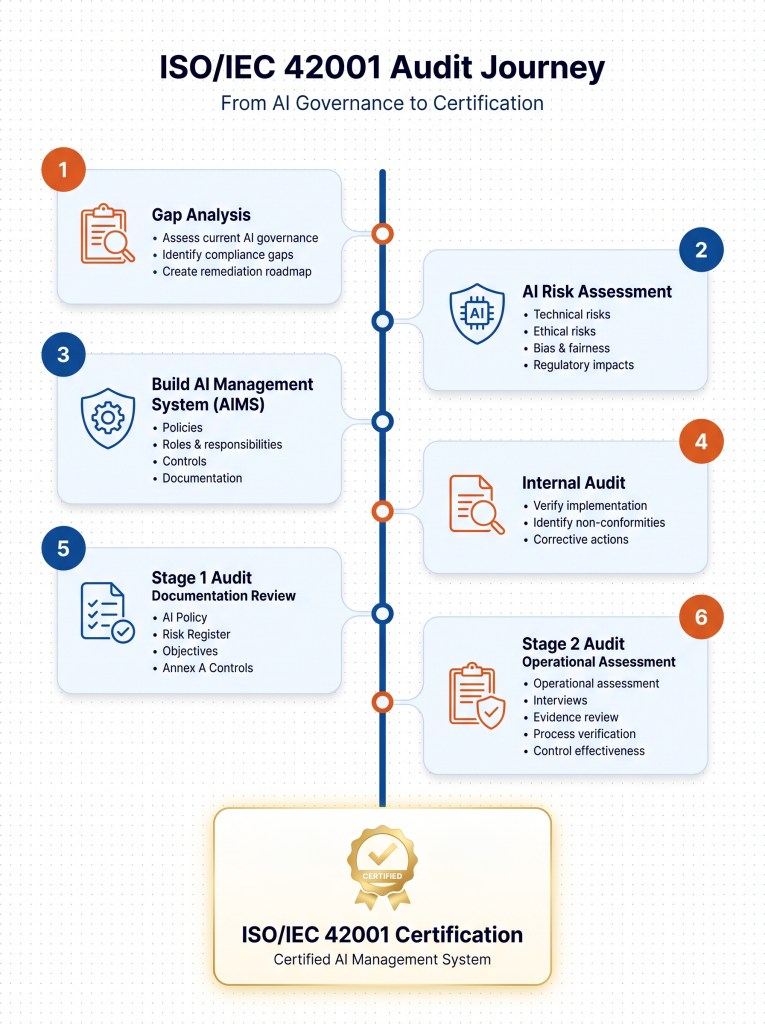
- An effective ISO 42001 audit encompasses four interdependent pillars: gap analysis, internal audit, Stage 1 documentation review, and Stage 2 on-site assessment.
- AI governance compliance demands that organisations demonstrate not just technical controls but also ethical accountability, transparency mechanisms, and continual improvement processes.
- AI risk assessment under ISO 42001 goes beyond conventional IT risk frameworks, requiring organisations to evaluate impact on individuals, society, and fundamental rights.
- Achieving trustworthy AI recognition through ISO 42001 certification strengthens stakeholder confidence, supports regulatory readiness, and positions the organisation as a credible AI actor in its sector.
The ISO 42001 audit is the mechanism by which an organisation transforms its AI governance commitments into independently verified auditable proof. Without a structured audit process, even the most comprehensive AI policies remain aspirational documents rather than operational realities.
Artificial intelligence has moved rapidly from experimental capability to critical organisational infrastructure. Across industries — financial services, healthcare, public administration, and manufacturing — AI systems now influence decisions of considerable consequence: credit approvals, clinical triage, resource allocation, and regulatory reporting. This expansion has intensified scrutiny from regulators, procurement bodies, and the public alike. CISOs, compliance officers, and governance leads are now expected to demonstrate not only that AI systems perform as intended, but that they are managed responsibly, with documented accountability structures and verifiable risk controls. ISO/IEC 42001:2023, the first internationally recognised standard for AI Management Systems (AIMS), provides precisely this framework.
Understanding the anatomy of an ISO 42001 audit — its stages, its requirements, and the evidence it demands is paramount for any organisation seeking certification or preparing for regulatory alignment. This blog provides a structured roadmap through each phase of the audit process, examines the intersection of AI governance compliance and AI risk assessment, and clarifies what it genuinely means to build and sustain trustworthy AI under an internationally recognised management system.
ISO/IEC 42001:2023 (ISO 42001): The first international standard published by the International Organization for Standardization and the International Electrotechnical Commission that specifies requirements for establishing, implementing, maintaining, and continually improving an Artificial Intelligence Management System (AIMS) within an organisation.
AI Management System (AIMS): A structured framework of policies, processes, roles, and controls through which an organisation governs the development, deployment, and operation of AI systems, designed to ensure responsible and transparent AI use aligned with organisational objectives and stakeholder expectations.
AI Governance Compliance: The state of demonstrably meeting the requirements of applicable AI-related standards, regulations, or frameworks — including ISO 42001 — through implemented controls, documented evidence, and verified practices, as assessed by internal or external audit.
Trustworthy AI: A characterisation of AI systems that are demonstrably safe, transparent, accountable, fair, and privacy-preserving, as evidenced through adherence to recognised governance frameworks and independently verified management practices.
Understanding AI Governance Compliance Under ISO 42001
Direct Answer: AI governance compliance under ISO 42001 means an organisation has built, documented, and operationalised a system of controls that govern every stage of the AI lifecycle — from development and deployment to monitoring and decommissioning — and can substantiate this through auditable evidence.
ISO 42001 does not operate in isolation. It follows the Annex SL high-level structure shared by ISO 27001 and ISO 9001, which means organisations with existing management systems can integrate an AIMS without building governance infrastructure from the ground up. This compatibility is significant: it enables compliance officers and CISOs to leverage established risk management processes, internal audit functions, and policy documentation frameworks while extending them to cover AI-specific requirements. For organisations already operating within a mature compliance programme, this integration reduces duplication of effort and accelerates the path to certification.
The Scope of Governance Obligations
AI governance compliance under ISO 42001 encompasses several distinct obligation areas. Organisations must define the scope of their AIMS clearly — specifying which AI systems fall within its boundaries and on what basis. Leadership must demonstrate visible commitment, including the establishment of an AI policy, the assignment of AI-related roles and responsibilities, and the allocation of sufficient resources. Operational planning must show how AI risks are identified, evaluated, and treated in a structured manner. Critically, the standard requires organisations to address not only technical risks but also societal and ethical dimensions, including impacts on fundamental rights, fairness, and transparency.
This breadth distinguishes ISO 42001 from narrower technical compliance frameworks. Governance compliance, in this context, is a cross-functional discipline. It requires coordination between legal counsel, data protection officers, engineering teams, and executive leadership. Compliance officers should treat ISO 42001 not as a checklist exercise but as an ongoing management commitment that evolves alongside the organisation’s AI capabilities and the regulatory landscape in which it operates.
Conducting a Rigorous AI Risk Assessment for ISO 42001
Direct Answer: A robust AI risk assessment under ISO 42001 requires organisations to systematically identify, analyse, and evaluate risks associated with their AI systems — encompassing technical failure, ethical harm, societal impact, and third-party dependencies — and to document treatment decisions with clear accountability.
ISO 42001 places AI risk assessment at the centre of its operational requirements. Unlike conventional IT risk assessments, which focus primarily on confidentiality, integrity, and availability of data and systems, an AIMS risk assessment must also evaluate the potential for AI systems to cause harm to individuals, groups, or society. This includes risks arising from biased outputs, opaque decision-making, over-reliance on automated processes, and the misuse of AI capabilities by internal or external actors. The scope of assessment is therefore broader in both its technical and ethical dimensions.
Structuring the Assessment Process
Organisations preparing for an ISO 42001 audit should structure their AI risk assessment across three interdependent layers. The first is the system-level assessment, which evaluates individual AI applications for their intended purpose, training data provenance, model behaviour, and potential failure modes. The second is the organisational-level assessment, which considers how AI systems interact with broader business processes, governance structures, and stakeholder obligations. The third is the contextual assessment, which examines external factors such as regulatory requirements, sector-specific expectations, and the rights of affected individuals.
Common Pitfalls in AI Risk Assessment
In practice, a frequent deficiency auditors identify is the tendency for organisations to conduct AI risk assessments as one-time exercises rather than as living processes. ISO 42001 requires risk assessment to be reviewed whenever significant changes occur — whether to the AI system itself, its operating context, or the regulatory environment. A well-designed AIMS will embed risk assessment into change management procedures, ensuring that new AI deployments or modifications trigger a formal evaluation before going live. Organisations that treat risk assessment as static documentation rather than a dynamic governance process will encounter significant non-conformities during audit.
Building Trustworthy AI: From Policy to Auditable Practice
Direct Answer: Trustworthy AI under ISO 42001 is not a design aspiration — it is an auditable outcome, demonstrated through documented controls, consistent operational practices, transparency mechanisms, and evidence of continual improvement reviewed at defined intervals.
The concept of trustworthy AI is increasingly referenced across regulatory frameworks, including the EU AI Act, NIST AI RMF, and various national guidance documents. ISO 42001 operationalises this concept by requiring organisations to establish and maintain specific controls that collectively produce AI systems stakeholders can rely upon. These controls span the full lifecycle: requirements specification, data management, model development practices, testing and validation, deployment controls, monitoring, and incident response. Each control area must be documented, implemented, and subject to periodic review.
Transparency and Accountability as Audit Evidence
Two properties that auditors scrutinise with particular rigour are transparency and accountability. Transparency requires that organisations be able to explain, to a level appropriate for the audience, how their AI systems reach outputs and what limitations apply. This does not necessarily demand full algorithmic explainability in all cases — particularly where proprietary protections apply — but it does require that affected parties receive meaningful information about the nature and implications of AI-driven decisions. Accountability requires that roles and responsibilities for AI governance be clearly defined, assigned to named individuals or functions, and exercised in practice, not merely documented in an organisational chart.
Organisations comparing the AIMS structure of ISO 42001 with familiar information security frameworks will find a useful reference in ValueMentor’s analysis of how ISO 42001 differs from ISO 27001, which clarifies the distinct governance obligations each standard imposes and where they complement one another.
The ISO 42001 Audit Process: Stages, Evidence, and Readiness
Direct Answer: The ISO 42001 audit process follows a structured sequence — gap analysis, internal audit, Stage 1 documentation review, and Stage 2 on-site assessment — each requiring distinct forms of evidence that collectively demonstrate the AIMS is not only designed but effectively implemented and maintained.
Organisations approaching their first ISO 42001 certification audit frequently underestimate the evidential burden of the process. Certification bodies do not award ISO 42001 on the basis of policy documents alone. Auditors expect to see records of AI risk assessments, minutes from management reviews, internal audit reports, corrective action logs, training completion records, and supplier assessment evidence where third-party AI providers are involved. The distinction between having a documented system and operating one consistently is precisely what the audit is designed to test.
Stage 1: Documentation and Readiness Review
The Stage 1 audit is a structured review of the organisation’s documented AIMS against the requirements of ISO/IEC 42001:2023. Auditors examine the scope statement, AI policy, risk assessment methodology, treatment plans, objectives, and the controls selected from Annex A of the standard. This stage is primarily conducted as a desk review, though auditors may conduct interviews with key personnel to assess awareness and understanding. The output is a readiness report identifying any areas where the documented system does not yet meet the standard’s requirements — areas that must be addressed before Stage 2 proceeds.
Stage 2: Operational Effectiveness Assessment
Stage 2 is a deeper, on-site assessment of whether the AIMS is functioning as documented. Auditors will sample records, interview staff across relevant functions, and trace the implementation of controls through operational evidence. Non-conformities identified at this stage are classified as major or minor, with major non-conformities precluding certification until adequately resolved. Organisations that have invested in a thorough internal audit cycle prior to Stage 2 consistently present stronger audit outcomes, as internal audit surfaces and corrects weaknesses before the external assessor encounters them.
Preparation for this entire process benefits significantly from expert partnership. ValueMentor works with organisations to assess their current AI governance maturity, structure their AIMS documentation, and conduct readiness reviews that reduce the risk of unexpected non-conformities at certification stage.
Conclusion
Achieving ISO 42001 certification represents a meaningful advance in an organisation’s AI governance maturity but the audit itself is the mechanism through which intent is converted into verified practice. Organisations that approach the process with structured preparation, a functioning internal audit programme, and genuine cross-functional ownership of their AIMS will find that the certification process strengthens governance capabilities rather than merely testing them. The standard’s requirements for AI risk assessment, transparency, accountability, and continual improvement are not administrative burdens; they are the architecture of resilience in an era where AI systems carry increasing organisational and societal consequence.
Looking ahead, ISO 42001 is positioned to become a foundational reference point as AI-specific regulation matures across jurisdictions. The EU AI Act, emerging national frameworks, and evolving procurement requirements are all moving toward expectations that ISO 42001 is well designed to address. Organisations that establish robust AIMS infrastructure now and can demonstrate it through audit will be substantially better positioned to meet future compliance obligations with confidence and credibility. Visit ValueMentor to explore how our AI governance and compliance specialists can support your organisation through gap analysis, AIMS implementation, and audit readiness so that when the time comes, your certification process reflects the strength of your preparation.
FAQ :
Yes, internal audits are a mandatory requirement of ISO 42001. The standard explicitly requires organisations to plan and conduct internal audits at defined intervals to verify that the AI Management System conforms to its own requirements and to those of ISO/IEC 42001:2023. Internal audit findings must be documented and reported to leadership as formal evidence of AIMS performance.
What is ISO 42001 compliance?
ISO 42001 compliance denotes the condition in which an organisation has established, implemented, and maintains an AI Management System that satisfies all requirements of ISO/IEC 42001:2023. Compliance encompasses AI governance structures, risk assessment processes, responsible AI controls, and continual improvement mechanisms, and is verified through a combination of internal audit activity and, where pursued, third-party certification assessment.
What is the difference between ISO 42001 and ISO 27001?
ISO 27001 focuses on managing information security risks through an Information Security Management System (ISMS). ISO 42001 focuses on governing AI systems through an Artificial Intelligence Management System (AIMS), addressing AI-specific risks, ethics, transparency, accountability, and regulatory compliance. While both follow the Annex SL structure for easy integration, ISO 27001 protects information, whereas ISO 42001 ensures responsible AI governance.
What is an ISO 42001 lead auditor?
An ISO 42001 lead auditor is a certified professional qualified to plan, lead, execute, and report on audits of AI Management Systems against ISO/IEC 42001:2023. Lead auditors must demonstrate competency in both formal audit methodology and the specific governance, ethical, and technical requirements of the standard, enabling them to independently assess AIMS conformity and operational effectiveness.