
AI adoption is creating new opportunities for businesses, but it is also introducing security risks that can have direct financial consequences. Two emerging concerns are drawing particular attention: LLMjacking, where attackers exploit stolen AI credentials to run expensive model workloads, and orphaned Model Context Protocol (MCP) servers, which introduce unmanaged access to enterprise systems.
Google Cloud reports that LLMjacking attacks can result in cloud bills reaching up to $1 million for affected organisations. Meanwhile, the growing use of AI coding agents is introducing MCP servers into development environments, often without adequate inventory, ownership or patch management.
Although these threats operate differently, they point to a common problem: organisations are adopting AI services and agent-based tools faster than they are establishing the security controls needed to manage them.
For technology leaders, this is a cloud security and AI governance concern. For finance leaders, it is becoming a matter of cost control, operational resilience and financial accountability.
What Is LLMjacking and How Does It Work?
LLMjacking refers to the unauthorised use and resale of access to large language models (LLMs) through compromised cloud accounts or stolen API credentials.
Attackers obtain access to an organisation’s AI services by stealing API keys, cloud credentials or other authentication tokens. They then use that access to run inference workloads, generate content or provide model access to other users, while the compromised organisation bears the associated cloud costs.
The financial impact can be significant. Researchers who first documented LLMjacking in 2024 highlighted how a compromised account could generate tens of thousands of dollars in daily inference costs under certain conditions.
Common Entry Points for LLMjacking Attacks
LLMjacking often exploits weaknesses in existing cloud security practices rather than sophisticated vulnerabilities in AI models.
Common exposure points include:
- Exposed API keys: AI credentials accidentally committed to public repositories or left accessible in internal code repositories.
- Long-lived cloud credentials: Persistent access keys stored on developer devices, CI/CD runners or application environments.
- Over-permissive IAM roles: Excessive permissions that allow users or services to invoke AI models across multiple regions without sufficient restrictions.
- Unprotected application endpoints: Applications that proxy AI model requests without authentication controls, usage limits or rate limiting.
- Insufficient cost monitoring: Missing budget alerts, usage thresholds and anomaly detection for AI services.
These weaknesses can allow attackers to exploit legitimate AI infrastructure without immediately triggering traditional security alerts.
Unlike many cyberattacks, where the financial impact becomes visible only after an investigation or recovery process, LLMjacking can show up directly in an organisation’s cloud consumption charges.
What Are Orphaned MCP Servers and Why Are They a Security Concern?
The Model Context Protocol (MCP) enables AI applications and agents to connect with external tools, databases, files and business systems. It provides a standardised way for AI models to interact with information and perform tasks beyond generating text.
As AI coding agents become more widely used, developers increasingly rely on MCP servers to connect these agents to development tools, source code repositories and other resources.
However, MCP servers can introduce security exposure when they are installed without proper oversight.
An orphaned MCP server is an MCP component that remains operational without a clearly assigned owner, documented approval, regular security review or defined maintenance responsibility.
These servers may be installed automatically by AI coding agents or pulled from public package registries to complete development tasks. Without an established governance process, organisations may not know which servers are running, what permissions they hold or whether they are receiving security updates.
How Orphaned MCP Servers Increase Enterprise Risk?
The primary concern is not the MCP protocol itself, but the lack of controls around its deployment and lifecycle management.
Potential security issues include:
- Unmanaged installations: MCP servers introduced by developers or AI agents without formal approval or centralised tracking.
- Excessive permissions: Servers operating with developer credentials or broad access to files, repositories, networks and cloud environments.
- Unpatched vulnerabilities: Outdated components that remain active because no team has responsibility for monitoring and updating them.
- Unverified third-party packages: MCP servers sourced from public registries without adequate security or integrity checks.
- Uncontrolled access to sensitive resources: Vulnerable or malicious servers potentially exposing source code, credentials, business data and cloud infrastructure.
The risk extends beyond individual development environments. If an MCP server has access to sensitive credentials or enterprise systems, its compromise could create additional pathways for unauthorised access.
For engineering and security leaders, three questions are particularly important:
- How many MCP servers are operating across developer endpoints and CI/CD environments?
- What credentials, applications and sensitive data can each server access?
- Who is responsible for approving, monitoring, updating and removing these components?
If these questions cannot be answered, the organisation may have an unmanaged AI toolchain exposure.
How LLMjacking and Orphaned MCP Servers Are Connected?
LLMjacking and orphaned MCP servers are distinct security risks, but they can intersect within the same enterprise environment.
LLMjacking targets access to AI services and model resources, while poorly governed MCP servers can introduce additional exposure points through their access to credentials, development systems and cloud resources.
For example, an inadequately secured MCP server with access to cloud credentials could potentially expose those credentials to attackers. If the compromised credentials allow access to AI services, they could then be misused to run unauthorised model workloads.
This creates a broader attack surface involving:
- AI service credentials and API keys.
- Developer endpoints and coding environments.
- Cloud identities and access permissions.
- Third-party MCP packages and integrations.
- CI/CD pipelines and software repositories.
The connection highlights why organisations should not assess AI security solely at the model or application level. The surrounding infrastructure, identities, integrations and development toolchains also require security oversight.
Why AI Security Is Becoming a CFO Conversation?
Traditionally, cybersecurity risks have been presented to finance leaders in terms of potential losses, operational disruption or regulatory penalties.
LLMjacking changes this dynamic because the financial impact can appear directly on cloud invoices. Unauthorised inference workloads can consume cloud resources rapidly, resulting in unexpected expenditure that may remain unnoticed until billing reviews or usage alerts identify unusual activity.
Orphaned MCP servers create a different financial exposure through potential credential compromise, data leakage, incident response expenses and operational disruption.
The business implications can be understood across three areas:
| AI security risk | Potential financial and business impact |
|---|---|
| Stolen AI credentials | Unauthorised cloud consumption, unexpected AI service charges and budget overruns. |
| Orphaned MCP servers | Credential exposure, data breaches, remediation costs and incident response expenses. |
| Ungoverned AI adoption | Audit findings, contractual and regulatory exposure, and delays in compliance or certification initiatives. |
These risks also highlight the importance of establishing clear accountability for AI-related expenditure and security controls.
A targeted cloud and AI configuration review can help identify weaknesses before they translate into substantial financial or operational losses. For CFOs, this provides a more measurable basis for evaluating cybersecurity investment.
How Organisations Can Reduce LLMjacking and MCP Security Risks?
Addressing these risks requires a combination of technical security controls, asset visibility and ongoing governance. Organisations should consider the following measures.
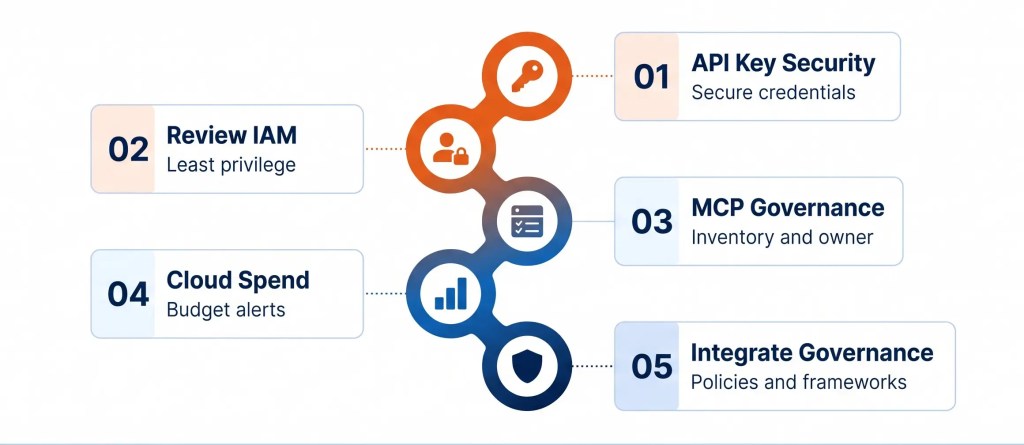
1. Strengthen AI Credential and API Key Security
AI API keys and cloud credentials should be treated as sensitive assets.
Organisations should:
- Store credentials in approved secrets management solutions.
- Scan source code repositories and CI/CD pipelines for exposed keys.
- Implement regular key rotation and revoke compromised credentials.
- Avoid storing long-lived access keys on developer endpoints.
- Apply least-privilege access to AI services and model endpoints.
2. Review Cloud IAM Permissions
Cloud identity and access management configurations should be reviewed to ensure that only authorised users and workloads can access AI services.
Key measures include:
- Restricting model invocation permissions to approved identities.
- Applying region-based restrictions where appropriate.
- Reviewing service accounts and IAM roles for excessive permissions.
- Removing unused or unnecessary access privileges.
- Monitoring unusual authentication and model invocation activity.
3. Establish Visibility and Governance for MCP Servers
Organisations should maintain an inventory of MCP servers operating across developer environments, endpoints and CI/CD pipelines.
Each server should have:
- A documented business or development purpose.
- An assigned owner responsible for its maintenance.
- A review of permissions and accessible resources.
- Verified package sources and version controls.
- Defined approval, patching and retirement procedures.
MCP servers should also undergo security assessments before deployment, particularly when they can access sensitive information or privileged systems.
4. Implement AI Cloud Spend Monitoring
Financial controls are essential to identifying LLMjacking activity early.
Organisations should configure:
- AI service usage quotas and spending limits.
- Budget alerts for unusual consumption.
- Usage anomaly detection across cloud accounts.
- Monitoring for unexpected model deployments or regional activity.
- Regular reviews of AI service consumption and billing records.
These measures can help identify abnormal usage patterns before unauthorised workloads generate substantial costs.
5. Integrate AI Security into Enterprise Governance
Technical controls alone cannot address the full scope of AI-related risks. Organisations also need policies that define how AI services, agents and third-party integrations are approved, monitored and maintained.
An established governance framework can help integrate AI assets and agent toolchains into existing information security and risk management processes.
How ISO/IEC 42001 and ISO/IEC 27001 Support AI Security
Organisations looking to establish a structured approach to AI security can use ISO/IEC 42001 and ISO/IEC 27001 as complementary frameworks.
ISO/IEC 42001 – AI Management System (AIMS)
ISO/IEC 42001 provides a framework for establishing, implementing and continually improving an AI management system.
It helps organisations establish governance around AI systems, including risk assessment, accountability, operational controls and ongoing monitoring.
For organisations adopting AI agents and MCP integrations, an AI management system can help establish:
- Clear ownership of AI assets and agent-based tools.
- Risk assessment processes for AI-related technologies.
- Approval and oversight mechanisms for AI adoption.
- Defined responsibilities for monitoring and managing AI systems.
- Continual evaluation of AI-related risks and controls.
ISO/IEC 27001 – Information Security Management System (ISMS)
ISO/IEC 27001 provides a systematic approach to managing information security risks across people, processes and technology.
Its control framework can support the management of security exposures associated with AI credentials, cloud environments and third-party integrations.
Relevant areas include:
- Identity and access management.
- Information and credential protection.
- Supplier and third-party security.
- Secure development and change management.
- Vulnerability management and security monitoring.
Together, these standards can help organisations establish a governance structure that addresses both AI-specific risks and the underlying information security weaknesses that could enable them.
How ValueMentor Helps Organisations Address AI and Cloud Security Risks?
As AI adoption expands across enterprise environments, organisations need to understand not only which AI services are in use, but also how those services, credentials and integrations are secured.
ValueMentor combines hands-on cloud and AI configuration assessments with structured governance support to help organisations identify and address these exposures.
Cloud and AI Configuration Review
ValueMentor’s assessment approach focuses on identifying security weaknesses across cloud environments and AI-enabled development workflows.
Key activities include:
- Discovering AI services, model endpoints, API keys and service accounts across AWS, Microsoft Azure and Google Cloud Platform.
- Reviewing IAM permissions, model invocation access, region restrictions and credential rotation practices.
- Scanning repositories and CI/CD pipelines for exposed AI and cloud credentials.
- Identifying MCP servers and AI agent toolchains across developer endpoints and development environments.
- Reviewing usage quotas, budget alerts and anomaly detection mechanisms for AI service consumption.
AI Governance and ISO/IEC 42001 & ISO/IEC 27001 Alignment
Beyond identifying technical vulnerabilities, ValueMentor helps organisations establish governance practices to manage AI security risks over time.
This includes:
- Mapping AI assets and agent toolchains into an AI management system aligned with ISO/IEC 42001.
- Extending relevant ISO/IEC 27001 controls to address secrets management, supplier security and change management for AI services and MCP servers.
- Defining ownership, approval and patch management responsibilities for AI-enabled components.
- Supporting organisations preparing for certification or integrating AI governance into an existing ISMS.
What Organisations Can Expect
The engagement provides organisations with:
- A prioritised report of identified security findings.
- An assessment of potential AI-related cloud cost exposure.
- Recommendations for addressing credential, configuration and MCP server risks.
- A practical remediation roadmap.
- Governance recommendations to support ongoing AI security management.
ValueMentor is a CREST-accredited cybersecurity firm serving organisations across India, the UAE, the UK, Saudi Arabia and the USA.
Make AI Security a Measurable Business Priority
AI-related security risks are no longer limited to theoretical scenarios or emerging technology concerns. Stolen credentials can translate into unexpected cloud expenditure, while unmanaged agent integrations can introduce security weaknesses across enterprise environments.
Organisations need visibility into their AI services, the identities accessing them and the tools operating within their development ecosystems.
A useful starting point is to ask your cloud and engineering teams one question:
What would our AI cloud expenditure look like if an active credential were compromised tonight?
If the answer is unclear, it may be time to assess your cloud configurations, AI credentials and agent toolchains.Talk to ValueMentor about a cloud and AI configuration review to identify security gaps, assess financial exposure and establish a more structured approach to AI governance.
Frequently Asked Questions (FAQs)
LLMjacking is the unauthorised use of stolen AI API keys or cloud credentials to access and run large language models at the victim organisation’s expense.
2. How does LLMjacking affect cloud costs?
Attackers generate unauthorised AI inference requests using compromised accounts, increasing token consumption and cloud service charges.
3. What are the common causes of LLMjacking?
Common causes include exposed API keys, stolen cloud credentials, excessive IAM permissions, unsecured application endpoints and inadequate usage monitoring.
4. What are orphaned MCP servers?
Orphaned MCP servers are AI tool integrations that lack clear ownership, regular maintenance, security reviews or defined patch management responsibilities.
5. Why are orphaned MCP servers a cybersecurity risk?
They may retain excessive access to files, credentials, repositories and enterprise systems, creating opportunities for unauthorised access or data exposure.
6. How are LLMjacking and MCP server vulnerabilities connected?
An insecure MCP server may expose credentials or cloud access. Attackers could exploit these credentials to access AI services and conduct LLMjacking attacks.
7. How can organisations prevent LLMjacking?
Organisations should secure API keys, enforce least-privilege IAM policies, rotate credentials, restrict model access and monitor unusual AI usage and cloud expenditure.
8. How can organisations secure MCP servers?
Maintain an MCP server inventory, verify package sources, restrict permissions, assign ownership and implement regular vulnerability assessments and patch management.
9. How do ISO/IEC 42001 and ISO/IEC 27001 support AI security?
ISO/IEC 42001 establishes AI governance and risk management practices, while ISO/IEC 27001 addresses information security risks involving credentials, access, suppliers and technology.
10. How can ValueMentor help manage AI security risks?
ValueMentor provides cloud and AI configuration reviews, credential assessments, MCP server discovery and governance support aligned with ISO/IEC 42001 and ISO/IEC 27001.