The digital landscape is experiencing rapid change, with modern-day web applications being the key driver behind the change. Organizations are required to provide a quick, agile, and personalized experience for their consumers on a wide range of platforms. This requirement necessitates the use of advanced technology in the form of AI and microservices by organizations while dealing with an ever-complicated cyber security scenario.
Web apps have come a long way from basic websites meant solely for displaying information. They now have evolved into smart environments which can analyze huge volumes of data and perform automatic decision making as well. As great as the prospects presented by such improvements might be, it would not be prudent to ignore the risks associated with modern web applications. It is imperative for a business to understand the connection between artificial intelligence, microservices and cybersecurity if it hopes to keep up in the current competitive environment.
Why businesses are rethinking traditional Web Application Development?
There have been great changes in customer expectations during the last ten years. They now expect applications to be fast, customized, integrated, and always available. The old monolithic architecture systems may find it difficult to provide the agility and scalability needed to meet those requirements.
New companies require solutions that will enable them to change with the market environment. The software should also be able to accommodate working from remote locations, heavy traffic loads, and integration with other digital products. This realization has made most firms turn towards contemporary methods of development.
AI and microservices are two such methods that are currently forming the foundation of future web applications.
How AI is making modern web applications smarter?
In this regard, Artificial Intelligence technology has become one of the most powerful factors affecting web design nowadays. The use of AI technology makes possible for organizations to develop more efficient software that learns from consumer actions, performs automatic tasks, and offers consumers an individualized experience.
The recommendation engines based on AI help e-commerce websites recommend products according to users’ choices and search history. Virtual assistants offer consumers immediate assistance. Furthermore, the use of predictive analytics offers businesses the chance to predict future occurrences and make sound business decisions. Aside from being beneficial to customers through its features, AI is also instrumental in making the processes more efficient. These include automated content moderation, fraud detection, smart search, and dynamic pricing tools which have become essential parts of most web applications today.
With further development of AI solutions, web applications are transitioning from merely reacting to users’ actions towards predicting what users will do and customizing their experience accordingly.
Why personalized user experiences are becoming a competitive advantage?
In the modern era of the digital world, personalization has become a necessity instead of an option. Consumers want apps that can provide them with content based on their likes and preferences.
The application of artificial intelligence becomes crucial in order to provide consumers with personalized services by studying their behavior, purchases, browsing history, etc. without any need for human assistance.
This not only helps improve consumer satisfaction but also improves retention and growth in organizations, making them more capable than other firms competing in the market.
Why Microservices have become the foundation of scalable applications?
There are certain limitations in the traditional monolithic software architecture that are not able to cope with modern needs. As the applications become more complex, there are difficulties in handling them within the same codebase. This problem has resulted in many companies opting for microservices architecture.
The idea is to split the application into multiple smaller services that perform one particular function. Each service communicates using APIs.
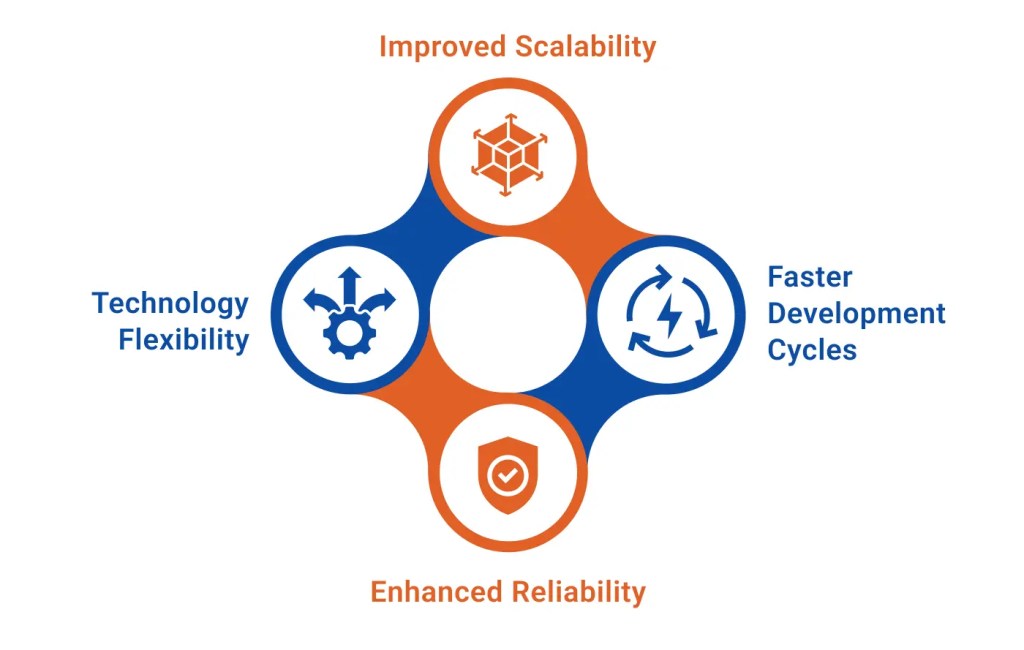
The benefits of microservices are substantial:
Improved Scalability
Each service can scale based on demand without affecting the entire application. For example, an online shopping platform can scale its payment processing service independently during peak sales periods.
Faster Development Cycles
Development teams can work on different services simultaneously, accelerating feature releases and reducing time-to-market.
Enhanced Reliability
If one microservice experiences a failure, the rest of the application can continue functioning, minimizing downtime and improving system resilience.
Technology Flexibility
Different services can be built using the most suitable programming languages, frameworks, and databases, allowing organizations to optimize performance and innovation.
Microservices have become a critical component of cloud-native development strategies, enabling businesses to build highly flexible and scalable web applications that can adapt quickly to changing market demands.
What happens when AI and Microservices work together?
AI combined with microservices is making possible a new class of applications powered by intelligence. Microservices provide a platform that facilitates the effective deployment and management of AI features.
The AI features can be built as AI services separately and not as part of the same monolithic application and tasked to perform tasks such as image recognition, natural language processing, recommendation engines, or prediction of future events.
There are various benefits that accrue to this strategy, including:
- Easy deployment of the AI models in existing systems.
- Scaling the AI workloads independently.
- Faster model updates and deployments.
- Improved system maintainability.
- Better resource utilization.
By treating AI capabilities as independent services, businesses can innovate more rapidly while maintaining the flexibility and scalability required for modern application development.
Why security can no longer be an afterthought?
Despite all the benefits that AI and microservices bring, they increase the exposure to cybercrime for attackers. Classic methods of ensuring security become inadequate in such systems.
Modern web applications handle huge amounts of sensitive data and work based on various systems interacting with each other. Each connection between these different services is vulnerable to attacks.
With the increasing number of cybercrimes, companies need to go beyond just being reactive in terms of cybersecurity and adopt an approach that takes proactive measures at all stages of development.
What are the biggest security risks facing Modern Web Applications?
There are many new security threats that are faced by contemporary web applications, which include:
API Threats
Since microservices use APIs for intercommunication purposes, insecure APIs can be used to exploit sensitive information, gain access, and create vulnerabilities.
High Complexity
With the increase in the number of services, there arises a need for secure authentication, authorization, and intercomponent communication, which may cause some security misconfiguration.
AI-Specific Threats
The presence of AI adds up another layer of security risk, which includes data poisoning, adversarial input attacks, model theft, and other privacy-related issues. Adversaries could manipulate AI algorithms using fake data.
Cloud Security Issues
Most web apps run in cloud environments. If not configured properly, they can result in data breach incidents and even lead to non-compliance issues.
Supply Chain Attacks
Applications often depend on third-party libraries, open-source components, and external services. A compromised dependency can introduce vulnerabilities throughout the entire application ecosystem.
These challenges highlight the need for a security-first approach throughout the software development lifecycle.
How can businesses build secure and Future-Ready Applications?
To address evolving threats, organizations must integrate security into every stage of application development and deployment.
Adopt DevSecOps Practices
DevSecOps integrates security directly into development workflows. Automated security testing, vulnerability scanning, and continuous monitoring help identify risks before they reach production environments.
Implement Zero Trust Architecture
The Zero Trust model assumes that no user, device, or service should be trusted automatically. Every request must be authenticated, authorized, and continuously validated.
Secure APIs Effectively
Organizations should implement strong authentication mechanisms, API gateways, rate limiting, encryption, and regular security assessments to protect service communications.
Strengthen Identity and Access Management
Role-based access control, multi-factor authentication, and least-privilege principles reduce the risk of unauthorized access.
Monitor Continuously
Real-time monitoring, logging, and threat detection systems enable security teams to identify suspicious activities quickly and respond before incidents escalate.
Protect AI Systems
Businesses deploying AI should secure training datasets, validate model inputs, monitor model behavior, and establish governance frameworks to ensure responsible AI usage.
By embedding security into architecture, development, and operations, organizations can significantly reduce risk while maintaining innovation and agility.
What does the future of Modern Web Applications look like?
The future direction for web applications is expected to include greater reliance on artificial intelligence, more automation, use of cloud computing architecture, and robust cybersecurity. The trend towards adopting increasingly modular systems that facilitate easy innovation and fast deployments will be continued in the future. Automation of processes with AI will not only help to make processes simpler but will also make decision-making and customer experience better.
Businesses that incorporate smart technology along with effective security measures will find themselves well-prepared for the future economy.
Conclusion
The current trend in web apps is being fueled by the dual force of artificial intelligence and microservices. Such technologies help companies provide personalization, efficiency, and innovative solutions to their customers. Nonetheless, the rise of advanced apps brings about the necessity of tackling complicated security issues. The combination of modern web technologies and effective cybersecurity measures can ensure the success of a company. Businesses that implement AI wisely and use microservices can ensure secure app development.
Web applications continue evolving, which means the security challenges are becoming more and more complicated. The implementation of any innovative solution should not overshadow the issue of cybersecurity. ValueMentor offers comprehensive support for businesses that aim at building advanced, secure applications. Our experts can perform application security assessment, penetration tests, API security test and DevSecOps consultation services. Get in touch with us to assess your web application security needs today.
FAQs:
Modern web applications help businesses improve customer experiences, increase operational efficiency, and scale digital services more effectively.
2. Can small businesses benefit from AI-powered web applications?
Yes. AI tools such as chatbots, personalized recommendations, and automated customer support can help small businesses enhance engagement and reduce operational costs.
3. Are microservices suitable for every web application?
Not always. While microservices offer scalability and flexibility, smaller applications may benefit from simpler architectures depending on business requirements.
4. How do modern web applications improve user experience?
They provide faster performance, personalized content, seamless integrations, responsive designs, and real-time interactions across devices.
5. What role does cloud computing play in modern web applications?
Cloud computing provides the infrastructure needed for scalability, high availability, faster deployment, and cost-effective resource management.
6. How do AI-powered web applications handle large volumes of data?
AI systems analyze and process data using machine learning algorithms, enabling businesses to extract insights and automate decision-making.
7. Why is it difficult to ensure cybersecurity of modern web apps today?
The presence of distributed architecture, various APIs, cloud environment, third-party services, and advanced cyber attacks complicates cybersecurity.
8. How do companies manage to secure microservices apps?
Companies apply techniques like API security, encryption, access management, constant monitoring, DevSecOps approach, and Zero Trust strategy.
9. In what sectors AI technology together with microservices will provide the biggest value?
E-commerce, healthcare, financial sector, education, logistics, and SaaS software benefit from the implementation of these tools.
10. What should be considered when modernizing web applications by business?
Businesses need to think about scalability, performance, security, user experience, and other factors when updating apps.