
Key Takeaways
- A PQC readiness assessment is a structured evaluation of where and how your organization uses cryptography, how exposed each use is to quantum attack, and what it will take to migrate to the new NIST post-quantum standards.
- It starts with a cryptographic inventory, not an algorithm swap. You cannot migrate what you cannot see, and most organizations have no idea where their RSA and elliptic-curve keys actually live.
- The threat is already live through “harvest now, decrypt later” — attackers copy encrypted data today and hold it until a quantum computer can open it. Any data with a long confidentiality shelf life is exposed right now.
- NIST finalized the first three post-quantum standards (FIPS 203, 204, 205) in August 2024, and regulators have set hard deadlines: the NSA’s CNSA 2.0 mandates full quantum resistance for national security systems by 2035, with earlier milestones from 2027 onward.
- The main output of an assessment is a prioritized migration roadmap and a plan for crypto-agility — the ability to swap algorithms again without re-architecting everything.
- Readiness surveys suggest most organizations have done nothing. That is a competitive and regulatory opening for those who move early.
Most security leaders know the quantum threat is coming. Far fewer can answer a simple question: where, exactly, does your organization use the encryption that quantum computers will break? A PQC readiness assessment exists to answer that question before it becomes an incident.
PQC stands for post-quantum cryptography the family of encryption algorithms designed to resist attack by a large-scale quantum computer. The assessment is the diagnostic step that comes before any migration. It tells you what you have, what is at risk, and what to fix first.
The reason this is harder than it sounds is that cryptography is everywhere and almost nowhere is it documented. It sits inside TLS certificates, VPNs, code-signing pipelines, hardware security modules, database encryption, firmware, third-party APIs, and products you bought years ago from vendors who may no longer exist. A readiness assessment is the work of dragging all of that into the light.
This blog covers what a PQC readiness assessment actually includes, the phases it runs through, the standards and deadlines driving it, and what a credible deliverable looks like when it lands on your desk.
Key Definitions
- Post-Quantum Cryptography (PQC): Cryptographic algorithms built to withstand attacks from both classical and quantum computers. Unlike quantum key distribution, PQC runs on today’s hardware and networks.
- Cryptographic Inventory: A documented record of every place cryptography is used across systems, applications, devices, and data flows — the algorithms, key lengths, protocols, and library versions in play.
- Cryptographic Bill of Materials (CBOM): A structured, machine-readable inventory of cryptographic assets, mapping each algorithm to the systems it protects and the sensitivity of the data at stake.
- Harvest Now, Decrypt Later (HNDL): An attack in which an adversary captures encrypted data today and stores it, planning to decrypt it once a cryptographically relevant quantum computer exists.
- Crypto-Agility: The property of a system that lets you replace cryptographic algorithms with minimal disruption — the strategic goal that a PQC assessment builds toward.
- Cryptographically Relevant Quantum Computer (CRQC): A quantum computer powerful enough to break the public-key cryptography, such as RSA and ECC, that secures most of today’s digital communication.
What is a PQC readiness assessment?
A PQC readiness assessment is a formal evaluation of your organization’s exposure to the quantum threat and its preparedness to migrate to post-quantum cryptography. It produces three things: a picture of where cryptography lives in your estate, a risk ranking of those uses, and a sequenced roadmap to fix them.
Think of it as the discovery and planning phase of a much longer program. The migration itself will take years for any organization of size. The assessment is what stops that migration from being a blind, expensive scramble later.
A good assessment spans more than technology. Its scope typically covers governance and ownership, asset discovery, risk classification, crypto-agile architecture, vendor and third-party management, testing, and reporting. The technical inventory is the foundation, but the governance and vendor questions are where most programs stall — because the answers sit outside the security team’s direct control.
The distinction worth holding onto: this is an assessment, not a migration. It does not swap a single algorithm. It tells you which algorithms to swap, in which systems, in what order, and what it will cost you if you get the sequence wrong.
Why does the quantum threat matter now, years before quantum computers can break encryption?
Because the attack that matters most does not need a quantum computer today — it only needs one eventually. Under “harvest now, decrypt later,” an adversary records your encrypted traffic or exfiltrates encrypted archives now and simply waits. When a cryptographically relevant quantum computer arrives, everything they stored becomes readable retroactively.
This reframes the deadline. The question is not “when will quantum computers break RSA?” It is “how long does my data need to stay secret?” If you hold health records, financial data, state secrets, intellectual property, or anything with a confidentiality lifetime of ten years or more, the exposure window is open right now.
The timelines have also moved. Expert panels assembled by the Global Risk Institute have put a meaningful probability in the range of 5 to 14 percent on a code-breaking quantum computer emerging within about five years, rising sharply over a decade. And research through 2025 sharply cut the estimated quantum resources needed to break RSA-2048, compressing the runway that engineers once assumed they had. You do not need to believe the most aggressive forecast to act. You only need data that must outlive the most conservative one.
There is a second reason the clock matters: migration is slow. Replacing cryptography across a large estate, testing it for interoperability, and coordinating with vendors is a multi-year effort. Start the assessment late and you compress the hardest work into the smallest window.
What are the phases of a PQC readiness assessment?
A credible assessment moves through a defined sequence, from discovery to roadmap. The exact labels vary between providers, but the underlying work is consistent.
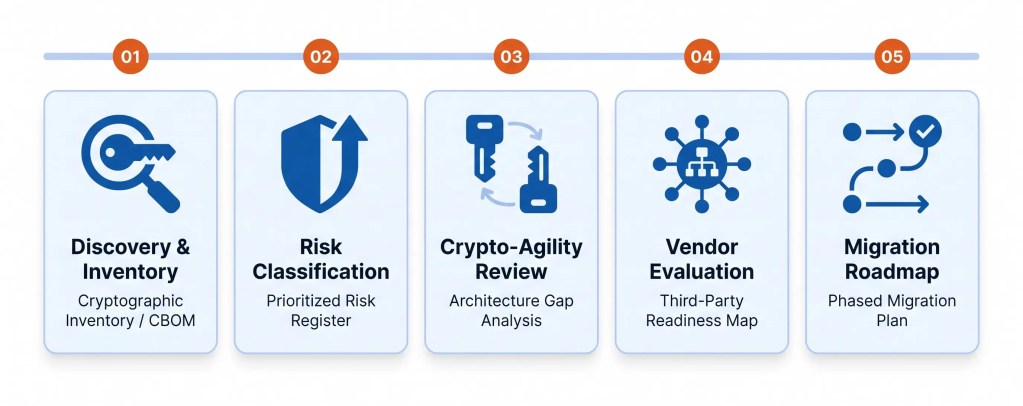
Discovery and cryptographic inventory
You cannot protect or migrate what you cannot see, so the assessment begins by finding every use of cryptography across the estate. This means scanning network traffic for TLS versions and cipher suites, auditing certificate stores, examining code repositories and their dependencies through software composition analysis, reviewing key management systems, and cataloguing hardware such as HSMs and IoT devices. The output is a cryptographic inventory — increasingly captured as a CBOM so it can be queried and maintained rather than left to rot in a spreadsheet.
Risk classification and prioritization
Not all cryptography is equally urgent, so each asset in the inventory is scored against exposure. The key variables are the sensitivity and confidentiality lifetime of the data protected, whether the system is internet-facing, the algorithm and key length in use, and how hard the system will be to change. A public-facing service protecting decades-sensitive data with RSA-2048 ranks far above an internal tool encrypting data that is worthless in a year. This step is where “harvest now, decrypt later” exposure gets made concrete.
Crypto-agility and architecture review
The assessment examines how easily your systems could swap algorithms at all. Many cannot — cryptography is hard-coded, buried in old libraries, or locked inside vendor products with no upgrade path. This phase identifies the architectural changes needed so that adopting PQC now, and adapting again later, does not require rebuilding everything each time. Crypto-agility is the real long-term prize, because the standards will keep evolving.
Vendor and third-party evaluation
Most of your cryptographic risk sits in software and services you did not build. The assessment maps third-party and supply-chain dependencies and asks each critical vendor a direct question: what is your PQC roadmap, and when? Get the answers in writing. A vendor with no quantum plan is a risk you have to manage on your own timeline, and you want that documented before renewal negotiations, not after.
Roadmap and migration plan
The assessment ends with a phased, prioritized roadmap — the deliverable everything else exists to produce. It sequences which systems migrate first, sets measurable milestones aligned to regulatory deadlines, recommends hybrid or dual-algorithm approaches for the transition period, and builds in pilot projects and decision gates so each stage is validated before the next begins. This is what turns a diagnostic into an executable program.
| Phase | Core question it answers | Primary output |
| Discovery & inventory | Where is cryptography used? | Cryptographic inventory / CBOM |
| Risk classification | What is most exposed? | Prioritized risk register |
| Crypto-agility review | Can we change algorithms at all? | Architecture gap analysis |
| Vendor evaluation | Are our suppliers ready? | Third-party readiness map |
| Roadmap | What do we fix, and when? | Phased migration plan |
What standards and deadlines are the assessment measured against?
The assessment is benchmarked against the finalized NIST standards and the migration deadlines regulators have already published. These are no longer draft or theoretical.
In August 2024, NIST finalized its first three post-quantum standards: FIPS 203 (ML-KEM, for key encapsulation), FIPS 204 (ML-DSA, for digital signatures), and FIPS 205 (SLH-DSA, a hash-based signature scheme). These are the algorithms your migration targets. NIST has also signalled it will deprecate RSA and elliptic-curve cryptography around 2030 and disallow them entirely by 2035.
On the government side, the NSA’s Commercial National Security Algorithm Suite 2.0 sets a phased timeline for national security systems: new deployments expected to support PQC from 2027, network equipment such as VPNs and routers on quantum-resistant algorithms by 2030, operating systems and cloud services by 2033, and full quantum resistance across all national security systems by 2035, in line with National Security Memorandum 10.
Sector regulators are converging on the same direction. The UK’s NCSC has laid out milestones expecting a full cryptographic discovery and migration plan by 2028, high-priority systems migrated by 2031, and complete migration by 2035. In financial services, the G7 Cyber Expert Group and national supervisors are increasingly expecting institutions to assess, document, and plan their quantum readiness. Even if none of these deadlines binds you directly today, they define the baseline auditors and customers will soon measure you against.
Summary
A PQC readiness assessment is the diagnostic and planning foundation of any serious quantum migration. It inventories where cryptography lives, ranks each use by exposure, tests whether your systems can change algorithms at all, checks your vendors, and hands you a sequenced roadmap tied to real regulatory deadlines. The threat is not hypothetical “harvest now, decrypt later” makes long-lived data vulnerable today, and the standards and deadlines are already published. The organizations that treat 2035 as a starting gun rather than a finish line are the ones that will migrate calmly instead of scrambling
Frequently Asked Questions
No. The assessment is the discovery and planning stage that comes before migration. It tells you where your cryptography is, what is most at risk, and in what order to fix it. The migration — replacing algorithms and re-testing systems — is a separate, multi-year program that the assessment makes executable.
How long does a PQC readiness assessment take?
It depends on the size and complexity of your estate. A focused assessment of a defined environment can take a few weeks; a full enterprise inventory across business units, cloud, and OT can run months. The discovery phase is usually the longest, because undocumented cryptography is time-consuming to find.
Do we need to act now if quantum computers can’t break encryption yet?
Yes, for two reasons. First, “harvest now, decrypt later” means data stolen today can be decrypted in the future, so any long-lived secret is already exposed. Second, migration is slow, and regulatory deadlines run from 2027 to 2035. Starting the assessment now is what keeps the migration manageable.
What is a cryptographic inventory and why does it come first?
A cryptographic inventory is a documented record of every place your organization uses cryptography — the algorithms, key lengths, protocols, and systems involved. It comes first because you cannot migrate or protect cryptography you cannot see, and most organizations genuinely do not know where all of theirs is.
Which NIST standards should our migration target?
The three finalized in August 2024: FIPS 203 (ML-KEM) for key establishment, and FIPS 204 (ML-DSA) and FIPS 205 (SLH-DSA) for digital signatures. During the transition, hybrid or dual-algorithm deployments that run classical and post-quantum algorithms together are widely recommended.
What is crypto-agility and why does the assessment emphasize it?
Crypto-agility is the ability to change cryptographic algorithms with minimal disruption. It matters because the standards will keep evolving, and you do not want to re-architect your systems every time. A good assessment treats crypto-agility, not just a one-off algorithm swap, as the strategic goal.
Does this apply to us if we’re not a government or defense organization?
Almost certainly. The NSA and NIST deadlines target national security systems, but sector regulators in finance, healthcare, and critical infrastructure are converging on the same expectations, and customers increasingly ask about quantum readiness in due diligence. Any organization holding data that must stay confidential for years has direct exposure regardless of sector.
What does a PQC readiness assessment actually deliver?
A cryptographic inventory (ideally a CBOM), a prioritized risk register ranking your most exposed systems, an architecture gap analysis on crypto-agility, a view of your vendors’ readiness, and a phased migration roadmap with milestones tied to regulatory deadlines. The roadmap is the centerpiece — it is what turns the diagnosis into action.