SWIFT CSCF v2026 introduces a more stringent compliance framework by elevating several previously advisory controls to mandatory requirements, thereby increasing the security and compliance expectations for all connected institutions. Among these, Control 2.4, which focuses on securing back-office data flows, remains one of the most technically challenging and frequently mis implemented controls. A clear understanding of an organization’s SWIFT CSP architecture type (A1 through B) is essential to accurately determine the controls applicable to its environment and ensure proper compliance scoping. In addition, independent assessments are now required for a broader range of institutions, reducing reliance on self-attestation as a sufficient means of compliance validation. As a result, organizations should move beyond treating SWIFT CSCF compliance as a once-a-year exercise and instead adopt a continuous control monitoring approach, aligning with the framework’s increasing emphasis on ongoing assurance and operational resilience.
SWIFT’s Customer Security Programme has redefined baseline security expectations for every institution connected to the global financial messaging network. For CISOs, compliance officers, and treasury technology teams, the annual release of an updated Customer Security Controls Framework is not a formality it is a directive that carries regulatory weight and, increasingly, direct supervisory visibility.
The 2026 iteration of the SWIFT CSCF is the most consequential update in recent years, not because it introduces an entirely new philosophy, but because it closes long-standing implementation gaps that many institutions had quietly deferred. Controls that once occupied advisory status signals of best practice rather than enforceable requirements have been reclassified. Assessment expectations have tightened. And Control 2.4, which addresses the security of back-office data flows, has emerged as the requirement that consistently catches organisations underestimated in scoping and underprepared in evidence. Understanding what has changed, and why certain controls carry disproportionate compliance risk, is now a fundamental responsibility for any professional accountable for SWIFT-connected infrastructure.
This blog provides a structured walkthrough of the SWIFT CSP framework, the three principal architecture types, the v2026 assessment requirements, and a focused examination of Control 2.4 including why its technical demands exceed what most organisations initially anticipate. The goal is not to catalogue every control in exhaustive detail, but to equip compliance professionals and security leaders with the context needed to prioritise effectively and avoid the implementation pitfalls that have become consistent findings in independent assessments.
SWIFT CSCF (Customer Security Controls Framework): The mandatory security framework published annually by SWIFT that defines the minimum controls all SWIFT network users must implement and attest to, structured around three core security objectives: restrict, protect, and detect.
Customer Security Programme (CSP): The overarching initiative launched by SWIFT in 2016 in response to the Bangladesh Bank heist and similar fraud events, under which the CSCF, attestation obligations, and the independent assessment requirement are collectively governed.
Independent Assessment: A formal evaluation of an institution’s SWIFT CSCF compliance conducted by a qualified external assessor or internal audit function meeting SWIFT’s competency criteria — distinct from self-attestation and required for a growing subset of institutions under v2026 rules.
KYC-SA (Know Your Customer Security Attestation): The SWIFT-administered platform through which institutions submit their annual compliance attestations, and through which counterparty banks can access each other’s attestation results for due diligence purposes.
Understanding the SWIFT CSP Framework
The SWIFT CSP framework is a mandatory, annually updated security programme that requires all SWIFT-connected institutions to implement a defined set of controls, attest to their compliance, and for a growing population of users subject that attestation to independent verification.
The framework is structured around three security objectives: securing the local environment (Restrict), preventing compromise of the SWIFT infrastructure (Protect), and detecting anomalous activity (Detect). Each objective contains a set of mandatory controls and a set of advisory controls. Mandatory controls represent the non-negotiable baseline; advisory controls reflect leading practice and are increasingly being elevated to mandatory status with each annual revision.
What distinguishes the SWIFT CSP framework from many other compliance regimes is its direct integration with counterparty risk management. Attestation results are visible to other SWIFT users via the KYC-SA platform, which means non-compliance or a degraded attestation carries reputational and commercial consequences beyond regulatory exposure. A correspondent banking relationship can, in principle, be scrutinised or reconsidered on the basis of a counterparty’s attestation posture. This dynamic has materially changed how treasury and compliance leadership treat SWIFT CSP obligations — it is no longer a back-office IT compliance matter; it is a business risk.
The framework also imposes obligations on service bureaux and other third-party providers that manage SWIFT infrastructure on behalf of institutions. This is a dimension that organisations relying on outsourced connectivity must explicitly address in their scoping decisions and contractual arrangements.
SWIFT CSP Architecture Types: Why Scoping Begins Here
SWIFT CSP architecture types — classified as A1, A2, A3, A4, and B determine which specific controls apply to an institution, making correct architecture classification the single most important prerequisite to any compliant SWIFT CSP implementation.
The Architecture Classification Model
SWIFT defines connectivity architectures based on how an institution interacts with the SWIFT network whether it operates its own SWIFT infrastructure locally, connects through a service bureau, or uses a SWIFT Alliance Lite2 interface. The five principal types are:
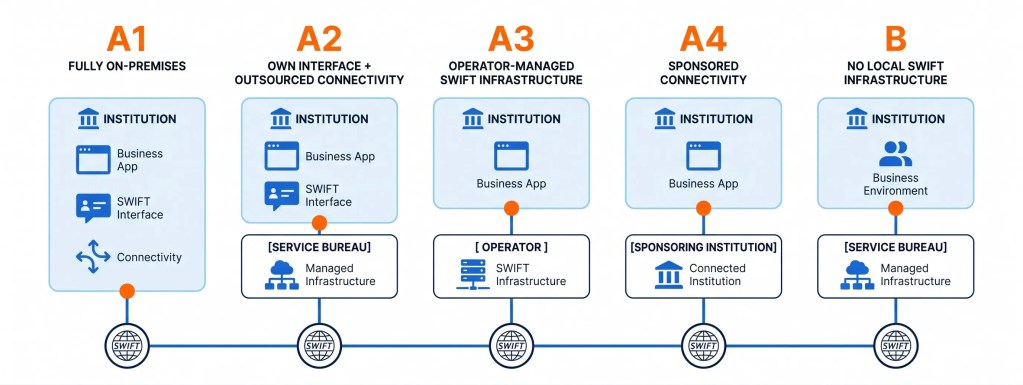
- A1: The institution operates its own SWIFT infrastructure entirely on-premises, including the messaging interface, and has full administrative control.
- A2: The institution operates its own SWIFT interface but outsources certain connectivity components, typically to a service bureau.
- A3: The institution connects to SWIFT via an operator (service bureau) that manages the SWIFT infrastructure on their behalf, but the institution retains its own BIC and business application.
- A4: The institution connects as a sponsored institution through an institution that operates the connectivity infrastructure.
- B: The institution connects via a service bureau and has no local SWIFT infrastructure of its own.
Why Misclassification Is a Material Risk?
Architecture misclassification is among the most common findings in SWIFT CSP independent assessments. Institutions operating A1 environments and carrying the full scope of mandatory controls that entails have in practice been assessed as though they were A2 or A3, resulting in gaps in physical security, logical access management, and precisely the back-office data flow protections that Control 2.4 mandates.
Correct classification is not a subjective exercise. SWIFT publishes detailed guidance on architecture determination, and assessors are expected to validate classification as a preliminary step before any control-level review begins. Organisations that have not formally documented their architecture classification, with supporting rationale, are already carrying a compliance risk before a single control is evaluated.
SWIFT CSCF v2026 Assessment Requirements: What Has Tightened
SWIFT CSCF v2026 introduces mandatory independent assessment obligations for a broader population of institutions, elevates several previously advisory controls to mandatory status, and sharpens the evidentiary expectations assessors must apply collectively raising the compliance threshold across the framework.
Mandatory Independent Assessment: The Expanding Scope
In earlier versions of the CSCF, self-attestation where an institution’s internal team assessed and attested to its own compliance was permissible for a significant portion of the SWIFT user population. V2026 materially narrows that permissibility. The independent assessment requirement now captures a larger cohort, and the competency criteria for who may conduct such an assessment have been further specified.
Institutions should not conflate an independent assessment with an internal audit conducted by their own staff. SWIFT’s framework requires assessors to demonstrate specific SWIFT CSP competency, and in many cases, this means engaging a qualified external assessor whether a SWIFT-approved assessor firm or a cybersecurity consultancy with demonstrated SWIFT framework expertise. The bar for what constitutes adequate evidence has also increased: assertions without supporting artefacts are insufficient, and assessors are expected to validate rather than simply accept management representations.
Controls Elevated from Advisory to Mandatory
Several controls that appeared as advisory recommendations in prior versions of the CSCF have been reclassified as mandatory in v2026. While SWIFT’s official release documentation provides the definitive list, the pattern of elevation has consistently targeted controls related to network segmentation, privileged access management, and critically data flow integrity between business applications and the SWIFT messaging layer. This is the category into which Control 2.4 falls. In the v2025 SWIFT CSCF, Control 2.4 was classified as an advisory control (2.4A). In the v2026 CSCF, this control has been upgraded to a mandatory control and is therefore required to be implemented and assessed as part of the 2026 assessment.
The practical implication is that institutions which documented advisory controls as aspirational rather than implemented now face a compliance gap that cannot be deferred. Gap remediation, particularly where it involves infrastructure changes or vendor engagement, must be planned and resourced ahead of the attestation deadline.
Control 2.4: The Requirement That Consistently Bites
Control 2.4 mandates the protection of data flows between business applications and the SWIFT infrastructure, requiring institutions to ensure that the communication path between back-office systems and the SWIFT messaging interface cannot be intercepted, manipulated, or exploited a technically demanding requirement that is routinely underestimated in scope.
What Control 2.4 Actually Requires?
At its core, Control 2.4 addresses the attack surface that exists between an institution’s internal business applications — trade systems, treasury platforms, ERP environments and the SWIFT messaging interface that transmits financial instructions. The concern is not theoretical: several high-profile SWIFT-related fraud incidents exploited precisely this layer, where authenticated but tampered messages were injected or modified before reaching the SWIFT interface.
The control requires institutions to implement technical measures that ensure the integrity and confidentiality of data in transit between these systems. This encompasses encryption of data flows, authenticated communication channels, and protection against tampering or interception within the local environment. It is not sufficient to assert that systems are within a secured network perimeter; the control requires demonstrable protection at the application communication layer.
Where Implementations Typically Fall Short
Scope Underestimation
The most frequent failure mode is scope underestimation. Institutions identify their primary business application as in-scope but fail to account for secondary systems that also interact with the SWIFT messaging environment reconciliation tools, sanctions screening platforms, automated payment engines. Each of these constitutes a data flow within the scope of Control 2.4, and each must be assessed individually.
Evidential Gaps
Even where technical controls are in place, evidential documentation is frequently insufficient. An assessor reviewing Control 2.4 compliance will seek configuration evidence, network diagrams that accurately reflect data flow paths, and records demonstrating that controls have been tested. Organisations that have implemented encryption at the transport layer but cannot produce current, accurate documentation of those flows will struggle to achieve a compliant attestation.
H3: Vendor and Integration Complexity
Many institutions rely on middleware, integration platforms, or third-party vendors to bridge their business applications and SWIFT infrastructure. In these cases, Control 2.4 obligations do not transfer to the vendor the institution remains accountable. Contractual arrangements must establish what security controls the vendor applies, and the institution must be able to validate those controls through assessment evidence. This is an area where compliance and procurement teams need to work in close alignment.
Conclusion
SWIFT CSCF v2026 represents a maturation of the Customer Security Programme — one that demands a corresponding maturation in how institutions approach their compliance obligations. The elevation of advisory controls to mandatory status, the expansion of independent assessment requirements, and the heightened evidentiary expectations collectively signals that SWIFT’s tolerance for superficial compliance is diminishing. For CISOs and compliance officers, the appropriate response is not to accelerate the annual attestation cycle, but to invest in the continuous monitoring, accurate scoping, and documented control operation that the framework now unambiguously requires.
Control 2.4 serves as an instructive proxy for the broader compliance challenge: it is not technically novel, but its demands are precise, its scope is wider than most organisations initially anticipate, and its evidentiary requirements are exacting. Institutions that approach it — and the framework as a whole — with the rigour it demands will find that compliance is achievable. Those that do not will encounter findings that are difficult to remediate under time pressure and increasingly visible to supervisors and counterparties alike.
SWIFT CSCF v2026 raises the mandatory compliance baseline for all SWIFT-connected institutions by elevating previously advisory controls, expanding independent assessment obligations, and tightening evidentiary standards. Correct architecture classification across A1 through B types is the prerequisite to accurate scoping. Control 2.4, governing back-office data flow protection between business applications and the SWIFT messaging interface, is the most technically demanding and frequently underestimated mandatory control in the framework, with scope underestimation, evidential gaps, and vendor complexity representing the primary failure modes in independent assessments.
If your organisation is preparing for SWIFT CSCF v2026 attestation or navigating the expanded independent assessment requirements, ValueMentor’s compliance specialists are ready to support you from architecture scoping and gap analysis through to full assessment readiness
FAQs
The SWIFT Customer Security Controls Framework (CSCF) is a mandatory security baseline published by SWIFT that defines the controls all users of the SWIFT network must implement to protect their local infrastructure. It addresses threats targeting the financial messaging environment, is structured around three security objectives, and is reviewed and updated annually.
Who needs to comply with SWIFT CSCF?
All institutions connected to the SWIFT network are required to comply with the CSCF. This includes banks, financial institutions, payment processors, and corporate entities operating SWIFT infrastructure. Compliance obligations apply regardless of organisation size or transaction volume, and attestation is submitted and verified through SWIFT’s KYC Security Attestation application.
How many controls are in the SWIFT CSCF?
The SWIFT CSCF contains a defined set of mandatory and advisory controls spanning three security objectives, and the total number evolves with each annual version. In recent iterations, the framework contains over 30 controls in total, with mandatory controls representing the non-negotiable baseline and advisory controls reflecting leading practice.
What happens if a company fails SWIFT CSCF compliance?
Failure to attest or non-compliance with mandatory SWIFT CSCF controls can result in SWIFT notifying the institution’s supervisory body and counterparty banks. This triggers reputational and regulatory consequences. In several jurisdictions, local regulators actively use SWIFT attestation data as an input into their own supervisory assessments and enforcement decisions.