Executive Summary
An organization offering an AI-powered application development platform engaged our security team to perform a comprehensive AI Security Assessment to evaluate the security of its environment. The platform leverages an intelligent AI agent to assist users in designing, generating, and managing applications through natural language interactions, making the security of AI-driven workflows a critical business requirement.
The assessment combined targeted AI security testing with in-depth manual penetration testing to evaluate the platform’s resilience against emerging AI-specific threats and traditional web application attack vectors. The evaluation focused on the AI agent’s prompt handling mechanisms, user input processing, AI-generated content, application generation workflows, access controls, session management, and supporting APIs.
Client Overview
The client operates a modern AI-powered application development platform that enables users to design, build, and deploy applications through an intelligent AI agent. By leveraging natural language interactions, the platform streamlines the application development process, allowing users to generate application components, automate development workflows, and accelerate software delivery with minimal manual effort.
The Challenge
The organization operates an AI-powered application development platform that enables users to create and manage applications using an intelligent AI agent. As the platform continued to evolve and attract more users, the organization wanted to ensure that its AI-driven features were secure against emerging cyber threats. To achieve this, they engaged our security team to assess the platform for vulnerabilities, validate existing security controls, and identify potential risks that could impact user data, AI-generated content, and the overall integrity of the application.
Benefits of an AI Security Assessment
As organizations increasingly adopt AI-powered applications, securing AI workflows becomes just as important as protecting traditional web applications. AI agents introduce new attack surfaces that require specialized security testing beyond conventional penetration testing methodologies.
The primary benefits of conducting an AI Security Assessment include:
- Identifying vulnerabilities within AI-driven workflows before they can be exploited.
- Assessing the security of user interactions with AI agents and AI-generated application content.
- Validating protection against AI-specific attacks such as prompt injection, unauthorized content manipulation, and insecure input handling.
- Evaluating access controls to ensure proper isolation between users, projects, and AI-generated resources.
- Identifying business logic weaknesses within AI-assisted application creation workflows.
- Providing actionable remediation guidance to improve the overall security posture of AI-powered platforms.
Our Approach
Unlike traditional vulnerability assessments that rely heavily on automated scanners, our methodology combines automated analysis with extensive manual testing to evaluate AI-specific attack vectors that scanners are often unable to detect.
We focus on identifying weaknesses in AI workflows, user input processing, AI-generated content, application generation logic, access controls, and supporting APIs to accurately simulate real-world attack scenarios.
AI Security Focus Areas
The assessment focused on critical security areas including:
AI Agent Security Assessment
- Prompt injection testing
- Stored and reflected prompt injection scenarios
- AI output validation
- Prompt leakage and system prompt disclosure
- Unauthorized access to AI-generated content
- Cross-user conversation isolation
- AI memory/context manipulation
- AI tool/function invocation validation
- AI-generated code security assessment
- AI response filtering and safety control validation
AI Application Builder Security
- Validation of generated application artifacts
- Secure handling of user-supplied prompts
- Injection testing within generated applications
- Authorization checks for generated resources
- File upload and generated asset security
- Workflow manipulation testing
AI Model & Integration Security
- AI API Security Assessment
- Prompt and Response Integrity Validation
- Model Access Control Verification
- Third-Party AI Service Integration Review
- AI Plugin and Tool Integration Security
- Secret and Credential Exposure Assessment
AI Abuse & Business Logic Testing
- AI Feature Abuse Scenarios
- Credit and Usage Quota Enforcement
- AI Workflow Manipulation
- Resource Ownership Validation
- Privilege Escalation Through AI Features
- Abuse of AI-Assisted Application Creation Workflows
- Multi-User Collaboration Security Validation
Technical Finding Overview
The security assessment uncovered several vulnerabilities impacting the confidentiality and integrity of the AI-powered application and its associated business processes. Notably, a Stored Cross-Site Scripting (Stored XSS) vulnerability was identified
Stored Cross-Site Scripting
During manual penetration testing, our consultants identified a critical Stored Cross-Site Scripting (Stored XSS) vulnerability within the AI-powered application builder. The issue was discovered during the assessment of the AI chat agent, which allows users to interact with the platform and generate application components.
The vulnerability was validated through the following observations:
1: A new project was created, and the AI Chat Agent interface was accessed.

2: User-controlled input submitted through the AI chat interface was accepted without adequate sanitization or output encoding.
- Malicious JavaScript content supplied by the tester was successfully stored by the application, indicating that the input persisted on the server.
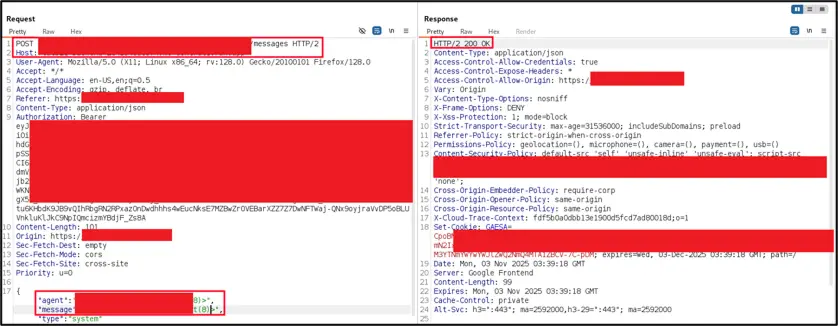
3: Upon revisiting the affected project or when another user accessed the same AI-generated content, the stored payload was rendered and executed automatically within the victim’s browser.
4: The successful execution confirmed that the application was vulnerable to persistent client-side code execution through the AI agent’s content handling workflow.

- The finding demonstrated that an attacker could leverage the vulnerability to execute arbitrary JavaScript within the context of the trusted application, potentially resulting in session hijacking, unauthorized actions, sensitive information disclosure, or further compromise of user accounts.
- The vulnerability was responsibly disclosed to the client, along with proof-of-concept evidence and detailed remediation guidance. Recommendations included implementing robust server-side input validation, context-aware output encoding, content sanitization, and strengthening browser-side security controls such as a restrictive Content Security Policy (CSP).
- This format closely resembles the style commonly used in professional case studies published by security consultancies, where the focus is on how the issue was discovered, what was observed during testing, and the resulting security impact, rather than providing an exploit walkthrough.
- An attacker could potentially perform unauthorized actions on behalf of affected users, access sensitive information available within the browser session, manipulate application content, or launch further client-side attacks.
- The finding highlighted insufficient server-side input validation and output encoding within the AI agent’s content generation and rendering workflow.
Remediation Approach
Following the assessment, our consultants collaborated closely with the client’s engineering team to ensure the identified security weaknesses were effectively addressed. The remediation process focused on strengthening the security of the AI-powered application builder while minimizing the impact on existing platform functionality.
The engagement included:
- Explaining the root cause and potential impact of each identified security finding.
- Demonstrating proof-of-concept exploit scenarios to help developers understand the associated risks.
- Providing detailed remediation recommendations aligned with secure development best practices.
- Recommending robust input validation, context-aware output encoding, and content sanitization across AI-generated and user-supplied content.
- Advising on the implementation of additional security controls, including a restrictive Content Security Policy (CSP), improved authentication mechanisms, rate limiting, and strengthened session management.
- Supporting the development team throughout the remediation process by addressing technical queries and validating the effectiveness of implemented fixes.
- Performing comprehensive retesting to verify that the identified vulnerabilities had been successfully remediated and that no regressions had been introduced.
This collaborative approach enabled the organization to strengthen the security posture of its AI-powered platform while ensuring the continued reliability and integrity of its application development workflows.
Secure Your AI Applications with Confidence
AI-powered applications present a rapidly evolving attack surface that requires specialized security expertise. Our AI Security Assessment combines manual penetration testing, AI-specific threat modeling, API security testing, business logic validation, and secure code review to identify vulnerabilities that traditional security assessments often miss.
Whether you are building AI chatbots, AI agents, copilots, LLM-powered platforms, or AI-powered business applications, or intelligent automation platforms, our security experts can help you identify risks, strengthen security controls, and protect your AI ecosystem against real-world threats.
Looking to secure your AI-powered platform? Contact our security team to schedule a comprehensive AI Security Assessment and build confidence in the security of your AI solutions.