Building a Regulator-Ready Security Organization
Client Overview
The client is an organization operating in the insurance and financial services sector within the Middle East, where regulatory compliance, information security, and effective risk management are critical to business operations.
Operating within a complex regulatory environment, the organization needed to demonstrate compliance with ADHICS 2.0 and address requirements spanning cybersecurity, information security, privacy, risk management, and third-party assurance.
To strengthen its regulatory posture and establish a sustainable approach to compliance, the organization engaged ValueMentor for virtual Chief Information Security Officer (vCISO) services. The engagement focused on connecting regulatory obligations with security governance, operational controls, technology teams, and management oversight.
Challenge / Problem Statement
The organization operated in a highly regulated environment with multiple compliance obligations and external assessments requiring coordinated attention.
Managing these requirements while maintaining effective security governance called for a structured approach that extended beyond individual audits and assessments.
The key challenges included:
- Complex Regulatory Requirements: Addressing ADHICS 2.0 requirements alongside broader cybersecurity, information security, privacy, and risk-management obligations.
- Concurrent Assessments: Coordinating multiple regulatory requirements, questionnaires, and external assessments while maintaining consistent compliance oversight.
- Governance and Accountability: Establishing clear ownership of security controls, risks, and remediation activities across relevant business and technology functions.
- Risk and Remediation Management: Maintaining visibility into identified control gaps, risk-treatment activities, corrective actions, and outstanding observations.
- Technology and Operational Risk: Strengthening oversight of security monitoring, data protection, critical technology risks, and third-party dependencies.
- Audit and Evidence Readiness: Ensuring regulatory evidence, internal audit preparation, external audit coordination, and observation closure were managed systematically.
- Continuous Compliance: Moving from assessment-driven compliance activities towards a governance model that could support ongoing regulatory readiness.
The organization therefore required strategic security leadership to coordinate regulatory compliance, strengthen accountability, and establish a repeatable framework for managing security risks and audit requirements.
Objectives
The primary objectives of the engagement were to:
- Strengthen the organization’s readiness against ADHICS 2.0 and applicable regulatory requirements.
- Establish a governance-led vCISO model to support continuous regulatory compliance.
- Enhance the ISMS, information security policies, and security governance practices.
- Improve risk-register governance, risk-treatment monitoring, and remediation tracking.
- Strengthen management oversight through Information Security Governance Committee (ISGC) support and security KPI reporting.
- Enhance governance of DLP, data protection, security monitoring, and critical technology risks.
- Improve third-party and service-provider security assurance.
- Streamline internal audit preparation, external audit readiness, evidence validation, and observation closure.
- Improve coordination across IT, Security, Risk, Privacy, and Business functions.
ValueMentor Approach
ValueMentor implemented a governance-led vCISO model designed to integrate regulatory compliance, security risk management, operational oversight, and audit readiness into a coordinated programme.
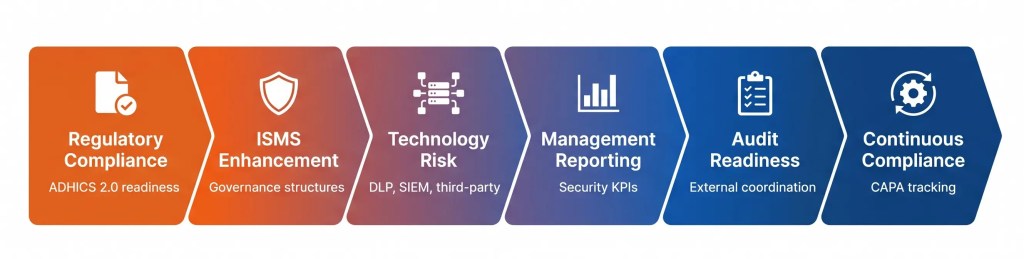
1. Regulatory Compliance and Readiness
ValueMentor supported ADHICS 2.0 control assessments, regulatory questionnaires, and Self-Assessment Questionnaire (SAQ) activities. The engagement included control-gap identification, remediation tracking, and regulatory evidence management to improve visibility into compliance status and outstanding requirements.
2. Information Security Governance and ISMS Enhancement
ValueMentor supported enhancements to the Information Security Management System (ISMS) and the information security policy framework. ISGC establishment and management support helped strengthen governance structures, while risk-register oversight and risk-treatment monitoring supported more systematic risk management.
3. Technology and Operational Risk Governance
ValueMentor supported governance initiatives covering DLP, data protection, and security monitoring, including Security Information and Event Management (SIEM). Critical technology risk reviews and third-party or service-provider security assessments helped strengthen oversight of operational and external security risks.
4. Security Performance and Management Reporting
ValueMentor supported the development and monitoring of security KPIs and management reporting to improve visibility into compliance status, security risks, remediation priorities, and governance activities. This helped establish a more structured basis for management-level oversight and decision-making.
5. Audit Readiness and Assurance Coordination
ValueMentor supported internal audit preparation, external audit readiness, auditor coordination, and evidence validation. The engagement also included tracking and closure of audit observations, ensuring that identified issues and required actions received continued attention.
6. Remediation Tracking and Continuous Compliance
ValueMentor supported CAPA tracking across technology and information security domains, with regular follow-up involving control owners. This approach reinforced accountability for remediation activities and helped establish a repeatable process for monitoring compliance and addressing outstanding gaps.
Results & Impact
Through ValueMentor’s vCISO-led regulatory transformation programme, the organization strengthened its regulatory posture, achieved ADHICS 2.0 requirements, and established a more structured approach to ongoing security governance.
Key outcomes included:
- ADHICS 2.0 Assessment Success: Strengthened regulatory readiness and achievement of the applicable ADHICS 2.0 requirements.
- Improved Audit Readiness: Enhanced preparation for internal and external assessments through structured evidence management and auditor coordination.
- Centralized Risk Visibility: Improved oversight of security and compliance risks through risk-register governance and management reporting.
- Stronger Remediation Accountability: Established structured tracking and follow-up for control gaps, corrective actions, and audit observations.
- Enhanced Security Governance: Strengthened management-level oversight through ISGC support, security KPIs, and risk-treatment monitoring.
- Improved Third-Party Risk Oversight: Strengthened governance of service-provider security risks and external dependencies.
- Cross-Functional Alignment: Improved coordination across IT, Security, Risk, Privacy, and Business stakeholders.
- A Repeatable Compliance Framework: Established governance practices to support continued regulatory readiness beyond individual assessments.
Lessons Learned / Key Takeaways
- Regulatory readiness requires continuous governance: Organizations benefit from embedding compliance into routine security operations rather than treating it as a periodic audit exercise.
- vCISO leadership connects business and security priorities: Strategic oversight helps align regulatory requirements, technology controls, risk management, and management decisions.
- Clear accountability accelerates remediation: Defined ownership, structured follow-up, and CAPA tracking help maintain momentum in closing compliance gaps.
- Evidence management strengthens assurance: Consistent documentation and validation improve the organization’s ability to demonstrate control implementation and support external assessments.
- Third-party assurance is integral to risk management: Effective service-provider oversight helps organizations maintain visibility into risks beyond their immediate environment.
- Sustainable compliance depends on repeatable processes: Governance committees, risk registers, security KPIs, and ongoing monitoring provide a foundation for long-term regulatory readiness.
The ValueMentor Difference
Regulatory compliance is not simply about meeting requirements at the time of an assessment. It requires the governance, accountability, and operational discipline to maintain readiness as risks and obligations evolve.
ValueMentor’s vCISO and cybersecurity governance services help organizations strengthen security leadership, improve regulatory visibility, coordinate remediation, and establish sustainable compliance practices.
From ADHICS 2.0 readiness and ISMS enhancement to risk governance, third-party assurance, and audit coordination, ValueMentor helps organizations build the capabilities needed to remain prepared for regulatory scrutiny while supporting business objectives.