What if your AI made an unexplainable decision? The advancement of Artificial Intelligence is redefining how companies do business, how companies operate, make decisions, grow, and increase operations, and how customers view the companies that are using these products. However, without governance, it could significantly diminish consumer confidence within a business. As regulators and consumers are requesting more transparency, ISO 42001 compliance will become the Standard for Responsible AI on a Global Scale. Companies that do not take a structured approach to AI by 2026 will be subject to compliance violations and reputational consequences.
ISO 42001 provides an effective framework to build a AI management system, reduce the Risk associated with using AI, and to provide Evidence of Responsible Use of AI. This guide covers everything you need to know to prepare, implement, and achieve compliance step by step.
What Is ISO 42001?
ISO 42001 is the world’s first international standard dealing exclusively with AI management system. It lays out how companies should implement, oversee, and refine AI systems in a structured and responsible manner.
Unlike stringent code or algorithms, ISO 42001 is aimed at management processes. It allows organizations to answer critical question, such as:
-
- Are our AI systems safe and fair?
-
- Do we comprehend the dangers they pose?
-
- Are decisions made by AI explainable?
-
- Do we have accountability when AI causes issues?
The standard introduces the concept of an Artificial Intelligence Management System (AIMS), which works similarly to other Information Security management systems. It can certainly be accommodated and supplemented with the likes of ISO 27001 for information security or ISO 9001 for quality.
Who Does ISO 42001 Apply To?
ISO 42001 applies to any organization that develops, provides, or uses AI systems, regardless of size or industry. And you don’t have to be an AI software company to be affected.
Organizations that should consider ISO 42001 include:
-
- AI model or platform builders
-
- Companies that use AI for profiling customers, hiring or making decisions
-
- AI Analytics in Healthcare, Finance and Insurance Companies that rely on AI for analytics
-
- Government bodies using AI for public services
-
- Organizations relying on third-party or cloud-based AI tools
If AI influences decisions, people, data, or operations, the ISO 42001 requirements are relevant. Even if AI is outsourced, the responsibility for governance and risk management still lies with the organization using it.
What is the Key ISO 42001 Requirements You Must Understand?
The New Standard The ISO 42001 sets out clear requirements to guarantee that for the entire of their lifecycle, AI systems are governed responsibly.
Leadership and AI Governance
Top management must show commitment to AI governance. This includes defining AI policies, assigning responsibilities, and ensuring AI aligns with organizational values and objectives.
AI risk and impact assessment
Companies need to identify and evaluate risks like bias, privacy breaches, failure of AI models or their misuse. These risks should be documented and periodically re-evaluated.
AI Lifecycle Management
AI systems must be controlled from design and development to deployment, monitoring, and retirement. Changes to AI models must be managed properly.
Data and Model Management
The standard emphasizes data quality, traceability, and fairness. Organizations should understand where data comes from and how models are trained.
Monitoring and Continuous Improvement
AI systems must be monitored for performance, errors, and unintended outcomes. Issues should lead to corrective actions and improvements.
Together, these elements form the foundation of the AI governance standard.
How to Achieve ISO 42001 Compliance in 2026?
Achieving compliance requires a structured and practical approach. Below is a detailed roadmap organizations can follow.
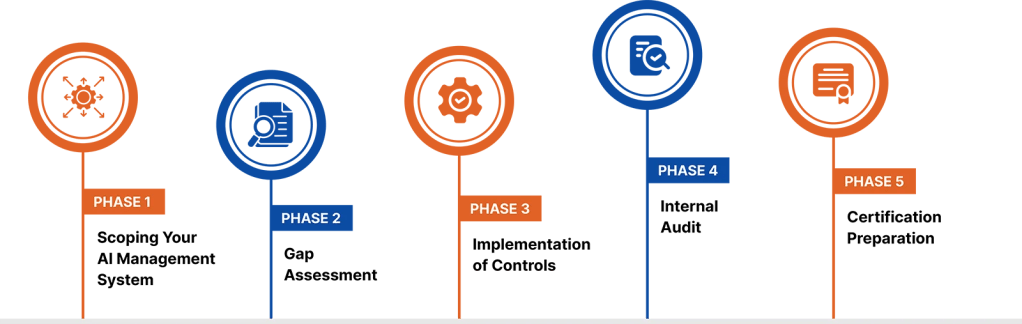
Phase 1: Scoping Your AI Management System
Scoping defines what is included in your AIMS.
Checklist:
-
- Identify all AI systems used across the organization
-
- Document AI use cases and purposes
-
- Define business units, locations, and processes in scope
-
- Clarify responsibilities for each AI system
Clear scoping prevents gaps and ensures compliance efforts are focused and realistic.
Phase 2: Gap Assessment
A gap assessment compares your current practices against ISO 42001 requirements.
Checklist:
-
- Review existing AI policies and procedures
-
- Evaluate current risk assessment practices
-
- Identify missing governance controls
-
- Assess documentation gaps
-
- Rank gaps based on risk and impact
This step provides a clear roadmap for improvement and planning.
Phase 3: Implementation of Controls
This is the most important phase and answers the question of how to implement ISO 42001 AIMS in daily operations.
Checklist:
-
- Develop AI governance and ethics policies
-
- Assign AI owners, risk owners, and reviewers
-
- Implement AI risk treatment plans
-
- Establish data quality and model validation controls
-
- Create monitoring, logging, and incident response processes
-
- Train employees on AI awareness and responsibilities
The goal is to embed AI governance into everyday business processes.
Phase 4: Internal Audit
Internal audits help verify whether your AIMS is working as intended.
Checklist:
-
- Train internal auditors on ISO 42001
-
- Conduct audits across AI processes and departments
-
- Identify non-conformities and weaknesses
-
- Document findings and corrective actions
Internal audits reduce the risk of surprises during certification audits.
Phase 5: Certification Preparation
This phase focuses on final readiness.
Checklist:
-
- Review all AIMS documentation
-
- Conduct management review meetings
-
- Close identified non-conformities
-
- Prepare audit evidence
-
- Select an accredited certification body
These activities complete the official ISO 42001 certification steps.
What Common Challenges Do Companies Face and How Can They Overcome Them?
Implementing ISO 42001 will likely present many obstacles to companies that are new to regulating artificial intelligence. All organizations will hit these same barriers throughout the implementation process. Below you will find information on how to better prepare for these barriers:
| Challenge | Solution |
|---|---|
| Limited Understanding of AI Risks | Conduct basic AI risk and ethics training for teams. |
| Poor Visibility of AI Usage | Maintain a centralized inventory of AI systems. |
| Managing Third-Party AI Tools | Include supplier risk assessments and contracts. |
| Resistance to Governance Processes | Show leadership support and business benefits. |
Organizations can use effective communication, preparation, and systematic employee development to mitigate these challenges. Rather than viewing ISO 42001 as an itemized list of tasks to complete on a checklist, companies see it as a tool for guiding their respective business strategies through integrating AI responsibly into daily work practices by instilling confidence in all parties involved in their business relationship to create sustainability and true business success over time.
Why Does ISO 42001 Compliance Matter to Organizations Today?
ISO 42001 not only prepares organizations for what’s next, but also addresses the immediate need for monitoring and addressing the risks associated with AI-enabled systems; Companies now have tremendous amounts of pressure on them to show that their systems are safe, equitable, and can be held accountable.
-
- Trust is currency: Customers and regulators expect transparency in how AI makes decisions. ISO 42001 helps build trust.
-
- AI risks are real and rising: From bias and privacy breaches to model failures, unmanaged AI can quickly become a liability.
-
- Decisions need to be explainable: ISO 42001 ensures organizations can trace and justify AI-driven outcomes.
-
- Regulations are catching up fast: Aligning with ISO 42001 prepares organizations for upcoming global AI laws.
-
- Governance is a competitive edge: Responsible AI use isn’t just ethical—it’s a market differentiator.
By adopting ISO 42001 now, organizations position themselves as leaders in responsible AI, reduce operational risk, and build resilience for the regulatory landscape ahead.
Conclusion
ISO 42001 is a practical and future-focused standard that helps organizations manage AI responsibly. With AI regulations increasing worldwide, waiting until the last moment can be risky. By following a structured approach—scoping, gap assessment, implementation, internal audits, and certification preparation—organizations can confidently achieve compliance by 2026. Early adoption not only reduces risk but also builds trust, credibility, and long-term value from AI investments.
Ready to achieve ISO 42001 compliance without complexity? ValueMentor helps organizations design, implement, and certify a robust AI management system aligned with ISO 42001 requirements. From gap assessment to certification readiness, our experts guide you at every step. Talk to us today and secure your AI governance framework for 2026 with confidence.
FAQs
Is ISO 42001 mandatory for organizations using AI in 2026?
ISO 42001 is not mandatory, but many regulators and customers expect organizations to follow recognized AI governance standards to demonstrate responsible AI use.
How long does it usually take to become ISO 42001 compliant?
The timeline will vary depending on the size of your organization and how many AI systems you have, but most organizations can be compliant within 3-6 months.
Can startups and small businesses apply for ISO 42001 certification?
Yes, ISO 42001 is applicable for startups and small companies since the standard is adaptable and can be sized based on the organization and its AI usage.
Does ISO 42001 cover ethical AI and bias control?
Yes, the standard includes requirements to identify, assess, and manage ethical risks such as bias, fairness, and unintended AI outcomes.
Can ISO 42001 be integrated with existing ISO standards?
ISO 42001 can be easily integrated with standards like ISO 27001, ISO 9001, and ISO 27701 to create a unified management system.
Is certification required, or can organizations self-declare compliance?
Organizations can follow the standard internally, but third-party certification provides stronger credibility and trust with customers and regulators.
How does ISO 42001 impact the use of third-party AI tools?
Organizations remain responsible for governing risks, even when AI systems are developed or hosted by external vendors.
Will ISO 42001 help with future AI regulations?
Yes, ISO 42001 helps organizations prepare for upcoming AI laws by establishing structured governance, risk management, and accountability.
How much does ISO 42001 certification cost?
Costs vary by organization size, AI complexity, and certification body. Expect a range from a few thousand to tens of thousands of dollars.
What documentation is required for ISO 42001 certification?
You’ll need AI policies, risk assessments, system inventory, data/model validation records, audit logs, and management review notes.