
AI fails without the right data foundation – yet most organisations skip this crucial step. The first and most vital step in preparing for Artificial Intelligence adoption is knowing your data, a cornerstone of AI data governance. It enables organisations to gain clear visibility into what data and where the data resides across systems, applications, databases, and platforms. If there is no strong governance in place, the risk of creating biased AI models, having compliance-related issues, or failing to successfully implement AI is exponentially increased. Understanding how sensitive, structured, and ready the data is for use will be crucial for organisations to properly leverage existing and future AI technologies. This blog explains why organisations must have a grasp on their data for responsible AI usage and provides an outline of the high-level steps that organisations need to take in advance of implementing an AI system.
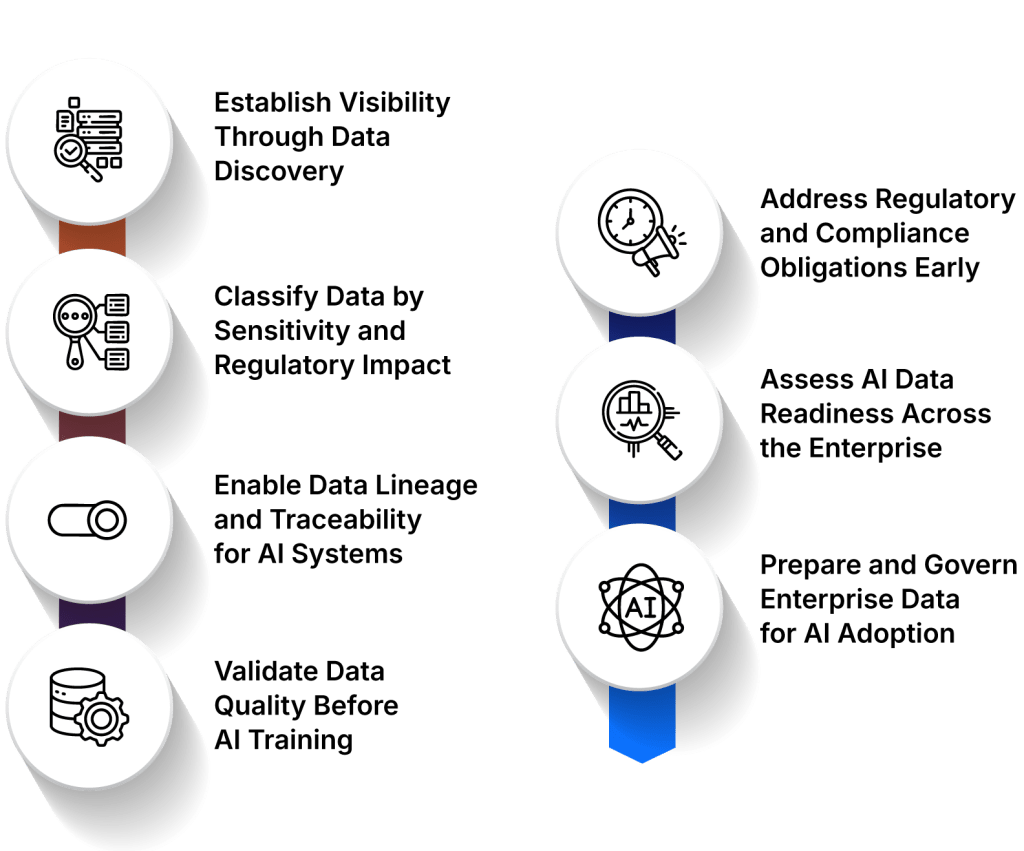
1. Establish Visibility Through Data Discovery
The first & most vital step in preparing for the adoption of Artificial Intelligence is knowing the data through Data Discovery exercises; it’s where organisations find out where their data is located throughout the systems, applications, databases & platforms they use. Most enterprises have fragmented environments, known as data sea lollies, – these lack visibility & control. Data discovery can help provide accurate & fast locations of both structured & unstructured datasets. By having an accurate inventory of all enterprise data, there is a decreased risk of unintentionally accessing restricted, obsolete, or irrelevant datasets, which are essential for establishing strong support for future AI-based initiatives.
2. Classify Data by Sensitivity and Regulatory Impact
The classification of data happens after its discovery by an organisation based on its regulatory and sensitivity requirements. Through data classification, organisations will know what different types of data (public, internal, confidential, and regulated) they have. AI systems will be prohibited from processing sensitive types of data until proper precautions have been established. By classifying data correctly, it allows organizations to implement access controls, encryption and limit the use of that data. Data classification will then allow for improvement in compliance, decrease in the risk of misuse of data, and ensure that AI systems will comply socially and ethically with a legal framework.
3. Enable Data Lineage and Traceability for AI Systems
Having knowledge of the origin, transformation, and flow of data in artificial intelligence over time is achieved using data lineage. Easy access to data lineage will improve transparency in both the design of the AI model and the decisions that are derived from the AI model. Many regulators are now requiring companies to provide proof that automated decision-making systems have traceability. Strong data lineage not only makes audits easier but also aids in the investigation of and creates greater trust in AI output by providing evidence regarding the explainability and validity of model activity.
4. Validate Data Quality Before AI Training
Good quality data is key to getting accurate and fair AI outputs. Organisations need to make sure their datasets are complete, accurate, consistent, and relevant before training any AI model. If the data has poor quality, then the predictions will be unreliable and/or the results will be biased. The validation process should identify missing values and outdated records, as well as determine if there are any inconsistencies, before entering the data into the AI pipeline. While there are also regular quality checks that can help to maintain AI performance in the future due to data changes.
5. Address Regulatory and Compliance Obligations Early
Enterprise datasets often have privacy regulations, financial rules, and regulations regarding certain industries that apply to them. Organisations wishing to use such data for AI must know their legal requirements around how they can use, store, transfer or share the data across countries. It is more efficient and less expensive to address compliance issues during the design of the AI system than it is to fix non-compliance after deployment of the AI system. Governance and compliance teams are vital in making certain that AI systems meet the expectations of applicable regulations so that the organisations minimise their legal exposure.
6. Assess AI Data Readiness Across the Enterprise
When evaluating whether an organisation’s data is ready for use with Artificial Intelligence (AI), there are many factors to consider. The organisation must evaluate data ownership, sensitivity, quality, consent, retention limits, and any regulatory authorisations before proceeding with an AI project. Additionally, security controls should be consistent with the level of data classification. A structured data readiness checklist is a good way to help organisations reduce AI risk and enhance their decision-making process, thus enhancing their overall success of AI projects.
7. Prepare and Govern Enterprise Data for AI Adoption
To prepare data for artificial intelligence, we must clean, organize and protect it. Data will be documented properly so that the team has an understanding of the data’s context, limitations, and ways to properly use the data. Properly prepared datasets help us expedite the development of AI and provide us with a way to implement AI initiatives that can be repeated and implemented on a large scale. The AI data governance framework provides value over time through the establishment of a consistent set of controls and accountability to AI projects.
Conclusion
Data governance is not about limiting data usage; it is about empowering the organization to use data responsibly, ethically, and securely to drive business value. To adopt AI successfully and responsibly, businesses must first understand the data used by their organisations. Structured steps should be taken (such as data discovery, classification, lineage tracking, quality validation, compliance assessment and governance) to mitigate the risks of implementing AI. AI data governance provides means to comply with regulations, build trust with stakeholders and deliver useful results from AI. To build these foundations, organisations often need to use specialised knowledge. Valuementor gives organisations assistance in assessing their data to determine if they are ready, building strong governance frameworks, and preparing the organisation to implement ethical, compliant, and sustainable AI.
FAQS
1. Why is data governance important for AI projects?
Data governance ensures AI systems use data responsibly and ethically. It also helps organisations comply with regulations and reduce legal and operational risks.
2. What is data discovery in AI initiatives?
Data discovery identifies where enterprise data is stored across systems and platforms. It helps discover the data hidden in your businesses and prevent the unintended use of unknown, restricted, or outdated data.
3. How does data classification support AI security?
Data classification defines the sensitivity level of datasets. This allows organisations to apply appropriate access controls and security protections.
4. What is data lineage, and why does it matter?
Data lineage tracks the origin and transformation of data throughout its lifecycle. It supports transparency, audits, and accountability in AI decision-making.
5. Can AI work with poor-quality data?
AI can process poor-quality data, but the results are often inaccurate or biased. High-quality data is essential for reliable and fair AI outcomes. The quality of AI outputs is directly dependent on the quality of the data it is trained on-garbage in, garbage out.
6. Are regulatory checks required before AI training?
Yes, many regulations restrict how certain data can be used in AI systems. Conducting checks early helps prevent compliance violations and rework later.
7. What does AI data readiness mean?
AI data readiness measures whether data is suitable for AI use. It considers quality, security, consent, and regulatory compliance.
8. How often should data quality be reviewed?
Data quality should be reviewed on a regular or continuous basis. Ongoing reviews help maintain consistent AI performance over time.
9. Who is responsible for AI data governance?
AI data governance is a shared responsibility across multiple teams. IT, security, legal, and business units must work together to ensure effectiveness.
10. What is the first step before adopting AI?
The first step is gaining clear visibility into the data your businesses handle. This understanding reduces risk and increases the likelihood of successful AI adoption.