I’m excited to share some significant news with you today: I’ve made a noteworthy discovery regarding a complete account takeover through the password reset feature.
During my investigation, I uncovered a critical vulnerability within the password reset functionality of https://www.vulnerable.website.com/forgetPassword. Surprisingly, the password reset code is inadvertently disclosed in base64 encoded format within the response. What’s even more alarming is that each reset request yields the same link. To compound the issue, the password reset code aligns with the user’s Email ID alongside a random 6-digit code. This oversight presents a glaring opportunity for malicious actors to reset any user’s password through brute force, thereby gaining unauthorized access to their account.
Steps to Reproduce
The application reveals user information via error messages on the Password Reset, allowing for user enumeration.
Before proceeding, I created an account with my email address to assess the application’s functionalities and behavior. Through this, I discovered that the token is expired after 2 hour and the application sends the reset password URL to the user with a reset token encoded in base64.
The reset password URL sent to the user when requesting a forgotten password appears as follows:

As you can see, the token is encoded in Base64. Decode the code using a base64 decoder. The decoded base64 token contains the Email Address and 6-digit random data.
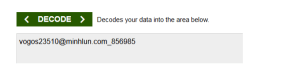
Thus, it’s evident that the application utilizes this method to send the reset password token to every user. By leveraging user enumeration to obtain a valid user email, one can initiate a password reset request. However, since the token includes email and 6 random digits that are unknown, brute force is required.
We can create a combination of 999999 possible combinations, resulting in a total of 999999 reset password tokens to be used as payload. Subsequently, a password reset request can be made using the victim’s email and brute force with the token payload, enabling us to crack the correct token and reset the victim’s password.
Remediation
This blog exposes a critical vulnerability in the password reset functionality of [invalid URL removed]. Here’s how to fix it:
-
Fix the Token Format:
The current token format combines the user’s email with a random 6-digit code. This predictability allows brute-forcing.
Implement a secure, random token generation process. Ideally, tokens should be long, cryptographically secure strings with no relation to user information.
2. Eliminate Base64 Encoding:
Transmitting the token in base64 encoding exposes it within the email content.
Never send sensitive information like reset tokens directly in emails. Instead, consider sending a unique link to the password reset page where the user can enter their email for verification. A new, secure token can be generated and used for password reset upon verification.
3. Implement Rate Limiting:
The blog mentions the application allows unlimited password reset attempts. This facilitates brute-forcing.
Enforce a rate limit on password reset attempts. This restricts the number of attempts allowed within a specific timeframe, hindering automated brute-force attacks.
4. Consider Multi-Factor Authentication (MFA):
Even with a secure token format, adding MFA introduces an extra layer of security.
Implement MFA during password resets. This requires a secondary verification factor, like a code sent to the user’s phone, in addition to the reset token, making unauthorized access significantly harder.
5. Address User Enumeration:
The blog mentions the application reveals usernames through error messages. This allows attackers to identify valid usernames for brute-forcing.
Implement robust error handling that doesn’t disclose user information. Generic error messages indicating an invalid email or username should suffice.
By implementing these recommendations, [invalid URL removed] can significantly improve the security of its password reset functionality and prevent account takeovers through brute-forcing.
Additionally, users of the website can further protect themselves by:
Choosing strong, unique passwords for their account.
Enabling MFA if available.
Being cautious of unexpected password reset emails and only clicking links from trusted sources.
Conclusion
The user invitation flaw exposed highlights a critical security concern: the potential for unauthorized password resets. By prioritizing robust security measures throughout the software development lifecycle, organizations can build applications that are resistant to such attacks.
The outlined remediation steps, including implementing multi-factor authentication, securing the password reset process, and enforcing stricter admin access controls, provide a roadmap for improved security.
Remember, a secure development process coupled with regular penetration testing is essential for safeguarding user data and building trust with your users.
FAQs
1. What is an account takeover (ATO) attack?
An account takeover (ATO) occurs when an attacker gains unauthorized access to a user’s account by exploiting vulnerabilities such as weak authentication, insecure password reset mechanisms, or stolen credentials.
2. How can an insecure password reset process lead to account takeover?
A weak password reset process can allow attackers to predict, intercept, or brute-force reset tokens, enabling them to reset passwords and gain unauthorized access to user accounts.
3. Why should password reset tokens be cryptographically secure?
Password reset tokens should be long, random, and cryptographically secure to prevent attackers from guessing or brute-forcing them. Tokens should also be unique, time-limited, and single-use.
4. Is Base64 encoding a secure way to protect password reset tokens?
No. Base64 is an encoding method, not an encryption technique. It does not protect sensitive information and should never be relied upon to secure password reset tokens or confidential data.
5. How does rate limiting improve password reset security?
Rate limiting restricts the number of password reset requests or token validation attempts within a specific time period, reducing the risk of automated brute-force and credential-based attacks.
6. What is user enumeration, and why is it a security risk?
User enumeration occurs when an application reveals whether a username or email address exists through its responses. Attackers can use this information to target valid accounts with password reset, phishing, or credential-stuffing attacks.
7. How does multi-factor authentication (MFA) strengthen password resets?
MFA adds an additional verification step, such as a one-time code or authenticator approval, ensuring that a password cannot be reset using only a reset token or email access.
8. What are the best practices for securing password reset functionality?
Secure password reset mechanisms should use cryptographically secure tokens, expire tokens quickly, enforce single-use tokens, implement rate limiting, prevent user enumeration, and require MFA whenever possible.
9. How can organizations prevent account takeover attacks?
Organizations can reduce account takeover risks by implementing strong authentication, secure password reset workflows, MFA, rate limiting, anomaly detection, and regular application security testing.
10. How can ValueMentor help secure authentication and password reset mechanisms?
ValueMentor performs comprehensive Web Application Penetration Testing (Web VAPT), authentication security assessments, secure code reviews, and API security testing to identify weaknesses in login and password reset workflows before attackers can exploit them.