
Agentic AI security governance is no longer a forward-looking concern it is an immediate operational imperative for any organisation deploying autonomous AI systems. When an AI agent can browse the web, execute code, query databases, and trigger downstream workflows without pausing for human review, the traditional question of “who approved this action?” no longer has a straightforward answer.
The pace at which agentic AI is entering enterprise environments has outrun the development of corresponding governance structures. CISOs and compliance officers who have invested years in building robust controls around human-operated systems now face a qualitatively different challenge: securing systems that act, adapt, and persist across tasks with minimal intervention. The risk surface is not simply larger it is structurally different, requiring governance models that account for autonomy, chained decision-making, and real-time environmental interaction.
This blog examines the core accountability gap that agentic AI introduces, the specific security risks that autonomous agents present, and the governance frameworks and controls that responsible organisations must establish. It is written for security leaders, compliance managers, and technology executives who recognise that deploying agentic AI without a corresponding governance programme is not an acceptable risk posture.
The Security Challenges of Autonomous AI Decision-Making
Traditional AI deployments centre on models that accept an input and return an output for human evaluation. The human remains the decision-maker; the model is an advisory instrument. Agentic AI inverts this dynamic. These systems receive a high-level objective and then autonomously determine the sequence of actions required to achieve it querying APIs, reading and writing files, sending communications, and orchestrating other systems. Each of these capabilities represents an attack surface and a potential compliance liability.
Prompt Injection and Goal Hijacking
One of the most consequential agentic AI security risks is prompt injection: an attacker embeds malicious instructions within content that an agent is designed to process — a webpage, an email, a document and the agent executes those instructions as though they originated from a trusted principal. Unlike a phishing attack targeting a human, prompt injection can redirect an AI agent silently, at scale, and without triggering conventional security alerts. For CISOs, this represents a novel threat model that existing email and endpoint security tooling was not designed to detect.
Privilege Escalation and Lateral Movement
Agentic systems are frequently provisioned with broad permissions to maximise their operational flexibility. In practice, this means an agent tasked with summarising internal reports may hold credentials sufficient to access financial systems, HR records, or customer data. If that agent is manipulated or behaves unexpectedly, the blast radius of the incident expands dramatically. Privilege escalation through excessive agent permissions is not a theoretical edge case it is an architectural pattern that emerges whenever convenience is prioritised over the principle of least privilege.
Cascading Failures Across Interconnected Systems
Multi-agent architectures where one AI agent delegates subtasks to others introduce the risk of cascading failures. A single compromised or misbehaving agent can propagate erroneous instructions to downstream agents, each of which may take further autonomous actions before any human review occurs. The speed and scale of these chains mean that by the time an anomaly is detected, significant organisational impact may already have materialised. Resilience in this context requires not only detecting failures but containing them before propagation.
Building an AI Agent Governance Framework
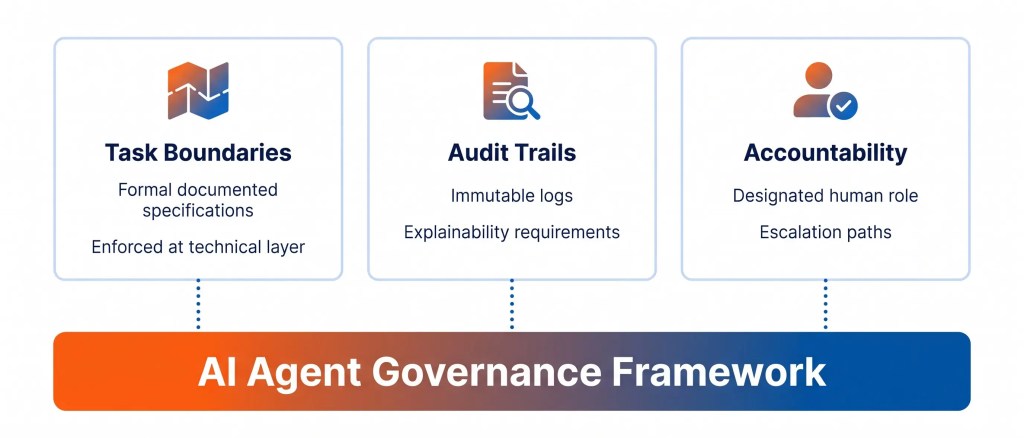
Governance of agentic AI begins with a fundamental policy question: what decisions is this agent permitted to make autonomously, and at what threshold does it require human authorisation? Organisations that deploy agents without answering this question formally — in writing, in a documented policy are operating without a governance framework in any meaningful sense. The framework must be specific to agent type, task domain, and data classification level, rather than relying on generic AI policy language that was written for predictive models or chatbots.
Defining Task Boundaries and Authorisation Thresholds
Each AI agent in a production environment should have a formally documented task boundary: a clear specification of the systems it may access, the actions it may take, the data classifications it may handle, and the conditions under which it must pause and escalate to a human operator. These boundaries should be enforced at the technical layer through access controls, API permission scoping, and runtime monitoring not merely stated in policy documents. A policy that exists only on paper provides no meaningful constraint on an autonomous system.
Audit Trails and Explainability Requirements
Governance frameworks must mandate immutable audit logs for every agent action. This is not simply a best practice; for organisations operating under regulatory frameworks such as PCI DSS, GDPR, or sector-specific compliance requirements, the ability to reconstruct an agent’s decision history is a compliance prerequisite. Explainability — the capacity to understand why an agent took a specific action — is equally important for incident response and accountability. When an AI agent initiates an unauthorised data transfer or triggers an unintended workflow, the organisation must be able to identify the root cause with precision.
Accountability Assignment and Governance Ownership
Governance frameworks without named owners fail in practice. Every agentic AI deployment should have a designated responsible party — a human role, not an AI system — accountable for that agent’s behaviour, its compliance with policy, and the adequacy of its monitoring controls. In many organisations, this accountability appropriately sits with the CISO or a delegated security leader. The governance framework should specify escalation paths, incident response responsibilities, and periodic review cycles that keep agent authorisation current with evolving risk conditions.
AI Agent Risk Management in Practice
Risk management for agentic AI demands a shift in methodology. Conventional IT risk assessments evaluate systems based on their technical components and the humans who operate them. Agentic AI introduces a third variable: the system’s own decision-making behaviour, which may diverge from intended parameters in ways that are difficult to anticipate. Risk registers must be expanded to capture agent-specific threat scenarios, including manipulation of agent objectives, unintended data access, and unanticipated interactions with connected systems.
Risk Assessment for Agent Deployment
Before an agentic AI system is deployed in a production environment, organisations should conduct a structured risk assessment that addresses: the sensitivity of data the agent will access, the criticality of the systems it will interact with, the potential impact of agent misbehaviour, and the adequacy of the proposed monitoring and containment controls. This assessment should be reviewed by a security leader with authority to impose conditions on deployment including access restrictions, mandatory human checkpoints, or staged rollout requirements.
Continuous Monitoring and Behavioural Baselines
Static risk assessments are insufficient for systems whose behaviour evolves over time. AI agent risk management must include continuous monitoring against established behavioural baselines patterns of normal agent activity against which anomalies can be detected. Deviations from baseline, such as unexpected API calls, access to data outside the agent’s defined scope, or unusual output volumes, should trigger automated alerts and, where appropriate, automated containment responses. This requires security operations teams to extend their monitoring capabilities to cover AI agent activity as a distinct log source and alert category.
The Role of Virtual CISO Services in AI Security Governance
The governance challenges presented by agentic AI are strategic in nature, not merely technical. They require an experienced security leader capable of translating organisational risk appetite into enforceable policy, engaging board-level stakeholders on AI accountability, and ensuring that AI security governance is embedded within the broader security programme rather than treated as an isolated technology project. For many organisations including mid-market enterprises and growth-stage companies deploying AI capabilities faster than their security teams can scale Virtual CISO consulting services provide this leadership on a sustainable and cost-effective basis.
What Virtual CISO Consulting Services Deliver for AI Governance?
A Virtual CISO engaged for AI security governance brings several capabilities that internal teams frequently lack in the early stages of agentic AI adoption. These include: the design of AI-specific security policies and governance frameworks, the development of agent access control standards, the integration of AI risk management into existing enterprise risk processes, and the preparation of governance documentation required for regulatory compliance or audit. Critically, a vCISO provides an external perspective that is not subject to the internal pressures that can lead organisations to accept governance gaps in pursuit of deployment speed.
Virtual CISO Services as a Partner in Ongoing Governance
Agentic AI governance is not a one-time project. As agent capabilities expand, as new agents are deployed, and as the regulatory environment around AI evolves, governance frameworks must be reviewed and updated continuously. Virtual CISO services provide the ongoing strategic partnership that keeps governance current reviewing agent deployments against updated risk assessments, advising on emerging threats and regulatory developments, and ensuring that the organisation’s AI security posture remains aligned with its broader compliance obligations. This is the essence of winning together: an experienced security partner invested in the organisation’s long-term resilience, not merely its initial deployment checklist.
Enterprise Agentic AI Security Governance Framework: Key Components
Large organisations deploying agentic AI at scale face governance challenges that extend beyond individual agent deployments. They must establish enterprise-wide standards that apply consistently across business units, geographies, and agent types while remaining flexible enough to accommodate the varying risk profiles of different AI use cases. This requires a governance architecture, not merely a governance document.
Core Components of an Enterprise Framework
An enterprise agentic AI security governance framework should encompass the following interconnected elements:
- AI Agent Inventory and Classification: A maintained register of all agentic AI systems in production, including their authorised scope, data access levels, and responsible owners.
- Policy and Standards Layer: Documented policies governing agent authorisation, access control, data handling, incident response, and periodic review — aligned with the organisation’s existing security policy hierarchy.
- Technical Control Layer: Enforced least-privilege access, runtime behavioural monitoring, immutable audit logging, and automated anomaly alerting for all agent activity.
- Human Oversight Layer: Defined thresholds for mandatory human-in-the-loop intervention, escalation procedures for agent anomalies, and named accountability roles for each agent category.
- Compliance Integration: Mapping of AI agent governance controls to applicable regulatory frameworks — including PCI DSS, GDPR, ISO 27001, and sector-specific requirements to ensure that AI deployments do not create compliance exposure.
- Governance Review Cycle: Scheduled reassessment of agent authorisations, risk profiles, and control adequacy at defined intervals, with documented evidence of review for audit purposes.
Autonomous AI Agent Access Control and Risk Management
Access control is the technical foundation upon which all other governance measures depend. An agent that has been granted excessive permissions will expose the organisation to risk regardless of how robust its policy documentation is. Organisations should implement role-based access controls for AI agents with the same rigour applied to privileged human accounts — including the use of just-in-time access provisioning, session logging, and regular access reviews. The principle that an agent should never hold standing access to a resource it does not need for its current task is not a technical constraint but a governance imperative.
Conclusion
The accountability gap created by agentic AI is not a problem that will resolve itself through technical maturity alone. As AI agents become more capable and more deeply embedded in enterprise workflows, the absence of formal governance frameworks will translate directly into security incidents, compliance failures, and reputational consequences. The organisations that navigate this challenge most effectively will be those that treat agentic AI governance as a strategic priority — assigning clear ownership, enforcing technical controls with the same rigour applied to privileged human accounts, and committing to continuous review as the technology evolves.
For CISOs, compliance officers, and technology executives, the imperative is clear: governance must precede deployment, not follow it. The frameworks, roles, and controls described in this article are not aspirational — they are the minimum conditions for responsible operation of autonomous AI systems in a regulated enterprise environment. Engaging experienced security leadership, whether through internal appointment or Virtual CISO consulting services, is the most direct path to building a governance programme that is both credible and durable. Autonomous AI agents are already operating inside enterprise environments often ahead of the governance frameworks designed to control them. If your organisation is deploying or evaluating agentic AI systems and does not yet have a formal security governance programme in place, the accountability gap is real and growing. Our Virtual CISO consulting services and AI security governance expertise can help you establish the controls, policies, and oversight structures your organisation needs before the gap becomes an incident.
FAQs
The organisation remains accountable, with a designated human owner responsible for the agent’s actions, security controls, and compliance with organisational policies.
2. What is the biggest security risk associated with agentic AI?
Excessive permissions combined with prompt injection can allow compromised AI agents to access sensitive data, execute unauthorised actions, or manipulate connected systems.
3. How does prompt injection affect autonomous AI agents?
Prompt injection embeds malicious instructions in content an AI agent processes, potentially overriding its intended objectives and triggering unauthorised actions.
4. Why do AI agents require least-privilege access controls?
Least-privilege controls restrict agents to the specific systems, data, and permissions required for their assigned tasks, reducing the impact of compromise or unexpected behaviour.
5. What is human-in-the-loop oversight in agentic AI security?
It requires human authorisation before an AI agent performs predefined high-impact actions, such as transferring sensitive data, modifying critical systems, or executing financial transactions.
6. How can organisations monitor autonomous AI agent activities?
Organisations should use continuous behavioural monitoring, API activity logs, anomaly detection, and automated alerts to identify actions that deviate from approved agent behaviour.
7. Why are audit trails important for AI agent governance?
Audit trails provide a record of agent actions, access requests, decisions, and system interactions, supporting incident investigations, accountability, and regulatory audits.
8. Which compliance frameworks are relevant to agentic AI security governance?
Relevant frameworks include ISO 27001, PCI DSS, and GDPR, depending on the organisation’s industry, data processing activities, and regulatory obligations.
9. What should an enterprise AI agent governance framework include?
It should include an AI agent inventory, risk classification, access controls, documented policies, human oversight, audit logging, incident response procedures, and periodic governance reviews.
10. How can Virtual CISO services help organisations secure agentic AI deployments?
Virtual CISO services help establish AI security policies, assess agent-specific risks, define accountability structures, implement governance controls, and integrate AI security into enterprise risk management.