If you are responsible for data protection compliance at a UAE-based organization, or you are a founder who has recently learned that your startup needs to maintain something called a Record of Processing Activities, there are chances that you may be feeling uncertain about legal terminology, or wondering whether this requirement applies to your business or not. Building your first ROPA is not as complex as it initially appears, and it represents one of the most valuable investments you can make in your organization’s compliance journey.
Why ROPA matters for every UAE Business?
The UAE Personal Data Protection Law, formally known as Federal Decree-Law No. 45 of 2021, came into full effect on January 2, 2023, following a one-year grace period that allowed organizations to prepare for compliance. This legislation represents the UAE’s first comprehensive federal data protection framework, and it places specific obligations on both data controllers and processors operating within the mainland UAE. Unlike the free zones such as DIFC and ADGM, which maintain their own data protection regulations modelled on GDPR principles, the PDPL applies across the Emirates and carries extraterritorial reach for organizations outside the UAE that process personal data of UAE residents.
Under Article 7 of the PDPL, data controllers are required to maintain records of their processing activities, and processors must maintain similar records under Article 8. This requirement is not optional, nor is it reserved for large enterprises. Whether you are a multinational corporation, a mid-sized SME, or a two-person startup operating from a co-working space in Dubai, if you process personal data, you need a ROPA. The process of creating this record will provide clarity about your data flows that you likely do not have today, and that clarity will serve your business well beyond mere compliance.
What is a ROPA and Why you actually need one?
A Record of Processing Activities is essentially a comprehensive inventory of how your organization handles personal data. It functions as a detailed log that explains what personal data you collect, why you collect it, who you share it with, how long you keep it, and what security measures protect it.
The PDPL requires controllers to include specific information in their ROPA, including the data of persons authorized to access the personal data, which goes beyond what the GDPR requires and reflects the UAE regulator’s particular focus on access controls.
A well-maintained ROPA enables you to:
- Respond efficiently to data subject rights requests
- Assess the impact of new processing activities before implementation
- Demonstrate accountability to the UAE Data Office
- Identify risks before they become breaches
- Spot opportunities for data minimization and security improvements
Your organization may act as both a controller and a processor depending on the circumstances, and the PDPL requires you to maintain separate records for each role. As a controller, you determine the purposes and means of processing personal data. As a processor, you handle data on behalf of another controller. Many UAE businesses operate in both capacities simultaneously, and your ROPA framework needs to account for this dual role.
The six steps to building your first ROPA
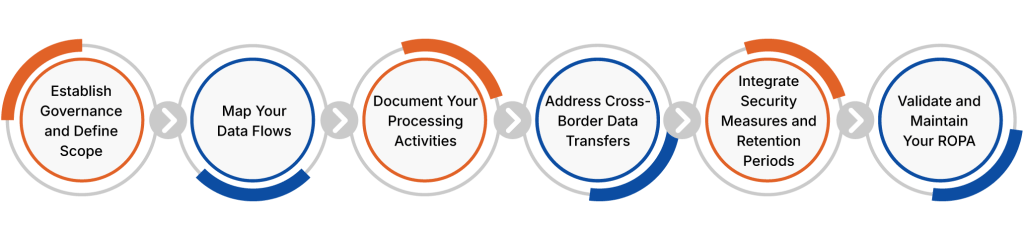
Step 1: Establish governance and define scope
Before you begin documenting individual processing activities, you need to establish clear ownership of the ROPA project and define its scope.
Determine your ROPA owner:
- SMEs and startups: Founder, operations manager, or IT lead
- Larger organizations: Dedicated Data Protection Officer (required if processing involves high risk, new technologies, large-scale sensitive data processing, or systematic profiling)
Choose your approach:
- Business function approach (recommended for most UAE businesses): Document by HR, sales, marketing, customer service, etc.
- System-based approach: Document by CRM, accounting software, HR platform, etc.
- Geographic approach: Document by office location or jurisdiction
Clarify group-level activities:
If your UAE entity is part of a larger corporate group, coordinate with affiliates to ensure your ROPA accurately reflects data sharing arrangements. The PDPL applies to personal data of UAE residents regardless of where the processing occurs.
Step 2: Map your data flows
This is often the most time-consuming part of the process, but it is absolutely essential. You cannot document what you do not know.
Start with these common systems:
- Customer relationship management system
- Accounting and ERP software
- HR and payroll platforms
- Email marketing tools
- Website analytics
- Industry-specific applications
For each system, document:
- What personal data it contains
- Where that data comes from
- How it is used and who has access
- Where it is stored (on-premises, cloud, hybrid)
Do not forget:
- Manual processes and spreadsheets on local drives
- Data shared through informal channels
- Personal devices used for business purposes
Pay special attention to special categories of personal data and biometric data, which the PDPL defines explicitly and which may trigger additional compliance obligations. The PDPL’s definition of sensitive personal data includes data revealing family and criminal record information, which differs from GDPR and requires careful attention.
Step 3: Document your processing activities
Now populate your ROPA with the specific information required by the PDPL.
For each processing activity, record:
- Name and contact details of your organization as controller
- Purposes of the processing (be specific, not generic)
- Categories of data subjects affected (employees, customers, vendors, etc.)
- Categories of personal data being processed
- Recipients or categories of recipients to whom data is disclosed
- Any transfers outside the UAE and protection measures applied
- Envisaged time limits for erasure
- General description of technical and organizational security measures
- Persons authorized to access the personal data (UAE-specific requirement)
Identify your legal basis for each activity under Article 4 of the PDPL:
- Consent (required for most processing)
- Contractual necessity
- Legal obligation
- Protection of the data subject’s interests
- Public interest
- Employment-related processing
Important: Unlike the GDPR, the PDPL does not recognize legitimate interests as a standalone legal basis. This significantly affects how companies structure their compliance programs and often requires explicit consent where legitimate interest would have previously applied.
Step 4: Address cross-border data transfers
This is one of the most complex aspects of UAE data protection compliance.
Your ROPA must document:
- All recipients of personal data located outside the UAE
- Cloud service providers with international servers
- Group affiliates overseas
- Third-party processors in other jurisdictions
Current challenges:
The PDPL permits transfers to jurisdictions that provide an adequate level of protection as determined by the UAE Data Office, or through alternative mechanisms including contractual clauses or explicit consent. At the time of writing, the UAE Data Office has not yet published a comprehensive list of adequate jurisdictions, which creates practical challenges for businesses relying on international data flows.
Practical consideration:
Many UAE businesses use international SaaS platforms (email, accounting, CRM) that automatically transfer data to servers in the US, Europe, or elsewhere. Identify these arrangements in your ROPA and ensure you have vendor-provided contractual protections in place until the UAE Data Office provides more clarity on adequacy decisions.
Step 5: Integrate security measures and retention periods
Security measures to document:
- Access control procedures
- Encryption standards
- Network security measures
- Physical security controls
Retention periods:
The PDPL states that personal data may not be kept after fulfilling the purpose of processing, except where the identity of the data subject has been anonymized.
For each category of personal data, document:
- Legal or regulatory minimum retention periods (employment records, financial transactions)
- Business need-based retention periods where no legal requirement exists
- Your rationale for the chosen retention period
Step 6: Validate and maintain your ROPA
Validation checklist:
- Review by business units that conduct the processing
- Legal or compliance review of legal bases and transfer mechanisms
- Approval at appropriate seniority level
- Secure storage with version control
Maintenance triggers (update your ROPA when):
- You implement new systems or technologies
- Business processes change
- You enter new vendor relationships
- You experience a data breach
- Regulatory guidance changes
Schedule: Conduct a comprehensive review at least annually.
Common challenges and how to overcome them
Challenge 1: Lack of centralized vendor records
Many SMEs find they lack centralized records of software vendors and data processing arrangements, making it difficult to identify all processing activities.
Solution: Start with your highest-risk processing activities. Focus on activities involving large volumes of personal data, sensitive categories, or high-risk processing such as automated decision-making. Expand coverage over time rather than attempting comprehensive documentation immediately.
Challenge 2: Shadow IT and informal data sharing
Employees often use personal devices or consumer-grade applications to store business data, or share data through informal channels.
Solution: Conduct interviews with department heads to uncover these practices. Document what you find and establish policies to bring shadow IT into compliance or migrate to approved systems.
Challenge 3: Rapid business change (especially for startups)
Processes evolve frequently, making it difficult to maintain accurate records.
Solution: Establish a lightweight ROPA update process that can accommodate rapid change. Schedule brief monthly reviews rather than waiting for annual comprehensive updates.
Challenge 4: Managing processor relationships
Many SMEs rely heavily on third-party processors but lack proper contractual protections or documentation.
Solution: Review all processor contracts to ensure they include necessary data protection clauses. Document processor activities in your ROPA and establish a vendor assessment process for future engagements.
The business value beyond compliance
While regulatory compliance is the primary driver, building a ROPA delivers significant business value:
- Operational efficiency: Visibility into data assets enables identification of opportunities for data minimization and system consolidation
- Customer trust: Foundation for responding efficiently to customer inquiries about data use
- Investment readiness: For startups seeking funding or preparing for acquisition, a well-maintained ROPA demonstrates that your data house is in order
- Competitive advantage: For SMEs competing for government contracts or corporate supply chain relationships, PDPL compliance demonstration can differentiate your business
- Risk reduction: Builds internal capability and awareness that reduces the risk of costly data breaches
The UAE Data Office has broad investigative and corrective powers under the PDPL, including the authority to impose administrative penalties for violations. While the exact penalty framework continues to evolve, the reputational and operational impact of regulatory enforcement can be severe. Maintaining accurate records of processing activities is a fundamental demonstration of accountability that will serve you well in any interaction with the regulator.
Conclusion: Your next steps
Building your first ROPA is achievable if you approach it systematically:
- Establish clear ownership and scope
- Conduct a thorough data mapping exercise
- Document each processing activity with required PDPL information
- Validate your records with business stakeholders
- Establish a process for ongoing maintenance
If you are unsure about any aspect of your ROPA obligations or need assistance with implementation, seeking professional guidance from qualified privacy consultants can help you avoid common pitfalls and ensure your compliance program meets the expectations of the UAE Data Office. The PDPL represents a significant evolution in the UAE’s approach to data protection, and compliance is no longer optional for businesses that want to operate with confidence in this market. Your ROPA is the foundation of that compliance, and the investment you make in building it properly will pay dividends for years to come.
FAQS
1. What exactly is a ROPA?
A Record of Processing Activities is a detailed inventory of how your organization collects, uses, stores, shares, and protects personal data. Think of it as your organization’s data diary.
2. Does my small startup really need a ROPA?
Yes. The UAE PDPL applies to all organizations processing personal data, regardless of size. A two-person startup has the same ROPA obligation as a multinational corporation.
3. What makes UAE ROPA different from GDPR?
The UAE PDPL requires documenting who is authorized to access each dataset-a specific requirement that goes beyond GDPR. Also, the PDPL does not recognize “legitimate interests” as a standalone legal basis.
4. How long does it take to build a first ROPA?
Typically, 4 to 8 weeks for an SME, depending on data complexity. Start with high-risk activities and expand coverage over time rather than aiming for perfection immediately.
5. Can I use a spreadsheet for my ROPA?
Absolutely. Spreadsheets work well for smaller organizations. Larger enterprises may benefit from dedicated GRC platforms, but the format matters less than the accuracy of content.
6. What happens if I don’t have a ROPA?
The UAE Data Office can impose administrative penalties. Beyond fines, you risk operational disruption during regulatory examinations and reputational damage.
7. Do I need a Data Protection Officer to create a ROPA?
Not necessarily. SMEs often assign ROPA ownership to a founder or operations lead. A DPO becomes mandatory only for high-risk processing, large-scale sensitive data, or systematic profiling.
8. How often should I update my ROPA?
At minimum, annually. However, trigger-based updates are essential-new systems, vendor changes, process modifications, or breaches should prompt immediate review.
9. What about data stored on personal devices or WhatsApp?
Shadow IT must be included. ROPA should reflect actual data flows, not just officially sanctioned systems. Document informal channels and establish migration policies.
10. Can I handle ROPA myself, or do I need a consultant?
Many SMEs build their first ROPA internally using the step-by-step framework. Consultants add value for complex organizations, international data flows, or when regulatory examination is imminent.