After months of building, pitching, and finally landing a pilot with a major hospital network or pharmacy benefit manager (PBM), the last thing you expect is a compliance requirement to derail it all. Then the vendor security questionnaire arrives and buried inside it is a single requirement that stops everything cold: HITRUST certification within 6 to 12 months, or the contract is void.
For an early-stage team already stretched across product, engineering, and fundraising, it feels like a dead end.
The assumption most founders make at this point is a costly one: that HITRUST is a compliance framework built exclusively for enterprise health systems with armies of security engineers and multi-million-dollar budgets. That assumption is wrong — and acting on it can cause startups to either walk away from deals they could close or overbuild compliance infrastructure they don’t need.
Small healthcare startups can achieve HITRUST certification. The HITRUST CSF framework is structured across three scalable tiers — e1, i1, and r2 — each designed for a different stage of organizational growth and risk. Choosing the right one is the difference between an achievable 6-week sprint and a 12-month compliance project that bleeds runway.
Why Tier Selection Is the Most Important Decision You’ll Make?
The most common and expensive mistake healthcare startups make is not failing to get certified it’s pursuing the wrong tier. Defaulting to the most comprehensive assessment without evaluating what your enterprise buyers actually require results in wasted engineering time, inflated assessor costs, and months of unnecessary policy documentation.
Understanding what each tier delivers and what it demands is where a realistic compliance roadmap begins.
HITRUST e1 — Essentials
The e1 assessment covers 44 specific requirement statements focused on foundational cyber hygiene: access control, patch management, basic encryption, and similar baseline controls. It is valid for one year and is designed for early-stage companies operating at lower risk profiles.
If your primary goal is satisfying initial enterprise procurement requirements or qualifying for early-stage vendor panels, e1 provides a validated HITRUST certificate without the operational overhead of a full-scale audit. For most pre-Series A healthcare startups, this is the right starting point.
HITRUST i1 — Implemented
The i1 certification covers approximately 182 pre-defined controls calibrated around the most active threat categories in healthcare — ransomware, phishing, credential attacks, and unauthorized access. Unlike r2, the control set does not expand based on your organization’s size. Under the current Assessment Handbook v1.2, i1 delivers a mid-market certification that satisfies the majority of hospital and health system procurement requirements without the administrative weight of a full risk-based assessment.
If your enterprise buyers are hospital networks or regional health systems with established vendor risk programs, i1 is frequently the level they require.
HITRUST r2 — Risk-Based
The r2 is the gold-standard HITRUST certification. It scales dynamically from 250 to over 1,000 controls based on your volume of Protected Health Information (PHI), transaction counts, and infrastructure complexity. It is valid for two years with an interim assessment and requires a mature security program with formally documented policies for every control statement.
For startups handling high PHI volumes, serving payers or large integrated delivery networks, or preparing for enterprise contracts at scale, r2 is the appropriate target. For most early-stage companies, it is premature and disproportionate to the risk profile.
2026 Cost and Timeline Breakdown
The table below reflects realistic financial and operational benchmarks for a startup running on standard cloud infrastructure (AWS, Azure, or GCP).
| Assessment Tier | Core Focus | Typical Controls | External Assessor Fees | Typical Timeline |
| e1 (Essentials) | Foundational Cyber Hygiene | 44 | $8500– $15000 | 6 – 12 Weeks |
| i1 (Implemented) | Threat-Adaptive Security | ~182 | $15000– $45,000 | 4 – 6 Months |
| r2 (Risk-Based) | Full Enterprise Assurance | 250 – 1,000+ | $30000– $120,000+ | 6 – 12 Months |
These figures assume a cloud-native architecture where physical and environmental controls can be inherited from your hosting provider a scope reduction that directly compresses both cost and timeline.
Closing deals shouldn’t mean stalling your product roadmap. ValueMentor’s HITRUST specialists help healthcare startups define the right tier, build automated evidence pipelines, and compress validation timelines — so compliance accelerates your growth rather than slowing it down.
Pre-Assessment Checklist: What Your Team Must Have in Place
Engaging an external assessor before your environment is ready is one of the fastest ways to inflate your compliance bill. The following steps should be completed sequentially before fieldwork begins.
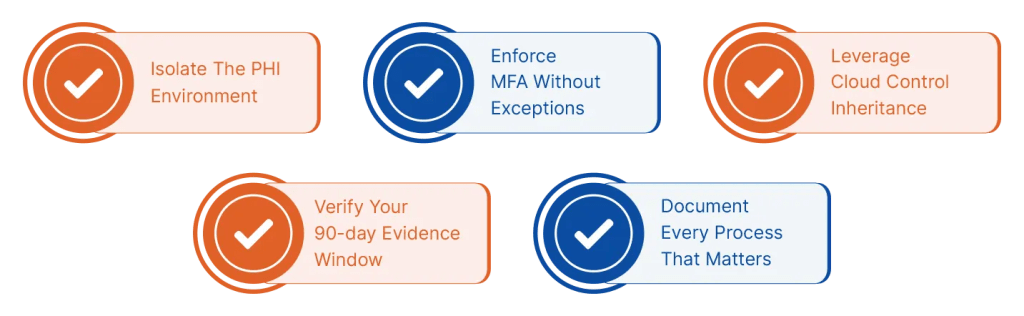
- Isolate the PHI environment. Architecturally separate your production systems from your corporate network using dedicated VPCs and bastion hosts. A tighter scope means fewer controls to validate and a shorter timeline.
- Enforce MFA without exceptions. Multi-factor authentication must be explicitly enforced on all user endpoints, server instances, and database connections that touch sensitive data. Partial enforcement does not satisfy current requirements.
- Leverage cloud control inheritance. Configure your MyCSF portal to inherit physical, environmental, and infrastructure controls directly from your cloud provider. This eliminates the need to independently test physical data centers and can reduce total validation effort by 10% to 20%.
- Verify your 90-day evidence window. HITRUST requires proof that every technical control operated continuously for a full 90 days immediately prior to the start of formal fieldwork. Any gap in logging, access monitoring, or vulnerability scanning resets the clock.
- Document every process that matters. Undocumented controls do not exist to an external assessor. Every technical control must be backed by a formal policy that specifies execution cadence, ownership, and review cycle.
Two Structural Pitfalls That Derails Cloud-Native Startups
The Jump Server Assumption Is Closed
Engineering teams frequently assume that routing all traffic through a jump server or Virtual Desktop Infrastructure (VDI) fully excludes local developer laptops from audit scope. Under Assessment Handbook v1.2, this is no longer accurate. If a developer uses a local machine to access production environments containing PHI, endpoint testing must include those devices unless technical data-exfiltration controls are strictly enforced and verified at the endpoint level.
Discovering this after your evidence collection period begins is an expensive problem. Validating your scope assumptions before starting the 90-day window is not optional — it is foundational.
Automation Tools Accelerate Evidence Collection — They Don’t Replace Validation
Modern GRC platforms and compliance automation tools significantly reduce the manual effort of evidence gathering. But they do not bypass the external validation process. Assessors are required to corroborate automated screenshots with underlying configuration files, execution timestamps, and network diagrams.
A dashboard that shows a green status without auditable evidence behind it will not survive fieldwork. Automation should be paired with a clear understanding of the configuration it represents, not used as a substitute for it.
Conclusion
HITRUST certification is not out of reach for early-stage healthcare startups. The framework’s tiered architecture — e1, i1, and r2 exists precisely to allow organizations at different stages of maturity to achieve a validated certificate appropriate to their risk profile and operational scale.
The outcome depends on two decisions made early: selecting the right tier for your enterprise buyers, and building your technical environment before the evidence clock starts. Getting either wrong will cost more in time and money than the certification itself.
At ValueMentor, we help healthcare startups navigate that process without the guesswork. Our HITRUST advisors define scope boundaries, build automated evidence pipelines, maximize cloud control inheritance, and compress validation timelines so your team can close enterprise deals without sacrificing product momentum.
Frequently Asked Questions
Yes. If your primary enterprise buyers explicitly require a HITRUST validated certificate, you can pursue e1 or i1 without first completing a SOC 2 audit. For many healthcare-focused startups, consolidating to a single framework saves both capital and engineering time.
What is the mandatory evidence window?
All technical controls must operate continuously for a minimum of 90 consecutive days immediately before external validation fieldwork begins. Any gap in logging, access monitoring, or vulnerability scanning within this window resets the timeline entirely.
How does cloud infrastructure reduce audit costs?
By leveraging a cloud-native architecture, startups can formally inherit hundreds of physical and environmental controls from their hosting provider within the MyCSF portal. This eliminates independent testing of physical data centers and reduces total validation effort by 10% to 20%.
Can we use compensating or alternate controls if we cannot meet a specific requirement?
Yes, but the process is governed strictly. Any alternate control must address the exact same threat as the original requirement statement. A formal proposal must be submitted to and approved by the alternate controls committee at least 30 days before validation fieldwork begins.