
If you are asking this question, you are not alone. For many organizations, HITRUST certification is the golden ticket to proving strong data protection and regulatory compliance. The first journey typically takes around six months, but once you have established the framework, the process becomes much faster and smoother in subsequent years. From the first gap assessment to the final HITRUST audit, every stage of the HITRUST certification process comes with its own timelines, roadblocks and best practices.
In this blog, we will break down the complete HITRUST certification process, explain each certification stage, and highlight common delays that derail the HITRUST compliance journey plus how to avoid them. By the end, you will know exactly what to expect, how to plan, and how to fast-track your certification without costly surprises.
What is the HITRUST certification process and why does it matter?
HITRUST certification is a widely recognized proof of compliance with the HITRUST CSF framework that demonstrates an organization’s commitment to safeguarding sensitive data. For healthcare and related industries, this means aligning with HIPAA, ISO, NIST, and other frameworks under one unified approach. Organizations pursue HITRUST certification for multiple reasons:
- Trust and credibility: It signals to clients, partners, and regulators that the organization takes data security seriously.
- Regulatory alignment: It provides a structured approach to meet complex compliance requirements without juggling multiple frameworks.
- Risk reduction: Certification ensures that security controls are systematically evaluated, reducing the likelihood of breaches.
- Competitive advantage: In highly regulated industries, certification can differentiate a business in RFPs, partnerships or vendor evaluations.
Key players involved in the certification journey
- Internal compliance and IT teams: They prepare documentation, implement controls, and address gaps.
- HITRUST assessor organizations: Authorized third-party assessors conduct validated assessments and audits.
- External consultants: Many organizations bring in experts to streamline the process, provide guidance, and ensure adherence to HITRUST CSF requirements.
- Executive leadership: Their support is crucial for resource allocation, prioritization, and decision-making.
How long does HITRUST certification really take?
HITRUST certification process is not instant, timelines vary depending on organizational maturity, scope and resources. Understanding what to expect can prevent frustration and mismanaged expectations.
On average, organizations can expect the process to take anywhere between 3 to 6 months, depending on the type of assessment:
- HITRUST r2 Certification: Typically takes 5-6 months
- HITRUST i1 and e1 Certifications: Typically take 3-4 months
Factoring in preparation time, readiness assessments, and remediation activities, some organizations may take longer to reach certification.
Smaller organizations with fewer systems may complete the process faster, while larger enterprises often require additional time due to complex IT environments.
Factors that affect how long the process takes
Several factors can extend or shorten the certification timeline:
- Existing compliance posture: Organizations with mature security programs may require less remediation.
- Scope of certification: More systems and business units in scope increase complexity.
- Resource availability: Adequate staffing and budget allocation directly affect speed.
- Third-party dependencies: Vendor compliance and integrations may introduce delays.
- Documentation readiness: Incomplete policies or procedures can lengthen the gap assessment stage.
Step-by-Step stages of the HITRUST certification journey
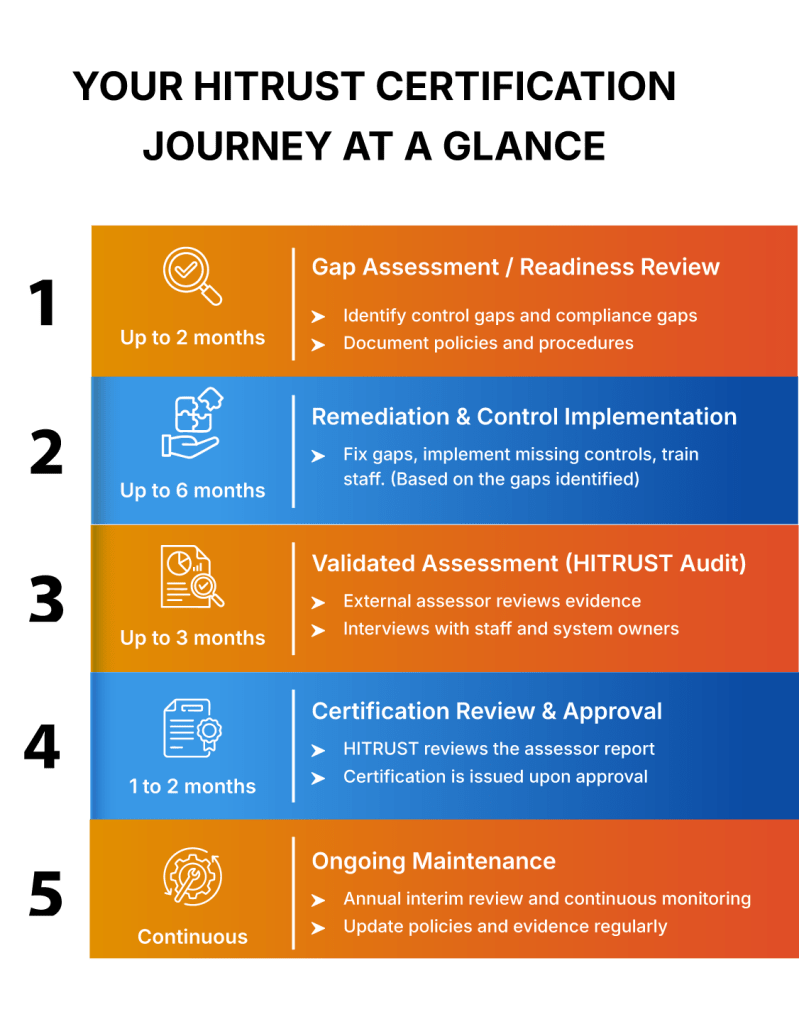
The HITRUST certification journey can be broken down into clear stages, each critical to achieving a successful outcome.
| Stage | Duration | Key Activities | Tips to Stay on Track |
|---|---|---|---|
| 1. Gap Assessment / Readiness Review | Up to 2 months | Review current controls, identify gaps, document policies | Conduct an internal pre-assessment to catch issues early |
| 2. Remediation & Control Implementation | Up to 6 months | Fix gaps, implement missing controls, train staff. (Based on the gaps identified) | Prioritize high-risk areas first; use a remediation plan |
| 3. Validated Assessment (HITRUST Audit) | Up to 3 months | External assessor reviews evidence, interviews staff, validates controls | Prepare documentation in advance; assign point-of-contact for assessor |
| 4. Certification Review & Approval | 1 to 2 months | HITRUST reviews assessor report, issues certification | Stay responsive to HITRUST queries; ensure timely submission |
| 5. Ongoing Maintenance | Continuous | Annual interim review, continuous monitoring, updates | Set reminders for evidence collection and policy updates |
Gap assessment and readiness review
This initial phase involves reviewing your current security controls against HITRUST CSF requirements.
- Identify gaps and weaknesses in policies, processes, and technologies.
- Prioritize remediation efforts based on risk and impact.
- Create a detailed roadmap for achieving compliance.
Remediation and control implementation
Once gaps are identified, the organization must:
- Implement or enhance security controls.
- Update documentation to reflect actual practices.
- Conduct internal testing to verify controls are effective.
Validated assessment and external audit
An authorized HITRUST assessor reviews the organization’s controls and evidence. This stage includes:
- Submitting documentation and evidence for each control.
- Conducting interviews and technical testing.
- Receiving feedback on deficiencies that need correction before certification.
Certification and maintenance
After a successful assessment:
- HITRUST grants certification, usually valid for two years.
- Organizations must maintain controls and prepare for ongoing annual assessments to retain compliance.
Ensure ongoing compliance by scheduling annual interim reviews, maintaining continuous monitoring and regularly updating security policies and procedures. Automate reminders for evidence collection and documentation to stay audit-ready year-round.
Why the HITRUST timeline gets delayed?
Even organizations with strong security programs often find the HITRUST timeline longer than expected. Understanding the common pitfalls and strategies to avoid them is key to staying on track.
- Limited internal resources:
Many organizations underestimate the effort needed. IT, compliance, and security teams often have ongoing operational responsibilities, leaving limited bandwidth for documentation, remediation, and assessment preparation. - Incomplete or outdated documentation:
HITRUST assessments rely heavily on accurate documentation. Policies, procedures, system diagrams, and logs must be current. Missing or inconsistent evidence often triggers delays as assessors request clarifications or additional proof. - Complex IT environments and third-party dependencies:
Organizations with multiple locations, cloud providers, SaaS tools, and integrated vendors may face coordination challenges. Ensuring that each system or vendor meets HITRUST requirements can be time-consuming. - Lack of clear ownership and accountability:
When roles and responsibilities are ambiguous, tasks can fall through the cracks. Without a single point of accountability, remediation activities and evidence collection may stall. - Unrealistic expectations:
Some organizations expect a “quick fix” approach. HITRUST certification is a rigorous process requiring careful planning and step-by-step validation. Skipping steps may lead to repeated assessments and wasted time.
How to fast-track your HITRUST compliance without cutting corners?
While HITRUST certification is rigorous, organizations can accelerate the process through careful planning, expert guidance and efficient use of tools without compromising quality or compliance.
Leveraging expert guidance and tools
- Engage experienced HITRUST consultants:
Consultants bring practical knowledge of common gaps, documentation requirements, and assessor expectations. Their guidance can prevent costly mistakes and reduce repeated cycles. - Work with authorized HITRUST assessors early:
Involving an assessor from the beginning provides clarity on expectations and allows for continuous feedback rather than waiting until the final assessment stage. - Use automation tools for evidence collection:
Digital platforms can streamline policy management, control tracking, and evidence submission. Automation reduces manual effort, speeds up documentation, and ensures nothing is overlooked. - Adopt standardized templates and checklists:
HITRUST provides templates for policies, procedures, and control evidence. Using these reduces ambiguity and ensures consistency across the organization. - Leverage training and knowledge resources:
HITRUST webinars, knowledge base articles, and training sessions equip teams with the right skills to implement and document controls effectively.
Building a realistic roadmap for success
- Set clear milestones for each certification stage:
Define specific objectives for gap assessment, remediation, validated assessment, and certification submission. Breaking the process into smaller, measurable tasks keeps teams focused. - Align timelines with resources and priorities:
Ensure that internal teams, IT operations, and vendors have the time and support required for remediation tasks. Avoid overloading teams or creating unrealistic deadlines. - Monitor progress continuously:
Regularly review remediation status, control effectiveness, and documentation readiness. Identify potential delays early and adjust plans proactively. - Maintain executive support:
Leadership buy-in is critical for resource allocation, approvals, and prioritization. Regular updates to executives can keep the project on track and ensure accountability. - Plan for ongoing compliance:
HITRUST certification is not a one-time achievement. Build a plan for continuous monitoring, annual reassessments, and updates to controls as systems and regulations evolve. This proactive approach prevents future delays and ensures lasting compliance. - Focus on culture, not just controls:
Encourage a security-first mindset within teams. When employees understand their role in compliance, adherence to policies improves, and remediation is faster and more effective.
Conclusion
Getting HITRUST certified is about proving your organization’s commitment to security and trust. While the timeline can vary from 6 months to over a year, most delays stem from poor planning, unclear roles, or underestimating the effort required. By understanding the HITRUST certification stages, preparing early and addressing common roadblocks, you can keep your HITRUST compliance journey smooth and predictable. If you are serious about achieving HITRUST certification without costly setbacks, the key is starting early and partnering with the right experts. With the right roadmap, you can fast-track your certification and build the credibility your business needs to win client trust and meet regulatory expectations.
Ready to begin your HITRUST journey? Let us make the process easier, faster and more predictable without cutting corners.
FAQs
1. How long does it take to get HITRUST certified on average?
Most organizations complete the HITRUST certification process in 6-12 months, depending on their readiness and resources.
2. What are the main stages of the HITRUST certification process?
The stages include a gap assessment, remediation, validated assessment, external audit, and certification approval.
3. Can HITRUST certification be completed in less than 6 months?
Yes, but only if your organization already has strong controls in place and minimal remediation work is needed.
4. What factors cause delays in the HITRUST certification timeline?
Delays often happen due to incomplete documentation, resource gaps, unclear scope, or slow remediation efforts.
5. Do small organizations get certified faster than large enterprises?
Not always. While smaller companies may have fewer systems to evaluate, resource limitations can still slow them down.
6. How much preparation time is needed before a HITRUST audit?
Most companies spend 3-6 months preparing through a readiness or gap assessment before starting the formal validated assessment.
7. What is the difference between a readiness assessment and a validated assessment in HITRUST?
A readiness assessment identifies gaps and areas to improve, while a validated assessment is the official review performed by an authorized HITRUST assessor firm.
8. Can the HITRUST certification process be done remotely?
Yes. Much of the assessment and documentation review can be conducted remotely, but evidence gathering still requires thorough preparation.
9. How long is HITRUST certification valid once achieved?
HITRUST certification is valid for two years, with an interim review after one year to ensure continued compliance.
10. What is the best way to speed up the HITRUST compliance journey?
The fastest way is to work with an experienced HITRUST assessor, use compliance automation tools, and allocate internal resources early.