
HITRUST CSF v11.8.0 represents the framework’s most recent evolution, introducing targeted updates to control language, authoritative source mappings, and assessment requirements that every compliance-focused organisation must address before entering their next certification cycle. For CISOs, compliance officers, and risk management professionals operating in regulated industries, this is not a background administrative update it is an active compliance obligation.
The HITRUST Common Security Framework has established itself as the pre-eminent assurance standard for organisations managing sensitive health information, and its regular versioning cycle reflects HITRUST’s commitment to maintaining alignment with the evolving regulatory and threat landscape. Each version release carries implications for how organisations scope their assessments, document their controls, and demonstrate assurance to customers, partners, and regulators. Version 11.8.0 continues this trajectory, with specific changes that merit structured review rather than assumption of continuity from prior versions.
This article provides compliance professionals and security leaders with a clear, authoritative account of what has changed in HITRUST CSF v11.8.0, why those changes matter, and what concrete steps organisations must take to remain on course for certification. Whether your organisation is approaching an initial e1 validated assessment or renewing a full r2 certification, understanding the specifics of this release is paramount to a successful outcome.
Understanding the HITRUST CSF Updates in Version 11.8.0
Every HITRUST version release follows a disciplined review cycle during which HITRUST’s internal teams and external advisory bodies assess changes in the regulatory environment, emerging threat intelligence, and stakeholder feedback from the assessor and practitioner community. Version 11.8.0 is the product of that cycle, and its updates reflect a deliberate effort to keep the framework precise, credible, and operationally relevant. For organisations that have been operating under a previous version, it is a professional obligation — not merely a best practice to conduct a structured review of the delta between their existing programme and the current framework requirements.
Among the most significant categories of change in v11.8.0 are revisions to requirement statement language. These are not cosmetic edits. When HITRUST modifies the language of a control requirement, it alters what an assessor will evaluate and what evidence an organisation must produce. Compliance teams that continue relying on control implementations and documentation aligned to prior requirement language face the risk of scoring gaps during assessment gaps that may not surface until late in the process, when remediation timelines are constrained.
Authoritative Source Revisions and Their Downstream Effect
Authoritative source updates represent another critical dimension of the v11.8.0 release. HITRUST maps each control requirement to one or more external reference standards, and when those underlying standards are themselves updated whether through revised NIST guidance, updated HIPAA sub-regulatory publications, or changes to ISO standards — HITRUST revises its mappings accordingly. For organisations in the healthcare sector, this is particularly significant, as HIPAA enforcement guidance and HHS sub-regulatory publications continue to evolve in response to the threat environment.
The downstream effect of authoritative source changes is practical rather than theoretical. An organisation that has implemented a control to satisfy a prior version of a referenced standard may find that the updated source document introduces additional specificity — around encryption standards, access management configurations, or incident response timelines, for example. Compliance managers must treat authoritative source updates as a trigger for control re-evaluation, not merely a documentation exercise.
What Changed in HITRUST CSF Authoritative Sources for v11.8.0?
The integrity of the HITRUST CSF as a meta-framework depends on the currency of its authoritative source mappings. When HITRUST publishes a new version, one of its primary technical outputs is a revised mapping document that specifies, control by control, which external standards and regulatory instruments are now referenced. In v11.8.0, organisations will observe revisions across several control domains areas where the referenced external standards have themselves been updated or where HITRUST has refined the precision of its mapping to better reflect the intent of the source material.
For compliance officers managing dual obligations maintaining HITRUST certification while simultaneously satisfying HIPAA, SOC 2, or state-level privacy requirements — these mapping updates carry a secondary benefit. Revised and more precise mappings can strengthen the organisation’s ability to demonstrate cross-framework alignment, using a single control implementation to satisfy multiple regulatory obligations. However, this benefit is contingent on the organisation’s compliance programme being current with the v11.8.0 mappings, rather than relying on mapping documents from prior versions.
Practical Implications for Control Documentation
When authoritative source references change, the organisation’s control documentation must be reviewed to ensure traceability. This means updating control crosswalk matrices, revising policy and procedure documents to reference current standards, and verifying that implemented technical controls satisfy the updated baseline. Assessors conducting HITRUST validated assessments will evaluate control maturity against the requirements and mappings in the active framework version at the time of the assessment. Residual reliance on prior-version documentation introduces unnecessary risk.
Compliance teams should also note that HITRUST provides official guidance documentation alongside each version release, including a what’s-new summary and a detailed change log. These documents are essential reference materials and should be obtained directly from the HITRUST website and MyCSF portal rather than through secondary interpretations. First-party documentation is the authoritative basis for assessment preparation, and organisations that rely on synthesised summaries alone risk missing control-level nuances.
HITRUST e1 and i1 Requirements: What v11.8.0 Changes for Your Assessment?
The e1 and i1 assessment pathways are the two most widely pursued HITRUST certification routes among healthcare technology vendors and business associates. Their relative accessibility compared to the full r2 pathway makes them attractive to organisations seeking credible, externally validated assurance without the resource overhead of a comprehensive assessment. However, this accessibility must not be mistaken for simplicity. Both pathways carry precise, auditable requirements, and version updates — including those in v11.8.0 apply equally to e1 and i1 as they do to the broader framework.
For the e1 pathway, which targets a focused subset of essential cybersecurity hygiene controls, any revision to the control requirement statements or their associated scoring criteria has a proportionally significant effect. Because the e1 control set is narrower, each individual control carries greater weight in the overall assessment outcome. Organisations approaching an e1 assessment under v11.8.0 must verify that their control implementations satisfy the updated requirement language precisely, and that their evidence artefacts policies, configurations, access logs, testing records reflect the revised criteria.
i1 Pathway Considerations Under the New Version
For i1 assessments, the considerations are broader in scope but similar in character. The i1 control set spans a wider range of control domains, meaning that authoritative source updates and requirement language revisions may affect a larger proportion of the organisation’s existing control inventory. Compliance managers overseeing an i1 programme should undertake a systematic control-by-control comparison between their current implementation documentation and the v11.8.0 requirement statements, prioritising any controls where the requirement language has changed materially.
One area that consistently warrants close attention during version transitions is the maturity scoring methodology. HITRUST assesses controls across multiple maturity levels — policy, procedure, implementation, measurement, and management. If a revised requirement statement introduces new specificity at the implementation or measurement level, an organisation that previously achieved a compliant score under the prior version may need to supplement its evidence or adjust its technical implementation to maintain the same maturity rating under v11.8.0. Assessors are trained to apply the current version’s criteria, and organisations should align their preparation accordingly.
How to Prepare for Your Next Assessment Under HITRUST CSF v11.8.0?
The most common preparation error organisations make during a framework version transition is assuming continuity proceeding with assessment preparation as though the control environment validated under a prior version remains fully current. This assumption is professionally risky. A structured gap analysis is the appropriate first step, and it should be conducted against the v11.8.0 requirement statements directly, using the official HITRUST MyCSF platform as the reference point. MyCSF is the primary tool through which assessments are managed, and it will reflect the v11.8.0 control library once the version is active.
Structuring a Gap Analysis for Version Transitions
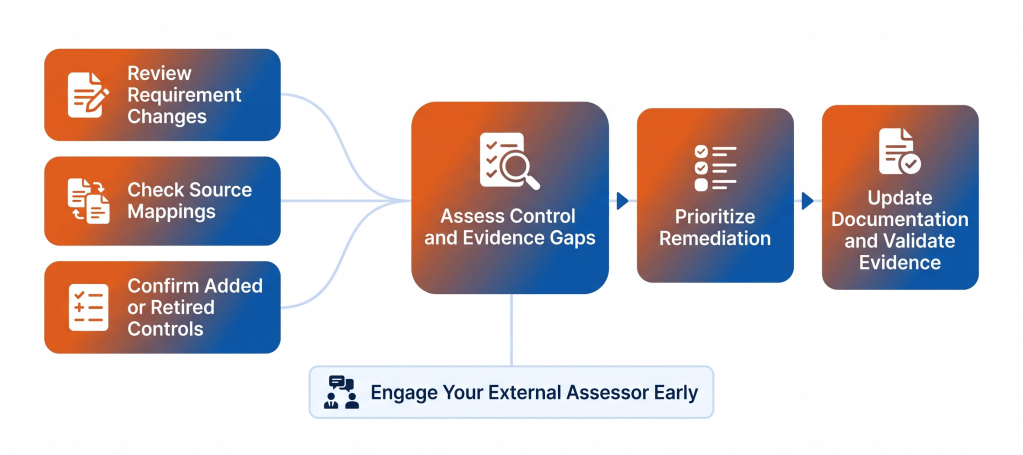
A gap analysis in the context of a version transition should be scoped to identify three categories of change: controls where requirement language has been revised, controls where authoritative source mappings have changed, and any controls that are new or have been retired in the current version. For each affected control, the compliance team should assess whether the existing implementation and documentation remain sufficient, require augmentation, or must be redesigned. The output of this analysis should be a prioritised remediation roadmap with clear ownership, timelines, and evidence requirements.
Policy and procedure documentation is frequently the first area to require updates during a version transition, as requirement statement changes often necessitate revised or more precise procedural language. Technical controls may also require adjustment particularly where updated authoritative sources introduce more specific configuration or testing criteria. Organisations should allocate adequate time for evidence collection and quality review before submitting for a validated assessment, recognising that remediation timelines can compress rapidly in the weeks preceding an assessment engagement.
Engaging an External Assessor Early
Engaging a HITRUST-approved external assessor early in the preparation process is a sound practice under any circumstances, but it is particularly valuable during a version transition. External assessors bring direct familiarity with how framework changes translate to assessment practice, and early engagement allows the organisation to clarify ambiguities in requirement interpretation before they become scoring issues during the formal assessment. The assessor relationship is most productive when it begins well before the assessment itself — not at the point of readiness declaration.
Conclusion
HITRUST CSF v11.8.0 is a substantive release that demands structured attention from every organisation operating within the HITRUST certification ecosystem. The updates to authoritative source mappings, requirement statement language, and e1 and i1 control sets are not incidental they reflect the framework’s active responsiveness to a shifting regulatory and threat environment. Organisations that treat this version transition as a routine administrative update risk entering their next assessment cycle with a control programme that is misaligned to the current framework’s expectations.
HITRUST CSF v11.8.0 is the current release of the HITRUST Common Security Framework, introducing updates to authoritative source mappings, control requirement language, and e1 and i1 assessment criteria. Organisations managing protected health information or pursuing HITRUST certification must conduct a structured gap analysis against v11.8.0, remediate affected controls, and align documentation to revised requirement statements before their next validated assessment. CISOs and compliance officers should treat this release as an active compliance obligation requiring prioritised action. Preparing for a HITRUST CSF v11.8.0 assessment requires precision, expertise, and a clear-eyed view of your current control environment. ValueMentor works alongside compliance teams and security leaders as a trusted partner from gap analysis through validated assessment to ensure your organisation enters the certification process with confidence and clarity. Visit our website to learn how we can support your HITRUST journey and accelerate your path to certification.
FAQs
HITRUST CSF v11.8.0 is the latest version of the HITRUST Common Security Framework, released to align controls with updated authoritative sources, regulatory guidance, and industry standards. It refines existing control categories, adjusts requirement statements, and introduces updated mappings ensuring the framework remains current, rigorous, and relevant to organisations managing sensitive data.
What are the key changes in HITRUST CSF v11.8.0?
HITRUST CSF v11.8.0 introduces updated authoritative source mappings, revised control language, and adjustments to e1 and i1 assessment requirements. Several control statements have been refined for precision and regulatory alignment. Organisations should review all updated requirement statements and revised scoping guidance before initiating or renewing their certification assessment.
How long does a HITRUST CSF v11.8.0 certification take?
HITRUST CSF certification typically takes between three and twelve months, depending on organisational size, scope, and assessment type. The e1 validated assessment is the most streamlined, while r2 assessments require more extensive preparation. Organisations beginning the process with a readiness gap analysis generally achieve more efficient assessment timelines.
HITRUST CSF v11.8.0 is most relevant to healthcare organisations, health technology vendors, business associates, and any entity handling protected health information. It is also increasingly adopted by financial services and cloud service providers under contractual or regulatory mandates. Any organisation pursuing HITRUST certification must align with the current version of the framework.