The HITRUST Assessment Handbook v1.2 is the governing procedural document that defines how HITRUST assessments must be planned, executed, evidenced, and validated. The HITRUST Assessment Handbook sets out the requirements and expectations that assessed entities and HITRUST External Assessors follow during the assessment and certification process; it is the structural foundation upon which a valid certification outcome depends.
In an environment where healthcare data breaches continue to carry profound regulatory, financial, and reputational consequences, the rigour embedded in HITRUST’s assessment methodology exists for good reason. The Handbook consolidates and formalises the procedural expectations that HITRUST has refined over successive framework iterations, providing CISOs, compliance officers, and assessment teams with a single authoritative reference. Understanding its requirements is not merely an administrative exercise it is a prerequisite for a defensible, successful certification outcome.
This blog examines two areas where the Handbook’s guidance carries the greatest practical weight: evidence requirements and inheritance rules. Both are frequent sources of assessment deficiency. Both are addressed with precision in v1.2. Whether you are an assessor preparing for an engagement or a compliance manager overseeing an internal readiness programme, this analysis is designed to orient your approach and sharpen your execution.
Understanding HITRUST Inheritance Requirements
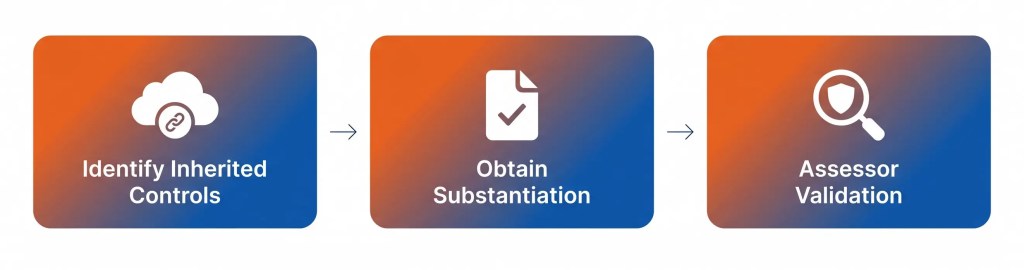
Inheritance is one of the most operationally consequential mechanisms in the HITRUST framework, and it is also one of the most frequently misapplied. At its core, inheritance allows an assessed entity to recognise that certain controls are implemented at the infrastructure or platform level by a service provider most commonly a cloud service provider (CSP) such as AWS, Microsoft Azure, or Google Cloud Platform and to carry a portion of that control’s score into their own assessment. However, the Assessment Handbook v1.2 is explicit that this carry-over is conditional, not automatic.
The Substantiation Requirement
For inheritance to be recognised, the Handbook requires that the assessed entity obtain and retain documentation from the inheriting party that confirms the control is implemented, operational, and applicable to the assessed entity’s specific environment. This substantiation typically takes the form of the service provider’s own HITRUST certification letter, a current Shared Responsibility Matrix (SRM), or equivalent compliance documentation such as a SOC 2 Type II report with relevant control mappings. The Handbook specifies that the assessed entity cannot simply assert inheritance based on a vendor relationship; the documentation must be current, scoped correctly, and reviewed by the External Assessor.
Assessor Responsibilities Under v1.2
External Assessors are responsible for validating that inheritance claims are substantiated before applying any inherited score. In practice, this means the assessor must review the service provider’s documentation, confirm that the scope of the provider’s own assessment or certification encompasses the systems and services used by the assessed entity, and determine that the control in question is genuinely within the provider’s operational domain. The Handbook places a clear quality assurance burden on the assessor here: an inherited score that lacks adequate substantiation will be challenged during HITRUST’s own quality review, potentially resulting in score adjustments and delays to certification issuance.
A particularly important edge case addressed in v1.2 concerns partial inheritance, where a control responsibility is shared between the assessed entity and the service provider. In these scenarios, the Handbook requires that both the provider’s portion and the assessed entity’s portion be independently evaluated and evidenced. Assessors must resist the temptation to treat partial inheritance as full inheritance, as the distinction materially affects the final control score and, by extension, the overall certification level.
HITRUST Assessment Evidence Requirements
Evidence collection is the operational backbone of any HITRUST assessment, and the Assessment Handbook v1.2 brings heightened clarity to what constitutes sufficient evidence across each assessment tier.
For compliance officers and assessment teams, it is important to understand these requirements early in the preparation cycle. Evidence that does not meet the applicable testing and documentation criteria may be challenged during validation.
Evidence Standards by Assessment Tier
The Handbook distinguishes evidence requirements across the three assessment types as follows:
- e1 (Essential) Assessment: Requires evidence demonstrating that foundational cyber hygiene controls are in place. Evidence at this tier is generally confirmatory in nature — policy documents, configuration screenshots, and system-generated reports that confirm the presence of a control. The evidentiary bar is deliberately accessible, reflecting the e1’s positioning as a baseline certification.
- i1 (Implemented, 1-year) Assessment: Requires evidence that controls are not only present but implemented in a manner consistent with good practice. Assessors must evaluate whether the evidence demonstrates operational effectiveness, not merely nominal existence. Policy documents alone are rarely sufficient at this tier; procedural records, training logs, and system configuration artefacts are typically required.
- r2 (Risk-based,2-year) Assessment: Carries the most rigorous evidence requirements. The Handbook specifies that r2 evidence must demonstrate implementation, operational effectiveness, and consistency over time. This typically demands a combination of policy and procedural documentation, system-generated logs, interview corroboration, and where applicable, testing records. The r2 tier is where assessors must exercise the greatest judgement in evaluating evidence sufficiency, and where deficiencies most often emerge during HITRUST’s quality assurance review.
Evidence Sufficiency and the Assessor’s Role
The Handbook does not prescribe a fixed list of acceptable evidence formats for every control; instead, it establishes a sufficiency standard that assessors must apply contextually. A sufficiency determination requires the assessor to ask whether the evidence presented, taken as a whole, provides reasonable assurance that the control is implemented and operating as intended. This is a professional judgement call, and v1.2 reinforces that External Assessors bear direct responsibility for the accuracy of that judgement.
In our experience auditing and supporting HITRUST engagements, the most common evidence-related failure modes are threefold: evidence that is out of scope (relating to systems or environments outside the defined assessment boundary), evidence that is stale (predating the assessment window by more than the permissible period), and evidence that addresses the wrong control maturity level. The Handbook provides specific guidance on each of these failure modes, and assessors are expected to apply that guidance consistently and document their reasoning when edge cases arise.
Maintaining an Evidence Repository
Practical adherence to the Handbook’s evidence requirements is greatly facilitated by establishing a structured evidence repository at the outset of the engagement. The repository should be organised by control domain and linked directly to the MyCSF platform, enabling both the assessed entity’s internal team and the External Assessor to track evidence completeness in real time. The Handbook implicitly supports this approach by emphasising the traceability of evidence to specific control requirements a standard that is far easier to meet when documentation is systematically catalogued rather than assembled under time pressure near the assessment submission deadline.
Navigating the HITRUST Assessment Evidence Requirements for Validated Assessment Reports
The VAR (Validated Assessment Report)represents the culmination of the assessment process and is the document upon which HITRUST’s certification decision rests. The Assessment Handbook v1.2 devotes considerable procedural attention to the standards that must be met before a VAR can be submitted, and both assessors and assessed entities benefit from understanding these requirements as early as the scoping phase rather than treating the VAR as a final-stage administrative step.
Quality Assurance Expectations
HITRUST conducts its own quality assurance review of every submitted VAR, evaluating whether the control scores assigned by the External Assessor are consistent with the evidence documented in MyCSF. Version 1.2 of the Handbook strengthens the expectations placed on assessors in this regard, making clear that score-evidence alignment is a non-negotiable standard. Where the quality assurance review identifies gaps controls scored higher than the evidence supports, or inheritance claims that lack adequate substantiation HITRUST may apply score corrections unilaterally, which can affect the assessed entity’s certification eligibility.
Scoping Accuracy and Its Impact on the VAR
One area where the Handbook’s guidance is particularly instructive concerns assessment scope boundaries. The VAR must accurately reflect the systems, processes, and organisational units included within the assessment scope. Scope creep where additional systems are implicitly covered by evidence without being formally included in the defined scope — is a risk that the Handbook specifically cautions against. Equally problematic is an overly narrow scope that excludes systems materially involved in the protection of regulated information. Assessors must work with the assessed entity during the scoping phase to establish boundaries that are both accurate and defensible, and those boundaries must remain consistent from the planning documentation through to the final VAR submission.
Conclusion
The HITRUST Assessment Handbook v1.2 is a document of considerable operational consequence. Its guidance on evidence requirements and inheritance substantiation addresses the areas where assessments most frequently encounter difficulty, and its quality assurance expectations make clear that procedural rigour is not a courtesy it is a condition of certification. For CISOs and compliance officers, the Handbook should function as an active reference throughout the engagement lifecycle, not a document consulted only when questions arise. Looking ahead, HITRUST continues to refine its framework in response to the evolving threat landscape and the increasing complexity of cloud-hosted and distributed operating environments. As inheritance arrangements become more sophisticated and evidence ecosystems more automated, the procedural standards set out in documents like the Assessment Handbook will only become more important. Organisations that build their compliance programmes around a thorough understanding of these standards rather than treating them as a final review checklist will be better positioned to achieve and maintain high-performance certification outcomes with confidence and consistency. ValueMentor‘s certified assessment specialists work alongside your team to ensure your evidence framework, inheritance documentation, and scope boundaries are structured for certification success from day one.
FAQs
The Handbook covers three HITRUST assessment types: the e1 (Essential), i1 (Implemented), and r2 (Risk-based) assessments. Each tier reflects a different depth of control evaluation and certification scope. The Handbook outlines specific evidence sufficiency standards, scoping requirements, and inheritance rules applicable to each assessment type independently.
Who needs to follow the HITRUST Assessment Handbook v1.2?
The Handbook is mandatory for HITRUST External Assessors and the organisations pursuing certification. CISOs, compliance officers, and internal audit teams at healthcare, health-tech, and business associate organisations subject to HIPAA or contractual HITRUST requirements must align their assessment preparation and execution procedures directly with the Handbook’s standards.
What are the key changes introduced in HITRUST Assessment Handbook v1.2?
Version 1.2 introduces refined guidance on inheritance substantiation, updated evidence sufficiency standards, and clarified procedures for the Validated Assessment Report. It also strengthens quality assurance expectations for External Assessors and aligns procedural steps more precisely with the HITRUST MyCSF platform workflows used throughout the assessment lifecycle.