Data has become the foundation of decision-making, customer trust and business growth. Yet, the misuse or mishandling of sensitive information exposes organizations to regulatory penalties, reputational damage and financial loss. Governments worldwide are tightening data privacy regulations to address these risks. For business leaders such as CISOs, compliance officers and risk managers, ensuring adherence is no longer optional. It has become a board-level priority that reflects directly on brand credibility.
This article explores the leading data privacy frameworks, common challenges and a step-by-step roadmap to compliance readiness. It also highlights how consulting and technology support enterprises in building resilient, privacy-first programs.
Key Global Data Privacy Frameworks and Regulations
1. GDPR (Europe)
The General Data Protection Regulation (GDPR) is the most powerful privacy regulation globally. GDPR regulates the way organizations collect, process and transfer personal data of EU citizens. The key principles are transparency, purpose limitation, data minimization and accountability. Noncompliance can lead to fines of up to 20 million euros or 4% of worldwide turnover. For CISOs, GDPR means integrating privacy into every system, process and vendor agreement.
2. HIPAA (United States)
The Health Insurance Portability and Accountability Act or HIPAA, governs the healthcare information in the United States. It requires covered health information protection, from confidentiality to integrity and availability. Hospitals, insurance companies and technology firms dealing with patient records need to have tight controls, from safe storage to breach notification processes. There is enforcement with serious fines and criminal penalties.
3. ISO 27701
ISO 27701 expands the widely used ISO 27001 standard to encompass management of privacy information. It sets up controls for the management of personally identifiable information (PII) and provides a global accepted platform for compliance. Organizations certified to ISO 27701 may demonstrate documented, audit-able privacy controls to regulators and business associates.
4. DPDP Act (India)
India’s Digital Personal Data Protection (DPDP) Act has stringent consent requirements, data localization mandates and accountability for companies processing personal data. Being the destination for the outsourcing of the world, DPDP compliance becomes inevitable for multinationals to ensure unhindered smooth functioning with local suppliers.
5. UAE Personal Data Protection Law
The UAE has come up with detailed federal privacy legislation applicable to enterprises that process information within its reach or reach out to UAE nationals. It recognizes the processing of personal data as lawful when conducted under defined conditions, including notifying in the event of a breach within strict timelines and the designation of data protection officers for eligible organizations.
6. KSA PPDL (Saudi Arabia)
Saudi Arabia’s Personal Data Protection Law (PDPL) generally requires consent prior to processing personal data, though certain exceptions are permitted under the law. It also imposes limits on cross-border transfers and mandates in-depth documentation of processing activity. As a region that is progressively becoming digitally reliant, the law has an important role in setting regional compliance policies.
Common Compliance Challenges Organizations Face
Even with clear regulations, organizations struggle to maintain compliance. Key challenges include:
- Data mapping gaps – Many enterprises lack a complete inventory of where personal data resides, how it flows and who accesses it. This blind spot makes compliance assessments incomplete.
- Vendor and third-party risk – Outsourced services, cloud platforms and global supply chains complicate data protection. Vendors may fail to meet required standards, exposing organizations to penalties.
- Cross-border transfers – Different regions enforce varied rules on moving data across borders. Without robust contracts and safeguards, businesses risk violating local requirements.
- Employee awareness – Human error remains one of the largest causes of data breaches. Staff unfamiliar with policies or failing to follow procedures increase compliance risks significantly.
These challenges underline the importance of structured readiness planning and continuous monitoring.
Roadmap to Achieving Data Privacy Readiness
A readiness program helps CISOs and compliance officers translate regulations into operational steps. The roadmap involves
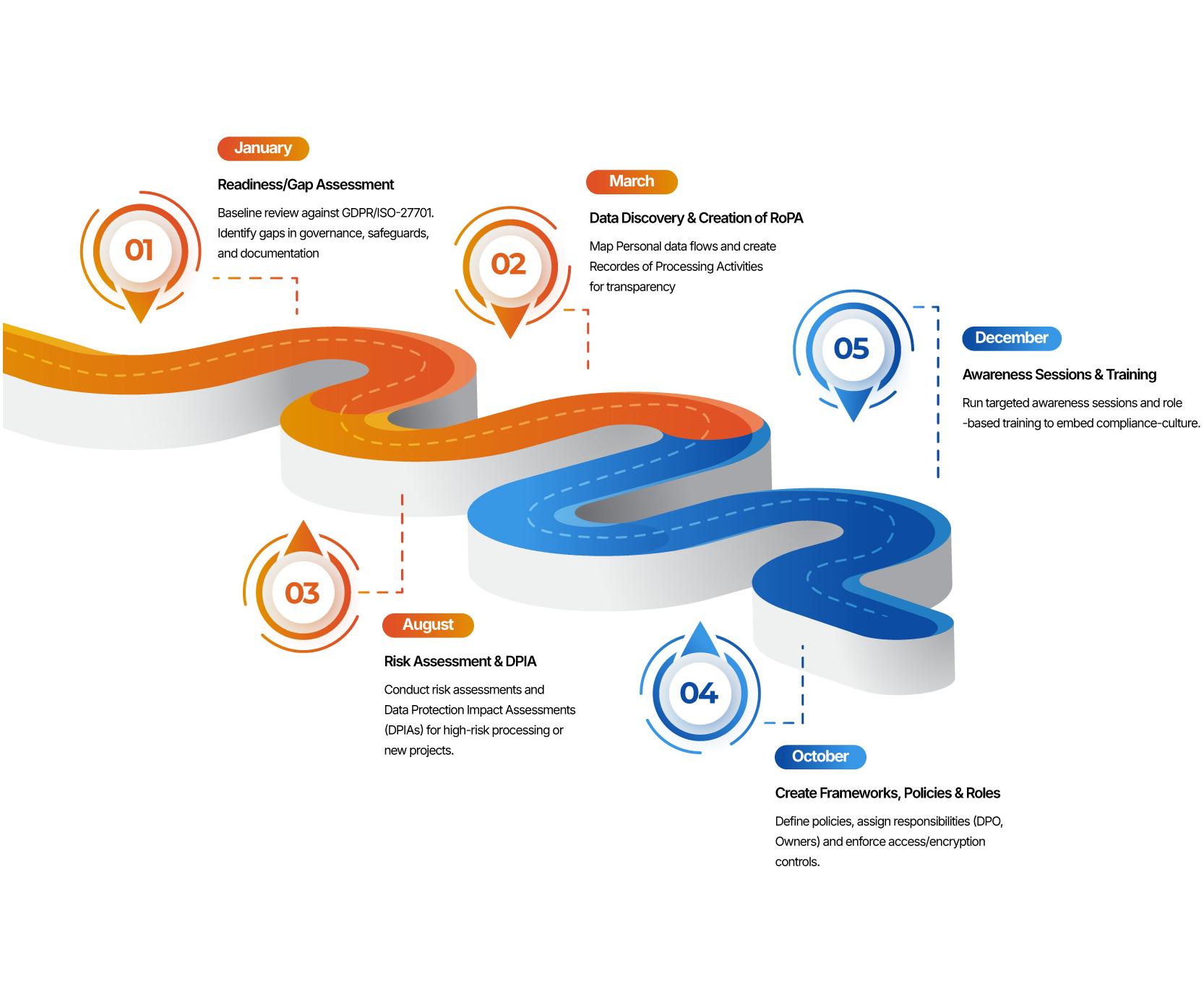
Step 1: Readiness or Gap Assessment
Conduct a baseline review of existing controls against relevant frameworks such as GDPR or ISO 27701. Identify gaps in governance, technical safeguards and documentation.
Step 2: Data Discovery & Creation of RoPA
Map what personal data you collect, store, process and share. Create and maintain a Record of Processing Activities (RoPA) so you have visibility over systems, data flows, legal bases, retention and third-party processors.
Step 3: Risk Assessment & DPIA
Conduct risk assessments and Data Protection Impact Assessments (DPIAs) for high-risk processing or new projects. Document findings, mitigation options and acceptance decisions; feed results back into design and controls.
Step 4: Create Frameworks, Policies & Roles
Build the privacy framework: policies, procedures, standards and controls (consent management, retention, breach of response, data subject rights). Assign roles and responsibilities (DPO, data owners, process owners) and establish escalation/reporting lines.
Step 5: Awareness Sessions & Training
Run targeted awareness campaigns and role-based training (developers, HR, sales, third-party on-boarding) so people know policy, process and their responsibilities in practice.
Role of Technology in Privacy Compliance
Compliance is facilitated by technology as a key element. Current institutions are dependent on:
- Data discovery and classifiers – They help discover sensitive data in cloud, on-premises and third-party sites.
- Automation and artificial intelligence – based monitoring – Automated alerts identify abnormalities and reduce the time it takes to recognize and remediate potential breaches.
- Encryption and anonymization – Mask sensitive information and allow for protected processing and analytics.
- Consent management platforms – Track user consent and preference management across channels and reduce customer interaction compliance risk.
For CISOs, investing in the right tools reduces manual overhead and strengthens assurance during audits.
Best Practices for Sustaining Compliance
Achieving compliance is only the beginning. Sustaining it requires consistent effort. Proven practices include:
- Regular audits – Scheduled assessments uncover gaps before regulators or partners raise concerns.
- Ongoing training – Employees must understand their privacy responsibilities and apply them daily. Training should be tailored by role, from frontline staff to executives.
- Privacy by design – Embedding privacy considerations during the planning stage of systems and projects avoids costly retrofitting later.
- Third-party management – Continuous evaluation of vendor contracts and controls ensures alignment with internal compliance objectives.
How Data Privacy Consulting Services Help
Given the complexity of overlapping global frameworks, many organizations engage consulting partners for support. Benefits include:
- Multi-jurisdiction expertise – Consultants track evolving regulations and guide businesses through compliance across regions.
- Tailored programs – Solutions are customized to industry, geography and organizational maturity.
- Audit readiness – Consultants prepare documentation, evidence and controls that satisfy regulators and certification bodies.
- Risk reduction – By addressing blind spots, external advisors help lower the likelihood of breaches and penalties.
Engaging experienced consultants accelerates compliance journeys while freeing internal teams to focus on operations.
Conclusion
Data privacy compliance is a strategic necessity that protects customer trust and shields organizations from costly disruptions. CISOs, compliance officers and risk managers play a central role in guiding this shift. By aligning with frameworks like GDPR, HIPAA, ISO 27701, DPDP, UAE law and KSA PPDL, organizations can demonstrate responsibility and resilience.
The path to readiness lies in structured assessments, governance, policies and technology-backed monitoring. Partnering with consultants further strengthens the journey. Enterprises that embrace privacy as a core business value position themselves for sustainable growth in an increasingly regulated global environment.
Frequently Asked Questions (FAQs)
1. What does data privacy compliance mean?
Compliance with data privacy involves fulfilling requirements of laws, regulations and standards which dictate what is permissible and what is not permissible when collecting, processing, storing and transferring personal data.
2. Why is GDPR a standard of global data protection laws?
GDPR is highly prescriptive on consent requirements, transparency and data subject rights. Its extraterritorial effect has ramifications on data protection laws worldwide and is a guidebook on compliance globally.
3. How is HIPAA different from other data protection models?
HIPAA is industry-specific and is concerned with safeguarding protected health information (PHI). It is distinguished from more general laws such as GDPR because HIPAA only applies to healthcare providers and insurance and their business associates.
4. What is ISO 27701 and what is it worth?
ISO 27701 is ISO 27001 extended and deals with management of privacy information. It is a framework that can be certified to demonstrate that an organization has proper controls in place for handling personally identifiable information (PII).
5. Where does India’s DPDP Act apply to foreign companies?
DPDP Act calls for express consent, specifies data fiduciary accountability and implements localisation norms. Global business houses offshoring have no choice but to conform to their processes to these clauses lest they face penalties.
6. What are the chief issues that arise within organizations to achieve compliance?
Notable weaknesses are incomplete data inventories, third-party risks, complex cross-border transfers and low employee understanding of the company’s privacy practice.
7. How does technology contribute to compliance with data privacy?
It enables automation of monitoring, data discovery, encryption and consent management. It reduces human error and makes it easier to have credible evidence for audits and regulatory examinations.
8. How often should a firm carry out compliance audits?
Recommended best practice is at least one annual formal audit supplemented by regular monitoring and quarterly review of high-risk processes and vendors.
9. When would a company ever consider bringing a data privacy consultant?
Organizations benefit from advice when they are operating within multiple jurisdictions, are contemplating certifications or need help constructing a proper data protection system sufficient to their risk profile.
10. How do companies achieve long-term preparedness for compliance?
Through the incorporation of privacy by design, frequent risk management, policy refreshment in alignment with changing laws and regular staff training, businesses can achieve long-term compliance.