Cyber threats are increasing quickly, and even one lapse can cost financial institutions a great deal and damage customer relationships. The SAMA CSF framework defines the required roles and processes, helping organizations create stronger cybersecurity measures and improve GRC operations.
SAMA Cyber Security Framework (SAMA CSF) provides bank and fintech executives with more capabilities to better evaluate cyber risk, maintain compliance monitoring and provide better decision-making capabilities than traditional technical controls could offer. By utilizing SAMA CSF framework helps banks, fintechs and insurers will be able to create a more secure environment and reduce their operational uncertainties, while still providing compliance with regulatory expectations. In this blog post we will describe how SAMA CSF enhances the Governance, Risk, and Compliance elements of the organization as well as tips on how to incorporate those elements into your own Cyber Security program.
How Does SAMA CSF Strengthen GRC Functions in Financial Institutions?
Every financial institution needs to comprehend how GRC is essential to building an effective Cybersecurity Program. A strong GRC structure defines how decisions are made, how risks are managed, and how regulatory obligations are met. When a financial institution doesn’t have a mature GRC Framework, their Cybersecurity initiatives tend to be ad hoc and not coordinated, thus leaving them vulnerable to attacks. The SAMA Cybersecurity Framework provides a Structured methodology to enhance a financial institution’s ability to establish and maintain a mature GRC Framework through the following elements:
- Governance: Setting direction, defining responsibilities, and ensuring accountability within the organization.
- Risk Management: Identifying, assessing, and responding to cybersecurity threats effectively.
- Compliance: Ensuring policies, procedures, and controls meet both regulatory and internal standards.
For financial institutions, a strong GRC Practice is essential to protect sensitive customer data, maintain trust, and give management clear visibility over cyber risks. The SAMA governance requirements embedded in the CSF strengthen these foundational elements, ensuring cybersecurity is integrated into organizational strategy.
How SAMA CSF Supports Strong Governance Structures?
Strong governance is essential for any cybersecurity and GRC program. SAMA CSF reinforces this by setting expectations for leadership involvement, accountability, and cross-departmental oversight. Although frameworks such as COBIT provide additional guidance on governance best practices, SAMA CSF focuses specifically on the needs of the Saudi financial sector and ensures consistent governance standards across institutions.
SAMA CSF provides this structure through the following key governance elements:
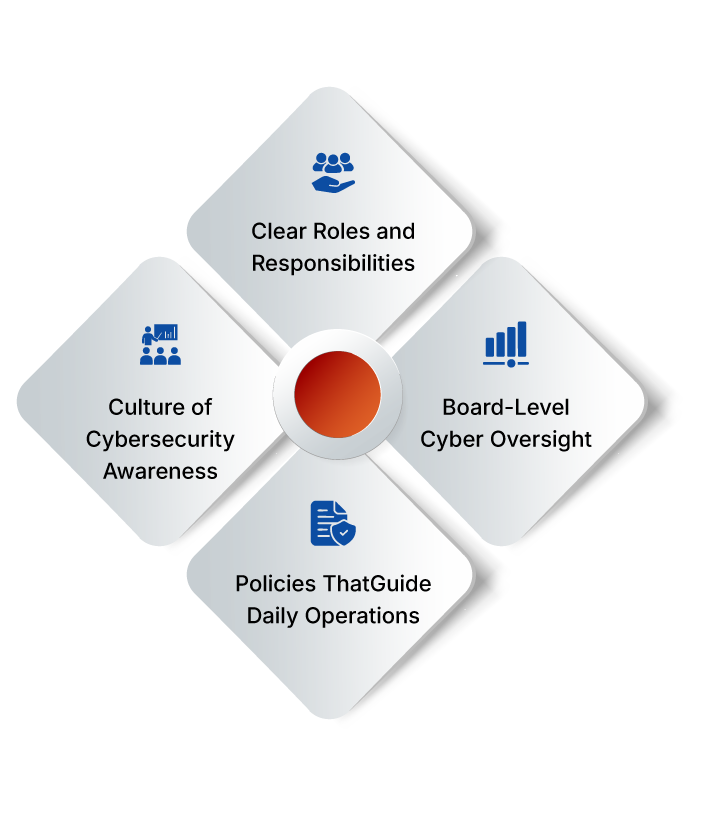
- Clear Roles and Responsibilities – The framework mandates that institutions define roles such as board oversight, senior management accountability, and cybersecurity leadership. This clarity accelerates decision-making and reduces confusion during critical incidents.
- Board-Level Cyber Oversight – The Cybersecurity Board is required to evaluate the institution’s cyber risk on a regular basis, to ensure that the institution’s cybersecurity strategy aligns with its business objectives – thereby repositioning cybersecurity as a high-level business risk instead of merely a technical issue. will evaluate the institution’s cyber risk on a regular basis, to ensure that the institution’s cybersecurity strategy aligns with its business objectives – thereby repositioning cybersecurity as a high-level business risk instead of merely a technical issue.
- Policies That Guide Daily Operations – SAMA’s Cybersecurity Framework requires organisation to establish, publish and regularly review and update your cyber security policies. SAMA’s Cybersecurity Framework mandates that your organisation create, publish, and update cyber security policies. These policies are foundational to the SAMA Framework: defining mandatory requirements, establishing controls, and setting clear standards for secure conduct. Policies also ensure staff are fully aware of acceptable behaviour and expected threat response.
- Culture of Cybersecurity Awareness – Governance extends beyond processes; it also involves people. The framework promotes training, awareness sessions, and simulations to cultivate a security-first culture. This human-focused approach reduces the likelihood of human error and internal threats.
In What Ways Does the SAMA CSF Improve Risk Methodologies?
Effective risk management is a cornerstone of GRC. The SAMA CSF provides a structured methodology for assessing and addressing cybersecurity risks.
Standardized Risk Assessment Practices
Institutions are required to use consistent methods to evaluate threats, assess vulnerabilities, and determine potential impacts. Standardization ensures that risks are comparable across the organization and helps prioritize mitigation efforts.
Risk-Based Decision Making
Using the framework, organizations make decisions based on a risk assessment instead of relying on unstructured or reactive methods. Organizations must take into account cyber risks associated with any decision made when implementing new technology, using third-party vendors or launching new digital products.
Continuous Risk Review
The SAMA (CSF) will help keep financial institution’s practices updated by periodic risk reassessment, continuous monitoring of threat landscape, reporting to senior management and the Board.
Why Is Compliance Oversight Stronger Under the SAMA CSF Framework?
Compliance is more than regulatory fulfillment-it demonstrates accountability and operational discipline. The SAMA CSF strengthens compliance oversight through structured practices.
Alignment With National Requirements
SAMA CSF is aligned with national and sector-specific regulations, making it easier for institutions to demonstrate compliance during audits.
Documented Controls and Procedures
Institutions are required to maintain clear, comprehensive documentation of access controls, incident response and business continuity procedures. This is essential for promoting transparency, ensuring consistency and accountability and enabling reliable performance monitoring.
Internal and External Audits
Regular internal assessments and independent external audits ensure that controls function effectively and identify areas for improvement.
Reporting and Transparency
Frequent reporting creates transparency to allow relevant stakeholders to see all risks and compliance matters and take appropriate action for timely decisions.
What Are the Steps to Integrate SAMA CSF into GRC Functions?
Many institutions struggle with operationalizing the framework. A step-by-step approach can help:
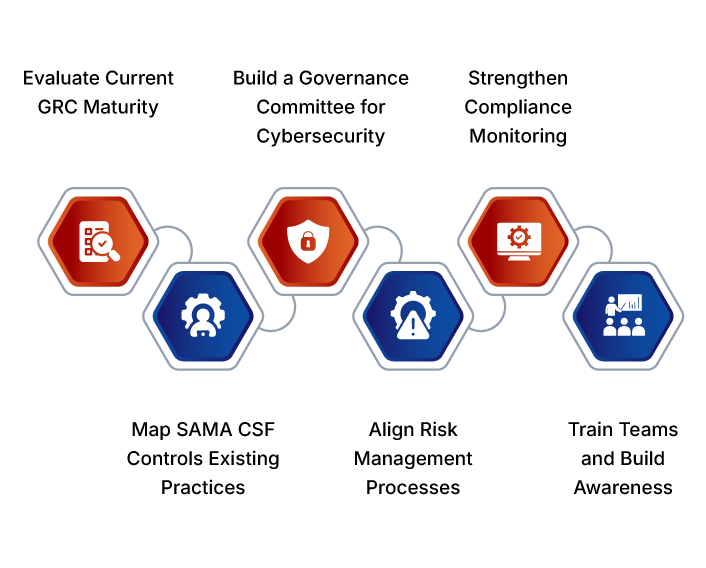
- Evaluate Current GRC Maturity: Assess existing governance structures, risk methodologies, and compliance programs to identify gaps.
- Map SAMA CSF Controls Existing Practices: Identify areas needing updates, formalization, or expansion.
- Build a Governance Committee for Cybersecurity: Establish cross-functional leadership to ensure consistent implementation of SAMA governance principles.
- Align Risk Management Processes: Update risk assessments to cover people, processes, and technology as per SAMA CSF standards.
- Strengthen Compliance Monitoring: Create dashboards, schedule audits, and ensure documentation is complete and up to date.
- Train Teams and Build Awareness: Educate employees about responsibilities to embed a culture of accountability and compliance.
How Can Financial Institutions Achieve Long-Term GRC Maturity with SAMA CSF?
Achieving GRC maturity requires a proactive, sustainable approach. Key elements of SAMA GRC maturity guidance include:
- Integrating cybersecurity into overall business strategy.
- Conducting regular policy reviews and updates.
- Engaging leadership in continuous monitoring.
- Aligning vendor risk management with SAMA requirements.
- Leveraging automation tools for risk and compliance tracking.
Following this roadmap transforms GRC functions from reactive compliance measures to proactive, strategic governance.
Final Thoughts
The SAMA CSF framework offers financial institutions a clear, structured approach to strengthen governance, manage risks, and enhance regulatory compliance. By fully implementing this framework, organizations can elevate their cybersecurity programs to a level of maturity that aligns with both business objectives and regulatory requirements. Embedding SAMA CSF into business operations ensures that cybersecurity becomes an integral part of decision-making and strategic planning. With SAMA CSF in place, financial institutions can confidently navigate evolving cyber threats, maintain customer trust, and build a robust defense against potential risks. Expert guidance from ValueMentor can further help organizations integrate the framework effectively and achieve long-term GRC maturity. Learn more about their services at ValueMentor.
FAQS
1. What is SAMA CSF?
The SAMA Cybersecurity Framework (SAMA CSF) is a structured set of guidelines created by the Saudi Central Bank to help financial institutions strengthen cybersecurity, governance, risk, and compliance practices.
2. Why is GRC important for financial institutions?
Governance, Risk, and Compliance (GRC) ensure organizations manage cybersecurity risks effectively, maintain regulatory compliance, protect customer data, and make informed business decisions.
3. How does SAMA CSF support governance in banks and fintechs?
SAMA CSF promotes clear roles, board-level oversight, cybersecurity policies, and a culture of awareness, ensuring cybersecurity is embedded into decision-making and organizational strategy.
4. Can SAMA CSF help improve risk management?
Yes, the framework provides standardized risk assessment practices, encourages risk-based decision-making, and supports continuous risk monitoring to mitigate cyber threats proactively.
5. How does SAMA CSF enhance compliance oversight?
SAMA CSF helps institutions align with national and international regulations, maintain documented controls, conduct audits, and implement transparent reporting to ensure effective compliance management.
6. What does “integrating SAMA CSF into GRC” mean?
It means embedding the framework’s guidelines into governance, risk, and compliance processes so that cybersecurity is part of daily decision-making, risk assessments, and compliance monitoring.
7. How often should financial institutions review their SAMA CSF controls?
Institutions should review and update their SAMA CSF controls at least annually or whenever major changes occur in technology, business operations, or threat landscapes to ensure the framework remains effective.
8. Who should be involved in implementing and taking responsibility for GRC practices?
Implementation requires collaboration between senior management, board members, IT and cybersecurity teams, risk officers, compliance teams, and other stakeholders across the entire organization. Cybersecurity is the responsibility of all individuals, not just the IT or security teams.
9. How does the SAMA Cybersecurity Framework strengthen GRC maturity in financial institutions?
It helps institutions transition from reactive compliance to proactive governance, embed cybersecurity into business strategy, use automated tools for tracking, and maintain continuous monitoring.
10. Where can institutions get support for implementing SAMA CSF?
Financial institutions can seek expert guidance from specialized advisory firms like ValueMentor, which helps integrate SAMA CSF into GRC operations and achieve sustainable maturity.