
Launching and scaling a healthcare startup is no small challenge. You are innovating in one of the most regulated industries in the world, where a single compliance gap or data breach can derail growth overnight. Patients, investors and enterprise partners expect the same level of security from a startup as they do from established healthcare giants. But how can a lean startup balance innovation with the weight of complex compliance requirements? That is where HITRUST certification comes in. More than a compliance framework, HITRUST provides a comprehensive and scalable approach to security, risk management and data protection. For startup founders, the benefits of HITRUST certification include faster trust-building, smoother funding rounds and shorter sales cycles with enterprise clients. For CISOs, it offers a structured way to align multiple compliance requirements without reinventing the wheel every time.
In this blog, we will explore how HITRUST helps healthcare startups earn patient trust, attract funding and show patients and partners that an organization takes data security seriously.
Benefits of HITRUST certification in healthcare
If you are running a healthcare startup which handles healthcare data, PHI or PII, you already know the weight of responsibility that comes with handling sensitive patient data. Between HIPAA, GDPR, and ever-changing state and international laws, compliance can feel overwhelming. This is where HITRUST comes in. The benefits of HITRUST certification go beyond “just another compliance badge.” It provides startups with a comprehensive, risk-based security framework that unifies multiple regulations into one streamlined system. For founders, this means fewer sleepless nights worrying about compliance gaps. For CISOs, it means a single, structured program to demonstrate strong cybersecurity and data privacy practices. In short, HITRUST is like a fast-track pass to credibility, scalability, and growth – all the things a healthcare startup needs to survive and thrive.
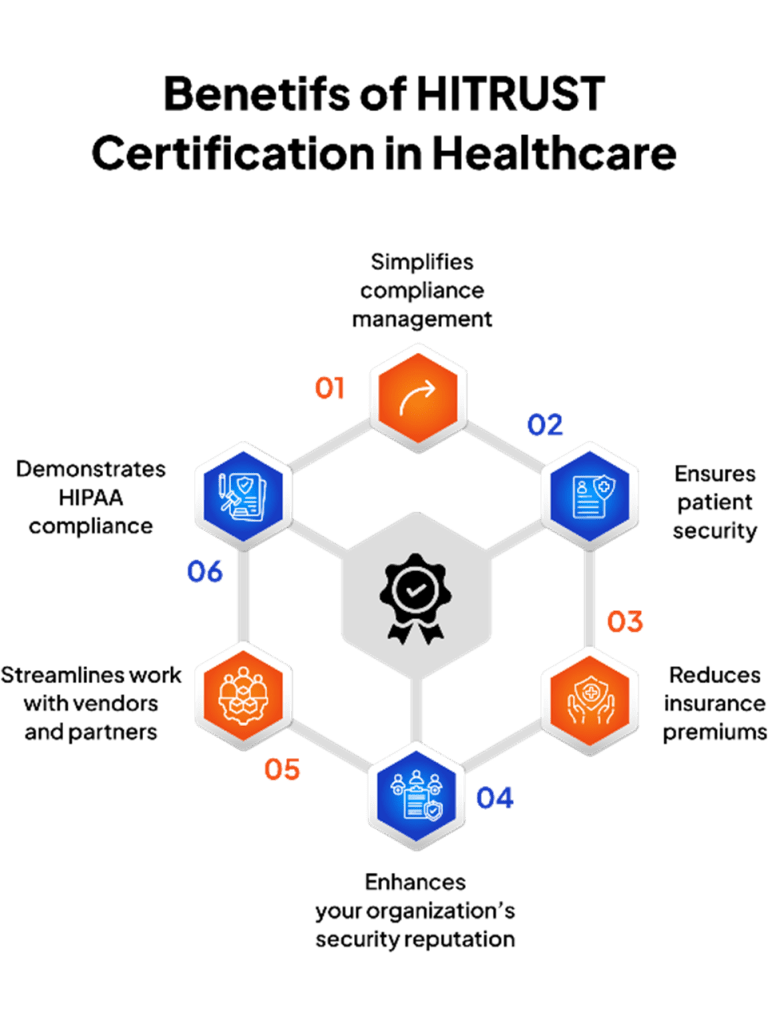
While the benefits of HITRUST certification are broad, this framework delivers some very practical advantages for healthcare startups and enterprises alike. The image above highlights six core areas where HITRUST makes an impact:
- Simplifies compliance management
Instead of juggling HIPAA, GDPR, PCI DSS, and other frameworks separately, HITRUST brings them together under one structured program. This makes compliance less overwhelming and more efficient for small teams. - Ensures patient security
Patients expect their health data to be protected with the highest standards. HITRUST certification enforces rigorous controls, reducing the risk of breaches and building trust with patients from day one. - Reduces insurance premiums
Cyber insurance providers often view HITRUST-certified organizations as lower risk. This can translate into reduced premiums and better coverage options, which is a major advantage for cost-sensitive startups. - Enhances your organization’s security reputation
Earning HITRUST certification signals to patients, partners, and investors that your startup prioritizes data protection. It builds credibility in a highly competitive market where reputation is everything. - Streamlines work with vendors and partners
Healthcare enterprises often prefer or require vendors to be HITRUST certified. This makes it easier to pass vendor risk assessments, close deals faster, and form stronger partnerships. - Demonstrates HIPAA compliance
For U.S. healthcare startups, HIPAA compliance is non-negotiable. HITRUST certification not only validates compliance but also provides assurance that your security program is built to scale beyond HIPAA requirements.
Building patient trust through HITRUST-certified data protection
Patients are more digitally aware than ever and they expect startups to treat their health information with the same level of care as established hospitals and insurers. Any security incident, no matter how small, can erode trust and slow down adoption. With HITRUST certification, startups gain a powerful trust signal. The framework enforces rigorous controls around data protection, access management and breach prevention, ensuring that patient information is safeguarded at every level. For founders, this translates into stronger branding and a competitive edge. For CISOs, it means deploying a security program that proactively addresses risks rather than waiting for incidents.
How HITRUST certification simplifies compliance for startup CISOs?
Healthcare compliance is a moving target. CISOs in startups often juggle multiple frameworks HIPAA in the U.S., GDPR for European users, NIST for federal alignment and PCI DSS for payment data. Managing each separately not only strains small security teams but also leaves gaps that attackers or auditors can exploit.
The benefits of HITRUST certification lie in its ability to unify these requirements into a single framework. HITRUST CSF maps controls across multiple regulations, so you don’t need to reinvent the wheel every time you enter a new market or face an audit. This saves time, reduces costs and minimizes compliance fatigue across teams. For startup CISOs, this is a huge advantage: fewer overlapping processes, clearer reporting to leadership and a compliance posture that grows with the business.
The benefits of HITRUST certification in securing startup funding
For healthcare startups, securing investor trust is as important as building a strong product. HITRUST certification acts as a seal of credibility, signalling that your company takes compliance and data security seriously. Here’s how it helps in attracting funding:
- Builds Investor Confidence – Investors see HITRUST as proof that your startup has the right governance and controls in place, reducing perceived risk.
- Accelerates Due Diligence – Compliance questions during funding rounds are addressed faster when you’re HITRUST-certified, shortening the decision-making cycle.
- Differentiates You from Competitors – Startups with HITRUST certification stand out as more mature and enterprise-ready, making them more appealing to VCs and strategic investors.
- Ensures Long-Term Scalability – Investors prefer startups that can handle rapid growth without compliance bottlenecks, and HITRUST certification demonstrates that preparedness.
Accelerating enterprise deals and partnerships with HITRUST compliance
Healthcare enterprises hospitals, insurers and digital health platforms are extremely cautious about who they work with. Startups often face long vendor risk assessments, where enterprises dig deep into security practices before signing a contract. For a small company, this can stretch sales cycles and slow down revenue. Here HITRUST makes a direct impact. Because many large enterprises already trust the HITRUST framework, certification reduces the need for lengthy risk assessments. In some cases, being HITRUST certified can even be a prerequisite for onboarding. For founders, this means closing deals faster and getting to revenue quicker. For CISOs, it reduces the back-and-forth with client security teams, saving valuable time. The benefits of HITRUST certification are clear here: it’s not just about passing audits it is about accelerating growth.
Long-term benefits of HITRUST certification for scalability and global growth
Early-stage startups often underestimate how quickly compliance demands grow. Expanding into new regions, entering enterprise contracts, or scaling operations introduces new risks and regulations. A compliance program that works for 20 employees may collapse under the weight of 200 employees and multiple markets.
The long-term benefits of HITRUST certification come from its scalability. Because HITRUST maps to global standards, it creates a future-proof compliance foundation that grows with your business. You don’t need to rebuild your security framework from scratch every time you expand HITRUST adapts with you. For founders, this ensures smoother growth without regulatory surprises. For CISOs, it provides consistency and a clear roadmap for scaling securely. HITRUST helps startups not just survive their early years but thrive in the long run locally, nationally and globally.
Concluding thoughts
For healthcare startups, HITRUST certification is about earning the license to grow in one of the most demanding industries. In an environment where trust determines adoption, speed and funding, HITRUST provides the ultimate foundation. It helps you prove to patients that their data is safe, gives investors’ confidence in your governance and shortens enterprise sales cycles that would otherwise stall your momentum. Startups that embrace HITRUST early don’t just survive regulatory hurdles they turn compliance into a strategic advantage. By embedding security and risk management from day one, you position your company as credible, investment-ready and scalable for global expansion.
Partner with ValueMentor to simplify your HITRUST journey and build a compliance framework that scales with your startup.
FAQs
1. What is HITRUST certification?
HITRUST certification is a security and compliance framework that unifies multiple regulations like HIPAA, GDPR, and PCI DSS into one standardized program. It helps healthcare organizations demonstrate strong data protection and risk management practices.
2. Why is HITRUST important for healthcare startups?
For startups, HITRUST provides a fast track to credibility with patients, investors, and enterprise partners. It shows that even a lean company can operate at the same security and compliance level as larger healthcare organizations.
3. Does HITRUST certification guarantee HIPAA compliance?
Yes. HITRUST is mapped to HIPAA requirements, so certification provides assurance that your organization meets and often exceeds HIPAA standards.
4. How does HITRUST certification help in securing funding?
Investors look for startups that can scale securely. HITRUST certification reduces perceived risk, accelerates due diligence, and makes your company more attractive to venture capital and institutional investors.
5. Can HITRUST certification shorten sales cycles with healthcare enterprises?
Absolutely. Many hospitals, insurers, and enterprise partners already trust the HITRUST framework. Being certified can reduce lengthy vendor risk assessments and, in some cases, is required to even start working with them.
6. Is HITRUST certification expensive for startups?
While there is an upfront investment, HITRUST saves money in the long run by reducing audit costs, avoiding penalties, lowering cyber insurance premiums, and accelerating revenue opportunities.
7. How long does it take a startup to become HITRUST certified?
The timeline varies depending on the startup’s size and security maturity, but on average, it can take 6-12 months. With proper planning, smaller startups can sometimes achieve it faster.
8. What role does HITRUST play in patient trust?
Patients want assurance that their health data is safe. HITRUST certification sends a strong signal that your startup follows the highest standards for data protection, boosting trust and adoption.
9. Can HITRUST certification scale as a startup grows?
Yes. HITRUST is designed to adapt with your business. As you expand into new markets or serve enterprise clients, the framework ensures your compliance program grows without needing to start from scratch.
10. Who benefits most from HITRUST certification in a startup the founders or CISOs?
Both. Founders benefit by gaining trust from investors and enterprise partners, while CISOs benefit from a structured framework that simplifies compliance and strengthens security operations.