
Wireless technologies play an important role in the operation of healthcare organizations, particularly in the administration of patient care, communication, and data handling. For instance, patient monitoring systems, connected medical devices, and hospital Wi-Fi, as well as tablets used by the staff, are just some of the many examples of the role of wireless technology in the operation of healthcare organizations. Nevertheless, the increased use of connected devices has created many security risks for the operation of these organizations. Wireless penetration testing in the healthcare industry plays an important role in identifying security risks before they are exploited. Hospitals and clinics are using more medical devices that are connected to the internet like smart pumps that give patients medicine, wireless machines that check on patients and mobile tools that help doctors figure out what is wrong with people.
These medical devices usually connect to the wireless system that stores or sends sensitive information about patients. If there are holes in the security bad people could get into the systems without permission mess up the way things work or get their hands on patient information. Medical IoT devices are a part of this. Medical IoT devices can be vulnerable to attacks. Hospitals and clinics must also ensure that the medical IoT devices they use are secure. In the following blog post, we will be discussing the importance of wireless penetration testing in healthcare environments, the main risks of wireless environments, and how the threats can be addressed.
What is wireless penetration testing?
Wireless penetration testing is a controlled security test wherein real-world cyber attacks are simulated against an organization’s existing infrastructure. In this test, cyber security experts attempt to exploit weaknesses in an organization’s existing Wi-Fi infrastructure, devices, and systems to gain access to its network.
The objective of this test is not to create any disruption to the organization but to identify weaknesses in the patient data and systems.
During wireless penetration testing, ethical hackers evaluate:
- Wireless access points
- Network authentication mechanisms
- Encryption standards
- Medical IoT devices
- Network segmentation
- Device configuration and firmware
The results help healthcare IT teams understand their security posture and prioritize remediation efforts.
Why wireless security is critical in healthcare?
Hospitals and healthcare facilities use lots of wireless technologies every single day. They use Wi-Fi networks so the staff can talk to each other and they use infusion pumps, patient monitoring devices, imaging systems and administrative systems. A lot of these devices need to be connected all the time to work the way they are supposed to. The thing is, using connectivity is really convenient but it also brings some big security problems. Bad people might find a way in by using encryption or old firmware or access points that are not set up right. If they get into the network they could then move around. Get to private patient records mess with medical devices or use ransomware.
So, because we are talking about patient safety and privacy having strong wireless security is not something you can just choose to do or not do. Hospitals and healthcare facilities need to have wireless security it is really important for patient safety and privacy and, for Hospitals and healthcare facilities to keep people safe.
Common wireless vulnerabilities in healthcare facilities
Healthcare networks often grow rapidly as new devices and systems are added. This means that without constant security assessment, the likelihood of developing such weaknesses is high. Penetration testing helps identify such weaknesses before they are exploited.
The most common security weaknesses include:
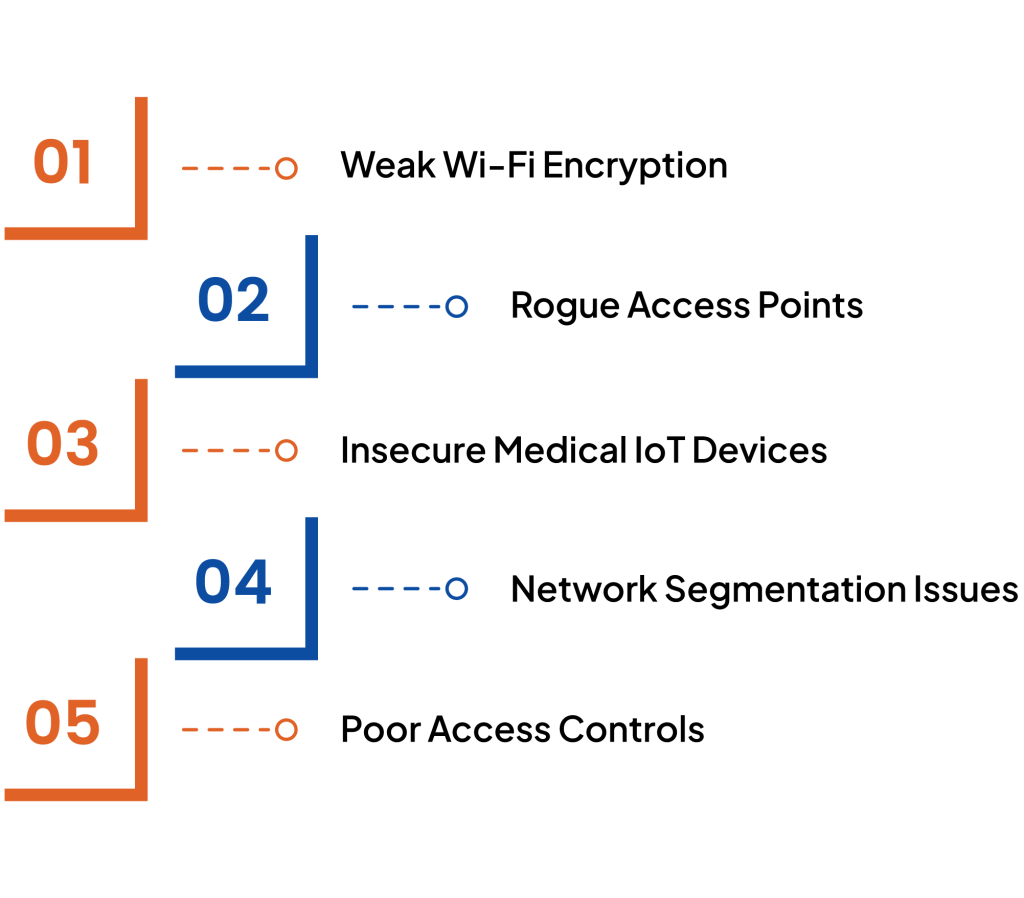
1. Weak Wi-Fi encryption: Most facilities use outdated security protocols such as WEP or poorly secured WPA2. These can be easily broken into by an intruder with the right tools.
2. Rogue access points: This occurs when unauthorized access points are set up, usually by the hospital staff or an intruder, which allow unauthorized access to the hospital network.
3. Insecure medical IoT devices: Medical devices usually focus on what they’re supposed to do not on how to keep information safe. Some medical devices do not have ways to check who is using them or to protect the information they have, and they do not get updated often which makes them easy to attack.
4. Network segmentation issues: When medical devices, systems that administrators use and guest Wi-Fi networks all use the infrastructure without being separated properly it is easier, for people who want to cause harm to move between these systems.
5. Poor access controls: Weak passwords, shared credentials, and insufficient authentication mechanisms increase the likelihood of unauthorized access.
Identifying these vulnerabilities through wireless penetration testing enables healthcare organizations to address them proactively.
The wireless penetration testing process
A structured testing approach ensures that assessments are thorough and produce actionable insights. Most wireless penetration testing engagements follow several key stages.
1. Planning and scope definition
Before testing begins, security teams identify the systems and wireless networks that will be evaluated. This step ensures that testing activities do not interfere with critical medical operations.
2. Wireless network discovery
Testers scan the facility to identify all wireless networks, access points, and connected devices. This includes both authorized and unauthorized (rogue) networks.
3. Vulnerability assessment
The discovered networks are analyzed for security weaknesses such as weak encryption, misconfigurations, and outdated protocols.
4. Exploitation testing
Ethical hackers attempt to exploit vulnerabilities to demonstrate how attackers could gain access to sensitive systems or devices.
5. Post-exploitation analysis
Once access is obtained, testers evaluate how far an attacker could move within the network and what data or systems could be compromised.
6. Reporting and remediation
A detailed report outlines the vulnerabilities discovered, their potential impact, and recommended mitigation strategies.
Wireless threats targeting medical IoT devices
Medical IoT devices are one of the fastest-growing areas of concern in healthcare cybersecurity. Devices such as infusion pumps, heart monitors, and imaging systems often rely on wireless communication to send and receive data.
Unfortunately, many of these devices were not originally designed with strong cybersecurity controls.
Potential risks include:
- Unauthorized device access
- Device manipulation or malfunction
- Interception of patient data
- Network infiltration through device vulnerabilities
Wireless penetration testing helps identify insecure devices and communication channels so that healthcare facilities can be provided with stronger security.
Key mitigation strategies for healthcare organizations
Identifying the vulnerabilities is just the beginning. What is also important is that healthcare organizations need to be provided with effective security controls.
Some of the most effective mitigation strategies include:
- Strong encryption standards: Use modern wireless encryption protocols such as WPA3 or properly configured WPA2-Enterprise to protect network communications.
- Network segmentation: Separate medical devices, administrative systems, and guest networks to limit attacker movement within the infrastructure.
- Device authentication: Implement strong authentication mechanisms for both users and devices connecting to the network.
- Continuous monitoring: Deploy wireless intrusion detection and prevention systems (WIDS/WIPS) to monitor for suspicious activity and rogue access points.
- Regular security assessments: Conduct periodic wireless penetration testing to identify new vulnerabilities as the network evolves.
- Firmware and patch management: Ensure that medical IoT devices and network equipment receive regular firmware updates and security patches.
By combining these strategies with ongoing security testing, healthcare facilities can significantly reduce the risk of cyberattacks.
The role of wireless penetration testing in regulatory compliance
Healthcare organizations have to adhere to strict regulations and guidelines in protecting patient data. For example, there is a requirement under HIPAA that data has to be kept confidential, have integrity, and be available.
Wireless penetration testing can support these regulations in:
- Demonstrating proactive risk management
- Identifying security gaps in wireless infrastructure
- Providing documented evidence of security testing
- Supporting incident prevention strategies
Regular security testing helps organizations avoid costly data breaches, regulatory penalties, and reputational damage.
Conclusion
Wireless networks are really important for healthcare these days. They let doctors and nurses talk to each other and to machines in time. Using wireless technology so much also means there are more chances for bad people to get into the system. If someone gets into the Wi-Fi or the medical machines that are connected to the internet, they could see information and even stop important medical services from working. Testing the network, for security problems is a good way for hospitals to find out if they have any weaknesses. They can pretend to be hackers. Try to get into the system. This helps them find out where they need to make things stronger so they can keep information safe and make sure the hospital keeps running smoothly.
As medical technology gets better and better it is going to be more important to make sure the wireless networks and machines that are connected to them are safe. Wireless penetration testing helps hospitals find out where they need to improve their security so they can stay one step ahead of the people. Wireless networks and medical devices that are connected to the internet need to be wireless penetration testing is a key part of making that happen. With extensive experience in healthcare cybersecurity, ValueMentor supports organizations in building secure, compliant, and resilient wireless environments. Get in touch with us to learn how expert penetration testing can help protect your patients, data, and critical healthcare infrastructure.
FAQS
1. What does the penetration testing of the wireless network detect?
It detects weaknesses in the Wi-Fi network, access points, and connected devices.
2. Why do healthcare facilities need penetration testing of their wireless network?
It helps detect security gaps which could put patient data or operations at risk.
3. What types of devices are penetration tested during the process of wireless penetration testing?
The medical IoT, wireless monitors, tablets, and hospital Wi-Fi access points are penetration tested.
4. How often should penetration testing be done in hospitals?
Most experts recommend penetration testing at least once a year or after significant changes to the network.
5. Can wireless attacks impact patient safety?
Yes, they can impact patient safety.
6. What are rogue access points in healthcare networks?
These are unauthorized wireless devices that create hidden entry points into hospital systems.
7. Does wireless penetration testing help with compliance?
Yes, it supports healthcare security requirements and helps maintain regulatory compliance.
8. Can attackers access hospital networks from outside the building?
If wireless signals extend beyond facility walls and security is weak, external attackers may attempt access.
9. What is the biggest wireless security risk in hospitals?
Poorly secured medical IoT devices connected to the network are among the most common risks.
10. What happens after a wireless penetration test is completed?
Organizations receive a report detailing vulnerabilities along with recommendations for remediation.