The rise of AI-driven, adaptive attacks capable of bypassing traditional defenses has made proactive threat detection a business-critical priority. This is where Intrusion Detection Systems (IDS) play a vital role.
Modern IDS solutions are no longer just optional add-ons they are essential components in any serious cybersecurity strategy. As cybercriminals deploy increasingly stealthy and self-mutating malware, relying solely on conventional firewalls or antivirus tools leaves dangerous gaps in protection.
A recent Gartner 2025 report reveals that more than 60% of security breaches last year went undetected in their early stages, largely due to outdated or misconfigured IDS infrastructure. This trend underscores an urgent need for organizations to reassess and upgrade their detection capabilities.
In this blog, we will explore how behavioral analytics, machine learning, and zero-trust frameworks are redefining IDS effectiveness. We’ll also examine key features to look for in 2025, current industry benchmarks, and how to choose the right IDS to stay ahead of increasingly sophisticated threats.
What is Intrusion Detection (IDS)?
Intrusion Detection Systems (IDS) are security technologies designed to monitor and analyze network traffic or system activity for signs of unauthorized access, policy violations, or malicious behavior. Acting as an early warning mechanism, an IDS helps organizations detect potential threats before they escalate into full-blown attacks.
Unlike preventive tools like firewalls or intrusion prevention systems (IPS), IDS does not block traffic but instead alerts security teams about suspicious events. Modern IDS solutions leverage both signature-based detection (which identifies known threats using pre-defined patterns) and anomaly-based detection (which flags deviations from normal behavior), providing comprehensive coverage against evolving cyber threats. As threats grow more complex often leveraging AI and advanced obfuscation techniques IDS plays a critical role in strengthening an organization’s real-time visibility and response capabilities.
IDSs may also help in compliance efforts. Some laws, including the Payment Card Industry Data Security Standard (PCI-DSS), mandate companies should have intrusion detection systems in place. It cannot prevent all security threats. However, features are usually combined with or built into intrusion prevention systems (IPSs), which can detect security issues and take rapid preventative action.

A simple computer networking architecture, which incorporates various security levels, is illustrated in this diagram. Once the network is connected, data is transmitted from user devices through an Intrusion Detection System (IDS) that monitors for any signs of unusual activity. After that, the data is routed through a firewall, where security rules are applied to filter traffic. It is then directed via a router, which leads towards the internet. The internal network is also protected from external attacks while smooth communication is maintained.
What are the different types of IDS?
In cybersecurity, different types of Intrusion Detection Systems (IDS) are deployed to monitor specific layers of an organization’s digital environment, each serving a distinct purpose in identifying potential threats. By targeting various points of vulnerability-such as network traffic, host activity, or system behavior-these IDS types work collectively to enhance threat visibility and improve incident response. Below are the primary categories of IDS and the unique roles they play in securing modern infrastructures.
1. Network-Based IDS (NIDS)
Network traffic is analyzed in real-time for unusual activity or known patterns of attack by a network-based IDS. It is usually installed at strategic sites like routers or firewalls, where external threats may be identified before they reach internal systems. Large-scale network intrusions are excellently detected by NIDS, but encrypted or internal host-level data may struggle to be analyzed by it.
2. Host-Based IDS (HIDS)
Devices, such as servers or workstations, are used for Host-based IDS to monitor internal system behaviour, such as file modifications, log entries or active programs. Malware or insider attacks on that specific device are effectively detected, as accurate transparency into single hosts is provided.
3. Signature-Based IDS
This IDS detects threats through matching system or network activity to a database of recognized attack signatures. It is very effective at identifying known risks and provides very few errors. The main downside is that it cannot detect new or unknown threats, requiring ongoing updates.
4. Anomaly-Based IDS
Anomaly-based IDS detects possible threats by determining what “normal” behavior is on a system or network and then highlighting breaks from this standard. Preventing unknown or zero-day attacks is one of its main uses. It may result in more false positives, particularly if the baseline is not properly set or kept up to date.
How Intrusion Detection Systems (IDS) Work?
Intrusion Detection Systems (IDS) use a combination of techniques to monitor, detect and respond to potential threats in real time. Below are the key steps involved in how an IDS operates:
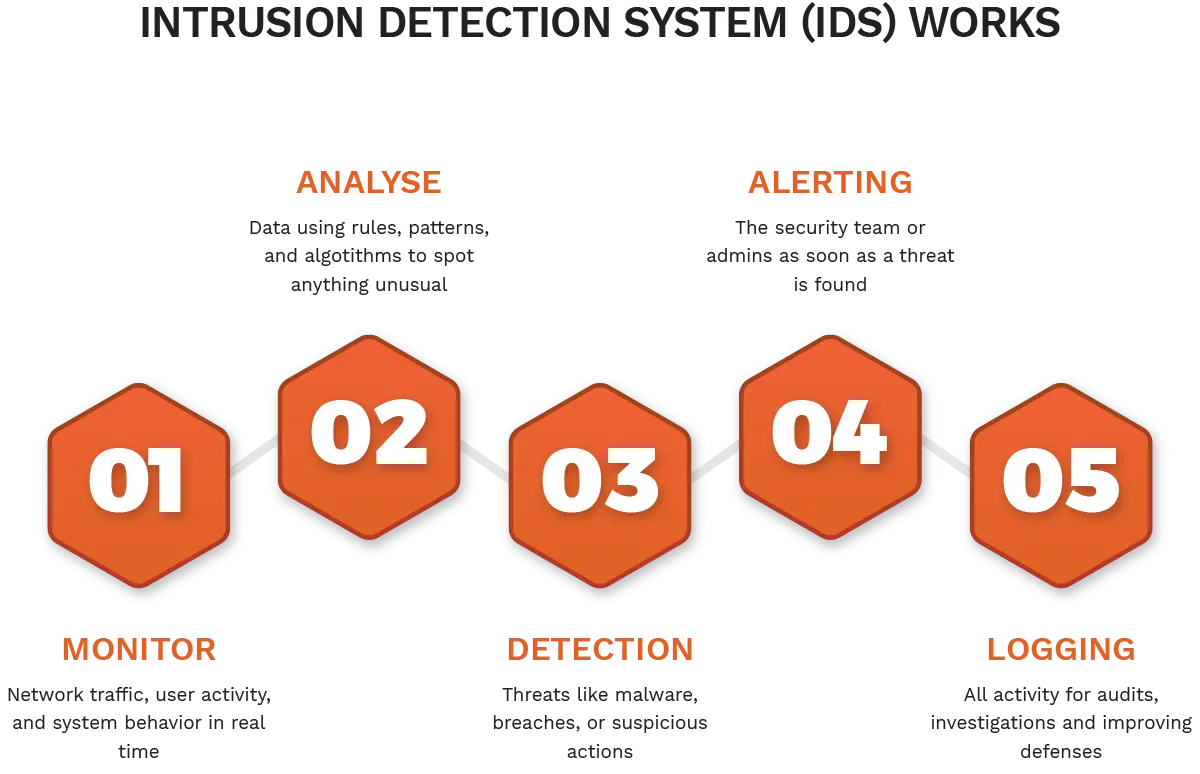
- Monitor –Real-time detection of unusual or suspicious activity depends on monitoring network traffic, user activity and system processes.
- Analyse- Examining data through algorithms, signatures and behavioral guidelines to determine potential risks or errors.
- Detection – Identifies possible security events, including viruses or breaches, by examining irregularities and trends discovered during analysis.
- Alerting –Notifies or warns system administrators or security teams about potential threats, allowing for rapid prevention.
- Logging – Provides precise logs of events and system operations for audits, forensic investigations and defense improvement.
What are the detection methodologies in Intrusion Detection System?
IDS uses various detection methodologies to identify network threats. These methods help detect both known and new types of attacks. The following are some of the key methods used:
- Anomaly-based IDS – Anomaly-based IDSs identify threats by recognizing deviations from usual behaviour. It provides an initial level using statistical studies of normal network or system operation. Real-time data is then compared to the baseline and any odd patterns are reported as possible breaches. It is useful for detecting unknown or zero-day attacks, although it can generate false positives.
- IDS hybrid – IDS hybrid combines detection methods based on exceptions and signatures. It employs signatures to quickly detect known attacks and anomalies to identify new or developing threats. This method offers better defense against a greater variety of threats, lowers false positives and improves overall detection accuracy.
- IDS Based on Signatures – By comparing recent behaviour to a database of known attack signatures, signature-based intrusion detection systems identify potential threats. These indicators point to specific patterns in malicious action. When a match is detected, the system sends an alert. It is highly accurate for known threats but cannot detect new or modified attacks unless the signature database is updated.
Application of Intrusion Detection System in the real world
Intrusion Detection Systems (IDS) function as vigilant security guards within your digital environment, continuously monitoring for signs of unauthorized access or malicious activity. Whether safeguarding a large enterprise network, a high-traffic data center, or a dynamic cloud infrastructure, IDS plays a crucial role in detecting and alerting teams to potential threats-such as hackers attempting to steal sensitive data or disrupt critical operations. Its importance spans across industries, ensuring business continuity and regulatory compliance. For instance, banks rely on IDS to protect financial transactions and customer data, hospitals use it to secure patient health records, and government agencies deploy it to defend confidential and national security information. Here’s a closer look at how various sectors integrate IDS into their cybersecurity frameworks:
- Enterprise Networks – IDS solutions are deployed across large-scale organizational infrastructures to monitor network traffic, detect external cyber threats, and identify insider misuse. This proactive approach enhances data security, enforces access controls, and ensures business continuity across departments and distributed systems
- Healthcare – In the healthcare sector, IDS plays a critical role in preventing data breaches and unauthorized access to electronic health records (EHRs). It supports compliance with stringent data protection regulations like HIPAA safeguarding patient privacy and securing sensitive medical information
- Finance – Financial institutions rely heavily on IDS to protect customer data, secure digital transactions, and defend against fraud, phishing, and system exploitation. These systems are essential for maintaining PCI-DSS compliance and preventing incidents like data breaches and identity theft that could undermine trust and regulatory standing.
- Government – Government agencies use IDS to secure national and local infrastructure against cyberattacks, espionage, and data leaks. These systems help protect classified information and support broader national security initiatives by detecting and responding to sophisticated threats in real time.
What are the challenges of Intrusion Detection Systems?
Intrusion Detection Systems (IDS) play a vital role in cybersecurity by continuously monitoring network activity to detect and respond to potential threats. While IDS serves as a crucial line of defense against cyberattacks, it also has certain limitations that organizations need to be aware of. Some of the key challenges include:
- Evolving Threats – Cyberattacks might avoid typical IDS detection methods due to their rapid evolution.
- Negatives and False Positives-Tuning the IDS is difficult, too sensitive and generates false alarms; inflexible and ignores serious threats.
- High Resource Consumption– Significant processing power, memory and storage are frequently needed to run an IDS efficiently.
- Complexity of Integration– Deploying IDS into existing systems might be difficult due to compatibility and configuration difficulties.
- Machine Learning and AI Dependence– AI and machine learning can use anomaly detection, but it may face challenges with training the model, poor data quality, or bias, leading to missed threats or false alarms.
Why are Intrusion Detection Systems Important?
An intrusion detection system provides a higher level of security for your network. It supports your primary security measures to identify potential attacks. IDS will alert you even when your main defenses fail to detect something, providing you with another opportunity to prevent an attack before it causes harm.
- Early Identification- It helps detect cyber threats early on, enabling prompt action to avoid damage. To prevent hackers from gaining access to confidential information or causing extensive damage.
- Forensic Analysis- IDS data and logs help with forensic analysis, which investigates the origin and mode of security breaches. It enhances future defenses by assisting in the understanding of attack patterns.
- Functioning Continuity- It keeps network performance steady and safe by guarding against cyberthreat interruptions. It ensures that company operations continue without interruption from attacks.
- Compliance – Supports industry rules and standards such as GDPR, HIPAA, and PCI-DSS. It shows good data protection and security policies.
Conclusion
Intrusion Detection Systems (IDS) have evolved from passive monitoring tools to proactive, intelligent defense mechanisms. Their ability to detect, analyze, and alert against potential threats often before damage occurs makes them indispensable to any robust cybersecurity strategy. As we’ve explored, modern IDS solutions powered by machine learning and behavioral analytics are more capable than ever at identifying both known and emerging threats, supporting regulatory compliance, and preserving operational continuity across industries.
From enterprise networks and healthcare systems to financial institutions and government agencies, IDS plays a pivotal role in securing digital infrastructures. However, to harness their full potential, organizations must prioritize regular updates, accurate configuration, and integration with broader security ecosystems. The future of cybersecurity hinges on layered, adaptive defense and IDS stands at the core of that architecture.
Investing in the right IDS solution tailored to evolving threats and infrastructure needs, businesses can gain critical visibility, reduce incident response times, and build a resilient, future-ready security posture.
Frequently Asked Questions (FAQs)
1. What does an IDS do?
An IDS monitors network or system activity to detect suspicious or unauthorized behavior, alerting administrators to potential threats.
2. Is an IDS similar to a firewall?
No, a firewall restricts traffic based on pre-established rules, while an Intrusion Detection System (IDS) monitors network activity and alerts you to any unusual or malicious behavior.
3. Can attacks be stopped by an IDS?
No, an IDS primarily detects threats. To block attacks, an Intrusion Prevention System (IPS) is required, as it actively takes measures to prevent attacks in real-time.
4. What does an IDS false positive mean?
A false positive occurs when an IDS incorrectly identifies normal, routine behavior as a potential threat, leading to an unnecessary alarm.
5. How might IDS benefit from machine learning?
Machine learning enhances IDS by allowing the system to analyze data, learn from patterns and recognize new, previously unknown threats more accurately.
6. Is it possible for an IDS to identify new (zero-day) attacks?
Yes, particularly with anomaly-based IDS, which uses machine learning to detect unusual behavior and can identify zero-day attacks even if they haven’t been seen before.
7. Can an IDS see encrypted traffic?
An IDS can’t always read encrypted data directly, but it may be able to detect suspicious patterns or anomalies in encrypted traffic.
8. What makes using IDS with IoT devices challenging?
Due to the vast and constantly changing nature of IoT networks, keeping IDS up to date with IoT devices can be challenging and requires continuous adaptation.
9. What are hybrid IDS systems?
Hybrid IDS systems combine multiple detection techniques, such as signature-based and anomaly-based methods, to improve detection accuracy and reduce false positives.
10. Can insider threats be detected by IDS?
Yes, particularly host-based IDS, which monitors activity on individual devices and can detect malicious behavior from within the organization.
11. What impact does 5G have on IDS performance?
The speed and complexity of 5G networks may challenge traditional IDS performance. Without updates, IDS may struggle to analyze the vast amounts of traffic in real-time.
12. Does IDS support adherence to the law?
Yes, an IDS helps organizations comply with data protection laws by logging and reporting security events, which can be critical for audits and legal compliance.
13. Can IDS be applied to any kind of network?
Yes, but it needs to be properly configured to suit the size and complexity of the specific network for optimal performance.
14. Do IDS systems require frequent updates?
Yes, to remain effective against emerging threats, IDS systems must be regularly updated with new rules, signatures and configurations.