Marketing has always been about connection reaching the right people with the right message at the right time. But in today’s UAE, connection must begin with consent. For years, brands could reach out freely through ads, emails, or calls. Now, audiences expect more they want transparency, respect, and control over how their personal data is used. The UAE’s Personal Data Protection Law (PDPL) and the country’s strengthened telemarketing regulations reflect this shift, placing the power back in the hands of the consumer.
In this blog, we will unpack what consent really means for marketing in the UAE, explore the core compliance requirements every business should know, and share practical strategies to design customer-first campaigns that stay compliant, ethical, and effective.
Comprehending Consent in UAE Marketing Laws
Today, most of the marketing activities in the United Arab Emirates are based on consent, which is both morally and legally acceptable. According to the UAE Personal Data Protection Law (PDPL), a company cannot process a person’s personal data for marketing purposes unless the consent is explicit, informed, specific and freely provided; this means that there cannot be any ambiguous language, hidden clauses or pre-checked boxes.
In practice, consent in the United Arab Emirates should essentially look like this:
-
- A clear explanation of the controller’s request for the data, the type of data that will be used (such as phone number, email address, and browsing habits), and the purpose of the request (such as promotional SMS or a monthly newsletter).
-
- A distinct, clear marketing opt-in that isn’t combined with irrelevant phrases like “I agree to the terms and conditions.
-
- Easy-to-follow guidelines for withdrawing consent at any moment (as well as a procedure to promptly honour withdrawals).
Why this matters for marketers:
-
- The main legal justification for email, SMS, retargeting, and personalised advertising is frequently consent; if it is flawed, your marketing is illegal.
-
- Beyond the law, good consent practices increase trust, and trust increases engagement, conversion, and deliverability. Negligent consent procedures harm a company’s reputation and clientele.
Practical examples (what is and is not valid):
-
- Valid: An email sign-up form with a labelled checkbox “Yes-I want to receive monthly product updates from [Brand]” (unchecked by default), with a link to a plain-language privacy notice.
-
- Not valid: pre-checked boxes, implied consent (e.g., “we’ll email you unless you opt out”), or burying marketing consent inside long legalese.
Record keeping and proof: keep logs that show who, when, how, and what was consented to (timestamp, IP, form version, exact wording). This evidence is essential if a regulator or customer queries the lawfulness of processing.
Important UAE Laws Regarding Marketing Communications
A short primer on the main legal instruments and practical obligations affecting marketing in the UAE:
1. Federal Decree-Law No. 45 of 2021-Personal Data Protection Law (PDPL)
The PDPL is the central statute governing personal data use in the UAE. It sets out data subject rights (access, correction, deletion), requires purpose limitation and data minimisation, and places strong emphasis on consent where that is the chosen legal basis for processing. Organizations must be transparent about how they use data for marketing and allow withdrawal of consent.
2. Telemarketing and direct communications rules (further national and sector guidance)
Separate telemarketing and consumer communications rules require clear identification of the caller/brand, restrictions on call times, and easy opt-out mechanisms. These rules complement PDPL consent requirements for phone-based marketing and SMS. Consult sector guidance for specific telemarketing operational obligations.
3. Cookies, online tracking & digital consent (website behaviour & analytics)
For non-essential cookies (analytics, advertising, tracking), the prevailing approach is explicit opt-in before setting those cookies. Websites should provide granular cookie settings (accept/reject specific categories) and store consent records. Cookie banners that only notify without actionable choices are inadequate.
4. Cross-border data transfers
Transferring marketing lists or analytics data outside the UAE generally requires assessment and, in many cases, prior approval or a legal mechanism ensuring an “adequate” level of protection in the destination jurisdiction. Marketers using foreign CRMs or ad platforms must review where customer data is hosted and consider UAE requirements for transfer.
5. Accountability measures
Depending on the scale and nature of processing, organisations may need to designate a Data Protection Officer (DPO) or otherwise demonstrate robust governance: documented policies, vendor due diligence, access controls, and an incident response plan. Given the growing regulatory focus and recent cyber incidents, breach readiness is essential.
6. Enforcement & practical risks
While PDPL enforcement was gradually phased in, regulators and courts are increasingly active. Penalties and remedies can include administrative fines, orders to cease processing, and reputational damage. Recent high-profile cyber incidents in The UAE serves as a reminder that inadequate data protection practices create both legal exposure and operational risk.
How do companies get consent and document it?
Let us walk you through how businesses can genuinely earn customer consent and keep solid proof of it to stay transparent and compliant with UAE data laws.
1. Make consent active, specific and unbundled.
Consent for marketing must be an active opt-in – not pre-ticked boxes, not buried inside terms and conditions, and not assumed from an existing commercial relationship unless a clear exception applies. Each channel (email, SMS, calls, tracking cookies) should have its own consent control so the individual can give granular permission.
2. Use plain language that explains purpose and identity.
A valid consent statement tells the person who will contact them, what contact channels will be used, and why (e.g., product updates, promotional offers, behavioural advertising). Avoid legalese; short, clear text improves conversions and reduces dispute risk.
3. Implement practical mechanisms (and prefer double opt-in where feasible).
Best practice for email lists is double opt-in (user signs up → receives confirmation email → clicks to confirm). For SMS and telemarketing, use explicit checkboxes plus an immediate confirmation message. For cookies and tracking, show a granular consent banner that blocks non-essential cookies until the user opts in. These measures reduce accidental or fraudulent signups and create stronger proof.
4. Record consent with an auditable trail.
Keep a consent log that captures at minimum, the exact consent text presented, timestamp, channel (web, in-store, phone), IP address (if applicable), method (checkbox, API), and the version of the privacy/cookie notice. Store that logs together with any confirmation messages you sent (confirmation email or SMS). Regulators expect you to demonstrate who gave consent and when.
5. Make withdrawal simple and effective.
Every marketing message must include an easy, working way to withdraw consent (unsubscribe link, STOP reply, simple preference centre). When consent is withdrawn, ensure suppression lists are enforced quickly and propagation to third-party processors (CRMs, ESPs, ad platforms) is immediate. The PDPL and consumer protection guidance emphasize the right to withdraw and the need to suspend processing on request.
6. Map data flows & manage vendors.
Document where marketing data is stored, who processes it (in-house and vendors), and where it’s transferred. Ensure contracts with processors include PDPL-compliant obligations (instructions only processing, security, breach notification, and permitted transfers). Cross-border transfers require special attention.
7. Keep consent current (re-permissioning).
If you rely on old or low-quality lists, run re-permission campaigns before using them for new marketing. Re-permissioning refreshes consent records and removes stale contacts, reducing legal and deliverability risk.
Top Techniques for UAE-Based Compliant Marketing Campaigns
Here are some smart, real-world strategies to run marketing campaigns that truly engage your audience while staying fully compliant with UAE’s consent and data protection rules.
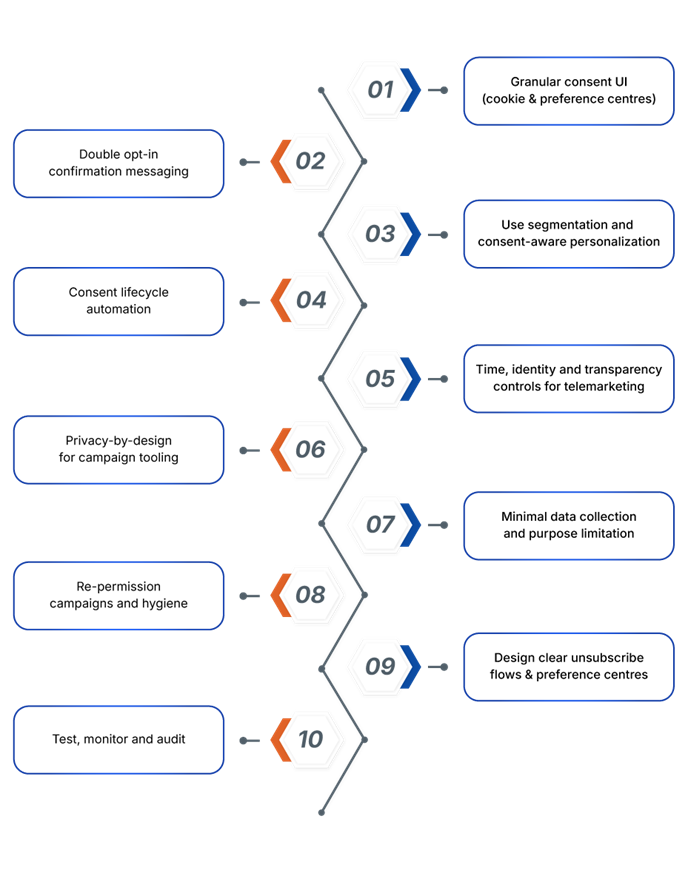
1. Granular consent UI (cookie & preference centres).
Use a cookie consent banner that blocks non-essential cookies until the user explicitly opts in and provide a preference centre where users can toggle categories (analytics, advertising, personalization) and channel preferences. A “notice only” banner is insufficient in the UAE context.
2. Double opt-in confirmation messaging.
For email, adopt double opt-in to prove intent. For phone/SMS signups, send an immediate confirmation SMS that explains what they signed up to receive and includes an easy unsubscribe option. These lower dispute rates and strengthen your compliance record.
3. Use segmentation and consent-aware personalization.
Personalization can proceed only where you have the right legal basis. Tag contacts with the exact marketing purposes they agreed to and limit targeting to those purposes. This avoids using data for unrelated profiling or behavioural ad uses without fresh consent.
4. Consent lifecycle automation.
Automate consent capture, versioning, expiry/re-permission triggers, and propagation to downstream systems (CRM, ESP, DSP). This reduces manual errors and ensures that when a user withdraws consent, suppression is applied everywhere.
5. Time, identity and transparency controls for telemarketing.
Follow the telemarketing guidance on call times, caller identification and script transparency. Train agents to confirm identity, purpose and opt-out options at the start of each call. Keep do-not-call lists and respect them.
6. Privacy-by-design for campaign tooling.
Choose vendors and ad tech that allow you to:
-
- Limit data retention.
-
- Encrypt data at rest and in transit.
-
- Support deletion requests.
-
- Produce audit logs. Embed privacy checks in campaign approvals.
7. Minimal data collection and purpose limitation.
Collect only the data you need for the stated marketing purpose (e.g., name + email for a newsletter). Avoid hoarding contact-level profiling data unless explicitly consented. This reduces risk and simplifies compliance.
8. Re-permission campaigns and hygiene.
Before launching a major campaign on an older list, run a re-permissioning drive: tell subscribers what you plan to send and ask them to confirm. Remove non-responders. This both improves engagement and ensures you have up-to-date consent records.
9. Design clears unsubscribe flows & preference centres.
Unsubscribe should do more than stop mail – present a simple preference centre allowing users to scale back frequency, change channels, or opt out completely. Ensure unsubscribe confirmation is immediate.
10. Test, monitor and audit.
Periodically audit consent records, suppression lists, and vendor compliance. Monitor deliverability metrics and complaint rates – high complaint rates can signal consent problems or poor targeting. Keep documentation ready for regulatory queries.
Final Thoughts
Consent is becoming essential in marketing communications as the UAE solidifies its position on data protection. The new regulatory environment forces companies to reconsider how they gather and use consumer data not as a legal burden but as a chance to establish sincere, trustworthy connections. These days, every marketing message has an obligation to maintain transparency, respect privacy, and communicate honestly. By incorporating consent mechanisms into each campaign, keeping transparent records, and adhering to the UAE’s Regulations and Personal Data Protection Law (PDPL), companies can do more than simply comply with the law; they can make a name for themselves as ethical marketers.
FAQS
1. According to the UAE Personal Data Protection Law (PDPL), what does “consent” mean?
According to the PDPL, consent means a person’s clear and informed agreement to let their personal data be used for a specific reason for instance, to receive marketing messages or promotional updates.
2. Does the UAE recognise implied or pre-ticked consent?
No, pre-selected options or implied consent do not adhere to the PDPL standard. Consent must be actively chosen by the individual (e.g., by checking an unchecked box or confirming via double opt-in).
3.Can businesses market using “legitimate interest” rather than consent?
The UAE places a strong emphasis on express consent for direct marketing, in contrast to certain other international laws. In most UAE contexts, “legitimate interest” is not a recognised alternative basis for marketing communications.
4. How can businesses get legitimate consent?
Through written consent, SMS confirmations, or opt-in forms, as long as the procedure is open and documented.
5.What occurs if a business advertises without permission?
Fines, legal action, and harm to a brand’s reputation can result from noncompliance.
6.What guidelines apply to telemarketing?
Companies must respect call time limits, get prior consent, and promptly comply with opt-out requests.
7. How can customers withdraw consent?
They have the option to opt out or unsubscribe at any time, and businesses are required to cease communication right away.
8. Do foreign businesses have to abide by these laws?
Yes, provided they target or handle data belonging to UAE citizens.
9. Are consent laws applicable to cookies?
Yes. Before being activated, non-essential cookies must be approved by the user.
10. How should consent be recorded?
For auditing purposes, maintain timestamped logs that document the how, when, and why of consent acquisition.