Artificial Intelligence is changing lots of things like the way we do healthcare and finance and even marketing and customer service. With all these changes people are getting worried about AI privacy challenges and how it affects our private information. Artificial Intelligence systems need a lot of data to work. Some of this data is personal or very sensitive. If companies are not careful they might break the rules about keeping our information private which can make people lose trust in them and even put their data at risk.
As governments make rules to protect us and people become more aware of what they are allowed to do online companies need to think again about how they get, use and look after our data. Making sure our private information is safe is not just something companies have to do because the law says so. It is a part of making technology that people can trust. Companies must use design principles and make rules for themselves that make sure they use our data in a fair way and protect our rights when they use Artificial Intelligence systems. In this blog we talk about the problems, with Artificial Intelligence and privacy and we explain how companies can make systems that are fair and protect our data and make sure they use our information in a good way.
Why privacy is a critical issue in AI development?
AI systems really need a lot of data to figure out patterns and make decisions. When we use data to come up with ideas it can be very helpful. If organizations do not handle personal data carefully it can cause big problems with privacy.
One big problem is how much information AI systems can look at. These systems can look at an amount of data from users in ways that we did not think of when we first got the data. This can cause problems with people watching us making profiles of us and treating people unfairly without meaning to. Another thing that worries us is that we do not know how AI systems work. Many of these systems are, like closed boxes so people do not know how their personal data is being used. If we do not get answers users might think that their privacy is not being respected. To fix these problems organizations need to make AI systems that follow privacy rules. They need to make sure privacy is protected from the start to the end of making AI systems. From getting the data to using the system and watching how it works. AI systems must be made so that they protect our privacy.
Key AI privacy challenges organizations must address
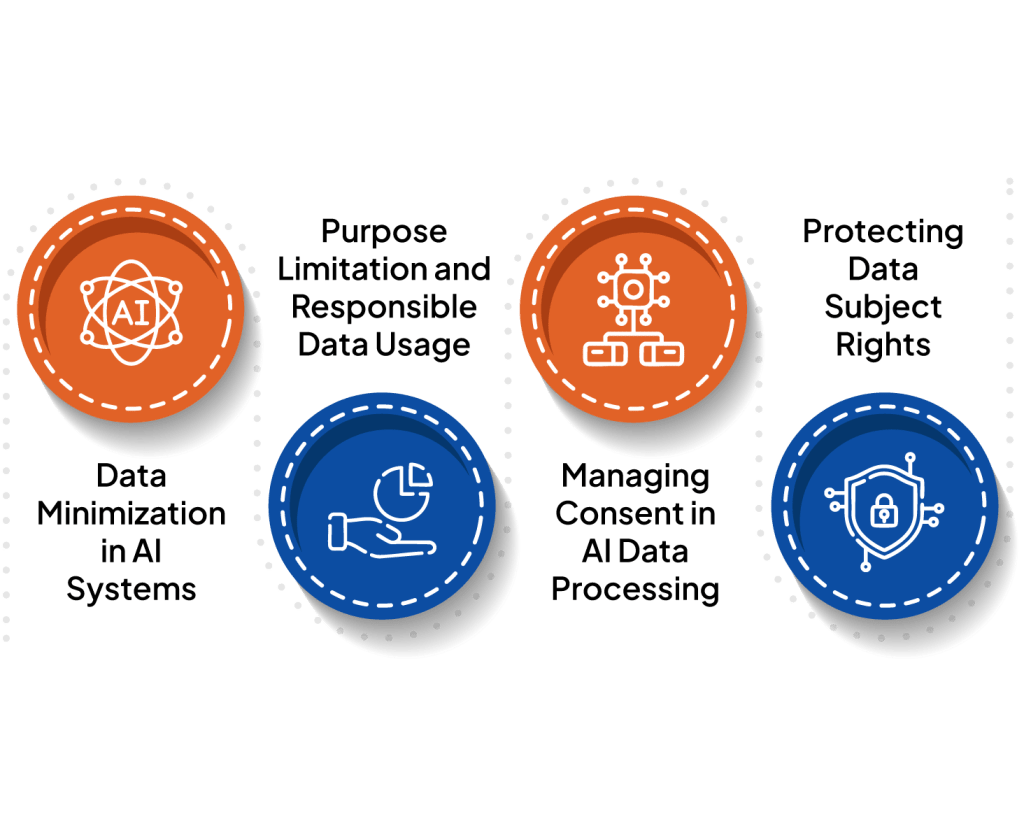
1. Data minimization in AI systems
Data minimization is one of the most important principles in modern privacy regulations. It requires organizations to collect and process only the data that is strictly necessary for a specific purpose.
In AI development, this can be challenging because data scientists often want as much data as possible to improve model accuracy. However, collecting excessive data increases the risk of privacy violations.
Organizations can address this challenge by:
- Limiting datasets to only essential variables
- Removing unnecessary personal identifiers
- Using anonymization or pseudonymization techniques
By applying these strategies, companies can reduce privacy risks while still maintaining effective AI performance.
2. Purpose limitation and responsible data usage
Purpose limitation means that personal data should only be used for the purpose for which it was originally collected. In AI projects, this principle is often overlooked because data collected for one application may later be reused for another AI model.
For example, data gathered for improving customer service may later be used for targeted advertising or behavioral analysis. Without clear consent or governance, such reuse may violate privacy laws.
To avoid this issue, organizations should establish clear policies that define how data can be used across AI projects. This ensures respecting user rights in AI systems and prevents misuse of personal data.
3. Managing consent in AI data processing
User consent plays a central role in privacy protection. However, obtaining meaningful consent in AI environments can be complex.
Many users may not fully understand how their data will be used in machine learning systems. Additionally, AI models may generate insights that go beyond the original scope of consent.
To improve transparency and fairness, organizations should:
- Provide clear and understandable consent notices
- Allow users to opt out of certain data uses
- Offer easy mechanisms for withdrawing consent
By empowering individuals with greater control over their data, companies can strengthen trust and ensure responsible data practices.
4. Protecting data subject rights
People now have some rights when it comes to the information that is collected about them. They have the right to see this information fix it if it is wrong get rid of it or stop companies from using it. AI systems need to be made in a way that lets companies deal with these requests quickly. For example if a user wants their information deleted companies have to make sure it is really gone. That means getting it out of the sets of information that AI systems learn from and, out of the AI systems themselves when they can.
Respecting user rights in AI requires organizations to build systems capable of:
- Tracking where personal data is stored
- Managing requests for data access or deletion
- Updating AI models when personal data is removed
These capabilities are essential for maintaining compliance and protecting individual privacy.
How to design AI Systems that protect user privacy?
Building responsible AI requires integrating privacy protection directly into system design rather than treating it as an afterthought. One effective approach is privacy by design, which embeds privacy considerations into every stage of AI development. This includes data collection, model training, deployment, and ongoing monitoring. Another important technique is data anonymization. By removing personally identifiable information before data is used for training, organizations can reduce privacy risks while still benefiting from valuable insights.
Federated learning is also gaining popularity as a privacy-friendly AI method. Instead of transferring raw data to a central server, models are trained locally on user devices and only share aggregated results. This approach significantly enhances AI data protection. By adopting these design strategies, companies can create innovative AI solutions while minimizing privacy risks.
What governance practices support ethical data use in AI?
Technology by itself is not enough to deal with privacy issues. We also need governance to make sure that Artificial Intelligence systems use data in a fair way. Organizations need to have rules in place and make sure people are watching what is going on. This means they have to make rules about how they get data what they do with it and how they use it.
Sometimes this means making teams with people who’re experts, in law people who work with data and people who make sure the organization is doing what it is supposed to do. Organizations should have these teams to guide how data is collected, processed and used by Artificial Intelligence systems.
Key governance practices include:
- Conducting AI privacy impact assessments before deployment
- Implementing internal review boards for high-risk AI projects
- Maintaining clear documentation of data usage and model decisions
- Regularly auditing AI systems for compliance risks
Developing a structured data ethics framework for AI solutions helps organizations align innovation with ethical responsibility.
How can businesses balance AI innovation with privacy compliance?
Businesses often worry that tough privacy rules may slow down ideas. Using data in a responsible way can actually help businesses grow in the long run. When companies focus on keeping data private they build relationships with their customers, regulators and partners. Trust becomes an advantage in a world where people are watching how data is used more closely. Also designing with privacy in mind makes developers think carefully about how they use data. This often leads to systems that work efficiently have better data and make better use of artificial intelligence.
The goal is not to stop ideas from happening but to make sure that progress, in technology respects people’s rights and what society values.
Conclusion
As the field of AI continues to change the way industries operate, the rising concern about the privacy of AI challenges and the protection of AI data must be addressed. However, the concern about the privacy of AI challenges and the protection of AI data is not merely about the law and technology but about the heart of the matter in building trust in the system of AI.
Organizations need to focus on an important things when it comes to data. They have to make sure they are collecting the data they need using it for the right purpose being honest with people about what they are doing with their data and protecting the rights of individuals. This is how organizations can build intelligence solutions that people can trust. The key to making intelligence solutions that people can trust in the future is how organizations handle privacy issues today.
To deal with the problems that come with intelligence and privacy organizations need a good plan the right rules and people who know what they are doing. ValueMentor helps organizations build intelligence systems that put privacy first and balance new ideas with strong protection of artificial intelligence data and ethical ways of handling data. You can contact us today to make sure your artificial intelligence systems respect the rights of users follow the rules, for handling data and meet the requirements that governments are coming up with.
FAQS
1. What are the main AI privacy challenges?
AI privacy challenges include excessive data collection, lack of transparency in algorithms, consent management issues, and protecting sensitive user data.
2. Why is AI data protection important?
AI data protection helps prevent misuse of personal data, ensures regulatory compliance, and builds user trust in AI-driven services.
3. How can organizations build privacy-compliant AI systems?
Organizations can implement privacy-by-design, data minimization, encryption, and governance frameworks to ensure compliance and responsible data use.
4. What is data minimization in AI?
Data minimization means collecting and processing only the data necessary for a specific purpose in AI systems.
5. How does AI impact user rights?
AI systems can affect user rights related to data access, correction, deletion, and the ability to challenge automated decisions.
6. What role does consent play in AI data processing?
Consent ensures users understand how their data is used and gives them control over how AI systems process their information.
7. What is ethical data use in AI?
Ethical data use involves collecting, processing, and analyzing data responsibly while respecting privacy, fairness, and transparency.
8. How does privacy-by-design improve AI systems?
Privacy-by-design integrates privacy protections into the development process, reducing risks before systems are deployed.
9. What is a data ethics framework for AI solutions?
A data ethics framework provides guidelines and governance policies that ensure responsible AI development and decision-making.
10. How can companies ensure transparency in AI systems?
Companies can improve transparency by documenting algorithms, explaining automated decisions, and communicating clearly with users about data practices.