Healthcare organizations are rapidly embracing digital transformation. Online consultations, patient portals, digital pharmacies, and contactless payments have significantly improved patient experiences. However, this shift has also expanded the cyber threat landscape, making payment security more critical than ever.
While protecting Electronic Protected Health Information (ePHI) is a top priority under HIPAA, safeguarding payment card information is equally important. Any healthcare organization that accepts credit or debit card payments must comply with the Payment Card Industry Data Security Standard (PCI DSS) to protect cardholder data and reduce the risk of payment fraud.
This guide explains why PCI DSS matters in healthcare, how it complements HIPAA, the common compliance challenges organizations face, and the practical steps hospitals, clinics, and telehealth providers can take to achieve compliance.
Why PCI DSS is Essential for healthcare?
Healthcare has become one of the most targeted industries for cybercriminals. While patient records remain highly valuable, payment card information presents another lucrative target for attackers seeking financial gain.
Every healthcare organization that accepts card payments—including hospitals, specialty clinics, pharmacies, diagnostic laboratories, telehealth providers, and medical billing companies—is responsible for protecting cardholder data.
Implementing PCI DSS helps healthcare organizations:
- Protect cardholder data throughout its lifecycle
- Reduce the risk of payment card fraud
- Secure both online and in-person payment channels
- Strengthen patient trust and confidence
- Meet acquiring bank and payment processor requirements
- Reduce financial and reputational damage resulting from data breaches
As digital healthcare services continue to expand, payment security has become an integral component of patient care.
Understanding PCI DSS Requirements for Healthcare
PCI DSS consists of security requirements designed to protect payment card information regardless of the organization’s size. Although implementation varies based on the payment environment, the underlying security principles remain consistent.
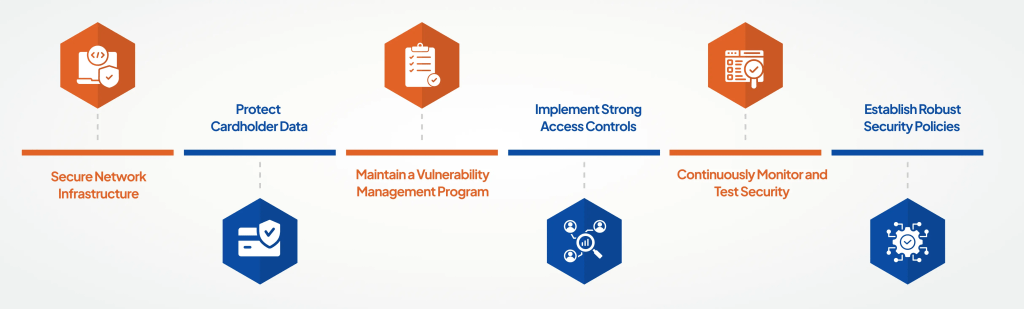
1. Secure Network Infrastructure
Healthcare organizations should implement properly configured firewalls and network segmentation to isolate payment systems from clinical networks and Electronic Health Record (EHR) environments, thereby reducing the Cardholder Data Environment (CDE).
2. Protect Cardholder Data
Cardholder data must be encrypted whenever it is stored or transmitted. Healthcare providers should ensure billing systems, payment gateways, kiosks, and patient portals use strong encryption mechanisms.
3. Maintain a Vulnerability Management Program
Medical billing applications, payment terminals, telehealth platforms, and supporting infrastructure should be regularly patched and protected against emerging vulnerabilities.
4. Implement Strong Access Controls
Only authorized personnel should have access to payment systems. Role-based access control (RBAC), least privilege, and multi-factor authentication (MFA) significantly reduce insider and external threats.
5. Continuously Monitor and Test Security
Organizations should continuously monitor their environments using centralized logging, Security Information and Event Management (SIEM) solutions, vulnerability scanning, penetration testing, and regular security assessments.
6. Establish Robust Security Policies
Security policies governing payment processing should be documented, regularly reviewed, and aligned with both PCI DSS and healthcare regulatory requirements.
PCI DSS vs. HIPAA: Understanding the Difference
A common misconception is that HIPAA compliance automatically satisfies PCI DSS requirements. In reality, these frameworks address different types of sensitive information.
| Aspect | HIPAA | PCI DSS | Overlap |
| Scope | Protects PHI (patient health info) | Protects cardholder data | Both safeguard sensitive data |
| Focus | Privacy & confidentiality | Payment security | Data integrity |
| Enforcement | HHS Office for Civil Rights | PCI Security Standards Council | Both require audits & penalties |
| Controls | Access, audit, breach notification | Encryption, monitoring, firewalls | Shared emphasis on access control & encryption |
Despite their different objectives, both frameworks emphasize:
- Strong access controls
- Encryption
- Logging and monitoring
- Risk assessments
- Incident response
- Security awareness training
Organizations can often implement shared security controls that help satisfy both HIPAA and PCI DSS requirements, simplifying overall compliance efforts.
Common PCI DSS Challenges in Healthcare
Healthcare payment environments are considerably more complex than traditional retail systems. Some of the most common compliance challenges include:
Legacy Medical Systems
Many healthcare applications and connected medical devices were not originally designed with modern cybersecurity controls, making them difficult to secure.
Multiple Payment Channels
Healthcare providers frequently accept payments through:
- Hospital reception desks
- Self-service kiosks
- Patient portals
- Mobile applications
- Telehealth platforms
- Third-party billing providers
Each payment channel introduces additional compliance considerations.
Third-Party Dependencies
Payment processors, cloud providers, billing vendors, software providers, and managed service providers all play a role in protecting payment data. Healthcare organizations remain responsible for ensuring these third parties maintain appropriate security controls.
Limited Security Resources
Many clinics and smaller healthcare providers lack dedicated cybersecurity teams, making continuous PCI DSS compliance challenging.
Expanding Attack Surface
Cloud adoption, remote work, connected medical devices, and digital healthcare platforms continue to increase the number of systems requiring protection.
Best Practices for PCI DSS Compliance
Achieving PCI DSS compliance requires more than passing an annual assessment. Organizations should adopt a continuous security program that includes people, processes, and technology.
Key best practices include:
- Minimize PCI DSS scope through tokenization and secure payment outsourcing
- Perform regular vulnerability assessments and penetration testing
- Segment payment systems from healthcare networks
- Enforce MFA for privileged users
- Periodically review user access rights
- Train employees on payment security and phishing awareness
Continuously monitor payment environments using SIEM, EDR, and centralized logging.
A Practical Roadmap to PCI DSS Compliance
Healthcare organizations can simplify compliance by following a structured approach:
Step 1 – Discover Cardholder Data
Identify where payment card information is stored, processed, or transmitted.
Step 2 – Define the PCI DSS Scope
Determine which systems, applications, and connected assets form part of the Cardholder Data Environment.
Step 3 – Conduct a Gap Assessment
Compare existing security controls against PCI DSS requirements to identify compliance gaps.
Step 4 – Remediate Identified Risks
Address gaps through stronger encryption, secure configurations, network segmentation, patch management, MFA, and system hardening.
Step 5 – Validate Compliance
Complete the appropriate Self-Assessment Questionnaire (SAQ) or undergo a PCI DSS assessment performed by a Qualified Security Assessor (QSA), depending on your compliance obligations.
Business Benefits beyond Compliance
PCI DSS delivers value far beyond regulatory compliance.
Organizations that maintain strong payment security can:
- Reduce payment fraud
- Improve cybersecurity resilience
- Enhance patient confidence
- Protect brand reputation
- Lower breach-related costs
- Strengthen relationships with payment processors and partners
- Support secure digital healthcare initiatives
Ultimately, secure payment processing contributes to a safer and more trustworthy patient experience.
Final Thoughts
As healthcare continues to embrace digital services, protecting payment card information is no longer optional—it is a fundamental business and regulatory requirement. PCI DSS enables hospitals, clinics, telehealth providers, and healthcare organizations to strengthen payment security while maintaining patient trust.
Although HIPAA and PCI DSS address different types of sensitive information, implementing strong security controls can help organizations meet the objectives of both frameworks efficiently.
Whether you are beginning your PCI DSS journey or preparing for your next assessment, adopting a proactive, risk-based approach will strengthen your cybersecurity posture and ensure secure payment experiences for every patient.
How ValueMentor can help?
ValueMentor helps healthcare organizations achieve and maintain PCI DSS compliance through comprehensive gap assessments, PCI DSS readiness reviews, QSA-led assessments, network segmentation reviews, vulnerability assessments, penetration testing, and continuous compliance support.
Our payment security experts work closely with healthcare providers to reduce compliance complexity while building resilient and secure payment environments.
FAQs:
It’s the application of PCI DSS standards to hospitals, clinics, and telehealth providers to secure patient payment data.
Why do hospitals need PCI compliance?
Hospitals process high volumes of card payments, making them prime targets for fraud and requiring strict compliance.
How does HIPAA PCI DSS differ?
HIPAA protects patient health information, while PCI DSS secures payment card data. Together, they cover both privacy and financial security.
Is PCI DSS mandatory for clinics?
Yes, any clinic accepting card payments must comply, regardless of size.
What is the overlap between HIPAA and PCI DSS?
Both require encryption, access controls, and audit trails, ensuring holistic protection of sensitive data.
How does PCI DSS apply to telehealth payments?
Telehealth platforms must encrypt online transactions and ensure secure cloud hosting for compliance.
What are common PCI DSS challenges in healthcare?
Legacy billing systems, third-party vendors, and staff training gaps often complicate compliance.
Can tokenization help healthcare PCI DSS compliance?
Yes, tokenization replaces card data with secure tokens, reducing risk exposure.
How often should hospitals conduct PCI DSS audits?
Quarterly scans and annual assessments are recommended to maintain compliance.
What happens if a healthcare provider fails PCI DSS compliance?
Non-compliance can lead to fines, reputational damage, and loss of patient trust.