Cyberattacks are becoming increasingly sophisticated, making it essential for organizations to proactively identify and address security vulnerabilities before they can be exploited. A professional penetration testing service helps businesses evaluate their security posture by simulating real-world attack scenarios and uncovering weaknesses across networks, applications, APIs, wireless environments, and other critical assets.
However, not all security assessments are the same. Different penetration testing methods and testing types are designed to address specific threats and business requirements. Understanding when to engage a penetration testing service and selecting the right testing approach can help organizations strengthen their defenses, reduce cyber risk, and maintain compliance with industry regulations.
When to go for Penetration Testing Services?
Penetration testing is a critical security measure that needs to be performed regularly to ensure the safety of your organizational information. It is not a one-time activity and has to be done regularly depending on the size of the organization, network infrastructure and regulatory compliance.
Additionally, it is recommended to do Penetration testing :
- When significant changes are made to the infrastructure
- When a new network infrastructure is added
- When you relocate your office, or a new office is added to the network
Different Penetration Testing Methods
1. Black Box Penetration Testing
This test is carried out with zero knowledge about the network. The tester will not have access to any of the client’s applications, network and internal information. This is the most authentic testing, which is done to demonstrate how a hacker with no inside knowledge of the organization can compromise your organization’s cyber security. Here, the tester may use the publicly available information over the internet or can acquire knowledge using penetration testing tools or social engineering techniques.
2. White Box Penetration Testing
This test is called complete knowledge testing and is used to check the robustness of the network in a specific environment, where the security information cannot be strictly controlled. The aim of this test is to ensure that the system can withstand security threats, even when the hacker has access to some of the security information. Testers are given full information about the target infrastructure like the host IP address, domains owned, applications used, network diagrams, security defences like IPs or IDs in the network, etc.
3. Gray Box Penetration Testing
This test is performed with limited or partial knowledge of the network’s security information. The tester simulates an employee inside the organization, usually with the help of their login credentials or the tester is given an account on the internal network with standard access. The aim of this test is to assess the internal threats from employees within the company and the potential damage they could cause.
Different Types of Penetration Testing
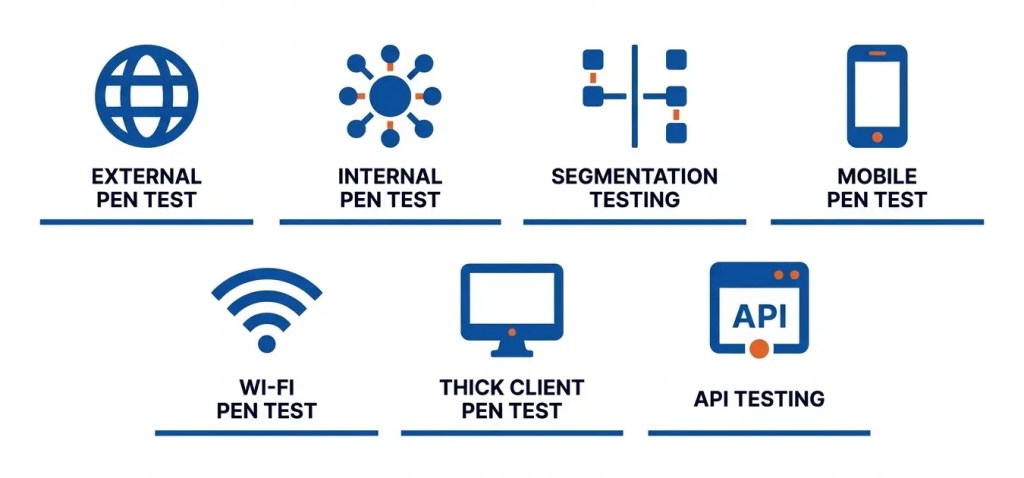
1. External Penetration Test
This Penetration test simulates a hacker’s attempt to enter and exploit the vulnerabilities in real-time within the network. The tester tries to enter the network by leveraging the information acquired from the external network. The aim of this test is to understand the security holes in your system. As the threat is from an external network within the internet, the test is performed over the internet, bypassing the firewall.
2. Internal Penetration Test
This penetration test identifies the risks that arise from within the network, assuming that the attacker already has access. The tester evaluates the damage that can be done by someone who has access to the organizational applications, data and systems. This can be anyone like employees, contractors, partners, etc. or outside hacker who has gained some credentials of the employee. The test is performed by connecting to the internal LAN and thereby trying to explore the vulnerabilities that exist.
3. Segmentation Testing
Network Segmentation is the process of splitting a larger network into smaller subnetworks according to your business requirements. These subnetworks act as individual networks, thereby helping to improve network performance and security. Segmentation testing is done to evaluate these individual networks and separate the less-secure subnetworks from the high-secure subnetworks, thus ensuring that the communication between these is restricted.
4. Mobile Penetration Testing
A mobile application is the best way to engage with your customer and is more than just a mobile-friendly website. An efficient mobile application can increase customer base, improve accessibility, boost brand popularity and enhance revenue. Hence it is important to ensure the security and safety of the application. Mobile Penetration Testing is a type of security testing used to analyze and validate the security controls of your mobile applications. The main aim of this testing is to find how the app interacts with the server-side systems and find security flaws in the application. This helps to uncover the vulnerabilities and exposure threats that the developers might have missed while designing the application.
5. Wi-Fi Penetration Testing
Wireless Connectivity, also known as Wi-Fi, is the technology used to connect PCs, Laptops, Mobiles, Tablets and other devices to high-speed internet without the need for a physical wired connection. Due to the open methods used by the Wi-Fi to connect, it often serves as a gateway for hackers and cybercriminals to enter the organizational network. This is where penetration testing serves useful. Wi-Fi Penetration Testing is an authorized hacking attempt, where the tester hacks the wireless system to identify the vulnerabilities in the security controls. The goal of this penetration testing is mainly to reduce security breaches by preventing unauthorized access to the wireless network.
6. Thick Client Penetration Testing
Thick Client applications are normal applications with rich functionality that runs on a user’s computer. The most common examples of thick client applications are Microsoft Outlook, Microsoft Teams, Yahoo Messenger, etc. These are important as most of the business operations are handled by these applications. They depend completely on computer resources and hence their security is dependent on the local computer. Thick client penetration testing tries to exploit the vulnerabilities associated with the application like insecure storage, denial of service, reverse engineering, improper session management, etc.
7. API Testing
Application Programming Interface is a software intermediary that allows interaction between two applications. Though APIs are the connector responsible for transferring information internally and externally, they do not go through vigorous security testing. A poorly secured API serves as a gateway for attackers to enter the network. The aim of API Penetration Testing is to maximize the API benefits by identifying the risks and vulnerabilities imposed by them.
When it comes to assessing your cybersecurity strategies, you must think from the perspective of a hacker. That is what exactly penetration testing does. If conducted accurately, Penetration Testing gives you valuable insights into the strength and weaknesses of your company’s Security Posture. Also, it is important to find the right type of penetration testing that meets your organization’s cybersecurity needs.
Conclusion
A penetration testing service is one of the most effective ways to evaluate the security of your organization’s digital assets from an attacker’s perspective. Whether you choose black box, white box, or gray box testing or focus on specific areas such as web applications, APIs, wireless networks, or mobile applications, regular testing helps uncover vulnerabilities before malicious actors can exploit them. By selecting the right testing approach and conducting assessments regularly, organizations can strengthen their security posture, support compliance efforts, and stay ahead of evolving cyber threats.
FAQs
A penetration testing service is a security assessment that simulates real-world cyberattacks to identify and validate vulnerabilities in systems, networks, applications, and other digital assets.
2. Why is penetration testing important for organizations?
It helps organizations identify security weaknesses, reduce cyber risk, improve security controls, and prevent potential data breaches.
3. How often should a penetration test be performed?
Most organizations should conduct penetration testing at least annually and after significant changes to their infrastructure, applications, or network environment.
4. What are the different methods used in penetration testing?
The three primary methods are black box testing, white box testing, and gray box testing, each providing different levels of information to the tester.
5. What is the difference between external and internal penetration testing?
External testing evaluates vulnerabilities exposed to the internet, while internal testing assesses risks from users or attackers who already have access to the network.
6. Can a penetration testing service help with compliance requirements?
Yes. Penetration testing can support compliance initiatives related to PCI DSS, ISO 27001, SOC 2, HIPAA, and other industry regulations.
7. What types of systems can be tested?
Networks, web applications, APIs, cloud environments, mobile applications, wireless networks, and thick client applications can all be assessed.
8. What is API penetration testing?
API penetration testing evaluates the security of application programming interfaces to identify vulnerabilities that could expose sensitive data or business functions.
9. What should a penetration testing report include?
A comprehensive report should include identified vulnerabilities, risk ratings, business impact, proof of findings, and remediation recommendations.
10. Why choose ValueMentor for penetration testing services?
ValueMentor delivers comprehensive penetration testing services through experienced security professionals, proven methodologies, and actionable remediation guidance that help organizations strengthen their cybersecurity posture