
Artificial Intelligence is now the backbone of many web apps out there. Think about chatbots, recommendation engines, and smart customer support systems; companies are hooked. They speed up processes and enhance user experience, but here’s the catch – AI brings new cybersecurity threats. These dangers? Traditional methods can’t spot them, making protection a whole new challenge.
That’s why Advanced Web Application Vulnerability Assessment and Penetration Testing (Web VAPT) is now crucial for keeping business AI apps secure. This blog looks at the security issues modern AI apps face and spells out why we need advanced testing methods to spot and fix those risks.
Why are AI-Powered web applications more vulnerable to cyber threats?
Businesses are increasingly embedding AI capabilities into their web applications to:
- Automate customer interactions
- Improve operational efficiency
- Deliver personalized user experiences
- Analyze massive datasets in real time
- Enhance business decision-making
- Streamline workflows using automation
Today, AI is no longer limited to large enterprises. Startups, e-commerce platforms, fintech companies, healthcare providers, educational portals, and SaaS applications are all integrating AI-driven functionality into their web environments.
However, as applications become smarter, they also become significantly more complex.
Every AI model, API integration, training dataset, plugin, automation workflow, and third-party service introduces additional attack surfaces that cybercriminals can potentially exploit.
Why AI-Powered Web Applications are more vulnerable?
Traditional web applications typically follow predictable workflows and known attack patterns. Security teams have spent years building defenses against common threats such as:
- SQL Injection
- Cross-Site Scripting (XSS)
- Broken Authentication
- Session Hijacking
- Security Misconfigurations
AI-powered applications are fundamentally different. They dynamically generate outputs, process unstructured data, interact with external AI services, and continuously adapt based on user input. This creates security risks that traditional scanners and conventional penetration testing approaches often fail to identify.
Some of the emerging threats unique to AI-powered web applications include:
- Prompt Injection Attacks
- AI Model Manipulation
- Sensitive Data Leakage Through AI Responses
- Insecure AI APIs
- AI Workflow Abuse
- Business Logic Exploitation
- Excessive AI Permissions
- Insecure Plugin Integrations
- AI Supply Chain Vulnerabilities
- Training Data Poisoning
- Abuse of Inference Endpoints
Unlike traditional vulnerabilities, many AI-related security issues exist within application logic, AI behavior, contextual workflows, and data interactions making them extremely difficult to detect without advanced testing methodologies.
Why “Advanced” Web VAPT matters for AI Applications?
Standard VAPT tests what organizations already know may exist.Advanced Web VAPT discovers the vulnerabilities organizations do not even realize are possible.
For AI-powered applications, Advanced Web VAPT means moving beyond traditional OWASP Top 10 testing and incorporating:
- AI/ML-specific threat modeling
- OWASP LLM Top 10 security testing
- Prompt injection testing
- AI abuse-case simulation
- Adversarial input testing
- AI workflow exploitation
- Context-aware penetration testing
- AI API security assessment
- Human-assisted manual exploitation techniques
Modern AI applications behave dynamically. Their responses may change depending on context, user interaction, connected systems, and live data processing.
This means many vulnerabilities cannot be identified through automated scanners alone.
Advanced Web VAPT combines automation, manual penetration testing, AI behavior analysis, and business logic testing to uncover hidden risks within AI ecosystems.
Key components of Advanced Web VAPT for AI Applications
Advanced Web VAPT for AI-powered apps moves past basic scans, checking unique risks from AI models, APIs, and third-party integrations. It uses manual testing and threat modeling to find issues that standard methods miss, helping keep orgs safer.
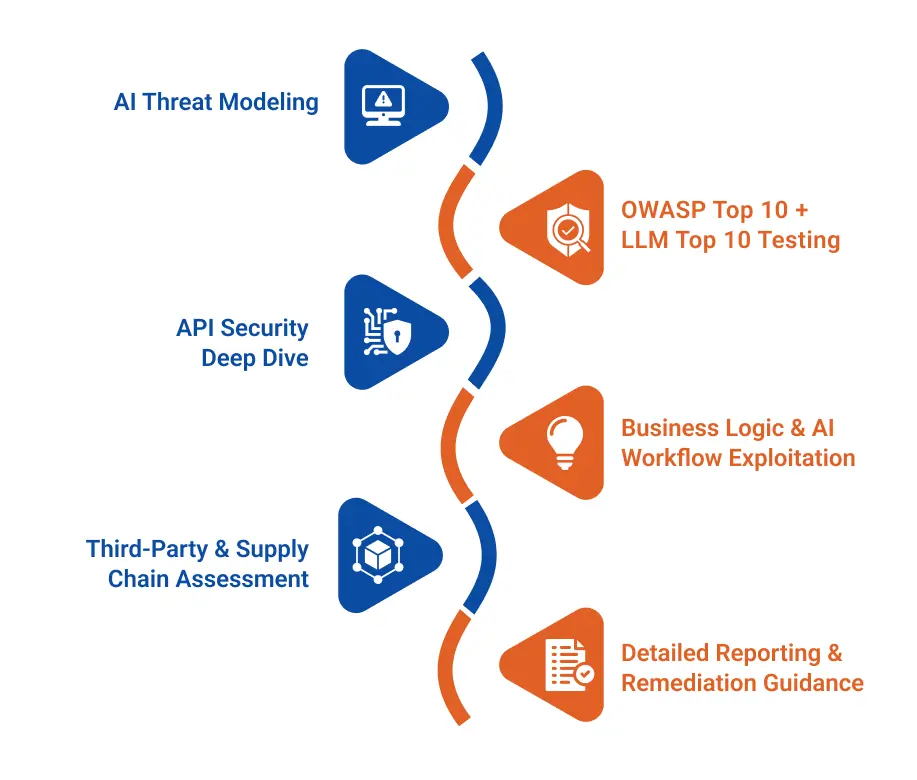
AI Threat Modeling
Security experts map AI components, workflows, integrations, APIs, and data flows to identify the unique attack surface of the application before testing begins.
OWASP Top 10 + LLM Top 10 Testing
Advanced testing validates both traditional web vulnerabilities and AI-specific threats, including:
- Prompt Injection
- Insecure Output Handling
- Sensitive Information Disclosure
- Excessive Agency
- Training Data Poisoning
- Model Denial-of-Service Risks
API Security Deep Dive
Comprehensive testing of all REST, GraphQL, and WebSocket endpoints that AI components communicate through including authentication, authorization, rate limiting, and data exposure.
Business Logic & AI Workflow Exploitation
Manual testing to identify flaws in AI-driven decision-making processes that automated scanners cannot detect including privilege escalation through AI manipulation.
Third-Party & Supply Chain Assessment
Evaluating risks from external AI APIs, ML libraries, datasets, and cloud AI services integrated into the application environment.
Detailed Reporting & Remediation Guidance
A clear, prioritized report with proof-of-concept exploits, business impact analysis, and step-by-step remediation roadmap tailored to your development team.
Who needs Advanced Web VAPT right now?
If your organization falls into any of the categories below, Advanced Web VAPT should be considered a high priority:
- Your application includes AI chatbots or virtual assistants
- Your platform integrates with OpenAI, Azure AI, Google AI, or similar services
- You use AI for personalization or automated recommendations
- Your web application processes sensitive customer data
- You operate in regulated industries such as Finance, Healthcare, Legal, or E-commerce
- Your application recently introduced AI/ML features
- You have never conducted AI-focused security testing
- You are preparing for compliance certifications such as ISO 27001, SOC 2, PCI-DSS, or GDPR
The Cost of Skipping VAPT: Real Consequences
Organizations that delay or skip Web VAPT for their AI applications face consequences far beyond a single breach. The business impact is multi-dimensional:
Financial damage from fines, breach remediation costs, legal liabilities, and lost business can dwarf the investment in proactive security testing by 30x or more.
Reputational harm is often permanent — customer trust, once lost through a security incident, rarely fully recovers. For AI products, where users already have concerns about data privacy, a breach can be catastrophic.
Regulatory penalties under GDPR, HIPAA, and other frameworks have grown sharply. AI systems processing personal data are now under heightened regulatory scrutiny globally.
Proactive Web VAPT converts these unpredictable, high-impact risks into a manageable, budgeted investment with clear, measurable ROI.
Final Thoughts
AI is changing modern web apps, making security way harder for orgs to handle. Traditional methods usually can’t spot the issues in AI parts like models and data flows. That’s where Advanced Web VAPT comes in it digs deeper to find those hidden risks so they don’t get abused. It checks all sorts of attack paths, common and AI-specific, helping companies secure their stuff, stay compliant, and make users trust their tech more.
Is your AI web app truly secure? Don’t wait for a security incident to expose hidden vulnerabilities. Our certified security experts at ValueMentor specialize in Advanced Web VAPT for AI-powered applications, helping organizations identify critical risks before attackers do. Secure your AI-driven applications with next-generation Web VAPT designed for the modern threat landscape.
FAQs:
Advanced Web VAPT is a security assessment that combines vulnerability scanning and penetration testing to identify both traditional and complex application security risks.
Why do AI-powered applications need specialized VAPT?
AI applications introduce unique risks such as prompt injection, data leakage, and AI workflow abuse that traditional testing may not detect.
Can traditional VAPT spot AI-specific risks?
Not always; many AI threats need manual checks and specialized methods.
What’s a prompt injection attack?
This occurs when hackers manipulate AI inputs to change its outputs. They might do this to get around safety measures or leak info.
Does Advanced Web VAPT test API security?
Yes, it looks for problems like auth failures, access issues, and data leaks.
How often should AI-powered apps do VAPT?
At least once a year is recommended, and also when major AI features or system updates are added.
What about the frameworks used?
Well, security testing commonly uses the OWASP Top 10 and OWASP LLM Top 10 guidelines.
Does Advanced Web VAPT help with meeting compliance standards?
Sure, it does. It assists with complying with ISO 27001, SOC 2, PCI DSS, and GDPR too.
What are AI supply chain vulnerabilities?
They’re risks from third-party AI models, libraries, datasets, plugins, and cloud services.
What is the main benefit of Advanced Web VAPT for AI apps?
It finds hidden weaknesses early on, lowering the chances of breaches, compliance issues, and business disruptions.