Artificial Intelligence (AI) has evolved from merely supporting management in decision-making to actively executing those decisions. Today, AI systems determine whom to hire, who qualifies for a loan, and who receives medical treatment. While AI has improved efficiency, it has also increased the AI risk of unfair decision-making and the misuse of personally identifiable information. Mismanagement of AI systems will permit biases to persist and damage user privacy. As a result,AI Bias mitigation and data privacy must be treated as shared responsibilities.
This blog explores how organizations can address both across the AI lifecycle, covering data selection, data labelling, privacy safeguards, continuous monitoring, human oversight, and the regulatory controls increasingly required to ensure responsible AI.
Why AI Bias Mitigation and Data Privacy Go Hand in Hand?
Historical inequalities and lack of diversity in data can result in many different types of biases within AI systems. Privacy concerns will lead to the potential for misuse of user data and exposes sensitive personal information. The combination of both issues also poses serious ethical, legal, and reputational risk to organizations. To achieve fairness in AI; organizations must limit collection of unnecessary personal data while also building solutions that treat each user group equally. Privacy and fairness have become regulators’ two key principles for determining trusted AI systems instead of being viewed as regulatory compliance tasks that are disconnected.
Building a Fair and Privacy-First Foundation
The AI lifecycle begins with data selection, making it one of the most critical stages for both bias and privacy control. If the training data is incomplete, skewed, or overly intrusive, the AI system will inherit those problems.
Best practices to reduce AI bias during data selection include:
- Using datasets that represent different demographics fairly
- Avoiding overuse of historical data that may reflect discrimination
- Testing datasets for imbalance before model training
From an AI data privacy perspective, organizations should:
- Collect only data that is strictly necessary
- Remove or anonymize personal identifiers
- Ensure lawful consent for data usage
Regulatory control example: Documented data sourcing policies and data minimization practices.
Building a Fair and Privacy-First Foundation
Data labeling is strongly dependent on people’s opinions, leading to numerous opportunities for bias. If different people label data differently or identify it incorrectly, it has consequences the way AI will determine what is fair and will impact the users of AI.
To support fairness in AI, the implementing entity should:
- Have standardized label guidelines
- Teach labelers to recognize bias and provide training
- Perform label quality assurance for each piece of labeled data
To protect Personal Identifiable Information:
- Put limits on who has access to the direct and identifiable data
- Mask or de-identify any personally identifiable information while data is being labeled
As an example of a regulatory control: Include an audit process to ensure that all labels can be traced back to their source and also incorporate bias sensitivity training for your annotators.
Embed Security from the Beginning: Security by Design
By incorporating security into your AI systems from the very beginning, you can significantly reduce the possibility of misusing people’s data and dramatically enhance the ability to be compliant with the law in the long run.
Examples of some of the most important ways to maintain privacy and fairness within AI systems are:
- Encryption of data at rest and in transit;
- Role-Based Access Control;
- Data retention and deletion policies.
By embedding these safeguards into your AI systems, you can also help to mitigate the risk that you create bias or discriminatory profiling as a result of misusing people’s data.
Example of how this can be regulated: Conducting Privacy Impact Assessments (PIAs) prior to deploying an AI system.
Continuous Monitoring Across the AI Lifecycle
Bias and privacy risks can emerge over time as AI systems evolve or are exposed to new data. Continuous monitoring is essential to maintain responsible AI performance.
Organizations should:
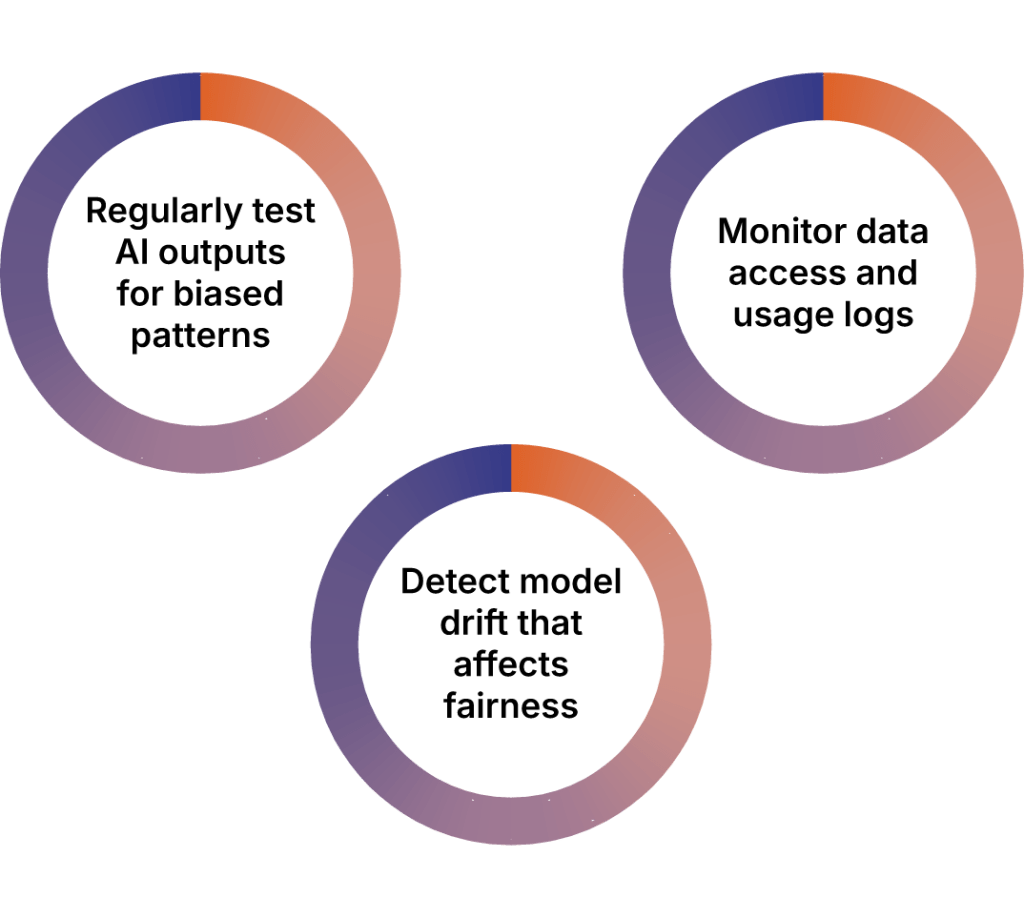
- Regularly test AI outputs for biased patterns
- Monitor data access and usage logs
- Detect model drift that affects fairness
Monitoring plays a key role in protecting user information in AI systems while ensuring consistent fairness.
Regulatory control example: Ongoing monitoring reports with corrective action plans.
Human Review and Oversight
AI systems should not operate without accountability. Human review ensures that automated decisions remain fair, explainable, and ethical-especially in high-impact use cases.
Best practices include:
- Human-in-the-loop review for sensitive decisions
- Clear escalation processes when bias is detected
- Defined ownership for AI governance
This approach strengthens AI bias mitigation while reinforcing trust and transparency.
Regulatory control example: Mandatory human oversight for high-risk AI applications.
Conclusion
As AI systems increasingly influence high-impact decisions, eliminating bias and protecting user data have become essential pillars of responsible AI development. Fairness and privacy must be addressed together across the entire AI lifecycle-from data selection and labelling to continuous monitoring and human oversight to ensure ethical, secure, and compliant outcomes. Strong AI governance not only reduces regulatory and reputational risk but also builds lasting trust with users and stakeholders. Valuementor supports organizations in achieving these goals by providing expert-led guidance on AI bias mitigation, data privacy controls, and regulatory alignment, helping businesses design AI systems that are transparent, accountable, and future-ready.
FAQS
1. What are the biggest risks organizations face if AI bias is not addressed?
Unmanaged AI bias can lead to discriminatory outcomes, regulatory penalties, legal action, and reputational damage. It can also reduce trust in AI-driven decisions among users and stakeholders.
2. Can an AI system be compliant but still unfair?
Yes, compliance alone does not guarantee fairness. Without regular bias testing, AI systems can still produce discriminatory results.
3. How do organizations identify hidden bias in AI systems?
Hidden bias is detected through fairness testing, impact assessments, and comparing outcomes across different user groups.
4. What role does transparency play in responsible AI?
Transparency helps explain how AI decisions are made. It builds trust and allows regulators and users to question unfair outcomes.
5. Are smaller organizations also expected to follow AI bias mitigation practices?
Yes, all organizations using AI are expected to manage bias and privacy risks. The controls may differ in scale but not in importance.
6. How does explainable AI support fairness and privacy?
Explainable AI helps understand decision logic and detect biased patterns. It also reduces misuse of personal or sensitive data.
7. What happens if bias or privacy issues are found after deployment?
Organizations must fix the issue by retraining models, updating data, or pausing the system until risks are addressed.
8. Do users have rights when affected by AI-driven decisions?
Yes, many regulations give users the right to explanation, correction, or human review of AI decisions.
9. How often should AI systems be reviewed for bias and privacy risks?
AI systems should be reviewed regularly, especially after updates or changes in data or model behavior.
10. How can organizations future-proof their AI governance strategy?
By embedding fairness and privacy early, staying updated with regulations, and continuously improving AI controls.