Meeting SOC 2 requirements can feel like navigating a maze of technical controls, policies and documentation. A clear checklist turns that complexity into a sequence of practical steps and makes it clear what auditors will expect. This guide provides a structured SOC 2 compliance checklist for 2026, explains how to apply it effectively and outlines the common gaps organizations face. Whether you are preparing for your first audit or renewing your certification, this checklist will help you stay organized, save time and approach SOC 2 with confidence.
Understanding SOC 2 and Its Requirements
Think of SOC 2 as the engineering blueprint for building a secure and reliable data environment. It does not just ask, “Do you have security?” but it asks, “Can you prove it works every day?” Created by the AICPA, SOC 2 sets out a series of technical and procedural checkpoints that organizations must meet to show they handle customer data with precision and care.
The SOC 2 audit looks for evidence like Audit/Security logs, security configuration and security reports to confirm your controls work in real-world conditions. When integrated into daily operations, these requirements do not just pass an audit; they create a self-monitoring system that keeps your security posture strong year-round. Many companies engage experienced SOC 2 compliance audit services to ensure every checkpoint is addressed effectively.
SOC 2 Compliance Checklist for 2026
The 2026 checklist reflects practical controls and tasks you need to cover before, during and after your audit. Here’s the SOC 2 checklist:
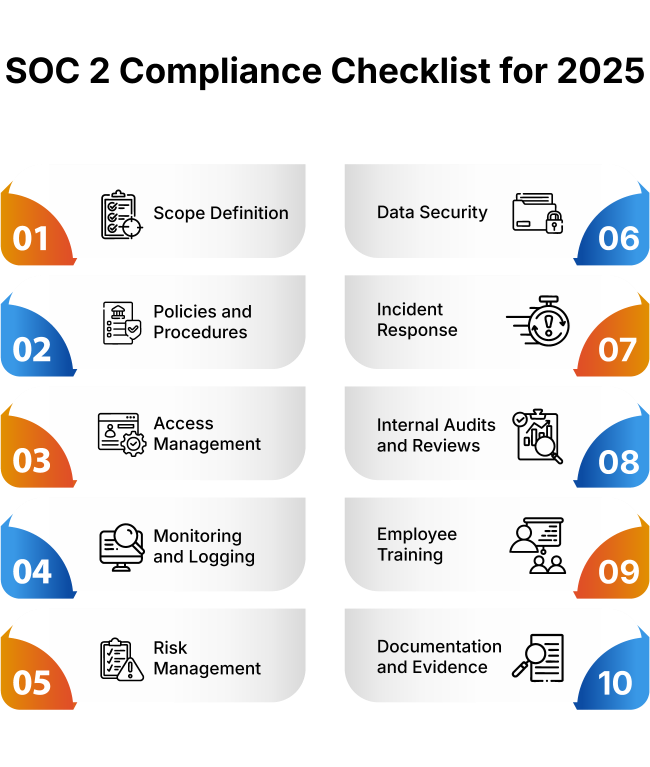
1. Scope Definition
Identify all systems, services and data covered by the SOC 2 audit. The mandatory Security criterion must always be included, while the other Trust Services Criteria like Availability, Processing Integrity, Confidentiality and Privacy are optional and selected based on the services provided by the organization.
2. Policies and Procedures
Document information security, access control, incident response, data privacy and change management policies. Ensure procedures clearly explain how controls are implemented and maintained.
3. Access Management
Establish access control principles that enforce appropriate authorization, least privilege and timely provisioning and deprovisioning. Conduct periodic reviews of user and privileged access and adjust access when roles change.
4. Monitoring and Logging
Collect and retain relevant logs for systems and user activity for the required period. Define monitoring and alerting for anomalous or unauthorized events and follow documented triage and escalation processes.
5. Risk Management
Conduct formal risk assessments at least annually and when significant changes occur. Maintain a risk register with treatment plans, target dates and owners. Operate vulnerability and patch management with defined timelines for remediation.
6. Data Security
Classify data and apply controls consistent with classification. Protect data in transit and at rest using appropriate measures. Manage keys and secrets securely, limit access to production data and apply least privilege to data handling.
7. Incident Response
Maintain and periodically test an incident response plan covering detection, reporting, containment, recovery and post-incident reviews. Define roles, communication paths and criteria for customer or regulatory notifications where applicable.
8. Internal Audits and Reviews
Perform periodic internal reviews to evaluate control design and operating effectiveness. Document findings, remediate gaps and update policies, procedures and controls based on results and management review.
9. Employee Training
Provide security awareness training during onboarding and on a recurring basis. Include topics such as acceptable use, data handling and social engineering and track completion and acknowledgments.
10. Documentation and Evidence
Maintain organized records demonstrating control operation over the relevant period, including configurations, logs, approvals and audit trails. Track policy acknowledgments and prepare evidence mapped to controls for auditor review.
Top Gaps Auditors Spot in SOC 2 Reviews
Change management often lacks audit‑ready evidence, with changes proceeding without documented approvals or peer review, emergency changes not post‑reviewed and weak linkage between tickets, testing and deployment records.
Logging and monitoring are incomplete, with gaps in coverage across applications, infrastructure and authentication, insufficient retention for the observation period and inconsistent alert triage, escalation and closure documentation.
Risk, vulnerability and patch management fall short when a recent formal risk assessment is absent, vulnerability discovery is ad hoc, remediation timelines are undefined or unmet and patching lacks tracked cadence and documented exceptions.
Vendor and subservice oversight is underdeveloped when third‑party due diligence and ongoing monitoring are not documented, SOC report reviews (or equivalents) lack follow‑ups and the chosen subservice method with assigned responsibilities is unclear.
Policies, training and operationalization issues arise when policies are outdated or unapproved, procedures don’t specify ownership and cadence and security awareness and role‑based training with acknowledgments are not consistently tracked.
Best Practices for Staying SOC 2 Compliant
SOC 2 compliance is easier to maintain when it becomes part of daily operations rather than a yearly scramble before an audit. The most effective approach is given below:
-
- Integrate compliance into routine operations: Embed SOC 2 requirements into day-to-day processes so controls operate consistently throughout the year, not just before audits.
-
- Adopt continuous monitoring: Use ongoing monitoring to track system activity, detect anomalies and generate timely alerts for suspicious events.
-
- Review access controls on a regular cadence: Periodically assess user and privileged access, remove unnecessary permissions and apply stronger authentication for sensitive environments.
-
- Assign clear policy ownership: Designate accountable owners for each policy to drive timely updates, ensure alignment with practices and communicate changes effectively.
-
- Schedule recurring log reviews: Evaluate system and security logs at defined intervals to validate that controls are operating as intended and to identify deviations.
-
- Maintain an active risk management process: Perform ongoing risk assessments, record risks in a central register, define treatment plans with owners and due dates and track them to closure.
-
- Test incident response readiness: Conduct tabletop exercises or simulations to validate detection, escalation, communication and recovery steps and address identified gaps.
-
- Keep documentation current and accessible: Maintain up-to-date records of configurations, monitoring outputs, approvals and other evidence in an organized repository.
-
- Provide regular security training: Deliver recurring awareness and role-based training so personnel understand responsibilities, emerging threats and updated policies.
Turning Your SOC 2 Checklist into Action with ValueMentor
SOC 2 compliance checklist tells you what to do. ValueMentor shows you how to do it. We turn each checklist item into a practical, manageable step that keeps your compliance process clear and on track. Our SOC 2 compliance audit services cover every stage, from scope definition to evidence preparation, making the journey less stressful and more predictable.
-
- Step-by-Step Implementation
We break down your SOC 2 compliance checklist into actionable tasks, assign responsibilities and set realistic timelines so progress is consistent and measurable.
- Step-by-Step Implementation
-
- Closing Gaps with Precision
While reviewing your checklist, we pinpoint and address any weaknesses in processes, policies or controls which ensuring each requirement is fully met.
- Closing Gaps with Precision
-
- Evidence and Documentation Made Simple
We help you organize and maintain the records, logs and proof needed for smooth and timely compliance reviews.
- Evidence and Documentation Made Simple
-
- Keeping Your Checklist Current
We support ongoing updates and periodic reviews, so your checklist remains accurate, relevant and aligned with best practices year after year.
- Keeping Your Checklist Current
Conclusion
SOC 2 compliance is a systematic process that proves your commitment to safeguarding customer data. A clear checklist helps you organize tasks, close gaps and maintain strong controls year-round. By making these practices part of your daily operations and preparing evidence in advance, you can approach your audit with confidence and efficiency.
Ready to turn your checklist into certification success?
Get your tailored SOC 2 Compliance Checklist from ValueMentor today and take the first confident step toward passing your audit.
FAQs
1. Why does a checklist play a crucial role in SOC 2 compliance?
A checklist keeps the compliance process structured, eliminates the possibility of overlooking any requirements and gives a clear guide for preparation prior to the audit.
2. Does the SOC 2 checklist cover all five Trust Services Criteria?
Yes, but organizations may select the criteria that pertain to their business. Security is mandatory, whereas Availability, Processing Integrity, Confidentiality and Privacy are elective based on scope.
3. Can a checklist by itself guarantee SOC 2 compliance?
No. A checklist is a starting point, but becoming compliant involves executing and sustaining effective controls, collecting evidence and closing gaps.
4. What are some of the most frequent mistake’s businesses make with the SOC 2 checklist?
Some of the common errors are using old documentation, not having a complete review of access, no testing of incident response and unequal monitoring of logs.
5. In what way is a SOC 2 checklist useful for audit preparation?
It breaks down all requirements into steps that are easy to handle, whereby evidence is prepared, policies are revised, and controls are tested prior to audit.
6. Is the SOC 2 checklist used for Type I and Type II reports any different?
The main items are the same, but Type II requires demonstration of control effectiveness over time, so ongoing monitoring steps are highlighted.
7. Do small businesses use the same SOC 2 checklist as big business?
Yes, but smaller firms can adapt the checklist to suit their size and resources while remaining in compliance with all requirements.
8. Can ValueMentor assist with customizing a SOC 2 checklist for my business?
Yes. ValueMentor assists companies in tailoring the checklist to suit their unique systems, processes and audit objectives for a more seamless compliance process6