India is moving fast towards a digital-first economy. Online payments, telemedicine, e-commerce, and digital banking are now part of everyday life. With this growth comes the need for strong data privacy. The DPDPA 2023 supports this shift. Because of the mass amounts of personal data that businesses keep on file, they need to manage this data responsibly, safely, and legally. The Act provides clarity on the responsibilities of businesses regarding the handling of personal data, achieving DPDPA compliance is not just beneficial. It is necessary for building customer trust, improving security, and reducing risks. This blog aims to provide readers with a step-by-step roadmap on implementing the DPDPA, including steps toward achieving compliance, assessments of readiness and a useful checklist for businesses operating in India.
Understanding the Digital Personal Data Protection Act (DPDPA 2023)
The Digital Personal Data Protection Act of India regulates the way that organizations use “digital” personal data on individuals, called Data Principals and describes the responsibilities of businesses, called Data Fiduciaries, as to how to handle data.
The main purposes of the DPDP Act 2023 are:
- Protecting the privacy of Indian Citizens
- Ensuring responsible use of data
- Improving Cyber Security and Governance
- Providing mechanisms for grievance redressal
- Creating transparency around the use of data in processing activities
In contrast to the established Privacy Laws around the world, the DPDP Act provides a more balanced approach to allow for companies to use personal data but at the same time provide individuals with control over their own data.
Why DPDPA compliance matters for Indian businesses?
Businesses across sectors-IT, BFSI, healthcare, retail, logistics, education, manufacturing, and e-commerce-deal with personal data every day. Non-compliance with the DPDP Act can lead to penalties, loss of customer trust, broken partnerships, and legal disputes.
Key business benefits of DPDPA compliance include:
- Enhanced data governance and security
- Better customer trust and brand value
- Lower risk of data breaches
- Alignment with global privacy standards
- Competitive advantage in global markets
Who needs to comply with the DPDPA 2023?
The DPDP Act covers the following:
- All Indian organisations managing digital personal data.
- All non-Indian organisations providing goods or services to people in India.
- All Indian government bodies and public sector organisations.
The DPDP Act covers all types of personal data that are in a digitised format or that will be digitised; however, it does not apply to anonymised data and non-personal data, which are both exempt from this Act.
How to implement DPDPA in your business: step-by-step guide
A structured roadmap makes DPDP Act implementation faster, clearer, and more cost-effective. Below is a practical, business-friendly roadmap that supports long-term compliance.
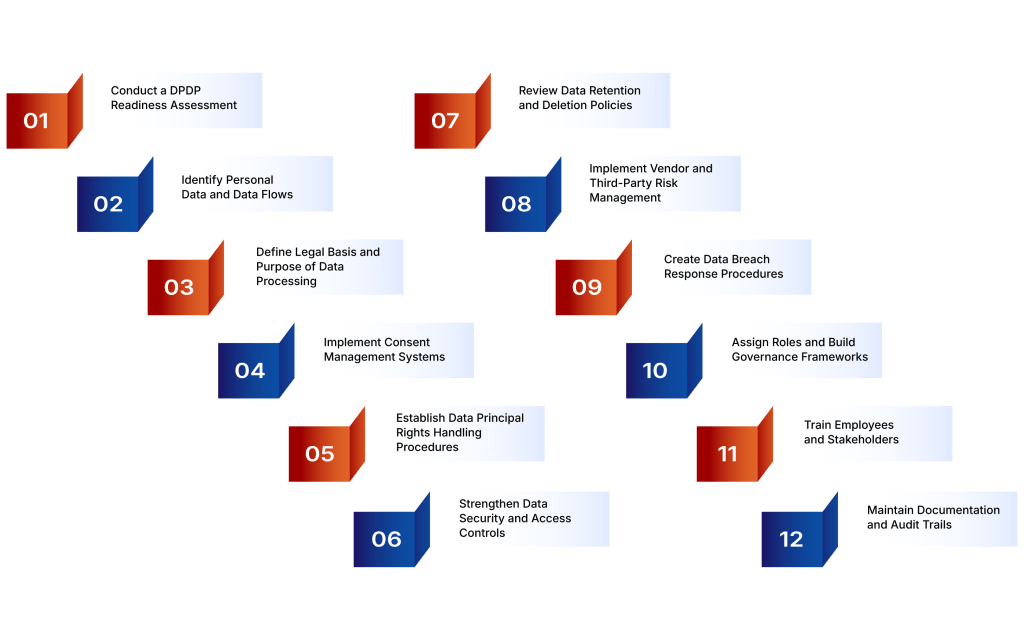
1. Conduct a DPDP readiness assessment
A readiness assessment helps businesses understand their current compliance position. This assessment examines:
- What data is collected and why
- Where data is stored and for how long
- Who has access to data
- Existing security controls
- Third-party sharing practices
- Data breach handling methods
This step forms the base of a DPDP compliance checklist in India and highlights improvement areas early.
2. Identify personal data and data flows
Businesses should map:
- Types of personal data collected (customer, employee, vendor, etc.)
- Data collection points (websites, mobile apps, HR systems)
- Data storage systems (databases, cloud platforms, CRMs).
- Data processors and partners
This mapping helps organizations understand the data lifecycle from creation to deletion and supports better governance.
3. Define legal basis and purpose of data processing
The DPDP Act requires organizations to:
- Collect only necessary personal data
- Process data for a clear, specific purpose
- Obtain consent wherever required
Processing categories include:
- Consent-based processing
- Legitimate use cases (as defined in the Act)
- Legal and regulatory obligations
Documenting this ensures transparency and accountability.
4. Implement consent management systems
Consent is a major part of DPDPA compliance. Consent systems must ensure:
- Clear and plain language
- Purpose-specific consent
- Easy withdrawal mechanisms
- Records of consent granted and withdrawn
Digital consent dashboards improve compliance and user experience.
5. Establish data principal rights handling procedures
Under the Act, individuals (Data Principals) have rights such as:
- Access to personal data
- Correction and deletion
- Grievance redressal
- Nomination rights
Businesses need internal workflows and SLAs to manage these rights efficiently.
6. Strengthen data security and access controls
Security controls help prevent unauthorized access and data breaches. Organizations must implement:
- Identity and access management
- Role-based access permissions
- Multi-factor authentication
- Data encryption (at rest and in transit)
- Logging and monitoring
- Secure coding practices
Technical controls protect both business continuity and consumer trust.
7. Review data retention and deletion policies
The DPDP Act requires businesses to delete personal data when:
- The purpose is fulfilled, or
- Consent is withdrawn
Organizations should set retention timelines depending on:
- Legal requirements
- Business needs
- Customer expectations
Automated deletion policies reduce storage costs and risk exposure.
8. Implement vendor and third-party risk management
Many Indian businesses rely on external service providers such as:
- Cloud platforms
- Payroll providers
- Marketing agencies
- Call centers
- IT support vendors
Under the DPDP Act, businesses (Data Fiduciaries) are responsible for how their vendors handle data.
Vendor management must include:
- Lawful data transfer agreements
- Security audits
- Data processing contracts
- Breach notification rules
9. Create data breach response procedures
The law requires Data Fiduciaries to notify the Data Protection Board and Data Principals in case of breaches. Businesses should:
- Set detection and reporting timelines
- Create incident response teams
- Maintain breach logs
- Conduct periodic security drills
Timely reporting reduces legal and reputational impact.
10. Assign roles and build governance frameworks
Businesses should define responsibilities for:
- Data Protection Officers (for Significant Data Fiduciaries)
- IT security teams
- Legal and compliance officers
- Vendor management teams
- Customer support for grievances
Clear roles reduce confusion and improve compliance quality.
11. Train employees and stakeholders
Training ensures that employees understand:
- Data handling rules
- Consent and privacy requirements
- Security policies
- Breach reporting procedures
Human error is a top cause of data breaches, so awareness training is critical.
12. Maintain documentation and audit trails
Documentation is essential for demonstrating compliance, including:
- Consent logs
- Vendor contracts
- Data maps
- Retention policies
- Impact assessments
- Breach reports
- Training records
Good documentation minimizes legal risk during audits.
DPDP act compliance checklist for India
The list below is a list of essential performance criteria to assist businesses in preparing for compliance with the DPDPA (Data Protection for Data Providers):
1. Personal data inventory: Identify which personal data you collect about individuals, who the individuals are, and what you are collecting personal data for.
2. Data flow mapping: Create a flow chart to illustrate how your organisation moves personal data from your servers and through various departments, systems, applications, third parties, etc.
3. Consent management: Collect consent for collecting personal data in common and simple language, provide a mechanism for easily withdrawing consent, and keep records digitally of both granted and withdrawn consent.
4. Legal base and purpose for data processing: Document the legal base for your data processing activities, and that the purpose of the activity is specific, required, and recorded.
5. Data principal rights handling: Implement internal processes to deal with requests from Data Principals for access, correction, deletion, redress, and nomination rights.
6. Data security measures: Establish appropriate data security measures such as encryption, access controls, multi-factor authentication, monitoring tools, and securing development practices.
7. Vendor and third-party risk management: Assess third-party processors for security and compliance with the DPDPA and ensure that your contracts with them contain provisions with respect to data protection.
8. Data retention and deletion policies: Establish periods for the retention of personal data and have an automated or documented process for deletion of personal data when the purpose for which the data was collected has been fulfilled or the consent has been withdrawn.
9. Data breach response and notification: Create a plan for responding to a data breach, including detection, escalation, timeframes for reporting breaches, communication and record-keeping.
10.Training and awareness for employees: Training of employees and contractors on the rules around privacy, as well as how to handle data securely and how to report issues, should take place regularly.
11.Governance and responsibility: Roles for the legal department, IT, and compliance departments should be assigned, and a Data Protection Officer should be appointed if deemed a Significant Data Fiduciary.
12.Audit readiness and documentation: Retain records of policy, assessment, contract, consent log, breach report, training record, and audit trail for use in potential regulatory audits.
Conclusion
Compliance with the Data Protection and Privacy Act of 2023 is not only a requirement under applicable laws, but also represents a strategic investment in your organization’s ability to have secure, trustworthy, and scalable growth. By utilizing a structured implementation plan for DPDPA, Indian businesses will develop robust data protection governance frameworks, lower the risk associated with cyber-attacks, and align with global best practices for data privacy. The key components of an effective data protection and compliance strategy include conducting a readiness assessment, performing a gap analysis, establishing a compliance framework for managing consent, implementing appropriate information security controls, developing and documenting company-wide data protection policies and procedures and having established processes to oversee compliance monitoring and audits but achieving total compliance with DPDPA may appear complicated.
This complexity is compounded because organizations must address all aspects of cybersecurity, data privacy governance and data privacy legal obligations simultaneously. ValueMentor assists organizations in their journey to implement the DPDPA by providing readiness assessments, compliance audits, development of data privacy policies, employee education and ongoing guidance. To create a secure, compliant and trustworthy digital operating environment, please visit our website to learn more about Quant API solutions.
FAQS
1. What is the Digital Personal Data Protection Act (DPDPA)?
The DPDPA is India’s data privacy law that regulates how businesses collect, store, use, and delete personal data.
2. Who must comply with the DPDP Act?
Any organization that handles digital personal data of individuals in India, including foreign companies offering services to Indian users.
3. What counts as personal data under the Act?
Personal data is any information that can identify an individual such as name, phone number, email, financial data, and biometric data.
4. Does the DPDP Act apply to government agencies?
Yes, the Act applies to both private entities and government institutions, with specific exemptions defined within the law.
5. What is a Data Fiduciary?
A Data Fiduciary is an organization that determines why and how personal data is processed.
6. What is a Significant Data Fiduciary?
Large organizations handling sensitive data or high-volume processing may be classified as Significant Data Fiduciaries and must appoint a Data Protection Officer.
7. What are Data Principal rights?
Individuals have rights such as access to their data, correction, deletion, grievance redressal, and nomination.
8. What is a DPDP readiness assessment?
It is an evaluation that helps businesses understand their current compliance gaps and improvements needed for DPDPA compliance.
9. What are the penalties for non-compliance?
Penalties may include financial fines, legal actions, and reputational damage depending on the severity of the violation.
10. Can businesses share data with third parties under the Act?
Yes, but only with valid legal bases, proper agreements, and transparency to ensure personal data is protected.