
A suspicious login. An unexpected configuration change. A transaction initiated outside normal operating hours. Individually, these events may appear insignificant. Together, they could indicate an attempt to compromise a financial institution’s SWIFT-connected environment.
The challenge is not simply collecting these events in security logs. It is recognising the signals, correlating them, and responding before suspicious activity escalates into a financial or operational incident.
This is where SWIFT CSP security monitoring becomes critical.
The SWIFT Customer Security Programme (CSP), through its Customer Security Controls Framework (CSCF), establishes security requirements that help financial institutions protect their SWIFT-related infrastructure. These requirements extend beyond preventive security measures to include effective logging, anomaly detection, monitoring and incident response capabilities.
For Chief Information Security Officers (CISOs), Security Operations Centre (SOC) leaders and compliance teams, the question is no longer whether security logs are being generated. It is whether those logs provide sufficient visibility to identify suspicious activity, support investigations and demonstrate compliance. Understanding these requirements is essential to building a monitoring programme that delivers both security assurance and operational resilience.
SWIFT CSP Logging and Monitoring Requirements
SWIFT CSP Logging requirements and monitoring are fundamental to maintaining visibility across a SWIFT-connected environment. However, collecting security events alone does not establish an effective monitoring capability.
Under CSCF control 6.4, Logging and Monitoring, institutions must implement capabilities to detect anomalous activity and establish processes or tools to retain and review security logs.
The objective is to ensure that security-relevant activities can be traced, suspicious behaviour can be identified, and potential incidents can be investigated effectively.
This requires financial institutions to establish a structured logging and monitoring plan covering applicable components within their SWIFT environment.
Key areas that require monitoring include:
- Authentication activities: Successful and failed login attempts, authentication errors and suspicious access patterns.
- Privileged account activity: Administrative commands, changes to user permissions and other privileged operations.
- System and application events: Unusual system behaviour, configuration changes and application errors.
- Network activity: Firewall events, network traffic anomalies and attempts to access protected infrastructure.
- Database activity: Relevant database events associated with SWIFT messaging interfaces and connected systems.
- Operator workstation activity: Security events originating from dedicated or general-purpose operator PCs.
The precise scope depends on the institution’s SWIFT architecture and applicable CSCF requirements.
Importantly, monitoring should provide traceability between account activity and the individual responsible. This allows security teams to investigate suspicious actions without relying solely on fragmented system records.
Logging Is Not Monitoring: What Financial Institutions Need to Demonstrate
One of the common weaknesses in security monitoring programmes is the assumption that retaining logs automatically satisfies monitoring requirements. But It does not.
Effective monitoring requires institutions to establish processes for reviewing security events, configuring alerts for suspicious activity and escalating findings for investigation.
For example, repeated failed authentication attempts against a privileged account may indicate a credential attack. However, unless the event is detected, reviewed and escalated, the institution may remain unaware of the potential compromise.
Financial institutions should therefore establish:
- Documented logging and monitoring procedures.
- Defined log sources covering applicable SWIFT-connected components.
- Regular review of application, server and network monitoring data.
- Automated alerts for suspicious security events wherever supported.
- Defined escalation and investigation procedures.
- Evidence of monitoring activities and incident handling.
This distinction between collecting information and acting on it is central to building an effective SWIFT CSP control monitoring programme.
Can Your Security Team Trust the Logs It Relies On?
The effectiveness of security monitoring depends on the reliability and integrity of the underlying log data.
If an attacker compromises an administrative account, the ability to modify or delete logs can significantly undermine an investigation. Without reliable records, security teams may struggle to establish what happened, when it happened and which accounts or systems were involved.
Financial institutions must therefore implement appropriate safeguards to protect logs against unauthorised access, modification and deletion.
These safeguards may include:
- Restricting access to log repositories through role-based access controls.
- Forwarding logs to a centralised logging or SIEM platform.
- Separating log storage administration from the administration of monitored systems.
- Protecting log transfers and stored records against unauthorised modification.
- Monitoring access to log repositories and administrative activities.
- Implementing appropriate backup and retention mechanisms.
Log retention also requires careful consideration.
Retention periods should support forensic investigations and comply with applicable legal and regulatory requirements. The CSCF provides specific retention guidance for different categories of logs, so institutions should not apply a single retention period indiscriminately across all systems.
For example, the CSCF v2026 guidance specified different minimum retention periods (Operator PC, firewall, and database audit logs are retained for no less than 31 days (it is recommended to extend firewall and database audit logs retention to three months and possibly 12 months to support longer investigations.
Audit logs captured on other identified in-scope components, at application level or system level, are retained for no less than 12 months) for messaging interface audit logs and other in-scope components. Institutions should verify the applicable requirements against the current CSCF version and relevant product guidance.
The objective is to ensure that security records remain accessible, trustworthy and useful when an incident needs to be investigated.
Where Does Detection and Response Fit Within the SWIFT CSP Framework?
SWIFT’s Customer Security Controls Framework is structured around three core security objectives:
- Secure your environment.
- Know and limit access.
- Detect and respond.
While logging and monitoring are directly associated with the Detect and Respond objective, they also support the effectiveness of access management and infrastructure protection controls.
For example, effective privileged access management restricts who can access critical systems. Monitoring provides the visibility needed to identify how those privileges are being used and whether any activity appears suspicious.
Under the detection and response domain, financial institutions must establish capabilities to identify anomalous activity involving systems and transaction records, supported by appropriate incident response arrangements.
What Should SWIFT Security Monitoring Detect?
Consider the following scenarios as an example:
| Security event | Potential security implication |
|---|---|
| Repeated failed login attempts | Possible credential compromise or brute-force activity |
| Privileged access outside normal operating hours | Unusual administrative activity requiring investigation |
| Unexpected configuration changes | Potential system manipulation or unauthorised changes |
| Unusual SWIFT message activity | Potentially suspicious transaction behaviour |
| Access from unfamiliar systems | Possible unauthorised access to the SWIFT environment |
| Changes to user permissions | Potential privilege escalation or misuse of administrative access |
These examples illustrate why monitoring must consider both technical security events and relevant operational activity.
A well-designed monitoring programme should establish appropriate baselines, identify deviations and ensure that suspicious events are investigated in context.
Not every anomaly indicates a security incident. However, the ability to distinguish legitimate operational changes from potentially malicious activity is essential to effective threat detection.
When an Alert Becomes an Incident: The Importance of Response Readiness
Detecting suspicious activity is only the first step. Financial institutions must also be prepared to investigate, contain and manage potential security incidents.
SWIFT CSP’s incident response requirements are addressed through the framework’s Detect and Respond objective, including control 7.1, Cyber Incident Response Planning and Preparation.
An effective incident response plan should address scenarios involving the SWIFT environment and establish clear responsibilities for handling security incidents.
Key elements include:
- Identification and classification of potential security incidents.
- Defined escalation paths and incident ownership.
- Procedures for investigating suspicious activity.
- Containment and recovery measures.
- Communication and information-sharing protocols.
- Relevant reporting obligations to SWIFT and other authorities, where applicable.
- Post-incident reviews and documented lessons learned.
However, having a documented response plan is not sufficient on its own.
Institutions should periodically review their procedures, conduct exercises and maintain evidence of response readiness.
Tabletop exercises can help security teams evaluate how effectively they respond to scenarios such as compromised privileged credentials, suspicious SWIFT-related activity or unauthorised changes to critical infrastructure.
The objective is to ensure that personnel understand their responsibilities and can respond effectively when an actual incident occurs.
Five SWIFT CSP Monitoring Gaps Financial Institutions Should Address
Even institutions with established security infrastructure may have weaknesses in their monitoring programmes.
The following gaps deserve particular attention during internal reviews and independent assessments.
1. Incomplete log source coverage
Security teams may collect logs from critical servers while overlooking operator workstations, network devices, authentication systems or other applicable SWIFT-connected components.
Without adequate coverage, suspicious activity may go undetected.
2. Passive log collection
Some institutions retain security logs without establishing consistent review procedures or automated alerting mechanisms.
This creates a situation where potentially important security events remain buried in large volumes of data.
3. Insufficient privileged activity monitoring
Administrative accounts have elevated access to critical infrastructure. Inadequate monitoring of these accounts can make unauthorised changes difficult to identify and investigate.
4. Generic SIEM detection rules
Standard SIEM configurations may not adequately address the specific threat scenarios associated with financial messaging environments.
Detection rules should be aligned with the institution’s SWIFT architecture, operational activities and relevant threat scenarios.
5. Untested incident response procedures
An incident response plan that has never been tested may not provide sufficient direction during an actual security incident.
Regular exercises, documented reviews and clearly assigned responsibilities help address this weakness.
Addressing these gaps requires more than deploying additional security tools. It requires institutions to evaluate how effectively their people, processes and technologies work together.
Turning Disconnected Logs into Actionable Security Intelligence: The Role of SIEM
Security Information and Event Management (SIEM) platforms play an important role in operationalising SWIFT CSP security control monitoring.
A SIEM collects and consolidates security events from multiple sources, correlates related activities and generates alerts based on predefined detection rules and behavioural patterns.
For financial institutions, this provides a more structured approach to monitoring the SWIFT-connected environment.
Rather than reviewing individual system logs in isolation, security teams can analyse events across different components to identify patterns that may indicate suspicious activity.
A typical SWIFT SIEM monitoring workflow involves four stages:
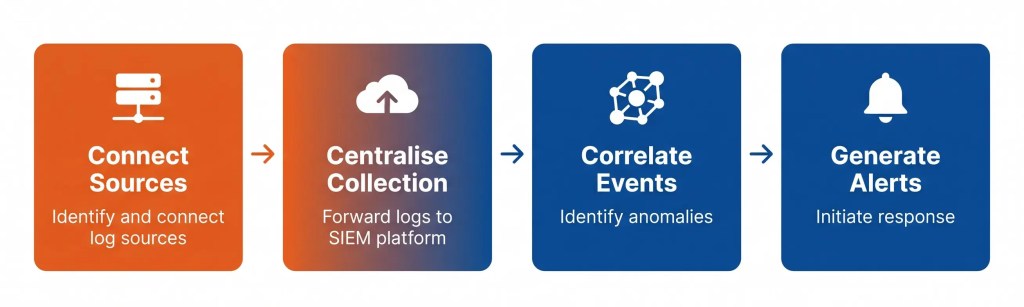
1. Identify and connect log sources
Identify applicable SWIFT-connected assets, including messaging interfaces, operator workstations, servers, network devices, authentication systems and other relevant components.
Configure appropriate log collection mechanisms to establish visibility across the environment.
2. Centralise security event collection
Forward relevant logs to a centralised SIEM platform.
This reduces dependence on individual log repositories and allows security teams to review events through a consolidated monitoring interface.
3. Correlate events and identify anomalies
Configure detection rules to identify suspicious patterns across different log sources.
Examples include repeated authentication failures followed by successful access, unexpected privileged account activity, unusual configuration changes and suspicious transaction-related events.
4. Generate alerts and initiate response
Configure alerts based on defined risk conditions and ensure that security teams have clear procedures for investigation, escalation and incident documentation.
This approach transforms fragmented security records into actionable intelligence that supports continuous monitoring and incident response.
Building SIEM Use Cases Around SWIFT-Specific Threats
Deploying a SIEM platform is only one part of establishing effective security monitoring.
Its effectiveness depends on how well detection rules, correlation logic and alert thresholds reflect the institution’s actual operating environment.
Generic out-of-the-box detection rules may not provide sufficient visibility into SWIFT-specific activity without appropriate customisation.
Financial institutions should therefore develop monitoring use cases around their SWIFT architecture, relevant security risks and operational requirements.
Some important considerations include:
Asset and log source mapping: Maintain an updated inventory of applicable SWIFT-connected components and verify that relevant log sources are integrated.
Detection rule development: Configure use cases for authentication anomalies, privileged account activity, suspicious configuration changes and other relevant security events.
Behavioural baselining: Establish normal patterns of operator and system activity to help identify deviations that require investigation.
Alert prioritisation: Categorise alerts according to severity and potential impact to help security teams focus on higher-risk events.
Continuous tuning: Periodically review detection rules, investigate false positives and refine alert thresholds as the environment evolves.
Alert fatigue is another important consideration. Excessive low-priority alerts can overwhelm security teams, delay investigations and reduce the effectiveness of monitoring operations.
A structured tuning lifecycle helps maintain meaningful alerts while improving the quality of threat detection.
Ultimately, the objective is not to generate more alerts. It is to identify the events that matter and ensure they receive an appropriate response.
Why Annual Attestation Cannot Replace Continuous Monitoring
SWIFT CSP compliance is an ongoing responsibility, not a once-a-year documentation exercise.
Financial institutions must annually attest to their level of compliance with the applicable mandatory controls through the KYC-Security Attestation process. The attestation is supported by an independent assessment of control implementation.
However, preparing for attestation requires evidence of how controls operate throughout the year.
For security monitoring, this means maintaining records of:
- Applicable systems and log sources.
- Logging and monitoring policies and procedures.
- Evidence of log reviews and security event analysis.
- Alert investigation and escalation records.
- Incident response activities and exercise outcomes.
- Log retention and integrity protection arrangements.
- Reviews of monitoring effectiveness and corrective actions.
Clear ownership is equally important.
The SOC or security operations team may manage day-to-day monitoring activities, while the CISO or Head of Information Security provides oversight. IT infrastructure teams, risk management and compliance functions should also have clearly defined responsibilities.
This cross-functional approach helps ensure that monitoring gaps are identified, escalated and addressed before they affect the institution’s compliance position.
Aligning SWIFT CSP Monitoring with Broader Compliance Frameworks
SWIFT CSP security controls does not operate in isolation.
Many financial institutions must also demonstrate compliance with frameworks such as PCI DSS and ISO/IEC 27001, alongside applicable national financial sector regulations.
These frameworks contain overlapping requirements relating to security logging, access monitoring, incident detection and response.
A coordinated approach can help institutions reduce duplicated effort and improve the consistency of their security operations.
For example:
- SWIFT CSP: Focuses on protecting the SWIFT-related environment through applicable security controls, including logging, monitoring and incident response.
- PCI DSS: Establishes requirements for logging, monitoring and protecting systems within the cardholder data environment.
- ISO/IEC 27001: Provides an information security management framework that supports systematic risk management, security monitoring and incident management.
A centralised SIEM platform and clearly documented monitoring procedures can support evidence collection across these frameworks.
However, shared technology does not automatically establish compliance with multiple standards. Institutions must assess each framework’s specific scope, control requirements and evidence expectations independently.
The opportunity lies in building a unified security operations capability that supports multiple compliance obligations without compromising framework-specific requirements.
Conclusion
Meeting SWIFT CSP logging requirements involves more than maintaining logs, deploying a SIEM platform or completing an annual attestation. It requires financial institutions to establish continuous visibility across their SWIFT-connected environment, identify suspicious activity and demonstrate that potential incidents trigger timely and documented responses.
The distinction lies between having monitoring controls in place and having monitoring capabilities that consistently deliver actionable security intelligence. As financial institutions strengthen their security operations, aligning SWIFT CSP requirements with effective log management, SIEM capabilities and incident response processes becomes essential to building a resilient financial messaging environment.
ValueMentor helps financial institutions strengthen their security and compliance posture through cybersecurity assessments, security monitoring, SIEM capabilities and compliance advisory. Connect with our specialists to evaluate your monitoring maturity, identify control gaps and build an audit-ready security monitoring programme aligned with applicable SWIFT CSP requirements.
Frequently Asked Questions
SWIFT CSP security monitoring involves recording and reviewing security events across an institution’s SWIFT-related environment to identify anomalous activity, investigate potential threats and support compliance with the Customer Security Controls Framework.
2. Which CSCF control addresses SWIFT logging and monitoring requirements?
CSCF control 6.4, Logging and Monitoring, addresses the requirement to record security events, detect anomalous activity and establish processes or tools for retaining and reviewing logs.
3. Which systems should be included in SWIFT CSP security monitoring?
Monitoring scope depends on the institution’s SWIFT architecture. Relevant components may include messaging interfaces, operator workstations, servers, network devices, authentication systems and databases connected to SWIFT-related infrastructure.
4. How long should SWIFT CSP security logs be retained?
Retention requirements vary by log category and applicable CSCF guidance. Institutions must also consider local regulatory requirements, data protection obligations and forensic investigation needs.
5. How should financial institutions protect SWIFT security logs?
Institutions should restrict access to log repositories, implement centralised log collection, separate log administration from monitored systems and deploy safeguards against unauthorised modification or deletion.
6. What types of suspicious activity should SWIFT monitoring detect?
Monitoring should identify events such as repeated failed logins, unusual privileged account activity, unexpected configuration changes, suspicious network events and anomalous transaction-related behaviour.
7. How does a SIEM support SWIFT CSP compliance?
A SIEM centralises security logs, correlates events across connected systems, identifies suspicious activity and generates alerts. It also supports investigation and the documentation of monitoring activities.
8. What should a SWIFT CSP incident response plan include?
It should define incident classification, investigation procedures, escalation responsibilities, containment and recovery measures, communication protocols, applicable reporting obligations and post-incident reviews.
9. How often should SWIFT CSP monitoring activities be reviewed?
Monitoring should operate continuously, with security event reviews, alert investigations and periodic assessments of detection rules and monitoring effectiveness. Review frequency should reflect the applicable control requirements and operational risk.
10. Can SIEM monitoring support both SWIFT CSP and ISO 27001 compliance?
Yes. A SIEM can support overlapping logging, monitoring and incident detection requirements under both frameworks. However, institutions must independently verify that each framework’s specific controls and evidence requirements are addressed.