
The SWIFT Customer Security Programme is a mandatory cybersecurity compliance framework that all institutions connected to the SWIFT interbank messaging network must address through annual security attestation against applicable mandatory controls.. It exists to establish a consistent, enforceable security baseline across the global financial system-a system that processes trillions of dollars in transactions daily.
The scale of financial interconnection that SWIFT enables is precisely what makes it a high-value target. When a vulnerability exists in one node of that network, the consequences can propagate rapidly across correspondent banking relationships spanning multiple jurisdictions. The 2016 Bangladesh Bank heist, in which attackers exploited weaknesses in a local SWIFT environment to initiate fraudulent transfers exceeding $80 million, demonstrated with stark clarity what is at stake when financial institutions treat network access as a convenience rather than a security responsibility. This incident was a major catalyst for the introduction of the SWIFT Customer Security Programme. Since its launch, the CSP has matured into a structured, annually updated framework. For CISOs, compliance officers, and risk professionals at institutions of any size, understanding the programme’s architecture, its requirements, its enforcement mechanisms, and its relationship to broader regulatory obligations is not optional. It is a fundamental component of responsible financial operations.
What Is SWIFT CSP?
The CSP was not created in isolation. It emerged as a direct institutional response to a series of sophisticated cyberattacks that exploited weaknesses in local SWIFT environments, not in SWIFT’s own infrastructure, but in the systems that member institutions used to access it. SWIFT recognised that the security of the global financial messaging network is only as strong as its weakest connected node. The programme was therefore designed to elevate the collective security posture of all participants, creating a consistent and enforceable baseline applicable across geographies, institution sizes, and operational architectures.
The programme operates through a layered structure. At its core is the Customer Security Controls Framework, which defines specific security controls aligned to three overarching objectives: securing the local SWIFT environment; knowing and limiting access; and detecting and responding to suspicious activities . These objectives are not aspirational — they form the structural logic through which individual controls are designed, categorised, and enforced.
It is important to understand that the CSP does not replace or supersede existing regulatory obligations such as PCI DSS, ISO 27001, or national financial sector regulations. Rather, it functions as a complementary framework with its own discrete scope: the SWIFT local environment and its adjacent systems. Institutions that have already invested in mature security programmes will find significant overlap, but alignment with one framework does not automatically confer compliance with another.
What Is the SWIFT CSP Framework?
The framework is organised around a clear distinction between mandatory and advisory controls. Mandatory controls represent the required security baseline, and every institution connected to the SWIFT network must implement all mandatory controls applicable to its architecture type and environment . Advisory controls represent recommended security practices that SWIFT encourages institutions to adopt as their programmes mature. It is worth noting that advisory controls in one CSCF version often become mandatory in subsequent releases, an important signal that institutions should treat the advisory tier as a roadmap rather than optional guidance.
Architecture Types and Scoping
A foundational element of the CSP framework is the concept of architecture types. SWIFT classifies connected institutions into several architecture categories — broadly characterised by whether they operate SWIFT-related software directly on their own infrastructure, use a service bureau, or operate in a more restricted manner through a lightweight interface. The applicable controls and assessment requirements differ across these architecture types, meaning that scoping the SWIFT local environment correctly is a prerequisite to any compliance exercise. Misidentifying the architecture type is one of the most common errors observed during assessments, and it carries material consequences for compliance accuracy.
Annual Versioning and Mandatory Updates
The SWIFT CSCF is released on an annual cycle. Each version is published in advance, giving institutions a defined transition window to assess gaps and implement changes before the new requirements take effect. This versioning cycle reflects the reality that the threat landscape evolves continuously, and a static framework would rapidly become inadequate. Institutions must monitor each release proactively, conduct gap assessments against the updated control set, and revise their internal programmes accordingly. Treating CSCF compliance as a point-in-time exercise rather than a continuous programme is a posture that consistently leads to compliance failures at attestation time.
What Is the SWIFT Customer Security Programme and How Does Compliance Work?
Compliance under the CSP is not simply a matter of implementing controls and moving on. The annual attestation submitted through the KYC-SA application is published for access by counterparties, allowing correspondent banks and financial partners to review a connected institution’s reported compliance status as part of their due diligence and relationship management processes . This transparency is deliberate. SWIFT designed the attestation mechanism to function as both a compliance tool and a trust signal within the correspondent banking community. An institution with a weak or incomplete attestation faces not only regulatory exposure but also reputational consequences that can affect its ability to maintain and develop correspondent relationships.
The Role of Independent Assessment
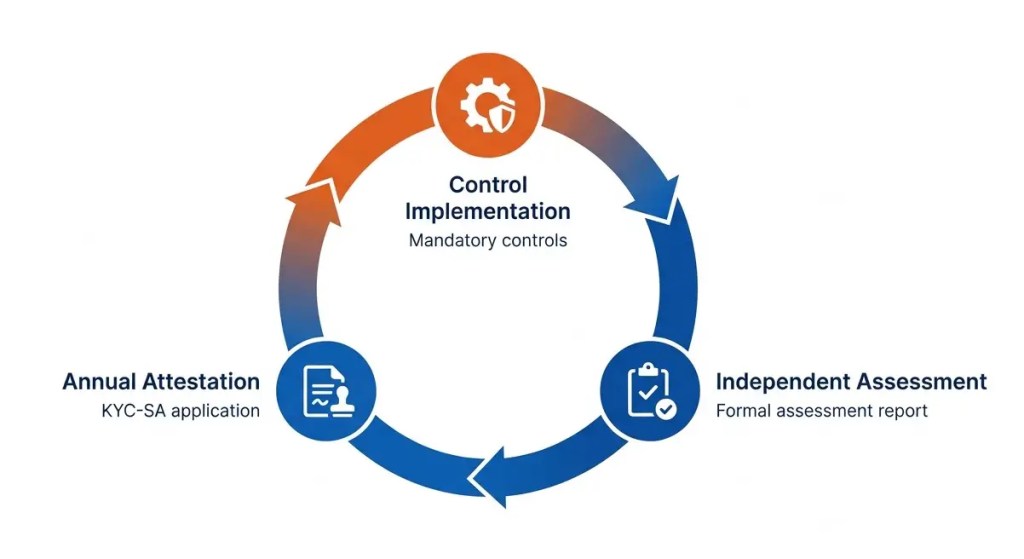
For institutions operating under certain SWIFT architecture types, independent assessment by a qualified third party is mandatory. This assessment can be performed internally by an independent second or third line of defence, such as Risk, Compliance or Internal Audit, or externally by an independent assessment provider. This represents a significant evolution in the programme’s rigour. In earlier CSP versions, self-attestation was the primary mechanism; independent verification has been progressively expanded as SWIFT has sought to address concerns about self-certification accuracy. An independent assessor reviews the institution’s control implementations, tests their effectiveness, and provides a formal assessment report that informs the attestation. Selecting an assessor with genuine expertise in both SWIFT environments and broader financial sector cybersecurity is paramount; a superficial review that misses control gaps will not protect the institution from consequences when those gaps are later identified by SWIFT or regulators.
Consequences of Non-Compliance
The consequences of failing to attest or of attesting inaccurately are substantial. SWIFT reserves the right to report institutions that do not have a valid attestation, have not complied with applicable mandatory controls, or have not completed the required independent assessment through its supervisory reporting arrangements. Such non-compliance may also result in additional scrutiny from counterparties and regulators, depending on the institution’s jurisdiction and applicable obligations. . Beyond the direct regulatory and operational impact, non-compliant institutions are exposed to significantly higher fraud risk — the very outcome the programme was designed to prevent. Financial institutions that invest in the resilience of their SWIFT compliance programmes are, in effect, protecting both their own operations and the integrity of the broader network.
What Is SWIFT CSCF and How Does It Structure Security Requirements?
The CSCF is structured around three overarching security objectives, supported by seven security principles and a set of mandatory and advisory controls. They span a range of domains: restricting internet access and protecting the critical interface environment; reducing the attack surface and vulnerabilities within the SWIFT local environment; physically securing the environment; preventing credential compromise; managing identities and separating privileges; detecting anomalous activity in the system or transaction records; planning for incident response and information sharing; and restricting operational utilities. Together, these objectives address both the technical and procedural dimensions of securing a SWIFT environment.
Mandatory Controls in Practice
The mandatory controls are specific, testable, and non-negotiable. They include requirements such as operating system hardening on SWIFT-related systems, restricting outbound internet connectivity from the secure zone, implementing multi-factor authentication for operator accounts, and ensuring that SWIFT-related software is kept up to date. These are not high-level principles; they are operational requirements that demand documented evidence of implementation. CISOs and compliance officers overseeing SWIFT programmes must ensure that internal control documentation policies, procedures, configuration records, access logs is maintained in a state that can support both self-attestation and independent assessment at any point in the annual cycle.
Advisory Controls as a Maturity Benchmark
Advisory controls deserve more strategic attention than they typically receive. As previously noted, SWIFT’s practice of elevating advisory controls to mandatory status in subsequent CSCF versions means that an institution’s approach to advisory controls is, in effect, its preparation for future mandatory requirements. Institutions that build programmes capable of progressively addressing advisory controls demonstrate a level of security maturity that serves them well both in attestations and in the broader regulatory environment. This is the difference between compliance as a minimum standard and compliance as a foundation for genuine operational resilience.
Conclusion
The CSCF provides a structured, evolving framework that demands continuous programme management, accurate scoping, and in many cases independent third-party verification. As SWIFT progressively raises the mandatory control baseline with each annual release, institutions that invest in robust, well-documented compliance programmes will be positioned not only to meet current requirements but to absorb future changes without operational disruption. The integrity of the global financial system depends on collective adherence to these standards, and that responsibility begins with every connected institution taking its obligations seriously. The SWIFT Customer Security Programme (CSP) is a mandatory annual compliance framework requiring all institutions connected to the SWIFT interbank messaging network to implement and attest adherence to the Customer Security Controls Framework (CSCF). Understanding the SWIFT CSCF is the first step; building a programme that meets its requirements year after year is where the real work begins. ValueMentor’s compliance specialists work alongside financial institutions and their security teams to scope SWIFT environments accurately, identify control gaps, and prepare audit-ready programmes that satisfy both CSCF mandatory requirements and independent assessment standards. journey.
FAQs
SWIFT CSCF (Customer Security Controls Framework) defines the cybersecurity controls that SWIFT-connected institutions must implement to protect their local SWIFT environments against cyber threats and financial fraud.
2. What are the mandatory controls in SWIFT CSCF?
Mandatory controls cover infrastructure protection, internet access restrictions, operating system hardening, multi-factor authentication, identity management, vulnerability management, and fraud detection. All mandatory controls applicable to the institution’s SWIFT architecture and environment must be implemented and attested annually.
3. How often are SWIFT CSCF requirements updated?
SWIFT updates the CSCF annually. Institutions must review each new version, assess control gaps, and implement revised requirements before the applicable attestation deadline.
4. What is the difference between SWIFT CSP and SWIFT CSCF?
SWIFT CSP (Customer Security Programme) is the overarching cybersecurity initiative, while CSCF is its technical control framework. The CSP establishes the compliance programme, and the CSCF defines the security requirements institutions must meet.
5. What are the three security objectives of SWIFT CSCF?
The three overarching objectives are:
– Secure and protect the local SWIFT infrastructure.
– Prevent and detect fraud in SWIFT-related activity.
– Continuously share threat intelligence across the SWIFT community.
6. What happens if a financial institution fails SWIFT CSCF compliance?
Non-compliance may result in regulator notification, transaction restrictions or limited SWIFT network access. It can also increase fraud exposure and damage correspondent banking relationships.
7. Is SWIFT CSCF compliance mandatory for all connected institutions?
Yes. All institutions connected to the SWIFT network must comply with applicable mandatory CSCF controls and complete annual security attestation, regardless of their size or transaction volume.
8. What is SWIFT CSP annual attestation?
Annual attestation is the formal declaration of an institution’s compliance status against applicable CSCF controls. It is submitted through SWIFT’s KYC Security Attestation (KYC-SA) application.
9. Is independent assessment mandatory for SWIFT CSCF compliance?
Independent assessment is mandatory for institutions operating under certain SWIFT architecture types. A qualified third-party assessor reviews control implementation and effectiveness to validate the institution’s compliance posture.
10. What are SWIFT CSCF architecture types?
Architecture types classify how institutions connect to and operate their SWIFT environments, such as through locally hosted SWIFT infrastructure, service bureaus or lightweight interfaces. The classification determines applicable controls and assessment requirements.