
Organizations consider the expenses for cybersecurity rather than the returns they will get from such expenses. In order to get a better perspective on how to view PCI DSS compliance, an insight into the return on investment for the PCI DSS would explain that compliance with the Payment Card Industry Data Security Standard (PCI DSS) is not only a legal requirement but also an investment. This will yield profits much greater than the cost incurred at first.
Compliance is seen as just another tick box exercise by many organizations, but the best organizations understand the direct relationship between security and organizational resiliency and growth. PCI DSS adds value in different ways – right from helping you avoid expensive security breaches to enhancing efficiency and increasing customer trust. The trick is knowing how to capture and articulate the value that you create. In this blog, we’ll explore the financial and strategic benefits of PCI DSS compliance and explain how organizations can generate measurable returns from their security investments.
Why should PCI DSS Compliance be viewed as an investment?
While many businesses limit their attention to the initial costs of compliance, which consist of security testing, technology changes, employee training, and monitoring, among others, this approach fails to take into account the financial burden of avoiding security breaches.
The cost of just one payment card data breach may include:
- Regulatory fines and penalties
- Legal fees and settlements
- Incident response and forensic investigations
- Customer notification costs
- Business disruption and lost revenue
- Reputational damage
When compared to these potential losses, PCI DSS compliance often proves to be a cost-effective investment that protects both revenue and brand value.
The financial impact of preventing data breaches
One of the strongest arguments in any PCI DSS business case is the ability to reduce breach-related costs.
A payment card breach can result in:
- Incident response and forensic investigation expenses
- Regulatory fines and penalties
- Card replacement costs
- Legal fees and settlements
- Customer notification expenses
- Increased cyber insurance premiums
- Business disruption and downtime
Even a single security incident can cost significantly more than several years of compliance investments. PCI DSS helps organizations identify vulnerabilities, implement security controls, and continuously monitor environments to reduce the likelihood of such events.
By minimizing the risk of a costly breach, organizations can protect revenue and preserve financial stability.
Reducing operational and security costs
Many security initiatives are implemented independently over time, leading to redundant tools, inconsistent processes, and unnecessary expenses.
PCI DSS encourages organizations to:
- Standardizing security procedures
- Improve asset visibility
- Strengthening access controls
- Establish continuous monitoring practices
- Streamline risk management activities
In most cases, such improvements generate operational efficiencies that will result in savings over time regarding the cost of security management.
As an illustration, central logging, improved access control, and documentation of security processes will lead to reduced response time during incidents and audit management. Such efficiencies will make positive contributions towards the ROI.
Building customer trust and brand value
Customers are more worried than ever before regarding how organizations keep their personal and financial information safe. One mistake could easily shatter the trust of customers.
Adherence to PCI DSS standards shows that one is committed to keeping sensitive payment information secure. Although PCI DSS compliance cannot guarantee complete safety, it is an indication of adhering to the industry standards.
The benefits include:
- Increased customer confidence
- Higher customer retention rates
- Stronger brand credibility
- Reduced reputational risk
For many businesses, trust directly influences purchasing decisions. Maintaining customer confidence can translate into higher revenue and improved lifetime customer value.
Supporting revenue growth and business opportunities
Another important factor when evaluating what is the roi of pci dss compliance is its impact on business growth.
Many enterprise customers, business partners, and payment providers require vendors to demonstrate security maturity before entering into agreements. PCI DSS compliance can help organizations:
- Qualify for larger contracts
- Meet customer security requirements
- Simplify vendor risk assessments
- Accelerate procurement processes
- Expand into regulated industries
Without compliance, organizations may lose opportunities or face lengthy security reviews that delay revenue generation.
In competitive markets, demonstrating compliance can become a differentiator that helps businesses win new customers and partnerships.
Lowering cyber insurance and risk exposure
Cyber insurance providers increasingly evaluate an organization’s security posture before determining premiums and coverage terms.
Organizations with stronger security controls often present lower risk profiles. PCI DSS compliance can support:
- More favorable insurance assessments
- Better documentation during underwriting
- Reduced exposure to security-related claims
Although insurance savings alone may not justify compliance investments, they contribute to the broader financial value generated by a mature security program.
Strengthening security across the organization
The benefits of PCI DSS often extend beyond payment environments.
Compliance initiatives frequently lead to improvements in:
- Network security
- Identity and access management
- Security awareness training
- Vulnerability management
- Incident response planning
These improvements help protect other business systems and sensitive information, creating value across the organization.
As security maturity increases, organizations become more resilient against evolving cyber threats, reducing the likelihood of costly disruptions.
How to justify PCI DSS cost to leadership?
When presenting compliance initiatives to executives, security teams should focus on measurable business outcomes rather than technical requirements alone.
To effectively explain how to justify PCI DSS cost, consider highlighting:
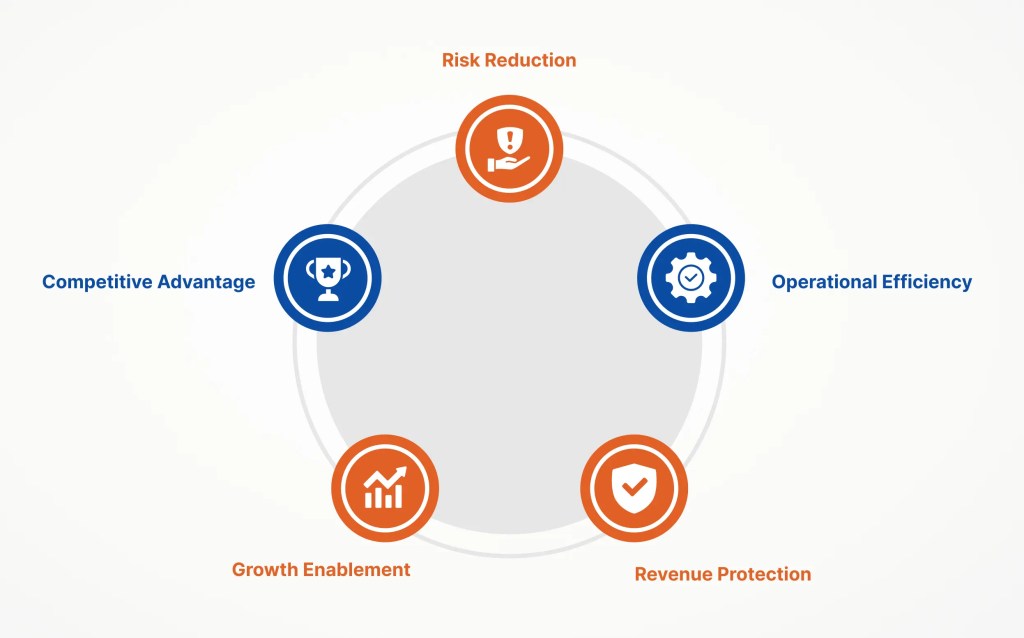
1. Risk Reduction
Estimate the financial impact of a potential data breach and compare it with the cost of maintaining compliance.
2. Operational Efficiency
Identify process improvements, automation opportunities, and resource savings created through compliance efforts.
3. Revenue Protection
Demonstrate how compliance helps preserve customer trust and supports business continuity.
4. Growth Enablement
Show how compliance can accelerate sales cycles and satisfy customer security requirements.
5. Competitive Advantage
Explain how security and compliance strengthen the organization’s market position.
By connecting compliance investments to business objectives, stakeholders can better understand the financial value of PCI DSS.
Measuring PCI DSS ROI
Organizations can evaluate ROI using several metrics:
- Reduction in security incidents
- Decrease in vulnerability remediation time
- Lower audit preparation effort
- Improved customer retention
- Increased contract win rates
- Reduced downtime and disruption
- Enhanced regulatory readiness
Tracking these indicators helps organizations quantify the benefits generated by compliance investments over time.
Rather than treating PCI DSS as a one-time project, businesses should view it as an ongoing strategy that supports both security and business performance.
Conclusion
While PCI DSS compliance is seen as a burden, there are many more benefits down the road than initially thought. Be it saving millions from the costly data breach, boosting productivity or creating customer loyalty, the advantages of PCI DSS compliance go way beyond compliance per se. Companies that approach PCI DSS compliance as an opportunity to gain more from it than just meeting certain regulations will be able to convert PCI DSS into something much more meaningful for their business.
Are you ready to make PCI DSS compliance work for your company? Our PCI DSS experts at ValueMentor help organizations reduce risk, strengthen payment security, and maximize the value of their compliance investments. Whether you’re pursuing compliance for the first time or optimizing an existing program, we can help you build a stronger security foundation while controlling costs. Schedule a consultation today and discover how PCI DSS can deliver measurable business returns for your organization.
FAQs:
Most organizations begin seeing benefits within the first year through reduced risk and improved security practices.
2. Can PCI DSS compliance lower cyber insurance premiums?
Yes, many insurers offer better rates or terms to businesses with strong security controls and compliance programs.
3. Is PCI DSS compliance useful only for big companies?
No, small and big organizations equally benefit from PCI DSS compliance because it increases security and client trust.
4. What are the main benefits of PCI DSS compliance in financial terms?
Saving money on expensive data breaches is usually the main financial advantage.
5. Can PCI DSS compliance increase client trust?
Yes, because it shows that the company is ready to protect sensitive payment information of its customers.
6. Can PCI DSS compliance help win new business?
Absolutely. Many customers and partners prefer working with organizations that meet recognized security standards.
7. How does PCI DSS compliance support operational efficiency?
It encourages better security processes, access controls, monitoring, and risk management practices.
8. What costs should be included when calculating PCI DSS ROI?
Include assessment fees, security tools, staff training, remediation efforts, and ongoing compliance maintenance.
9. Can non-compliance cost more than compliance?
Yes, fines, penalties, breach recovery expenses, and reputational damage can significantly exceed compliance costs.
10. How can businesses justify the cost of PCI DSS compliance?
Comparing compliance investments against avoided breach costs, reduced risks, operational improvements, and business growth opportunities.