The success of modern software delivery lies in striking a balance between speed and security. As organizations embrace DevSecOps to weave security into every stage of development, one truth becomes increasingly clear: automation can only go so far. While scanners and CI/CD checks flag common vulnerabilities, they often miss the nuanced, evolving tactics of real-world attackers. This is where penetration testing companies play a pivotal rolebringing in-depth expertise, contextual analysis and attacker-like perspectives that elevate security beyond compliance checklists. By integrating with DevSecOps pipelines, they help enterprises move from reactive patching to proactive resilience, ensuring that innovation is delivered without compromise.
In this blog, we explore how penetration testing companies integrate with DevSecOps pipelines, enhance security beyond automation, bridge the gap between compliance and real-world protection, and help organizations build proactive, resilient software delivery
Why DevSecOps needs more than just automation?
DevSecOps has revolutionized how organizations build and release software by embedding security into every stage of the CI/CD pipeline. Automated tools like static code analyzers, dynamic scanners, and container vulnerability checks form the backbone of this process, allowing teams to catch common misconfigurations and coding errors at scale.
But here’s the challenge: attackers rarely follow predictable patterns. Automated scanners operate on known signatures and rulesets, which means they are excellent at spotting low-hanging fruit but less effective at identifying complex attack vectors. For example, a scanner might flag outdated software libraries but completely miss a chained exploit that leverages business logic flaws, misused APIs, or privilege escalation paths. This gap highlights the need for specialized human expertise. While automation accelerates development and enforces security hygiene, real-world resilience requires adversarial thinking something machines can’t replicate fully. That’s where penetration testing companies’ step in, complementing automation with deep contextual understanding.
The role of penetration testing companies in security
Penetration testing companies bring a critical “attacker’s mindset” into the DevSecOps pipeline. Unlike automated scans, their methodology is dynamic, simulating real-world threats to uncover vulnerabilities that would otherwise remain hidden.
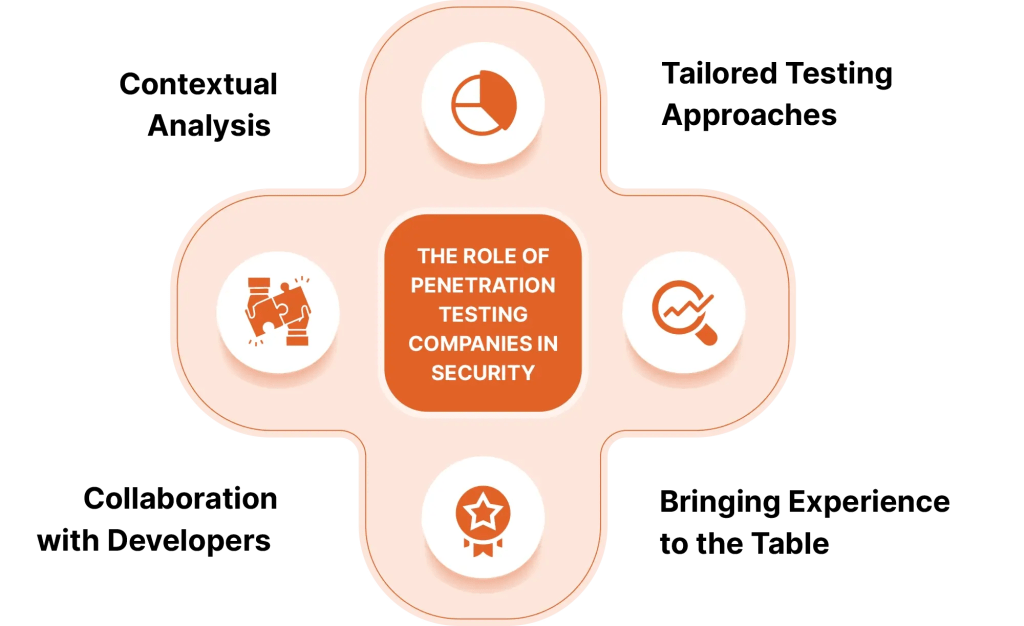
Their role spans multiple dimensions:
-
- Contextual Analysis – They don’t just report vulnerabilities; they analyze their impact on the business. A medium-risk technical flaw in isolation might become critical when chained with another weakness.
-
- Tailored Testing Approaches – Different applications, industries, and compliance needs demand customized testing methods ranging from black-box penetration tests to red team simulations.
-
- Bringing Experience to the Table – Penetration testers continuously track new exploits, threat actor behaviors, and industry attack patterns. This evolving knowledge ensures that organizations aren’t just defending against yesterday’s threats.
-
- Collaboration with Developers – Penetration testing companies increasingly act as partners within DevSecOps, providing actionable remediation advice rather than lengthy, jargon-heavy reports.
In short, their value lies not just in “finding issues” but in helping organizations build practical security defenses that align with business goals and regulatory requirements.
Bridging the gap between compliance and real security
For many organizations, especially in regulated industries like finance, healthcare, or retail, penetration testing is often treated as a compliance checkbox. Standards such as PCI DSS, HIPAA, or ISO 27001 mandate periodic testing, which drives companies to hire vendors only to meet audit requirements.
But compliance alone doesn’t guarantee safety. Meeting the minimum testing frequency—say, once a year ignores the fact that attackers operate continuously, exploiting new zero-days and logic flaws that regulations don’t explicitly cover. Penetration testing companies bridge this gap by reframing testing as a proactive security strategy rather than a compliance burden.
They help organizations move beyond:
-
- Static Compliance Testing → towards Continuous Risk Evaluation
-
- Generic Audit Reports → towards Business-Relevant Security Insights
-
- One-Time Assessments → towards Ongoing Vulnerability Management
By shifting this perspective, businesses gain a more realistic view of their security posture, addressing gaps that compliance frameworks don’t always highlight. This approach not only strengthens defenses but also makes compliance audits smoother, since regulators increasingly value risk-driven security practices.
Integrating penetration testing into continuous development cycles
One of the biggest misconceptions is that penetration testing is only a one-time, pre-release activity. In modern DevSecOps, penetration testing can and should be integrated at multiple stages of the development lifecycle.
Here’s how companies embed testing seamlessly:
-
- Pre-Deployment Testing: Before a major release, penetration testing validates that new code, APIs, or features don’t introduce exploitable weaknesses.
-
- Post-Deployment Testing: Once a web application is live, testers simulate external attacks to ensure production environments remain secure, especially against misconfigurations.
-
- Scheduled Periodic Testing: Even if no major updates are deployed, attackers may find new ways to exploit existing code. Regular testing helps identify these evolving threats.
-
- Continuous Collaboration: Some companies adopt “Pentest-as-a-Service (PTaaS)” models, where penetration testers provide ongoing insights, integrate findings directly into ticketing systems (like Jira), and work in parallel with agile sprints.
By doing this, organizations align pentesting with the rhythm of modern software delivery—quick, iterative and continuous. This not only reduces vulnerabilities but also helps developers fix issues faster, when the code is still fresh in their minds.
Driving proactive resilience through expert security insights
Ultimately, the true value of penetration testing companies lies in building resilience. Modern cyber threats evolve rapidly zero-day exploits, AI-driven attacks, and supply chain vulnerabilities are becoming common. Organizations that rely solely on automated tools or compliance-driven testing often remain reactive, patching issues only after incidents occur.
Expert penetration testers change this dynamic by:
-
- Thinking Like Attackers – They identify not just “what’s broken” but “how it could be exploited,” preparing businesses for real-world adversaries.
-
- Providing Prioritized Risk Insights – Instead of overwhelming teams with endless vulnerability lists, they highlight what matters most to business continuity and data protection.
-
- Guiding Secure Innovation – With testers embedded in DevSecOps, businesses can confidently roll out new features, cloud deployments, or API integrations without fearing hidden security gaps.
-
- Shaping Security Culture – Frequent engagement with penetration testers educates developers, product owners, and operations teams, making security a shared responsibility rather than a siloed task.
This proactive resilience ensures that organizations don’t just keep up with attackers—they stay one step ahead.
Final Thoughts
In the age of rapid software delivery, DevSecOps has become the gold standard for building secure, scalable, and resilient web applications. But automation, while powerful, is not enough on its own. Attackers think creatively, exploit gaps that scanners can’t recognize, and chain vulnerabilities in ways automated tools can’t predict.
This is where penetration testing companies bring irreplaceable value. By integrating human expertise into DevSecOps pipelines, they go beyond compliance checkboxes to deliver contextual, actionable insights. More importantly, they help organizations shift security left, stay ahead of evolving threats, and enable innovation without compromise. At ValueMentor, we go beyond traditional penetration testing. Our experts integrate seamlessly into your DevSecOps pipelines, applying attacker-like thinking to uncover hidden risks and deliver actionable insights. From compliance readiness to proactive resilience, we help you secure software delivery without slowing innovation.
FAQs
1. How does penetration testing complement DevSecOps practices?
Penetration testing adds a human-driven, attacker-like perspective that automation lacks. It helps uncover logic flaws, chained exploits, and real-world risks that scanners often miss.
2. At what stage should penetration testing be introduced in a DevSecOps pipeline?
Penetration testing can be valuable at multiple stages—before deployment, after release, and at regular intervals. Ideally, it should be integrated as a continuous process, not just a one-time event.
3. Can automated security tools replace penetration testing?
No. Automated tools are efficient for identifying common vulnerabilities, but they cannot replicate the creativity and adaptability of skilled attackers. Penetration testing fills this critical gap.
4. How often should companies perform penetration tests within DevSecOps?
Frequency depends on business needs, regulatory requirements, and risk levels. Many organizations adopt quarterly or continuous testing models, especially when code is updated frequently.
5. What types of vulnerabilities do penetration testing companies typically uncover?
They identify business logic flaws, misconfigured cloud environments, insecure APIs, privilege escalation paths, weak authentication mechanisms, and more advanced attack vectors.
6. How do penetration testing companies help with compliance?
They provide detailed reports aligned with standards like PCI DSS, HIPAA, and ISO 27001, helping organizations meet audit requirements while also addressing deeper security risks.
7. Does penetration testing slow down DevOps pipelines?
When integrated correctly (e.g., through Pentest-as-a-Service models), penetration testing runs alongside agile sprints without causing bottlenecks, delivering continuous feedback.
8. What is the difference between penetration testing and vulnerability scanning in DevSecOps?
Vulnerability scanning is automated and broad, while penetration testing is manual, contextual, and deep focusing on how vulnerabilities can be exploited in real-world attacks.
9. How can penetration testing results be integrated into developer workflows?
Findings can be pushed into ticketing systems like Jira or GitLab, enabling developers to fix issues quickly while code context is still fresh. With Secusy Vulnerability Management Solution, this integration becomes seamless findings are prioritized by risk, assigned to the right teams, and tracked through remediation, ensuring faster and more efficient closure.
10. What should businesses look for when choosing a penetration testing company for DevSecOps?
Look for providers with proven expertise in your industry, experience in continuous testing models, collaborative reporting styles, and strong integration capabilities with CI/CD pipelines.