Which industry sector is the most targeted when it comes to cyber-attacks? – Financial Sector, with millions of users and sensitive information hovering every second. As the world pushes itself further into the digital setting, banks and other FIs requiring safety must overcome multiple security challenges. With increasing cyber threats to confront, FIs must do more than enough to guard proactively against them. The particular blog will take you to the top cyber security threats in digital banking and the ways required to fend against the same.
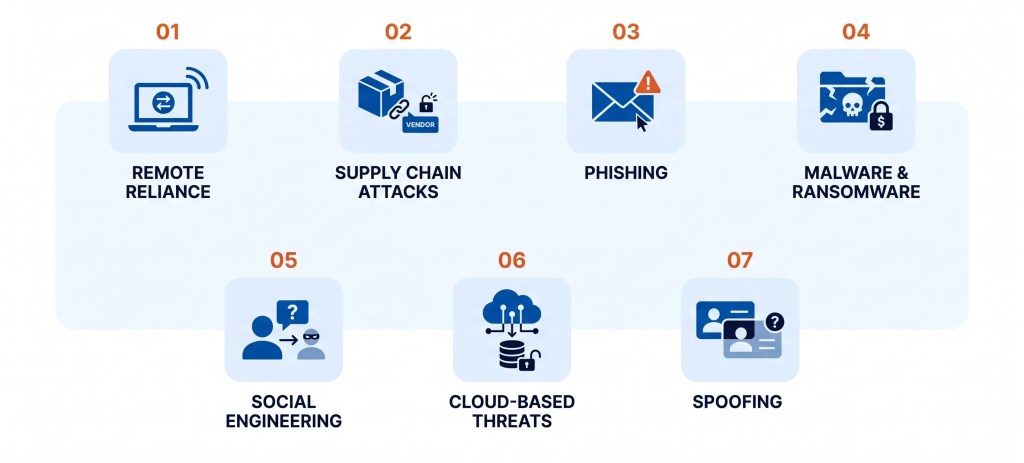
1. Remote Reliance
Remote reliance won’t cease anytime sooner. Since the onset of Covid 19- the approach has become no longer an exception to any industry. More and more financial institutions continue remote work cultures for their employees.
However, with all the comfort signs of remote work culture, cyber security requires more diligence. When the end-users shift to their preferable workplaces, they get far from an organization’s physical security wrap. It can hinder the ability of IT teams to keep internal software safe and customer-sensitive information out of malicious hands.
To handle the security issue or challenge is to make employees or end-users aware of security challenges while working remotely. FI’s could also invest in cyber security training and awareness programs binding their entire working layer.
2. Software Supply Chain attacks
It is a malware distribution technique targeting a software vendor and using their distribution channels to deliver their intended code to customers. The attack propagates through the supply chain in the form of software updates or products that seem to be legitimate. You must note that attackers can ingrain their malicious code in illegitimate updates from the primary vendor.
The attack compromises distributed systems and would allow easy access to supplier networks. It can get persistent with business systems and remain undetected for the long haul. To successfully fend against supply chain attacks, you must be proactive in vulnerability scanning and penetration testing. Partnering with a security testing vendor is most recommended to detect such advanced and persistent threats.
3. Phishing
If you ask us ‘which is one of the biggest cyber security threats in digital banking, it would be none other than phishing attacks. Phishing proves the most favoured tool for hackers in the digital domain. The malicious agents use disguised emails/domains to deceive individuals into downloading malware or giving away personal information. The process is known as credential phishing.
When it comes to banking, employees and end-users are at the same level of risk. Attackers might use emails that resemble official bank correspondence to customers that intend to steal critical information. As a solution, employees need to give the right direction or awareness to users to help filter such phishing emails.
4. Malware & Ransomware
While looking at the stats of the most dangerous threats over the last couple of years, malware & ransomware attacks hit the deck. Malware and ransomware threats don’t confine just to the financial sector but to every other industry. While the digital landscape evolves, these threats turn more advanced and sophisticated.
Organizations require advanced cyber security techniques and approaches to fend against these persistent threats. Cyber security specialists combine capabilities of Artificial Intelligence (AI), Machine Learning (ML) mechanisms and Behavioural Analysis tools as a top solution. All financial institutions need to enhance their security belt to contain these cybersecurity threats and thereby avoid a potential reputation-damaging data breach.
5. Social Engineering
Both Phishing and Social Engineering go on parallel notions but with different goals. The specific attack targets users and employees because they are the weakest links or vulnerable threads of a supply chain. They can be easily tricked into giving sensitive information and other credentials.
The attack can take any form. It can be through phishing or whaling attacks. The actors might also direct malicious invoices to users that seem like originated from legitimate sources. Social Engineering has been gaining popularity with its success rate, and employees must give proper awareness to customers about the same.
6. Cloud-based Threats
50 % of corporate data goes under the cloud shadow, and 90 % of organizations leverage multi-cloud infrastructure. You can witness the rise in stats as the cloud provides advantages that no industry could sidestep. More and more systems and data get enabled within the cloud, and at the same time, security concerns are mounting, especially in the financial sector.
Attackers have used cloud-based attacks to capture sensitive information. More than two years into the pandemic, banks, insurers, and other monetary institutions report costly outcomes of falling short of covering their critical data from cloud-based cyber security attacks and network disruptions. Here, organisations need to ensure that the cloud infrastructure gets configured securely to protect from destructive breaches.
7. Spoofing
Spoofing is like Phishing but more intricate. You can find many types of spoofing attacks utilising some form of impersonation. Brand spoofing is when scammers simulate a person or a company to deceive customers into trusting the sender and providing sensitive information such as personal identifiable information (PII), bank account details, etc. Domain spoofing consists of forming a deceitful version of the actual domain to drive users into giving away personal information or other credentials.
There are many other situations where spoofing exists like a fake email confirmation, fake SMS alerts, fake wire transfer requests, fake phone call scams, etc. Email authentication & identity verification play a significant part in containing the risks of becoming a target of brand spoofing & impersonation attacks. There are many other possible online security solutions that financial institutions can use against spoofing attacks.
8. Unencrypted Data
Unencrypted data is always a huge threat to financial institutions of all scopes. Encryption plays a vital role in helping protect data from unauthorized access. If hackers capture your unencrypted data or use them for undesirable purposes, that can create serious problems for financial entities. Hence, data should be encrypted so that even if the bad actors get hold of your critical data, it will be hard to decrypt the same.
9. Fraud & Identity Threats
Fraud and Identity threats aren’t running anyway far. While these aren’t something new to the financial industry, they keep evolving to different digital versions or channels. These can also be driven through other channels, making detection more complex and harder for security personnel.
A possible way out of fraud and identity threats for organizations is to improve their cyber security strategies. The process helps actively search for suspicious account activities. It can help organizations fight these attacks on the virtual front and is one of the effective ways to catch fraud attempts.
10. Customer Behaviours
Not only employee negligence or reckless behaviour can put organizational data at the wound, but customer behaviour too. Imagine a case where a customer doesn’t follow the stipulated
security measures as directed by security personnel. With poor security practices, it would only take a few seconds for your information to get compromised. Some examples of these are reusing passwords, using default credentials, and clicking suspicious emails.
As a solution, there are a few ways digital banking entities could prevent breaches from happening due to customer errors. Using a security-first approach while designing mobile applications, and that have built-in security functions can help prevent breaches to some extent. Parallelly, fostering multifactor authentication methods for accesses and fingerprinting techniques goes useful.
Assured security possibility with ValueMentor
Cyber security attacks are becoming more common and refined each year. Whether the cyber attackers look to mask themselves as third-party vendors or implement new spoofing techniques to steal data, it’s vital to implement a platform built to help streamline your security processes. When more consumers turn their heads the digital way, a reactive approach to protecting the network is what organizations require. Also, financial institutions must stay at the forefront of cybersecurity innovations in today’s digital banking environment. ValueMentor is a full-fledged cyber security team and one of the trusted names that you can rely on in the financial sector. To know more about our cyber security services, click the link below that can take you to our array of services reflecting financial security.
Consult our cyber security specialists
We can help you optimize cyber security. ValueMentor, with a full-fledged Cyber Security team, is ever ready to handhold you with a holistic and proactive security approach. Have a concealed security ring around your business, helping you alleviate risks, enhance security and meet compliance with various regulations. Get your customized consultation and security advice.
FAQs
1. How do AI-powered phishing and deepfake scams change banking fraud dynamics?
Generative AI enables ultra-realistic phishing emails, voice deepfakes, and video scams that easily bypass human and some automated systems, increase the urgency for advanced detection tools and continuous security training.
2. Why are supply chain attacks one of the toughest risks for banks?
Threats can hide in vendor updates or third-party software, making it hard to detect until after a breach-requiring continuous vendor testing and deep dependency audits.
3. What makes Man‑in‑the‑Browser (MitB) attacks so stealthy in banking apps?
MitB malware silently alters transactions or injects fraudulent messages within the browser, bypassing network encryption and typical endpoint detection.
4. How do ransomware operations now exploit financial institutions beyond encryption?
Modern attacks exfiltrate data for extortion and threaten public exposure or regulatory complaints, pressuring banks beyond traditional decryption demands.
5. Why are cloud‑based threats rising sharply for banks in 2025?
Complex multi-cloud setups often lead to misconfigurations or exposed APIs-creating valuable access points for attackers without obvious network footprints.
6. What role do insider threats play in digital banking security?
Employees or contractors-malicious or negligent-can misuse privileged access or credentials, especially in environments lacking strong controls like behavioral monitoring, PAM or audit logging.
7. How does cryptojacking affect banking infrastructure?
Attackers hijack computing resources in cloud or on-prem environments for mining, degrading system performance and increasing costs without immediate detection.
8. What steps can mitigate DDoS risk in financial services?
Implement scalable traffic filtering, redundant infrastructure, and well-defined DDoS response protocols paired with cloud-based scrubbing to safeguard availability.
9. Why is post-quantum cryptography becoming urgent for banks?
With quantum computing on the horizon, current encryption (like RSA/ECC) could be broken, so migrating to quantum-resistant algorithms now is critical.
10. How can ValueMentor assist banks facing these complex threats?
ValueMentor delivers bespoke threat modelling, adversary simulation (including AI/deepfake and supply-chain scenarios), secure architecture reviews, and continuous monitoring tailored for financial institutions.