In the commercial gaming industry, a Sensitive Data Protection Plan (SDPP) is not just another policy; it is the blueprint that determines whether your operation survives a regulatory audit. Yet, many Internet Gaming and Lottery operators still treat SDPP documentation as a static compliance artifact rather than a living governance framework.
If you are a licensed operator under the UAE General Commercial Gaming Regulatory Authority (GCGRA), here are the five most common SDPP failures and what you must fix to protect your business, data and license.
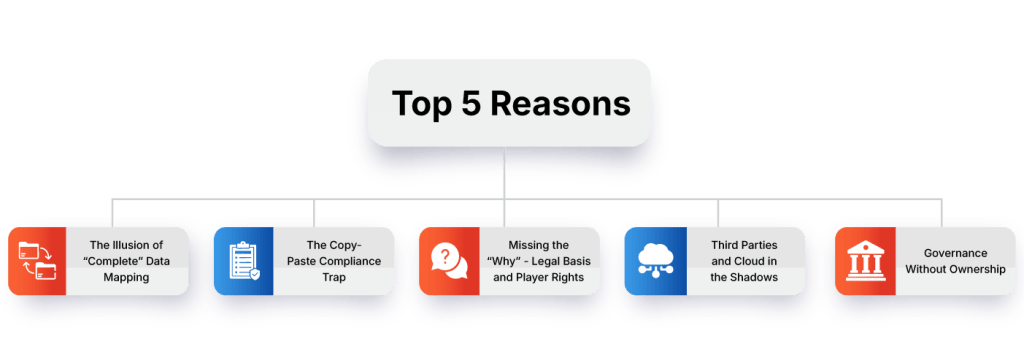
1) The Illusion of “Complete” Data Mapping
Most SDPPs assume sensitive data lives inside databases. Gaming data flows across multiple systems player chats, RNG logs, payment gateways, analytics platforms, and third-party affiliates.
- The Risk: Incomplete data inventories create blind spots and weak audit trails.
- The Fix: Build a dynamic data flow map that captures every collection, processing, transfer, and deletion point. Assign ownership, link to retention rules, and validate quarterly. Regulators expect live documentation, not static diagrams.
2) The Copy-Paste Compliance Trap
Boilerplate SDPPs are still common across gaming operators. Generic language like “data is encrypted” or “consent is obtained” signals a lack of operational control.
- The Risk: Non-compliance findings and credibility loss during regulatory inspections.
- The Fix: Replace generic lines with technology-specific controls. For example: “Player KYC images shall be stored in Azure Blob (hot to cool lifecycle) encrypted with AES-256; retention period-X years per AML policy.”
Real systems, real controls, real evidence – that’s what compliance reviewers expect.
3) Missing the “Why” – Legal Basis and Player Rights
Many gaming operators explain what they process but fail to justify why. Under UAE PDPL/GDPR and GCGRA SDPP requirements, lawful processing and player rights handling must be explicitly documented.
- The Risk: Undefined legal bases, invalid consent, and privacy-right violations.
- The Fix: For each purpose-KYC, fraud detection, analytics, and marketing-document the lawful basis (consent, legitimate interest, contractual necessities or legal obligation). Maintain a player rights workflow with SLAs for access, erasure, and restriction requests. Keep evidence logs to prove fulfillment during audits.
4) Third Parties and Cloud in the Shadows
Gaming ecosystems rely on affiliates, payment processors, and cloud platforms. But most SDPPs fail to document third-party accountability.
- The Risk: Breaches traced to vendors without documented responsibility or data protection agreements (DPAs).
- The Fix: Maintain a third-party data register covering:
- Data shared and purpose
- Role (controller/processor)
- Transfer mechanism and jurisdiction
- DPA and assurance evidence (ISO 27001, SOC 2)
Regularly review vendor access and compliance status. Regulatory authority expects end-to-end accountability, not partial oversight.
5) Governance Without Ownership
A strong SDPP fails if no one owns it. When roles aren’t defined, updates lapse, and documentation stops reflecting the live environment.
- The Risk: Outdated plans, untracked changes, and failed regulatory revalidation.
- The Fix: Appoint an accountable owner (e.g., DPO or Compliance Manager), establish quarterly reviews, and integrate SDPP updates into change management workflows. Treat your SDPP like source code-versioned, reviewed, and updated.
What the Regulatory Authority Expect to See?
- A live, version-controlled SDPP mapped to real systems and data owners
- Clear lawful processing basis and evidence of player consent
- Vendor register with transfer mechanisms and compliance assurance
- Control proof: encryption configs, IR playbooks, data-retention logs
- Governance trail: approvals, reviews, and training records
Closing Thought
The GCGRA Regulations require every licensed Gaming Operator in the UAE must contract an authorized Sensitive Data Services Provider to develop and maintain an approved Sensitive Data Protection Plan (SDPP). ValueMentor, a GCGRA-approved Sensitive Data Services Provider, works with gaming operators to build SDPPs that are fully aligned with UAE data protection and gaming regulations. Our consultants transform SDPP documentation into a regulatory-ready governance framework-complete with data mapping, vendor assurance, and evidence that holds up under audit.
If your SDPP still reads like a template instead of a protection strategy, it’s time to rebuild it. With ValueMentor, your SDPP becomes what regulators expect-a living, verifiable control framework that keeps your operations compliant, secure, and audit-ready.
FAQs
1.What is a Sensitive Data Protection Plan (SDPP)?
A Sensitive Data Protection Plan, or SDPP, is a plan that specifies how your organization processes sensitive information from gathering to deletion. For licensed gaming operators in the UAE, it’s a required document under the General Commercial Gaming Regulatory Authority (GCGRA) that substantiates your data handling procedures are regulatory compliant.
2.Why do most Sensitive Data Protection Plans fail during regulatory audits?
Most SDPPs don’t succeed because they are addressed as paperwork one-time affairs rather than a living document. Issues typically include incomplete data mapping, stale data, missing ownership, or the absence of evidence that the controls listed are indeed implemented. Regulators seek evidence, not assumptions.
3.What must an effective SDPP contain?
A good SDPP must identify where data resides, how it travels, and who is responsible for it. It must address the lawful processing requirements, vendor obligations, encryption policies, retention schedules, and incident response procedures. Above all, it must be updated from time to time to ensure it accurately documents your business operations.
4.How does the GCGRA govern Sensitive Data Protection Plans?
The GCGRA mandates that all licensed gaming operators in the UAE establish and keep current an SDPP with the assistance of a qualified Sensitive Data Services Provider. The plan will need to conform to UAE’s data protection law (PDPL) and show adherence to all GCGRA-prescribed governance provisions.
5.Why is data mapping so important to sensitive data protection?
Without proper data mapping, you simply can’t defend what you can’t see. Gaming data moves through numerous systems-payment systems, analytics tools, chat history, and so on. Mapping tracks down each point where data is gathered or passed, lessening the risk of leaks and compliance holes.
6.How do gaming operators effectively manage third-party data risks?
Third-party vendors are usually the greatest unknown risks. The optimal solution for dealing with them is keeping a vendor data register with what data is exchanged, for what reasons it’s exchanged, and what security certifications each vendor maintains. Periodic compliance checks and signed Data Processing Agreements (DPAs) come a long way in assuring accountability.
7.What is the difference between an SDPP and a privacy policy?
A privacy policy is an external statement for your users-it tells them how their data is used. An SDPP, on the other hand, is an internal governance document. It details how your systems, teams, and vendors actually protect that data behind the scenes. Both are essential, but they serve very different purposes.
8.How does ValueMentor support gaming operators with SDPP compliance?
ValueMentor collaborates directly with licensed gaming operators to develop and sustain SDPPs that are compliant with GCGRA executive regulations. As a certified Sensitive Data Services Provider, we assist operators in developing governance structures supported by tangible controls, audits, and evidence that regulators can validate.
9.How frequently must the SDPP be updated or reviewed?
Your SDPP must never remain static. Ideally, it must be inspected quarterly or whenever you implement a new system, vendor, or process. Regular maintenance demonstrates to regulators that your data protection plan adapts to your operations-not after an incident.
10.What if a gaming operator fails to meet SDPP requirements?
Disregarding SDPP compliance has serious repercussions. It may result in audit failure, suspension of licenses, monetary fines, and erosion of player trust. An up-to-date SDPP not only ensures you remain compliant but also bolsters your data security posture overall.