
PCI DSS compliance protects your business and customers, but many organizations make costly mistakes during the process. Common errors like inadequate scoping, selecting the wrong assessment questionnaire, insufficient testing, and poor documentation can lead to failed audits and significant financial penalties. This guide identifies these critical mistakes and provides practical solutions to help you achieve and maintain compliance effectively.
What are the Most Common Mistakes?
Businesses pursuing PCI DSS compliance is repeating the same basic errors repeatedly, irrespective of the size or industry. It is very critical to point out these errors before there is any severe impact on the PCI DSS assessment.
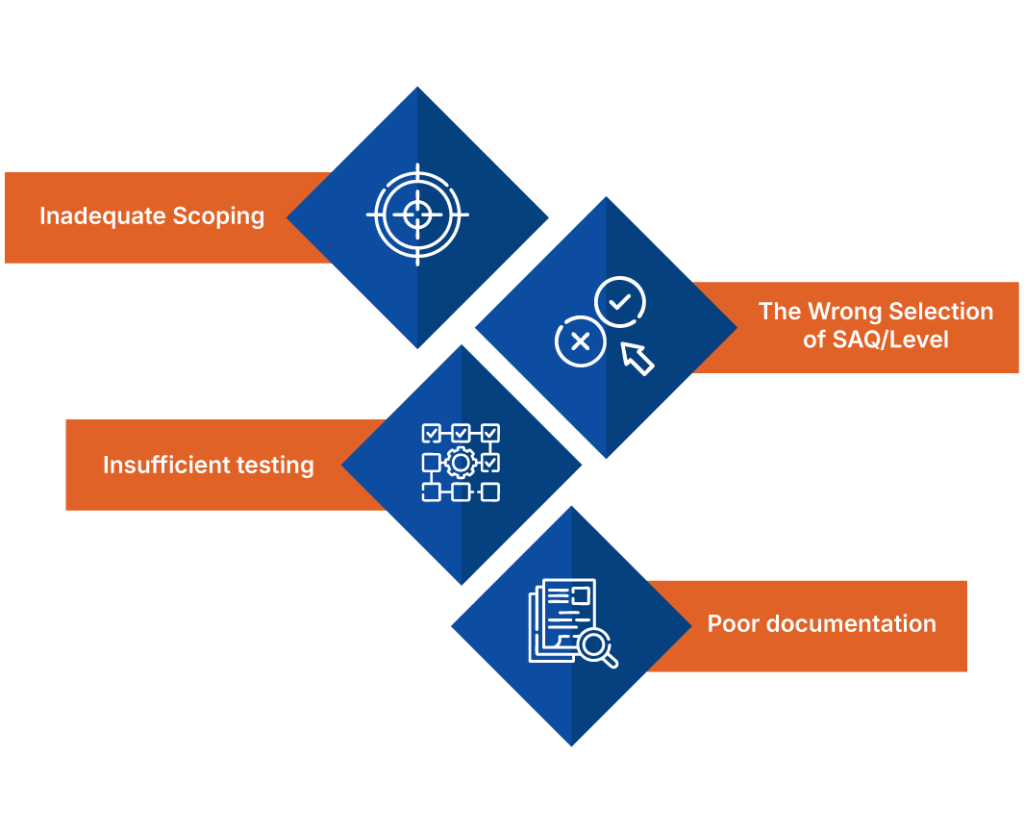
- Inadequate Scoping: Inadequate scoping ranks are one of the most common errors. Businesses often poorly identify which systems, networks, and processes handle cardholder data, which leads to incomplete protection and failed audits. If the CDE is wrongly defined, security controls will miss critical assets, leaving vulnerabilities exposed.
- The Wrong Selection of SAQ/Level: Most organizations make the mistake of selecting Self-Assessment Questionnaires or the level by prioritizing convenience instead of actual payment processing methods. This difference results in compliance gaps that manifest during the formal validation process and lead to costly remediation work.
- Insufficient testing: Companies often conduct the activities related to PCI DSS compliance checks without addressing the real causes and perform less-than-adequate vulnerability scanning without taking due care in remediation, or they even skip the penetration testing completely. Such shortcuts will leave security weaknesses unidentified until a breach hits them or is brought to light by an auditor.
- Poor documentation: Poor documentation depletes otherwise good compliance efforts. Without appropriate evidence, policies, or incomplete records of security controls, unnecessary PCI DSS audit issues arise. In their absence, proving compliance is impossible, even when relevant controls may exist.
Unfortunately, most organizations discover these PCI DSS common pitfalls too late, either during formal assessments or, worse, after security incidents. The early involvement of a qualified PCI DSS consultant will help identify and rectify these mistakes before they become expensive problems.
How Severe Can Be the Impact?
The costs of PCI DSS non-compliance go far beyond the mere regulatory fines. The financial, operational, and reputational consequences have organizations aligned in a tailspin towards potential extinction business-wise.
- Financial Penalties strike immediately: Payment card brands impose heavy fines depending on the severity of the offense. These penalties increase with repeated violations or data breaches. Banks may also raise transaction fees costs that add up quickly for high-volume merchants. A mid-sized retailer processing 100,000 monthly transactions faces an additional monthly fee.
- Breach-related costs dwarf compliance penalties: The average data breach costs organizations $4.35 million, including forensic investigations, legal fees, customer notification, credit monitoring services, and regulatory fines. In fact, card reissuance costs alone can reach $5 to $10 per compromised card.
- Operational disruptions exacerbate financial losses: The suspension of a merchant account by payment processors during PCI DSS audit issues brings revenue streams to a complete standstill. Businesses are unable to accept cards, the death sentence for most modern commerce operations. Remediation efforts tie up IT resources from strategic initiatives on emergency work necessary for compliance.
- Long-term harm is inflicted by reputational damage: After data breaches, customer trust evaporates; studies have shown that 60% of consumers avoid businesses that have experienced security incidents. Lost customers, reduced brand value, and competitive disadvantages continue for years.
- Legal Liability adds another layer of risk: Class-action lawsuits from affected customers, along with regulatory investigations, create ongoing legal expenses. Most organizations have not considered these cascading impacts until they engage in their first comprehensive PCI DSS compliance check with a qualified PCI DSS consultant.
What are the Most Effective Strategies to Avoid Them?
Preventing common PCI DSS pitfalls requires proactive planning, expert guidance, and step-by-step implementation of security controls. Companies that use these approaches considerably reduce the rate of compliance failures and security risks.
Engage an experienced PCI DSS consultant as early as possible. Rather than attempting compliance independently, partnering with an experienced PCI DSS consultant provides expert guidance through complex requirements. Consultants identify gaps before they become audit failures, recommend appropriate SAQ types or levels, and ensure accurate scoping. This investment prevents costly remediation cycles and failed assessments.
- Perform Thorough CDE Mapping: Scoping accuracy starts with proper documentation of all systems, applications, networks, and personnel storing, processing, or transmitting cardholder data. Utilize network diagrams, data flow analysis, and asset inventories to create comprehensive visibility. Include those connected systems that may affect the security of the CDE even if they don’t directly handle card data.
- Segment Your Network: Properly segmenting your network isolates cardholder data from other business systems, reducing scope and simplifying PCI DSS compliance. This architectural approach minimizes the number of systems requiring stringent controls and thereby reduces overall compliance costs.
- Establish Continuous Monitoring: Instead of treating PCI DSS assessment as an annual event, implement ongoing security monitoring, regular vulnerability scanning, and periodic internal audits. Continuous compliance prevents drift from security standards and identifies issues before formal validation.
- Develop Robust Documentation Practices: Create standardized templates for policies, procedures, and evidence collection. Maintain detailed records of all security controls, testing results, remediation efforts, and configuration changes. Strong documentation transforms PCI DSS compliance check activities from a cumbersome scramble into manageable processes.
- Regular Staff Training: Human error is the driving cause of most compliance failures. Staff should be trained on data handling procedures, security policies, and their role in maintaining compliance. Regular awareness programs reduce accidental exposures and policy violations.
What Is the “Fix-It” Checklist?
This checklist lays out practical steps to combat common pitfalls in PCI DSS and improve your compliance stance. Use this as a roadmap during your assessment preparation or if any issues arise from a PCI DSS audit.
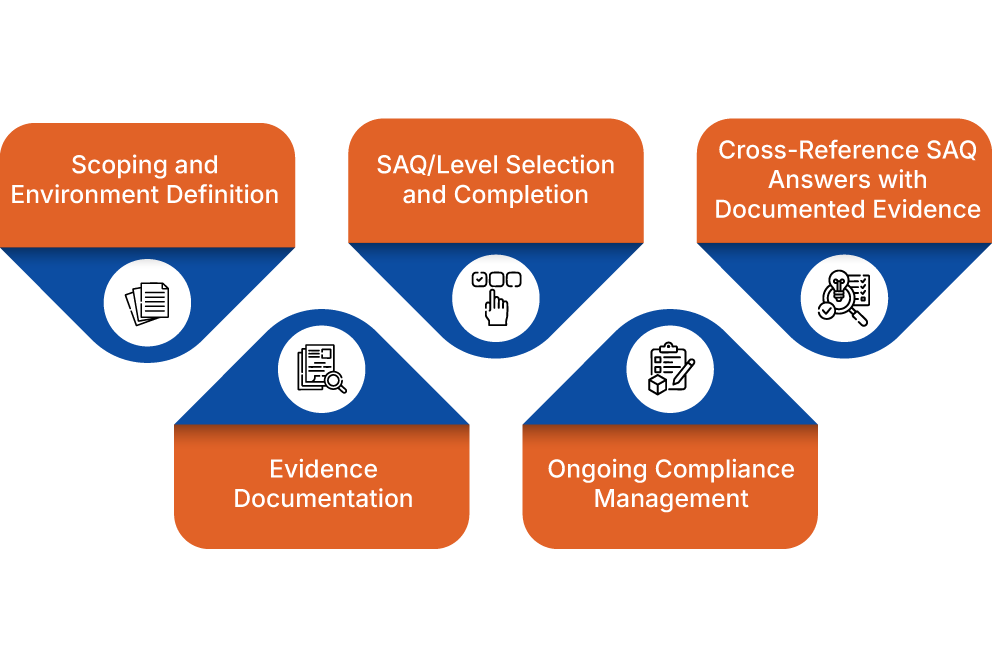
Scoping and Environment Definition
- Document all locations where cardholder data is stored, processed, or transmitted.
- Draw detailed network diagrams showing the CDE boundary and segmentation points
- Identify all systems connected with or affecting the security of CDE
- Review and update scoping documentation quarterly or upon infrastructure changes. Validate that the segmentation controls isolate the CDE effectively.
SAQ/Level Selection and Completion
- Select the Correct SAQ Type and Level: Determine your merchant or service-provider level based on annual transaction volume and choose the SAQ type that most precisely matches how your business stores, processes, or transmits cardholder data. An example would be that SAQ A is suited for fully outsourced e-commerce merchants, while SAQ D applies to environments handling or storing card data directly.
- Answer Based on Implemented Controls, Not Intent: Every “Yes” answer in the SAQ should be for controls that exist and are verifiable. Provide appropriate details or evidence to support each answer and justify any “No” or “N/A” responses with remediation steps or compensating controls.
- Validate and cross-check before submission: Cross-check all SAQ responses against supporting documentation/evidence (policies, scan reports, configuration records). The completed SAQ and AOC should be reviewed by a PCI DSS consultant or internal expert to ensure that it is accurate before submitting it.
Cross-Reference SAQ Answers with Documented Evidence
- Have a PCI DSS consultant reviews your completed SAQ before submission.
- Security Testing Requirements: Schedule quarterly vulnerability scans with an Approved Scanning Vendor (ASV).
- Perform annual penetration testing of CDE systems and segmentation controls.
- Remediate all high-risk vulnerabilities before considering the PCI DSS compliance.
- Check complete document all test results, findings, and remediation actions.
- Perform internal vulnerability assessments between external scans.
Evidence Documentation
- Current versions of all security policies and procedures shall be maintained.
- Continuously collect evidence, instead of scrambling during audit periods.
- Organize documentation by PCI DSS requirement for ease of retrieval.
- Store evidence securely by using appropriate access controls and retention policies.
- Create evidence matrices linking each requirement to supporting documentation.
Ongoing Compliance Management
Assign clear ownership of PCI DSS compliance responsibilities. Establish periodic compliance review meetings with stakeholders. Monitor security controls for both effectiveness and configuration drift. Update compliance documentation when systems or processes change Schedule annual formal assessments well in advance of expiration deadlines This checklist turns overwhelming compliance requirements into manageable tasks that will help prevent critical oversights in your PCI DSS assessment.
Final Thoughts
PCI DSS compliance failures stem from inadequate scoping, incorrect SAQ selection, insufficient testing, and poor documentation. Non-compliance triggers fines up to $100,000 monthly and a substantial breach costs. Prevention requires qualified consultants, thorough CDE mapping, network segmentation, and continuous monitoring. Proactive compliance significantly reduces audit failures before they escalate.
Remember, compliance is all about customer trust, brand reputation, and business continuity. It is always important to go with the fix-it checklist, handle weaknesses sequentially, and carry out periodic PCI DSS compliance check activities to keep the security posture healthy. ValueMentor is continuously helping organizations to identify the critical mistakes and fix them within the timeframe. Partner with ValueMentor for any PCI DSS compliance-related assistance.
FAQs
1. What are the four PCI DSS merchant levels, and how do service providers fit into these levels?
The four PCI DSS merchant levels are based on annual transaction volume: Level 1 (over 6 million), Level 2 (1-6 million), Level 3 (20,000-1 million), and Level 4 (under 20,000). Service providers are classified separately based on the number of transactions they process or store, and their PCI DSS validation requirements depend on their specific service level.
2. Do small businesses need PCI DSS compliance?
PCI DSS applies to all entities involved in payment processing, regardless of size or transaction volume PCI DSS Security Standards Council. Even Level 4 merchants must complete annual SAQs and quarterly scans.
3. What is a Qualified Security Assessor (QSA)?
QSAs are independent security organizations qualified by PCI SSC to perform PCI DSS assessments PCI DSS Security Standards Council. Level 1 merchants require QSA validation and formal Reports on Compliance. QSA signature on SAQ is not required, but there are cases where their acquiring bank/payment brands would specifically ask for SAQ with QSA signature.
4. How often must vulnerability scans occur?
External scans must be performed quarterly by an Approved Scanning Vendor, while internal vulnerability assessments must be conducted at least quarterly and after any significant change. Penetration testing is required annually or after major infrastructure modifications.
5. Can outsourcing eliminate PCI DSS requirements?
No, outsourcing reduces scope but doesn’t eliminate compliance responsibility. You must validate service provider compliance annually.
6. What are the differences between PCI DSS 3.2.1 and 4.0.1?
Version 4.0 requires tighter access management, continuous monitoring, mandatory multi-factor authentication, and stronger password practices, Data, emphasizing ongoing security rather than point-in-time compliance.
7. What is an Attestation of Compliance (AOC)?
An AOC validates completion of your SAQ or Report on Compliance. All merchant/service provider levels must submit AOCs to acquiring banks annually.
8. Does encryption remove systems from scope?
Encryption alone doesn’t render cardholder data out of scope PCI DSS Security Standards Council. Systems managing encryption or keys remain in the compliance scope.
9. How long does achieving compliance take?
Small businesses typically require 2-4 months, while complex organizations need 6-12 months for complete implementation and validation.
10. What happens after a breach while compliant?
After a breach, even if compliant, the organization must investigate the incident, report it, assess system weaknesses, enhance security measures, and demonstrate continued PCI DSS compliance to avoid penalties.