
For many IT, compliance, and security teams, the mere idea of an audit seems daunting. There is documentation to be collected, systems to be scanned, and evidence to be harmonized, all while maintaining business as usual. But the reality is this: a PCI DSS audit need not be traumatic. Faced with the proper preparation and attitude, it can even enhance your organization’s overall security stance and reveal vulnerabilities you could have missed. Consider it more of a check-up than an examination of your payment environment security.
In this blog, we are going to walk you through a step-by-step PCI DSS audit preparation checklist, realistic timelines for your team, and the most common pitfalls organizations face before their audit. Whether you’re preparing for your first test or looking to streamline your compliance process, this blog will guide you through the process with ease and fewer surprises.
What is a PCI DSS Compliance Audit?
A PCI DSS audit of compliance is an independent examination by a Qualified Security Assessor (QSA) to ensure your business has adhered to the PCI DSS requirements for securing cardholder data. Depending on the volume of card transactions your business processes or handles in a year, a requirement from your compliance accepting entities, such as acquirer banks, central banks, payment gateways, and other government or non-government entities, and the risk level, you might require a Report on Compliance (ROC) or a Self-Assessment Questionnaire (SAQ).
The audit evaluates your compliance with six critical PCI DSS control objectives:
- Build and maintain a secure network and systems
- Secure cardholder data
- Maintain a vulnerability management program.
- Apply strong access control measures
- Regularly monitor and test networks
- Keep an information security policy
Early preparation for the audit prevents you from facing last-minute shocks, compliance gaps, or costly non-conformities.
Why PCI DSS Audit Preparation is Important?
Popping a PCI DSS compliance audit can initiate severe business repercussions like fines from card brands, higher transaction fees, bad publicity, or even exclusion from card acceptance. Proactive preparation not only keeps your organization compliant but also enhances your overall security position by exposing vulnerabilities before attackers do. It turns compliance into an ongoing exercise and is transformed into a routine security operation.
PCI DSS Audit Preparation Timeline
You should typically prepare for a PCI DSS audit 8-12 weeks before the final audit, based on the size and readiness of your organization. Below is an example of a preparation schedule.
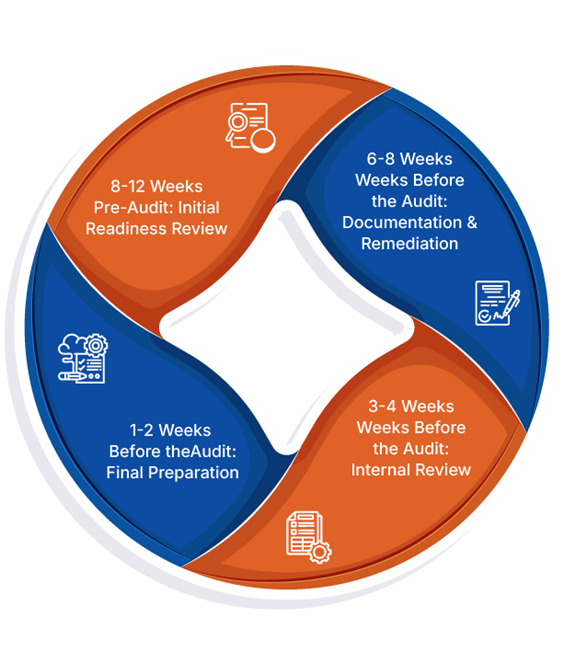
8-12 Weeks Pre-Audit: Initial Readiness Review
- Perform gap analysis against the latest PCI DSS version (currently v4.0).
- Establish scoping boundaries for systems, applications, and networks that transmit, store, or process cardholder data.
- Track the status of compliance of third-party service providers.
- Assign responsibilities and tasks to your compliance, IT, and security teams.
6-8 Weeks Before the Audit: Documentation & Remediation
- Update and merge security and compliance procedures and policies.
- Implement remediation strategies in areas of gaps identified.
- Audit system hardening, patch management, and network segmentation policies.
- Collect evidence artifacts like firewall and server configurations, vulnerability scans, and access control lists.
3-4 Weeks Before the Audit: Internal Review
- Conduct internal, external penetration testing and vulnerability scans.
- Validate incident response plans and log monitoring systems.
- Re-validate password configuration and access control policies.
- Validate encryption and key management procedures.
1-2 Weeks Before the Audit: Final Preparation
- Set up an audit binder or centralized location holding all requisite documents.
- Conduct a mock audit or internal walkthrough.
- Validate key personnel understand their role during interviews.
- Make sure the previously reported gaps are addressed.
- Ensure timestamps and evidence logs are up to date.
What Do You Need to Prepare for a PCI DSS Compliance Audit?
The following is an exhaustive PCI DSS pre-audit checklist to ensure you are prepared.
1. Policies and Documentation
- Information Security Policy (ISP)
- Access Control Policy
- Data Retention and Disposal Policy
- Incident Response Plan
- Risk Assessment Reports
- Firewall and Router Configuration Standards
- Policy for Change Management
2. Technical Evidence
- Network topological diagrams
- Data flow and system inventory diagrams
- Firewall and IDS/IPS rules
- Patch management logs
- Anti-malware settings
- Encryption key management logs
- Authentication and authorization configurations
3. Monitoring and Testing
- Reports of internal and external vulnerability scans
- Penetration test reports
- Audit logs and monitoring evidence
- Log retention policy and SIEM configurations
4. Personnel and Training
- Employee IT security training records
- Access review logs and HR offboarding procedures
- Incident response team roster and communication plan
5. Third-Party and Vendor Management
- Up-to-date Attestation of Compliance (AoC) from all vendors
- PCI DSS requirements clearly outlined within contracts
- Ongoing vendor risk assessments
Having these documents in place before the QSA’s arrival saves time and shows audit maturity.
What Common Pitfalls Can Delay Your PCI DSS Compliance Audit?
Good intentions can befall even good-natured teams and cause PCI DSS compliance audit to become challenging. The following are common pitfalls:
- Poor Scope Definition: Most organizations cannot define their Cardholder Data Environment (CDE) adequately. Over-scoping increases workload but under-scoping compromises compliance.
- Outdated Documentation: QSAs typically find policies over 12 months old or no longer reflective of current operations.
- Incomplete Evidence: Stale logs, stale scan data, or inconsistent configurations can create remediation loops.
- Weak Access Controls: Shared credentials, over-granted privileges, and the absence of two-factor authentication are big compliance red flags.
- Neglecting Third-Party Risks: Depending on service providers without checking their PCI compliance can affect your own audit findings.
- Treating PCI as a Once-a-Year Exercise: PCI DSS compliance needs to be an all-year-round effort, not a catch-up exercise before audit time.
Tips for Smooth PCI DSS Audit Documentation
- Centralize all: Store all evidence in a compliance management system or shared repository.
- Maintain Version control: Document when policies were last revised and who approved them.
- Provide Context: Add brief descriptions or notes to interpret technical evidence that is tricky.
- Naming conventions: Give all evidence standard names so they can be quickly retrieved during audit interviews.
- Track Dependencies: Connect dependent artifacts (e.g., firewall rule → policy reference → change request).
What to Do After a PCI DSS Compliance Audit?
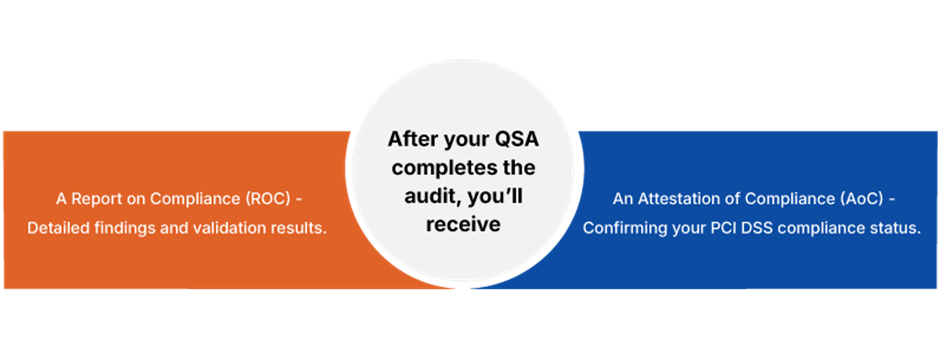
After your QSA completes the audit, you’ll receive:
- A Report on Compliance (ROC) – detailed findings and validation results.
- An Attestation of Compliance (AoC) – confirming your PCI DSS compliance status.
Use the post-audit phase to:
- Address any non-conformities or remediation findings.
- Review audit recommendations and update internal controls.
- Plan for continuous monitoring and quarterly validation to maintain compliance year-round.
Conclusion
Preparing for a PCI DSS audit does not have to be daunting. Good planning, documentation discipline, and team coordination enable your business to get ready to face the audit confidently. View preparation as an opportunity to create a more robust payment data environment and not as a compliance checkbox. A well-executed PCI DSS audit a foundation for long-term trust, security, and business resilience in the digital payment economy. ValueMentor’s experienced professionals can guide you through every step of the process, from pre-audit preparation to post-audit remediation. Contact ValueMentor today and let our experts ensure your organization is in top shape, compliant, and secure before the QSA ever arrives at the door.
FAQS
1. How often should a PCI DSS compliance audit be performed?
Every year, or whenever there are significant changes in your cardholder data environment.
2. Who performs a PCI DSS compliance audit?
A Qualified Security Assessor (QSA) who is certified by the PCI Security Standards Council.
3. How long will a PCI DSS audit last?
Typically, 2-4 weeks, depending on the size and complexity of your environment.
4. What happens if my organization fails the PCI DSS audit?
You will get a non-compliance report and need to remediate the problems before to re-assessment. Systemic failures will result in fines or the withdrawal of card-processing rights.
5. How is an SAQ different from an ROC?
Small merchants fill in a Self-Assessment Questionnaire (SAQ), whereas larger ones need a Report on Compliance (ROC) by a QSA.
6. Do PCI DSS apply to organizations storing tokens and not card data?
Yes, if tokenization or storage solutions are traceable back to cardholder data, then they fall under the PCI DSS scope.
7. Do cloud providers aid PCI DSS compliance?
Yes, but shared responsibility you must ensure your provider’s facilities are PCI-compliant.
8. What is PCI DSS version currently?
The latest version of PCI DSS is v4.0, with enforcement of requirements taking place in 2025.
9. Is employee training on PCI DSS required?
Yes, security awareness training is mandatory for all employees who are involved with handling cardholder data.
10. How do I remain compliant post-audit?
Implement continuous monitoring, quarterly vulnerability scans, and regular review of the policy during the course of the year.