Key Takeaways
- A Unified Controls Framework (UCF) consolidates the requirements of multiple standards and regulations into one harmonized control library, so a single implemented control satisfies several frameworks at once instead of being rebuilt for each audit.
- The overlap between major frameworks typically runs between 40% and 70%, which means organizations running siloed compliance programs are re-implementing, re-documenting, and re-evidencing a large share of the same controls several times over. Nearly 70% of service organizations now need to demonstrate compliance against six or more frameworks, and over half run four or more audits a year — the operating conditions that make audit fatigue and duplicated evidence collection a structural cost, not an occasional annoyance.
- ISO’s own Harmonized Structure (Annex SL) already aligns clauses 4–10 across ISO 27001, 27701, 42001, 22301, 20000-1, and 9001, giving a UCF a natural backbone: one context, leadership, risk, and improvement layer serving every management system.
- ValueMentor’s Unified Controls Framework organizes this into 21 control domains mapped across ISMS, PIMS, ITSM, BCMS, AIMS, QMS, GDPR, India’s DPDPA, UAE PDPL, the EU AI Act, NIST 800-53, NIST AI RMF, ISO 31000, and other standards, operationalized through its in-house Secusy platform for continuous, evidence-based compliance.
Every additional standard an organization takes on multiplies work that has already been done. Access control gets implemented for ISO 27001, documented again for PCI DSS, evidenced a third time for a privacy audit, and explained a fourth time to an AI governance assessor — the same control, the same evidence, four separate exercises. A Unified Controls Framework exists to end exactly that pattern: define each control once, map it to every framework that demands it, and maintain one set of evidence that answers all of them.
This has moved from a nice-to-have to a necessity because the regulatory surface has expanded faster than compliance teams have. Information security, privacy, business continuity, service management, quality, and now AI governance each carry their own certifiable standard, and jurisdictions have layered their own privacy and AI laws on top. An organization operating across the GCC, Europe, and India can realistically face ISO 27001, UAE PDPL, GDPR, DPDPA, and the EU AI Act simultaneously — with heavily overlapping demands written in entirely different language.
This blog explains what a Unified Controls Framework is, the measurable benefits it delivers, how ISO’s own Harmonized Structure makes unification practical, and how ValueMentor’s 21-domain Unified Controls Framework applies the model across security, privacy, continuity, quality, and AI governance standards.
Key Definitions
Unified Controls Framework (UCF): A harmonized control library that consolidates the requirements of multiple standards, regulations, and frameworks into a single set of controls, with each control traceably mapped back to every source requirement it satisfies.
Common Control: A single control (e.g., role-based access management) that simultaneously satisfies requirements in several frameworks — the building block of any unified compliance approach.
Annex SL / Harmonized Structure: ISO’s common ten-clause backbone shared by modern management system standards (ISO 9001, 27001, 27701, 42001, 22301, 20000-1), making clauses on context, leadership, planning, support, operation, performance evaluation, and improvement structurally identical across them.
Control Mapping: The exercise of linking each unified control to the specific clauses, articles, or control IDs of every framework it addresses, preserving traceability for auditors and regulators.
Audit Fatigue: The operational burnout caused by frequent, overlapping audits that repeatedly demand the same evidence, interviews, and documentation from the same teams.
What Is a Unified Controls Framework?
A Unified Controls Framework is a single, harmonized set of controls built by identifying where multiple standards and regulations ask for the same thing, merging those overlapping requirements into one control, and maintaining a traceable mapping from that control back to every framework it satisfies.
The logic rests on a simple observation: compliance frameworks overlap far more than their differing vocabularies suggest. ISO 27001 organizes controls into Annex A themes, SOC 2 uses Trust Service Criteria, NIST CSF uses five functions — but the underlying asks (access control, encryption, incident response, vendor oversight, logging, awareness training) are substantially the same. Analyses of cross-framework mappings consistently put the overlap between major frameworks at 40–70%, depending on the pair being compared.
A siloed program ignores that overlap and pays for it repeatedly. A UCF exploits it: the control is implemented once, the evidence is collected once, and each new framework added to the organization’s obligations becomes an incremental delta exercise — mapping the genuinely new requirements rather than a full standalone project.
Traceability is what keeps this defensible. A well-built UCF does not blur frameworks into vagueness; every unified control carries explicit references to the ISO clause, GDPR article, NIST control ID, or regulatory provision it answers, so an auditor scoping any single framework can be handed a report drawn from the same underlying control data.
The Benefits of a Unified Controls Framework
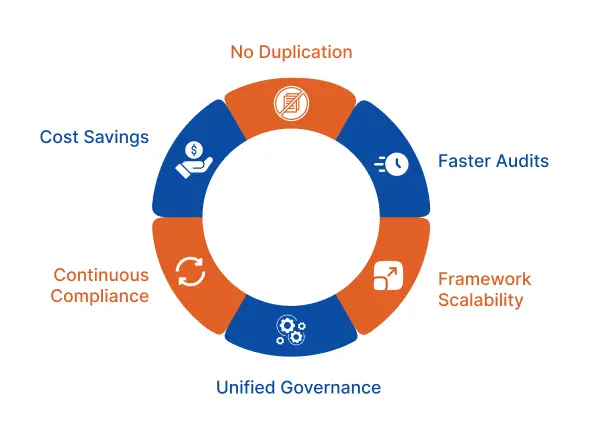
1. Eliminates duplicated implementation and evidence work
The most direct benefit is arithmetic. If frameworks overlap 40–70% and an organization maintains separate control sets for each, a large share of implementation, documentation, and evidence collection is being done two, three, or four times. Consolidating to shared controls and shared evidence removes that duplication at the source. Organizations that have centralized evidence management report audit preparation time reduced by around half, with control owners providing evidence once instead of once per audit cycle.
2. Reduces audit fatigue and compresses audit timelines
With 92% of organizations running at least two audits or assessments a year and 58% running four or more, back-to-back audit cycles pulling the same teams into the same evidence requests are now the norm. A UCF lets audits draw from one continuously maintained control and evidence base, so each audit becomes a scoped extract rather than a fresh mobilization — and audit windows can be coordinated instead of colliding.
3. Makes adding a new framework an incremental exercise
When a new obligation arrives — a customer demanding SOC 2, a regulator introducing an AI law, expansion into a new jurisdiction — a siloed program starts from scratch. A UCF starts from the existing mapping: most of the new framework’s requirements are already met by controls in place, and the project narrows to the genuine delta. This is the “build once, comply many” model, and it is the difference between a new framework costing months versus weeks.
4. Creates one language across security, privacy, quality, and AI teams
Fragmented frameworks fragment teams. Security speaks Annex A, privacy speaks GDPR articles, quality speaks ISO 9001 clauses, and the AI governance function speaks NIST AI RMF. A unified control library gives all of them a shared taxonomy and shared control ownership, which reduces the misinterpretation and gap-blindness that occur when the same underlying obligation is being managed under four different names.
5. Enables continuous compliance instead of point-in-time scrambles
Because a UCF concentrates all obligations onto one control set, that control set becomes practical to monitor continuously — dashboards, evidence freshness tracking, and automated posture checks against every mapped framework at once. Compliance shifts from an annual audit-preparation event to an operating state, and drift is caught between audits rather than during them.
6. Lowers total compliance cost
Analyses of compliance spending consistently identify duplicated effort across frameworks, tools, and regions as a primary cost driver, and control harmonization as one of the most effective levers to bring it down. The savings compound: fewer redundant tools, fewer repeated consultant engagements, shorter audits, and internal teams freed from re-answering questions they have already answered.
How ISO’s Harmonized Structure Makes Unification Practical?
ISO’s Harmonized Structure (Annex SL) gives a Unified Controls Framework its natural backbone: clauses 4 through 10 — context, leadership, planning, support, operation, performance evaluation, and improvement are structurally identical across ISO 9001, ISO 27001, ISO 27701, ISO 42001, ISO 22301, and ISO 20000-1.
This means the management system layer only needs to exist once. A single risk management process (aligned to ISO 31000), a single management review cadence, a single internal audit program, and a single corrective action workflow can legitimately serve the ISMS, PIMS, AIMS, BCMS, ITSM, and QMS simultaneously with certification bodies increasingly willing to conduct integrated audits across them. What remains framework-specific is the domain depth: Annex A controls for information security, privacy-specific processing requirements for ISO 27701, AI lifecycle and impact assessment controls for ISO 42001, continuity strategies for ISO 22301.
A UCF formalizes exactly that split: one shared spine, plus clearly mapped domain-specific controls, rather than six parallel management systems each maintaining its own copy of the same clauses.
Inside ValueMentor’s Unified Controls Framework: 21 Domains, One Control Library
ValueMentor has built its Unified Controls Framework around 21 control domains, each mapped across the management system standards, regulations, and risk frameworks its clients are most commonly required to meet allowing a single control implementation to be assessed, evidenced, and reported against multiple obligations at once.
The mapping below shows a representative cross-section of the framework’s coverage — the full library extends well beyond it, spanning additional international standards, regional regulations, and sector-specific frameworks mapped into the same 21 domains:
| Category | Standards and regulations mapped (illustrative, not exhaustive) |
| Management system standards | ISMS ( 27001 ISO), PIMS (ISO 27701), ITSM (ISO 20000-1), BCMS (ISO 22301), AIMS (ISO 42001), QMS (ISO 9001), among other ISO management system standards |
| Privacy regulations | GDPR (EU), DPDPA (India), UAE PDPL, and other jurisdictional data protection laws |
| AI regulation and risk frameworks | EU AI Act, NIST AI RMF, and emerging AI governance requirements as they are published |
| Security and risk control catalogs | NIST 800-53, ISO 31000, and related control and risk management catalogs |
| Sector and regional frameworks | Regulatory and industry-specific frameworks across the GCC and other operating regions, mapped into the same domain structure |
Because new obligations are mapped into the existing 21 domains rather than bolted on as separate programs, the framework’s coverage grows with the regulatory landscape — each newly published standard or regulation becomes a mapping exercise against controls that already exist, not a new compliance project.
Structuring the library into 21 domains keeps the framework navigable for control owners — each domain groups related controls (spanning areas such as governance, risk, access, operations, continuity, privacy, and AI lifecycle management) regardless of which source framework a given requirement originated from. When an assessor needs an ISO 42001 view, a GDPR view, or a NIST 800-53 view, each is generated from the same underlying domain structure, with traceability back to the specific clauses and articles.
What makes the framework operational rather than theoretical is its pairing with Secusy, ValueMentor’s in-house unified compliance management platform. Secusy runs the UCF as a live system: automated assessments against the mapped frameworks, a unified risk register, vendor oversight, evidence tracking, and continuous monitoring in a single dashboard. AI governance obligations under ISO 42001 or the EU AI Act sit in the same control structure as an organization’s ISO 27001 or PDPL program, instead of forming yet another compliance silo — which is precisely the failure mode a unified framework exists to prevent. ValueMentor’s assessors and consultants then work on top of the platform, interpreting results, closing gaps, and preparing organizations for certification audits across any of the mapped standards.
Summary
A Unified Controls Framework replaces framework-by-framework compliance with a single harmonized control library: overlapping requirements are merged into common controls, every control stays traceable to its source clauses and articles, and evidence is maintained once for all audits. The benefits are concrete — duplicated work eliminated, audit fatigue reduced, new frameworks absorbed as incremental deltas, one shared language across teams, continuous rather than point-in-time compliance, and lower total cost. ISO’s Harmonized Structure makes the model practical by aligning the management system spine across ISMS, PIMS, ITSM, BCMS, AIMS, and QMS. ValueMentor’s Unified Controls Framework applies this at full breadth: 21 control domains mapped across those management systems plus GDPR, DPDPA, UAE PDPL, the EU AI Act, NIST 800-53, NIST AI RMF, and ISO 31000, run as a live program through the Secusy platform — so organizations facing security, privacy, continuity, quality, and AI obligations simultaneously manage them as one program, not six.
Frequently Asked Questions
No. Certification is always issued against a specific standard (such as ISO 27001 or ISO 42001) by an accredited certification body. A UCF is the internal structure that lets one control program satisfy several certifiable standards and regulations at once — the framework-specific views generated from it are what auditors assess.
Doesn’t merging frameworks risk missing framework-specific requirements?
Only if the mapping is done superficially. A properly built UCF preserves full traceability: every unified control references the exact clauses, articles, or control IDs it satisfies, and requirements with no equivalent elsewhere (such as ISO 42001’s AI impact assessments or GDPR’s data subject rights processes) remain as distinct controls within the relevant domain rather than being absorbed into a generic one.
How does a UCF handle regulations from different jurisdictions, like GDPR, DPDPA, and UAE PDPL?
Privacy regulations share a large common core — lawful basis, consent, data subject rights, breach notification, cross-border transfer controls — which maps into shared controls, while jurisdiction-specific obligations (such as differing breach notification timelines or transfer mechanisms) are maintained as scoped variations within the same domain. The organization runs one privacy control set with jurisdictional overlays, not three parallel privacy programs.
Does a UCF require a GRC platform to work?
A UCF can exist in documents and spreadsheets, but it delivers its full value — continuous monitoring, shared evidence, live multi-framework reporting — when operated on a platform. That is the role Secusy plays in ValueMentor’s model: the UCF defines the control structure, and the platform runs it as a continuous program.