Missing the annual SWIFT Customer Security Programme (CSP) attestation deadline can create significant compliance and governance challenges for financial institutions. For banks and other organisations connected to the SWIFT network, timely attestation is an essential part of demonstrating that the security of their SWIFT-related environment has been assessed against the applicable security requirements.
SWIFT’s Customer Security Programme is designed to strengthen the cybersecurity of the global financial ecosystem. Under this programme, SWIFT users must implement the applicable mandatory controls defined in the Customer Security Controls Framework (CSCF), undergo an independent assessment, and submit their annual security attestation through the KYC-Security Attestation (KYC-SA) application. According to SWIFT’s published guidance, the annual attestation must be submitted by 31 December, before the applicable CSCF version expires. A valid attestation must be supported by an independent assessment. Failure to submit a valid attestation, comply with mandatory controls, or perform the required independent assessment may result in SWIFT reporting the institution to relevant supervisory authorities.
For CISOs, information security teams, and compliance officers, understanding these requirements is essential to managing the risks associated with a missed deadline. This article explains the potential consequences, common causes of non-compliance, and the practical steps institutions should take to address the situation.
This blog addresses the full scope of what happens when an institution misses the SWIFT CSP attestation deadline: the immediate operational consequences, the regulatory and reputational dimensions, and the practical steps that compliance-focused institutions should take to avoid or remediate a non-compliant status. The discussion is structured to serve both CISOs navigating technical obligations and compliance officers managing supervisory relationships.
What Happens Immediately After Missing the SWIFT Attestation Deadline?
Missing the deadline does not automatically mean that an institution will be disconnected from SWIFT. However, it can leave the institution without a valid attestation and create a compliance issue that requires prompt attention. The institution should first establish whether its attestation has expired, was not submitted, or reflects non-compliance with one or more mandatory controls.
SWIFT Reporting and Supervisory Visibility
SWIFT’s published guidance states that it reserves the right to report users who:
- Do not have a valid attestation, including where an attestation has not been submitted or has expired.
- Are not compliant with mandatory security controls.
- Have not performed the required independent assessment.
This means that missing the deadline is not simply an internal administrative matter. Depending on the circumstances and applicable SWIFT policies, the issue may be reported to relevant supervisory authorities. The institution should therefore confirm its current status through the KYC-SA application, review the applicable SWIFT requirements, and determine the appropriate corrective actions without delay.
Visibility to Counterparties
SWIFT provides mechanisms for sharing security attestation information with counterparties. Its CSP guidance confirms that attestation results become visible to counterparties when access is granted, supporting transparency and third-party risk management.
A missing or non-compliant attestation may therefore prompt counterparties to request clarification, seek additional security evidence, or reassess the risks associated with the relationship.
The commercial impact will depend on the counterparty’s due diligence processes, contractual arrangements, and risk appetite. A missed deadline does not automatically result in transaction restrictions, but it may create additional scrutiny.
Can Missing the SWIFT CSP Deadline Lead to Regulatory Consequences?
Yes. SWIFT explicitly identifies potential reporting to supervisory authorities in cases involving invalid or missing attestations, non-compliance with mandatory controls, or the absence of the required independent assessment.
However, the precise regulatory consequences are not identical across jurisdictions. They depend on the applicable supervisory framework, the institution’s circumstances, and the nature and persistence of the compliance deficiencies.
What May Supervisory Authorities Require?
Where the matter becomes relevant to supervisory oversight, an institution may need to explain its compliance position and demonstrate how identified deficiencies are being addressed.
Depending on the applicable requirements and circumstances, this may involve:
- An explanation of the missed deadline or outstanding compliance gaps.
- A documented remediation plan with assigned responsibilities and target dates.
- Evidence demonstrating the implementation of mandatory security controls.
- Additional management reporting or supervisory engagement, where required.
- Follow-up validation of remediation activities.
Institutions should avoid assuming that a specific regulatory penalty or enforcement action will automatically follow a missed deadline. The appropriate response must be determined in accordance with the applicable SWIFT policies and local regulatory requirements.
Why Senior Management Should Be Involved?
SWIFT CSP compliance should be supported by clear ownership and oversight across information security, infrastructure, operations, risk management, and compliance functions.
Senior management should receive regular updates on the attestation status, unresolved findings, remediation progress, and risks that could affect the institution’s ability to meet the applicable requirements.
This oversight helps ensure that compliance gaps are addressed promptly and that attestation declarations are supported by validated evidence.
Will a Bank Lose Access to SWIFT Because of Non-Compliance?
A missed attestation deadline does not, by itself, establish that an institution will lose access to the SWIFT network. Nevertheless, institutions must take the issue seriously because SWIFT’s published programme guidance permits reporting of specified non-compliance cases to supervisory authorities. Further consequences, if any, must be evaluated against the applicable SWIFT policies, contractual arrangements, and supervisory requirements.
Counterparties may also independently reassess their relationships with an institution whose attestation status raises concerns. Depending on their internal policies, this could lead to additional due diligence or changes to the relationship.
Financial institutions should therefore distinguish between three separate issues:
Attestation status: Whether a valid annual security attestation has been submitted.
Control compliance: Whether the applicable mandatory CSCF controls have been implemented and independently assessed.
Network or commercial consequences: Whether any further action is taken under applicable SWIFT policies, supervisory requirements, or counterparty arrangements.
Understanding these distinctions helps compliance teams communicate the situation accurately and avoid overstating the consequences of a missed deadline.
Common Reasons for Missing the SWIFT CSP Attestation Deadline
Institutions may miss the deadline because of incomplete assessments, unresolved security findings, insufficient evidence, or delays in coordinating activities across technical and compliance teams.
The following areas deserve particular attention.
- Access Control and Privileged Account Management
- Weak access controls can create significant risks within a SWIFT-related environment. Common deficiencies include excessive privileges, inadequate authentication, incomplete access reviews, and insufficient segregation of duties.
- Institutions should review the applicable CSCF requirements relating to identity management, privileged access, authentication, and monitoring.
Key activities include:
- Reviewing user and privileged accounts.
- Enforcing applicable authentication requirements.
- Applying least-privilege principles.
- Maintaining appropriate segregation of duties.
- Reviewing access rights periodically.
- Monitoring and retaining relevant security logs.
- These controls should be supported by documented procedures and evidence demonstrating their implementation.
- Infrastructure Hardening and Vulnerability Management
- Institutions may also encounter compliance gaps when systems within the defined SWIFT-related environment are not adequately secured or maintained.
Examples include unsupported operating systems, missing security patches, insecure configurations, inadequate network segmentation, and weaknesses in firewall rules.
A reliable asset inventory and documented environment scope are essential for determining which systems and controls must be assessed.
Institutions should also review the applicable CSCF requirements and relevant SWIFT product security guidance to confirm that their technical controls meet the expected standards.
Incomplete Documentation and Evidence
Technical controls may be implemented but difficult to validate when supporting evidence is incomplete or outdated.
Examples include missing access review records, outdated policies, incomplete configuration evidence, missing vulnerability management records, and undocumented remediation activities.
Evidence collection should begin well before the attestation deadline. Each applicable control should have a designated owner, clearly defined evidence requirements, and a process for validating that the evidence accurately reflects the current environment.
Delayed Independent Assessment
SWIFT requires an annual independent assessment to support the security attestation.
Under the Community Standard Assessment approach, the assessment may be performed internally by an appropriately independent function, such as internal audit, or externally by an assessment provider.
The assessment should not be confused with a routine self-review performed by the same team responsible for implementing the controls. The independence and competence requirements must be considered when selecting the assessment team.
Institutions should allow sufficient time for scoping, control validation, evidence review, gap remediation, and completion of the attestation.
What Should You Do If You Have Already Missed the Deadline?
Once an institution identifies a missed deadline or an invalid attestation, the priority should be to establish the current compliance position and initiate appropriate corrective actions.
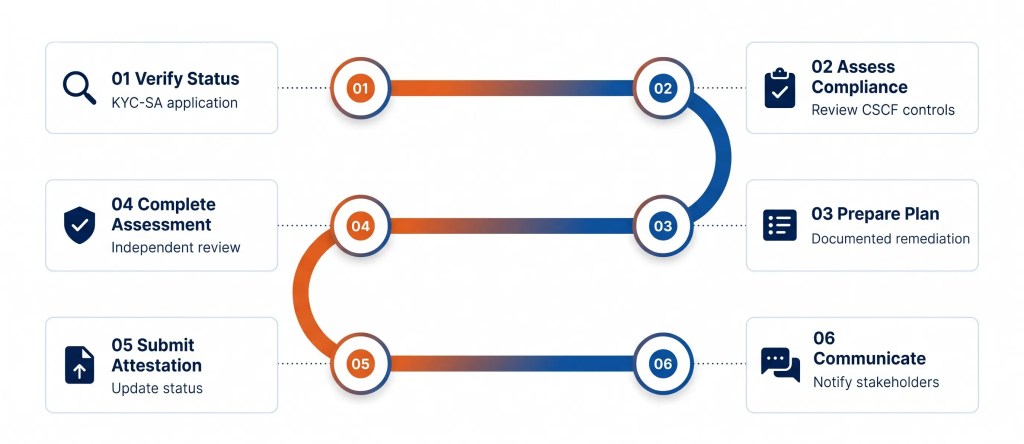
Step 1: Verify the Attestation Status
Review the institution’s status in the KYC-SA application and determine whether the attestation is missing, expired, incomplete, or affected by outstanding mandatory controls.
Confirm the applicable CSCF version, submission requirements, and any instructions provided by SWIFT.
Where clarification is required, contact the relevant SWIFT programme representatives to understand the appropriate next steps.
Step 2: Assess Compliance Against the Applicable CSCF
Perform a structured review of the institution’s SWIFT-related environment against the applicable CSCF version.
The review should cover the controls relevant to the institution’s architecture and connectivity model, including applicable requirements for:
- Network segregation and protection of critical systems.
- Vulnerability management and system hardening.
- Identity and privileged access management.
- Detection and monitoring of anomalous activity.
- Incident response and information sharing.
- Physical security and other applicable control areas.
- The output should identify non-compliant controls, risks, remediation actions, responsible owners, and target dates.
Step 3: Prepare a Documented Remediation Plan
Develop a prioritised action plan based on the identified gaps and applicable requirements.
Each action should include:
- A description of the deficiency.
- The associated control reference.
- The required corrective action.
- The responsible owner.
- The target completion date.
- The evidence required to validate remediation.
Critical security deficiencies should receive appropriate priority, with progress monitored by the responsible security and compliance teams.
Step 4: Complete an Independent Assessment
Arrange the required independent assessment in accordance with the applicable SWIFT framework. The assessment should validate the design and implementation of the relevant controls and support an accurate declaration of compliance.
Where an external assessor is selected, confirm the applicable qualification and eligibility requirements. Where the assessment is conducted internally, ensure that the assessment function meets the relevant independence and competence expectations.
Step 5: Submit or Update the Attestation
Once the institution has established its compliance position, it should follow SWIFT’s applicable instructions for submitting or updating the attestation. SWIFT’s published guidance provides for the declaration of compliance levels against applicable controls. Where a control has not yet been met, the institution should provide the required remediation date and update its attestation once compliant, in accordance with the applicable process. Institutions should not declare controls compliant without sufficient evidence to support the declaration.
Step 6: Communicate with Relevant Stakeholders
The institution should determine whether communications with supervisory authorities, counterparties, or other stakeholders are required. Any communication should accurately describe the current status, outstanding deficiencies, remediation plan, and expected milestones.
The institution should also retain appropriate records of decisions, communications, and remediation activities to support governance and future reviews.
How to Prevent Future SWIFT CSP Attestation Delays?
A structured, year-round compliance programme is the most effective way to reduce the risk of missing the annual deadline.
SWIFT’s CSP guidance describes an annual cycle that includes understanding the applicable controls, implementing them, performing an independent assessment, and submitting the attestation.
Financial institutions should consider the following practices.
Maintain an annual compliance calendar.
Plan the assessment, evidence collection, remediation, independent review, and attestation submission well before 31 December.
Monitor CSCF updates.
Review the applicable framework version and assess the impact of new or revised controls on the institution’s environment.
Maintain an accurate scope.
Keep the inventory of SWIFT-related systems, network diagrams, connectivity information, and relevant dependencies up to date.
Assign control owners.
Ensure that each applicable control has a responsible owner for implementation, evidence maintenance, and remediation.
Conduct periodic internal reviews.
Identify weaknesses early enough to address them before the annual assessment.
Maintain evidence throughout the year.
Keep access reviews, configuration records, vulnerability management results, monitoring evidence, and relevant procedures current.
Escalate overdue actions.
Ensure that unresolved gaps and risks are reported to the appropriate management level.
Validate the attestation before submission.
Confirm that the declared compliance levels are supported by the independent assessment and current evidence.
These practices help institutions manage compliance proactively rather than treating the attestation deadline as the starting point for assessment activities.
Conclusion
Missing the SWIFT CSP attestation deadline can create significant compliance and governance challenges for financial institutions. SWIFT’s published guidance confirms that it reserves the right to report users who lack a valid attestation, fail to comply with mandatory controls, or have not performed the required independent assessment. Attestation information may also be shared with counterparties where access is granted, potentially leading to additional due diligence and questions about the institution’s security posture.
However, a missed deadline does not automatically mean that an institution will be disconnected from SWIFT or face a specific regulatory penalty. The consequences depend on the applicable SWIFT policies, supervisory requirements, and the institution’s circumstances. The appropriate response is to confirm the current attestation status, assess compliance against the applicable CSCF, address identified gaps, complete the required independent assessment, and follow SWIFT’s instructions for submitting or updating the attestation. ValueMentor supports financial institutions with SWIFT CSP readiness, CSCF gap assessments, independent assessment services, remediation validation, and compliance documentation. Visit ValueMentor to discuss how our cybersecurity and compliance specialists can help your institution strengthen its SWIFT security posture and prepare for the applicable attestation cycle.
Frequently Asked Questions (FAQs)
SWIFT states that it reserves the right to report users who do not have a valid attestation, do not comply with mandatory controls, or have not performed the required independent assessment. The institution should verify its status in KYC-SA and follow the applicable SWIFT process to address the issue.
2. What is the deadline for SWIFT CSP attestation?
SWIFT’s published guidance states that annual attestations must be submitted by 31 December, before the applicable CSCF version expires. Institutions should confirm the current requirements and applicable framework version through SWIFT’s official documentation.
3. Does SWIFT automatically suspend institutions that miss the deadline?
A missed deadline does not automatically mean that an institution will be disconnected from the SWIFT network. Any further consequences must be evaluated against the applicable SWIFT policies, contractual arrangements, and supervisory requirements.
4. Can SWIFT report a non-compliant institution to supervisory authorities?
Yes. SWIFT states that it reserves the right to report users who lack a valid attestation, fail to comply with mandatory controls, or have not performed an independent assessment. The specific implications depend on the applicable circumstances and supervisory framework.
5. Is an independent assessment mandatory for SWIFT CSP compliance?
Yes. SWIFT’s published guidance states that all SWIFT users must undergo a Community Standard Assessment to support their annual security attestation. This can be performed internally by an independent function or externally by an assessment provider, subject to the applicable requirements.
6. What should an institution do after missing the deadline?
The institution should verify its attestation status, review the applicable CSCF requirements, identify and remediate outstanding gaps, complete the required independent assessment, and follow SWIFT’s instructions for submitting or updating the attestation.
7. Can an institution attest if some mandatory controls are not yet compliant?
SWIFT’s guidance provides for declaring compliance levels against applicable controls and recording remediation dates where controls have not yet been met. The institution must accurately represent its status and update the attestation when the relevant controls become compliant, in accordance with the applicable process.
8. Where can institutions find official SWIFT CSP documentation?
Institutions should refer to the SWIFT Customer Security Programme, the CSCF and related document centre, and the Independent Assessment guidance for the applicable requirements and supporting materials.