The role of the Chief Information Security Officer has never been more critical or more difficult to fill. A global talent shortage and increasing regulatory demands have created a leadership gap that traditional hiring models can’t solve. But here is the reality hiring and retaining a full-time CISO is often out of reach for many organizations. The global shortage of cybersecurity leaders, coupled with rising compensation packages, makes it a serious challenge. According to recent industry reports, CISO salaries in mature markets can exceed $200,000 annually, and the demand continues to outpace supply. This gap has given rise to an alternative model-virtual CISO (vCISO).
Virtual CISOs are emerging as a strategic solution, enabling organizations to access top-tier cybersecurity leadership on demand. Far from being a temporary fix, this model is reshaping cybersecurity leadership by providing the vision, governance, and risk oversight that businesses need to stay secure and compliant.
What is CISO as a Service (CaaS) and how does it work?
If you have ever wondered “what is CISO as a Service?” the answer lies in solving one of today’s biggest cybersecurity challenges: leadership gaps. Traditionally, organizations hire a Chief Information Security Officer (CISO) as a full-time executive to oversee security strategy, compliance and risk management. But high salaries, global talent shortages and rising cyber threats have made this approach unsustainable for many businesses.
Virtual CISO is an innovative model where organizations gain on-demand access to seasoned cybersecurity leadership without the cost and complexity of a permanent executive hire. Instead of relying on a single individual, CaaS clients benefit from the collective knowledge of a team of experts. This means every engagement draws on a broad pool of real-world experience across multiple industries, compliance frameworks and threat landscapes something a single CISO often cannot provide. Services typically include building security programs, leading compliance audits, managing vendor risks, and providing board-level reporting delivered flexibly through subscription or project-based engagements. These services may be provided virtually (often called vCISO) or in a hybrid model, where experts integrate closely with internal teams. By adopting this model, organizations don’t just get leadership they get shared intelligence, best practices, and proactive insights from a wider community of security professionals, all at a fraction of the cost of a full-time executive hire.
Why are businesses turning to CISO as a Service?
Cybersecurity has become a boardroom priority, but finding the right leader is increasingly difficult. There are several reasons why organizations are embracing CISO as a Service providers instead of pursuing traditional hires:
- Talent shortage – Industry studies highlight a significant global gap in qualified CISOs, making it hard for small and mid-sized organizations to compete with large enterprises.
- High costs – Compensation for CISOs in mature markets can exceed $250,000 annually, not including the cost of a supporting team.
- Regulatory pressures – From regional government regulators to global standards like PCI DSS, ISO 27001, and SOC 2, businesses face growing compliance demands that require seasoned leadership.
- Evolving threats – Cybercriminals are using AI-driven attacks, ransomware, and advanced phishing, requiring up-to-date expertise that internal teams often lack.
- Flexibility needs – As companies undergo digital transformation, mergers, or market expansion, their cybersecurity requirements shift rapidly.
- Talent & knowledge pool access – Beyond a single executive’s expertise, CISO as a Service provides organizations with access to a broader pool of specialists. This collective intelligence brings cross-industry best practices, regulatory insights, and shared learnings that strengthen decision-making and resilience.
By turning to CISO as a Service, businesses gain agility, cost-efficiency and access to a broader knowledge base than a single individual might provide.
Key Benefits of CISO as a Service for organizations
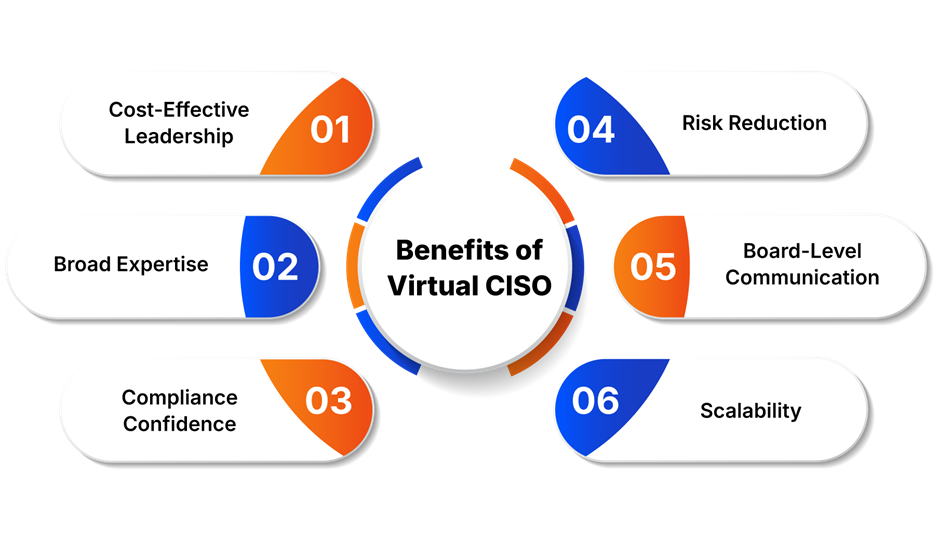
The CISO as a Service model offers clear, measurable advantages:
- Cost-Effective Leadership: Access executive-level strategy without the long-term financial commitment of a full-time hire.
- Broad Expertise: Unlike a single CISO, CISO as a Service providers often bring a team of specialists with cross-industry experience.
- Compliance Confidence: Ensure readiness for audits and certifications like ISO 27001, HIPAA, and PCI DSS.
- Risk Reduction: Identify vulnerabilities, implement best practices, and improve incident response readiness.
- Board-Level Communication: Translate technical risks into business language, helping executives make informed decisions.
- Scalability: Services can be scaled up during critical projects (like cloud migration or M&A) and scaled down when not needed.
For many mid-sized businesses, these benefits make virtual CISO services not just a stop-gap measure but a long-term strategic investment.
How CISO as a Service is reshaping cybersecurity leadership?
Traditional CISOs often work in isolation, focused on a single organization’s needs. The CISO as a Service model disrupts this by making cybersecurity leadership more shared, scalable and democratized.
Here’s how it is changing the game:
- Accessibility: Even smaller companies now have access to world-class expertise that was once exclusive to Fortune 500 firms.
- Adaptability: CaaS professionals bring insights from multiple industries, ensuring fresh, practical approaches.
- Shared Intelligence: Many CISO services providers leverage real-time threat intelligence across clients, helping organizations anticipate and defend against emerging risks.
- Boardroom Influence: Instead of technical jargon, CaaS leaders frame cybersecurity in terms of business impact aligning risk with strategy.
In short, CISO as a Service is transforming the role from a siloed executive position to a flexible, business-aligned leadership model that supports growth without compromising security.
Who needs CISO as a Service?
Not every organization can afford or even justify a full-time Chief Information Security Officer. This is where CISO as a Service (CaaS) or virtual CISO services come in providing flexible, high-level security leadership tailored to unique business needs. Here are some common scenarios where CISOaaS proves to be the perfect fit:
1. Startups looking for affordable expertise
Young companies often need to establish a strong security foundation but may not have the budget for a permanent CISO. With CISO as a Service, startups gain access to seasoned security leaders who can design and implement effective security strategies at a fraction of the cost.
2. Organizations in transition
Businesses searching for a full-time security leader often face a gap period between hires. A vCISO can temporarily step in, providing leadership, maintaining compliance, and ensuring no critical security functions are overlooked during the transition.
3. Companies under compliance or security pressure
When organizations face upcoming audits, regulatory deadlines, or an urgent need to upgrade security, CISO as a Service providers deliver immediate, on-demand expertise. This helps businesses meet requirements quickly without being locked into a long-term commitment.
4. Businesses without a formal security program
For companies just starting their cybersecurity journey, a CISO as a Service model offers the strategic vision and governance needed to build a robust framework from the ground up. It’s an efficient way to set strong foundations without trial and error.
5. Growing organizations
As businesses scale, their attack surface and regulatory obligations often grow as well. CISO services provide the flexibility to scale security efforts alongside business growth, ensuring that protection and compliance evolve without slowing down operations.
Is CISO as a Service right for your organization?
While the value is clear, CISO as a Service may not be the right fit for everyone. Businesses should consider factors such as:
- Size & Maturity: Startups, SMBs and mid-sized firms often gain the most from virtual CISO services, while large enterprises may use CaaS as interim support.
- Compliance Needs: If your industry faces strict regulatory audits, CISO as a Service providers can ensure you meet requirements without building an in-house team from scratch.
- Budget Constraints: For companies unable to afford a permanent CISO, CaaS provides a scalable alternative.
- Business Growth Plans: Expanding into new markets or adopting cloud technologies? A CaaS leader can guide secure transformation.
Ultimately, the decision comes down to whether your organization needs flexible, cost-effective cybersecurity leadership that scales with business priorities.
Conclusion
CISO as a service is an excellent option for organizations that need strong cybersecurity leadership but may not be able to hire a full-time, in-house CISO. With a flexible engagement model and a budget-friendly approach, businesses can access the same level of strategic guidance and technical expertise required to navigate even the most complex security challenges.
The key lies in choosing the right partner-one with proven experience, the right certifications, and the ability to align with your organizational culture and business vision. At ValueMentor, our team of seasoned cybersecurity leaders brings deep expertise across industries, including highly regulated sectors such as banking, healthcare, and government. We take pride in delivering practical, business-aligned security strategies that not only protect but also enable growth.
FAQs
1. What is the difference between a CISO and a vCISO?
A traditional CISO is a full-time executive within the organization, while a virtual CISO (vCISO) or CISO as a Service provides the same expertise on a flexible, on-demand basis without the long-term hiring commitment.
2. Is CISO as a Service only for small businesses?
No. While startups and SMBs benefit the most, larger enterprises also use CaaS during leadership transitions, special projects, or when they need additional expertise.
3. How much does CISO as a Service typically cost?
Costs vary depending on scope, engagement model, and industry requirements. Generally, CaaS is a fraction of the cost of hiring a full-time CISO (whose salaries can exceed $250,000 annually).
4. What services does a CISO as a Service usually cover?
CaaS offerings often include security strategy development, compliance audits, vendor risk management, incident response planning, cloud security guidance, and board-level reporting.
5. How is CISO as a Service delivered-remotely or on-site?
Most engagements are remote (virtual CISO), but many providers also offer hybrid models with periodic on-site visits to work directly with internal teams.
6. Can a CISO as a Service help with compliance requirements like GDPR or PCI DSS?
Yes. A vCISO can guide your business through regulatory frameworks, prepare for audits, and implement governance structures tailored to your industry.
7. How do businesses ensure they choose the right CISO as a Service provider?
Key factors include proven industry experience, relevant certifications (e.g., CISSP, CISM, ISO 27001 Lead Implementer), strong references, and the ability to align with your company’s culture and long-term vision.
8. What industries benefit most from CISO as a Service?
Highly regulated sectors such as finance, healthcare, insurance, government, and retail are prime candidates, but any organization concerned with data protection and risk management can benefit.
9. How quickly can a CISO as a Service step in to support an organization?
In most cases, vCISO providers can begin engagements within days or weeks-far quicker than recruiting a permanent CISO, which can take months.
10. Is CISO as a Service a long-term solution or just a stop-gap?
It can be either. Many businesses use CaaS as an interim measure, while others adopt it as a strategic, long-term model because of its scalability, cost-efficiency, and access to broader expertise.