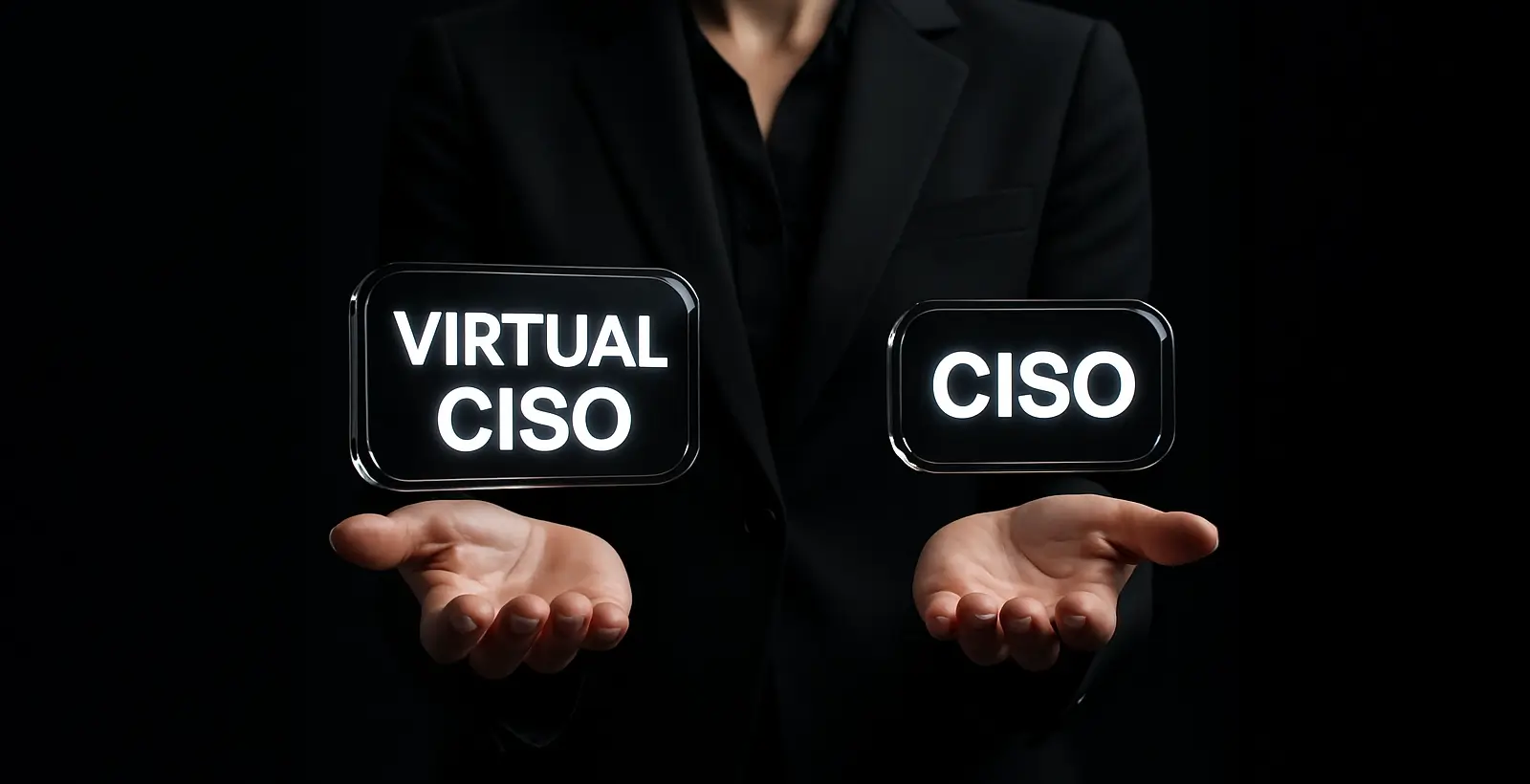
For years, hiring a Chief Information Security Officer (CISO) was the gold standard if you didn’t have one, you weren’t “serious” about security. But let us be honest not every business can or should sink a six-figure salary (often seven in global markets) into a single executive. That is where the Virtual CISO (vCISO) shakes up the status quo. A vCISO isn’t a watered-down version of the role it is a flexible, high-caliber alternative. One company may rely on a vCISO to quickly build compliance programs without blowing up budgets, while another may need a full-time CISO entrenched in board discussions and long-term security culture.The real debate isn’t “which is better,” but which model creates the right impact at the right stage of your business balancing cost, flexibility and long-term strategic control. In this blog, we will break down how the two models compare, where each shines and which scenarios demand one over the other.
What does a CISO Do? The traditional security leadership model
A Chief Information Security Officer (CISO) has long been the go-to leader for managing enterprise security. Positioned at the executive level, the CISO is responsible for shaping security strategy, overseeing compliance, managing risk, and building a team to defend against evolving cyber threats.In practice, a CISO typically:
-
- Defines and implements security strategy aligned with business goals.
-
- Builds and leads internal security teams for monitoring, incident response, and governance.
-
- Reports to the board and communicates risks in business language executives can understand.
For large enterprises with complex infrastructures, having a CISO on the payroll makes sense. Their presence ensures security is treated as a boardroom-level priority and woven into every aspect of business operations. But here is the challenge, CISOs come at a high cost often commanding six- or seven-figure salaries plus overheads for building in-house security teams. For growing businesses, startups, and even many mid-sized organizations, the CISO model can feel out of reach.
Case in point: A mid-sized fintech firm preparing for PCI DSS compliance struggled to map its payment systems, enforce encryption policies, and meet audit deadlines. Hiring a full-time CISO was financially impractical, highlighting how resource constraints can make traditional security leadership challenging for rapidly scaling companies.
Who is a virtual CISO (vCISO) and how do they work?
A Virtual CISO (vCISO) is an outsourced security leader who provides the same strategic guidance and expertise as a full-time Chief Information Security Officer but in a more flexible, cost-effective way. Instead of hiring a permanent executive, businesses can tap into seasoned security leadership on demand.
How it works:
-
- Fractional engagement: Businesses pay only for the time and expertise they need, whether that’s a few hours a month or ongoing advisory support.
-
- Specialized expertise: vCISOs often bring diverse backgrounds, having worked across multiple industries and compliance frameworks.
-
- Scalable services: From designing policies and conducting risk assessments to guiding board-level discussions, the vCISO adapts to business growth.
-
- Immediate impact: Unlike full-time hires that require months of recruitment and onboarding, a vCISO can start adding value right away.
-
- Flexible models: A vCISO can be engaged for specific projects such as overseeing a cloud migration, preparing for a compliance audit or implementing an incident response plan without committing to long-term contracts.
For example, a fintech startup rushing to meet PCI DSS compliance deadlines could engage a vCISO to design security controls and prepare for audits without taking on the financial burden of a full-time executive.In essence, the vCISO brings executive-level security leadership on tap, making cybersecurity accessible and effective for businesses of all sizes.
CISO vs. vCISO: Key differences in cost, flexibility and Strategic Impact
While both roles aim to protect the organization from cyber risks, the way they deliver value differs significantly.
Cost:
-
- CISO: A full-time executive with a hefty salary, benefits, and team costs.
-
- vCISO: A pay-as-you-need model, dramatically reducing overhead while still providing strategic expertise.
Flexibility:
-
- CISO: Locked into one organization, with responsibilities tied to long-term employment.
-
- vCISO: Available on-demand, scaling up or down based on projects, compliance timelines, or emerging risks.
Strategic Impact:
-
- CISO: Deep integration into company culture, ideal for global enterprises needing continuous oversight.
-
- vCISO: Targeted, high-impact contributions that accelerate compliance, strengthen defenses, and guide strategy without the bureaucracy.
Cost Comparison: CISO vs. vCISO
| Feature / Model | Full-Time CISO | vCISO (Virtual CISO) |
|---|---|---|
| Salary / Fees | $565,000+ per year (including benefits and bonuses) | $2,600–$20,000 per month (average ~$7,120) or hourly $200–$500 |
| Employment Type | Full-time | Part-time / On-demand |
| Team Costs | Often includes dedicated security staff | Optional, only as needed |
| Flexibility | Low – fixed role, tied to organization | High – can scale engagement up or down |
| Strategic Scope | Deeply integrated, long-term oversight | Targeted, high-impact contributions |
| Ideal For | Large enterprises with complex needs | SMBs, startups, or growing businesses |
A CISO offers depth but at a high cost while a vCISO delivers agility, ensuring businesses get just the right level of expertise without overcommitting resources.
When to choose a vCISO: Use cases for growing and Mid-sized businesses
A vCISO isn’t just a cost-saving option it is often the smartest strategic choice for organizations that want strong security leadership without executive overhead.

Key scenarios where a vCISO makes sense:
-
- Rapid growth phase: Startups and scale-ups that need to build security frameworks quickly to win client trust or secure funding.
-
- Regulatory compliance: Companies facing sector-specific compliance requirements (PCI DSS for fintech, HIPAA for healthcare, GDPR for SaaS providers).
-
- Budget-conscious organizations: Businesses that need executive-level expertise but don’t have the financial bandwidth for a full-time CISO.
-
- Project-based needs: Companies undergoing a digital transformation, cloud migration, or preparing for certifications.
-
- Board-level reporting: Organizations that need a credible security voice in investor meetings, audits, or client negotiations.
For instance, a mid-sized e-commerce brand expanding internationally could engage a vCISO to guide data protection strategy, meet regional compliance, and assure customers of secure operations without committing to a full-time hire.
Choosing the right model: Why vCISO Is the Future
The debate isn’t about whether a CISO or vCISO is “better.” Both models have their place. But the way businesses operate today lean, digital-first and often global makes the flexibility of the vCISO model more future-proof.
-
- It lowers barriers to cybersecurity leadership for companies of all sizes.
-
- It ensures businesses can scale security as they grow, instead of over-investing too early.
-
- It provides access to multi-industry expertise that a single full-time hire may not bring.
-
- It bridges the gap between compliance and business growth, giving leadership confidence while keeping costs in check.
For enterprises with complex, global risk landscapes, a full-time CISO may still be essential. But for most growing and mid-sized businesses, the Virtual CISO is the smarter choice delivering executive-level security without executive-level cost.
Final Thoughts
Cybersecurity is no longer a “nice to have” it is a board-level priority that directly impacts trust, compliance, and long-term growth. The question isn’t whether you need security leadership, but what kind of leadership fits your business best. For large, complex enterprises with multi-layered risks, a full-time CISO may still be essential. But for growing and mid-sized businesses, the vCISO model delivers unmatched value offering flexibility, cost efficiency and immediate access to seasoned expertise.
At ValueMentor, our Virtual CISO service goes beyond advisory. We work as an extension of your leadership team guiding compliance journeys, building resilient security programs, and aligning cybersecurity with your business vision. Now is the time to evaluate your business: Do you need a full-time CISO, or could a flexible, expert vCISO provide the leadership your organization requires to thrive securely? Take the first step in aligning your cybersecurity strategy with your business goals today.
FAQs
1. Is a Virtual CISO only suitable for small businesses?
No. While vCISOs are popular with small and mid-sized companies, many large enterprises also engage vCISOs to support specific projects, compliance initiatives, or board-level reporting.
2. Can a vCISO replace a full-time CISO entirely?
Yes, in many cases. A vCISO can perform nearly all the functions of a traditional CISO. However, enterprises with highly complex, global operations may still require a dedicated in-house CISO.
3. How much does a vCISO cost compared to a full-time CISO?
A full-time CISO can cost hundreds of thousands annually (plus benefits and team costs). A vCISO is typically a fraction of that cost, billed based on hours, projects, or retainer agreements.
4. Can a vCISO work alongside an in-house IT or security team?
Absolutely. A vCISO often collaborates with internal teams, providing strategic oversight while the in-house staff handles day-to-day technical operations.
5. What industries benefit the most from vCISO services?
SaaS, fintech, e-commerce, healthcare, and any business facing compliance obligations like PCI DSS, HIPAA, or GDPR gain significant value from vCISO services.
6. How quickly can a vCISO add value?
Unlike a CISO hire that may take months to recruit and onboard, a vCISO can start delivering insights, risk assessments, and compliance roadmaps within weeks—or even days.
7. Does using a vCISO mean we’re outsourcing security entirely?
Not at all. A vCISO provides leadership and strategy. Execution can still be handled by your in-house team or external partners, depending on your setup.
8. Can a vCISO help with board and investor communication?
Yes. A vCISO often prepares executive reports, risk dashboards, and compliance updates tailored for non-technical stakeholders helping leadership make informed decisions.
9. Are vCISOs experienced professionals?
Yes. Most vCISOs are seasoned executives who have served as CISOs or senior security leaders across industries, bringing diverse expertise and best practices.
10. Why choose ValueMentor for vCISO services?
ValueMentor’s vCISO offering combines deep regulatory expertise, global client experience and a practical, business-aligned approach ensuring security is not just about compliance, but about enabling growth.