The importance of APIs in modern digital companies cannot be overstated. Mobile applications, websites, clouds, payments systems, and third-party connections are just some of the areas that use APIs as their main means of communication. With the ongoing digital transformation efforts, the number of APIs in use increases exponentially. Unfortunately, along with all the benefits of using APIs, there is an increasing threat of cyber attacks related to this technology. API-based attacks differ from regular web application attacks because they tend to blend in perfectly into usual activity and exploit gaps that standard security measures ignore. This is why many cases of API breaches get discovered too late when it is already too late.
One of the main issues contributing to the under detection of API attacks is poor visibility and logging practices. Although many companies implement extensive network and application monitoring procedures, they do not have enough insight regarding API activity. Poor visibility makes it easy for attacks to go unnoticed and undetected for months at a time. This blog will address this issue, discussing why API attacks are hard to detect, how poor visibility creates security weaknesses, and what businesses can do about it.
Why APIs have become a prime target for attackers?
APIs have access to important information related to businesses, which is why they are vulnerable to attacks. Important data like customers’ information, transaction details, authentication tokens, and business logic often pass through API endpoints.
Unlike applications that have GUI, APIs communicate from one machine to another and generate a lot of automation traffic, which helps in hiding malicious requests.
Attackers commonly target APIs through:
- Broken authentication mechanisms
- Authorization flaws
- Excessive data exposure
- Business logic abuse
- Credential stuffing attacks
- API enumeration and reconnaissance
- Injection attacks
Since many API requests appear legitimate on the surface, security teams may struggle to distinguish malicious activity from normal user behavior.
Why Security Teams Can’t See API Threats?
Many organizations have limited visibility into their API ecosystems. In large enterprises, development teams often create and deploy APIs independently, leading to API sprawl and shadow APIs that security teams may not even know exist.
This visibility challenge creates several security risks:
Unknown APIs
Security teams cannot protect APIs they are unaware of. Unmanaged or undocumented APIs often become easy entry points for attackers.
Incomplete Traffic Monitoring
Traditional security tools focus on network traffic, firewalls, and web applications. They may not capture detailed API-specific interactions, request patterns, or user behavior.
Lack of Context
The absence of business context makes it difficult to understand if the API call being made is malicious or not. A technical API call might look perfectly fine but can misuse the business logic.
An organization’s inability to discover and monitor the use of APIs creates large loopholes for hackers.
How poor logging creates dangerous security gaps?
Even when API traffic is visible, inadequate logging can prevent organizations from detecting and investigating attacks effectively.
Many organizations log only basic information such as:
- Request timestamps
- Source IP addresses
- Response codes
- Endpoint URLs
While useful, these logs rarely provide enough context to identify sophisticated attacks.
Missing User Activity Data
Organizations often fail to log user actions, authentication events, and access patterns. This makes it difficult to identify account takeovers or privilege escalation attempts.
Insufficient Request Details
Critical request parameters, payload data, and behavioral indicators may not be recorded, limiting forensic investigations.
Short Log Retention Periods
Attackers frequently remain undetected for extended periods. If logs are retained for only a few days or weeks, valuable evidence may disappear before investigations begin.
Disconnected Logging Systems
API logs may be stored separately from application, authentication, and network logs. This fragmentation makes threat analysis more difficult and slows incident response efforts.
Why Traditional Security Tools Often Miss API Attacks?
Many security solutions were designed before APIs became central to business operations. As a result, they may struggle to identify API-specific threats.
For example:
Firewalls Focus on Perimeter Security
Traditional firewalls primarily inspect network traffic and may not understand API-specific behaviors or business logic abuse.
Signature-Based Detection Has Limitations
Many security tools rely on known attack signatures. Sophisticated API attacks often use valid requests that do not match predefined attack patterns.
Authentication Doesn’t Guarantee Safety
An authenticated user can still abuse APIs through excessive requests, unauthorized data access, or manipulation of application workflows.
Business Logic Attacks Remain Invisible
Attackers are now using attacks based on business logic, and not exploiting software bugs. The attack could circumvent conventional security measures as they would look like a normal request from the technical perspective.
Companies that rely only on security measures might be unaware of significant API vulnerabilities present.
Common Signs of Undetected API Abuse
Several indicators can suggest ongoing API attacks that might otherwise remain unnoticed:
- Sudden spikes in API requests
- Unusual access patterns from authenticated users
- Excessive data downloads
- Repeated failed authorization attempts
- Requests targeting undocumented endpoints
- Abnormal geographic access patterns
- High volumes of automated transactions
Monitoring these behavioral anomalies can help security teams identify attacks before significant damage occurs.
Closing the Visibility and Logging Gap
Organizations can significantly improve API security by implementing stronger visibility and logging practices.
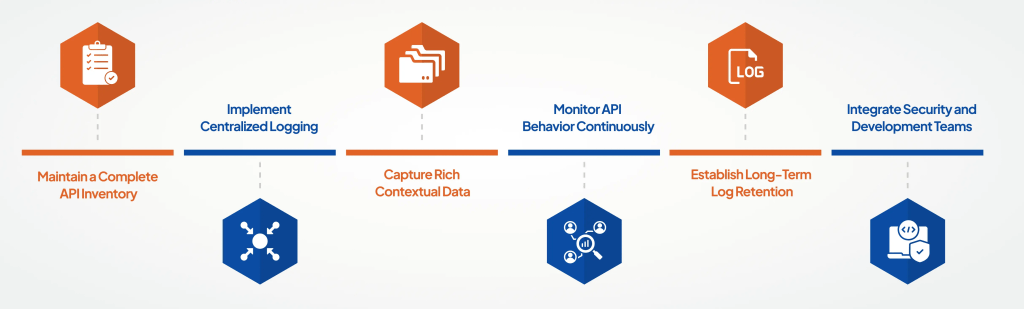
Maintain a Complete API Inventory
Continuously discover and catalog all APIs, including internal, external, partner, and shadow APIs.
Implement Centralized Logging
Consolidate API logs with application, authentication, and network logs to provide a unified security view.
Capture Rich Contextual Data
Log critical details such as:
- User identities
- Authentication events
- Request parameters
- Response data
- Device information
- Behavioral patterns
Monitor API Behavior Continuously
Behavioral analytics can identify anomalies that signature-based detection tools may miss.
Establish Long-Term Log Retention
Retaining logs for longer periods improves forensic investigations and helps identify slow-moving attacks.
Integrate Security and Development Teams
Collaboration between security and development teams ensures APIs are designed with visibility and monitoring requirements from the start.
The Future of API Threat Detection
As the ecosystem surrounding APIs continues to develop, companies need to look past their current approach to security measures. The new generation of API security relies heavily on visibility, intelligent monitoring, and the contextual analysis of the API’s behavior.
Machine learning and artificial intelligence technologies are becoming more popular in detecting abnormal API behaviors, helping to identify any potential threats. This is done to avoid alert fatigue due to an overabundance of irrelevant notifications. Businesses that take action to create visibility around their APIs now will find themselves ahead of the game later on.
Conclusion
The attacks on APIs usually remain undetected as companies do not have sufficient visibility regarding their API ecosystem and generate insufficient logs about the same. While traditional security systems may miss out on the potential threat, partial visibility leaves gaps which hackers may exploit. Through the process of generating a complete list of APIs, having logging in place, detecting any deviation in behavior from the norm, and collecting context, companies can ensure greater visibility and detect any API attacks that might be occurring in their ecosystem.
Is your organization confident that it can detect an API attack before significant damage occurs? Now is the time to evaluate your API security strategy. Investing in comprehensive API discovery, real-time monitoring, and advanced logging capabilities can help eliminate blind spots and improve threat detection across your API ecosystem. Partnering with experienced cybersecurity providers like ValueMentor can help organizations assess API security risks, enhance visibility, and implement robust monitoring frameworks that strengthen overall security posture. The sooner you close the visibility and logging gap, the better prepared you will be to detect, respond to, and prevent modern API-based attacks before they impact your business.
FAQs:
API attacks often mimic legitimate user activity, making them harder to identify than traditional cyberattacks.
2. What is API visibility?
API visibility refers to the ability to discover, monitor, and understand all API activity across an organization’s environment.
3. Why are API logs important for security?
API logs provide critical evidence for detecting suspicious behavior, investigating incidents, and meeting compliance requirements.
4. What are shadow APIs?
Shadow APIs are undocumented or unmanaged APIs that operate outside the security team’s awareness and oversight.
5. Can traditional firewalls stop API attacks?
Traditional firewalls offer basic protection but often lack the context needed to detect sophisticated API-specific threats.
6. What is an API security monitoring solution?
It is a security tool that continuously analyzes API traffic, behavior, and anomalies to identify potential threats.
7. How long should API logs be kept?
This varies based on different industries and regulatory requirements, but increased retention leads to better forensics and threat hunting.
8. What are some of the indicators for API abuse?
Unusual levels of request, excessive data access attempts, multiple failed authentication attempts, and strange behavior by users are among some of the signs.
9. How is API sprawl a source of additional risk?
API sprawl means having too many APIs, leading to potential blindness regarding which endpoints are used.
10. How can organizations improve API attack detection?
Organizations can improve detection through API discovery, centralized logging, behavioral analytics, and continuous monitoring.