
In the contemporary business landscape, ensuring robust cybersecurity is paramount. As threats continue to evolve in complexity and sophistication, the adoption of managed detection and response (MDR) services emerges as a proactive and robust strategy to safeguarding your organization’s integrity, resilience, and compliance.
Let’s delve into MDR services and unearth several pivotal advantages of integrating this comprehensive cybersecurity solution within your organization.
Understanding Managed Detection and Response (MDR)
Despite a cyber attack happening approximately every 39 seconds, many question about the necessity of employing a managed data service. The answer is simple:
- Financial Efficiency: Cut costs and save time by diminishing the reliance on internal security staff and capitalizing on cost advantages through security technology scalability.
- Preemptive Threat Identification: Maintain a proactive stance against threats, promptly recognizing and addressing them before they escalate into substantial harm.
- Rapid Incident Response: Mitigate the fallout of a security breach and expedite the return to regular operations with a proficient team poised to handle incidents promptly.
So, what is MDR?
MDR is a proactive cybersecurity service that combines advanced threat detection technologies with human expertise to identify, investigate, and respond to cyber threats in real-time. Unlike traditional security solutions that rely solely on automated tools, MDR leverages a team of skilled analysts who continuously monitor and analyze network traffic, endpoints, and other digital assets to detect suspicious activities and potential threats.
The Evolving Threat Landscape
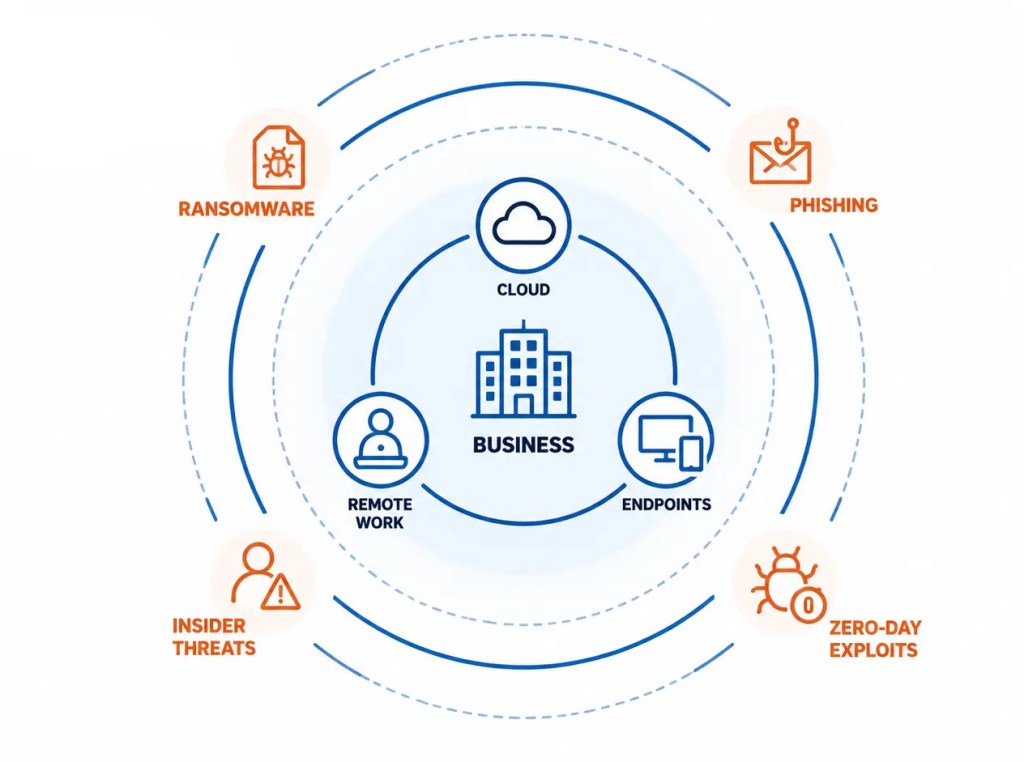
Cyber threats are constantly evolving, becoming more sophisticated and challenging to detect. From ransomware and phishing attacks to insider threats and zero-day exploits, businesses face a myriad of risks that can result in data breaches, financial losses, and reputational damage. Moreover, with the rise of remote work and cloud adoption, the attack surface has expanded, making it even more challenging for organizations to defend against cyber threats.
The Limitations of Traditional Security Measures
Traditional security measures such as firewalls, antivirus software, and intrusion detection systems are no longer sufficient to protect against modern cyber threats. These tools often rely on signature-based detection methods, which can be easily bypassed by polymorphic malware and other advanced attack techniques. Additionally, traditional security solutions lack the ability to provide real-time visibility into complex and dynamic environments, leaving businesses vulnerable to sophisticated attacks.
How Managed Detection and Response (MDR) operates?
MDR involves remote monitoring, detection, and response to threats within an organization. It relies on an Endpoint Detection and Response (EDR) tool to provide visibility into security events on endpoints.
Relevant threat intelligence, advanced analytics, and forensic data are analyzed by human analysts. They triage alerts and decide the best response to mitigate the impact and risk of confirmed incidents. Through a blend of human expertise and automated capabilities, threats are eradicated, and affected endpoints are restored to their pre-infected condition.
Key functions of MDR include
- Priority Management: MDR aids organizations overwhelmed by alert volumes by managing prioritization. This involves applying automated rules and human scrutiny to distinguish between benign events and genuine threats, generating a stream of high-quality alerts enriched with context.
- Threat Hunting: Human threat hunters with specialized skills identify and alert on the most elusive threats, complementing automated defenses with human insight to catch evasive adversaries.
- Investigation: Managed investigation services enhance security alerts with additional context, enabling organizations to comprehensively understand the nature and extent of threats, aiding in planning an effective response.
- Guided Response: MDR offers actionable guidance on containing and remediating specific threats, ranging from isolating affected systems to executing sophisticated remediation steps, ensuring a methodical response.
- Remediation: Managed remediation ensures that systems are restored to a clean state by removing malware, eliminating intruders, and preventing further compromise, safeguarding the network’s integrity.
The Benefits of Managed Detection and Response
With MDR, businesses gain peace of mind knowing their digital assets are continuously monitored and protected against evolving cyber threats. Let’s explore some of the benefits of Managed Detection and Response (MDR) services, which provide proactive threat detection and rapid response capabilities, ensuring enhanced cybersecurity defenses for your organization.
- Proactive Threat Detection: MDR takes a proactive approach to cybersecurity, continuously monitoring network traffic, endpoints, and cloud environments for signs of suspicious activity. By detecting threats in real-time, MDR enables businesses to respond swiftly and effectively, minimizing the impact of cyberattacks.
- 24/7 Monitoring and Response: Unlike in-house security teams that may lack the resources and expertise to monitor and respond to threats round-the-clock, MDR providers offer 24/7 monitoring and response capabilities. This ensures that businesses have access to timely threat intelligence and incident response support whenever they need it.
- Advanced Threat Detection Technologies: MDR leverages advanced threat detection technologies such as machine learning, behavioral analytics, and threat intelligence feeds to identify both known and unknown threats. By analyzing patterns and anomalies in network traffic and user behavior, MDR can detect malicious activities that may evade traditional security measures.
- Human Expertise and Analysis: In addition to automated tools, MDR relies on human expertise to analyze and investigate security incidents. Skilled security analysts leverage their knowledge and experience to triage alerts, conduct in-depth investigations, and provide actionable insights to help businesses mitigate cyber threats effectively.
- Customized Security Solutions: MDR providers offer customized security solutions tailored to the specific needs and requirements of each business. Whether it’s endpoint security, threat hunting, incident response, or compliance monitoring, MDR services can be tailored to address the unique cybersecurity challenges faced by organizations across different industries.
- Cost-Effective Security Solutions: Investing in MDR can be more cost-effective than building and maintaining an in-house security operation. By outsourcing cybersecurity to a trusted MDR provider, businesses can access enterprise-grade security capabilities without the upfront costs and overhead associated with hiring and training internal security teams.
- Compliance and Regulatory Requirements: With an increasing number of regulations and compliance mandates governing data protection and privacy, businesses need to demonstrate robust cybersecurity measures to remain compliant. MDR can help businesses meet regulatory requirements by providing continuous monitoring, incident response capabilities, and comprehensive reporting.
Concluding thoughts
Nowadays, no business is immune to cyberattacks. To effectively defend against evolving threats and protect their assets and data, businesses need a proactive and comprehensive cybersecurity strategy. Managed Detection and Response (MDR) offers a proactive approach to cybersecurity, combining advanced threat detection technologies with human expertise to detect, investigate, and respond to cyber threats in real-time.
ValueMentor’s Managed Services provide organizations with robust, real-time protection against a variety of threats. By leveraging MDR, businesses can enhance their security posture and gain confidence in their digital operations. With the appropriate MDR solution from ValueMentor, businesses can proactively address the dynamic challenges posed by the digital threats, ensuring they remain ahead of potential risks.
By partnering with a trusted MDR provider, businesses can enhance their security posture, minimize the risk of data breaches, and safeguard their reputation in an increasingly digital world.
FAQs
1. What is Managed Detection and Response (MDR)?
MDR is a managed cybersecurity service that combines advanced security technologies with human expertise to continuously detect, investigate, and respond to cyber threats.
2. Why do businesses need MDR services?
MDR helps organizations address evolving cyber threats through continuous monitoring, proactive threat detection, rapid incident response, and access to specialized security expertise.
3. How does MDR work?
MDR continuously monitors endpoints, networks, cloud environments, and other digital assets, analyzes security events, investigates suspicious activity, and guides or performs appropriate response and remediation.
4. What are the key functions of MDR?
Key MDR functions include alert prioritization, threat hunting, security investigation, guided response, incident containment, and remediation.
5. Does MDR provide 24/7 security monitoring?
Yes. MDR services typically provide continuous monitoring and response, helping organizations detect and address threats regardless of when an incident occurs.
6. How does MDR differ from traditional security solutions?
Traditional security tools often rely heavily on automated detection, while MDR combines security technologies with human analysis, threat hunting, investigation, and response capabilities.
7. What types of cyber threats can MDR detect?
MDR can help detect and respond to threats such as ransomware, phishing, malware, suspicious user activity, insider threats, and other advanced or evasive attacks.
8. Is MDR suitable for organizations without an in-house SOC?
Yes. MDR can provide organizations with access to security monitoring, threat detection, investigation, and response expertise without requiring them to build and operate a full in-house SOC.
9. How can MDR help with regulatory compliance?
MDR can support compliance efforts by providing continuous security monitoring, incident detection and response capabilities, security records, and reporting that can help demonstrate the effectiveness of security controls.
10. What are the key benefits of MDR services?
MDR provides proactive threat detection, 24/7 monitoring, faster incident response, expert security analysis, threat hunting, improved resilience, and potentially lower security operations costs.