
API penetration testing has followed roughly the same methodology for the past decade. Reconnaissance, endpoint discovery, authentication testing, authorization testing, input validation, business logic rinse and repeat. Skilled pentesters built their workflows around tools like Burp Suite, Postman, and OWASP ZAP, combined with deep manual analysis.
That methodology is not going away. But it is being fundamentally augmented by large language models – and security teams that ignore this shift are already falling behind.
LLMs are not replacing API pentesters. They are making good pentesters significantly faster and enabling them to cover more surface area with greater precision. This blog post walks through exactly how the traditional API penetration testing methodology is changing, phase by phase, and what your team needs to adopt today.
How API Penetration Testing has traditionally been done?
Before covering what is changing, it helps to be clear about what the standard methodology looks like. A thorough API pentest typically follows these phases:
- Scope definition and documentation review
- Reconnaissance and endpoint discovery
- Authentication and authorization testing
- Input validation and injection testing
- Business logic testing
- Rate limiting and resource abuse testing
- Reporting and remediation guidance
Each phase has traditionally required significant manual effort reading documentation, crafting payloads by hand, interpreting responses, and reasoning about what the backend might be doing. This is exactly where LLMs are creating leverage.
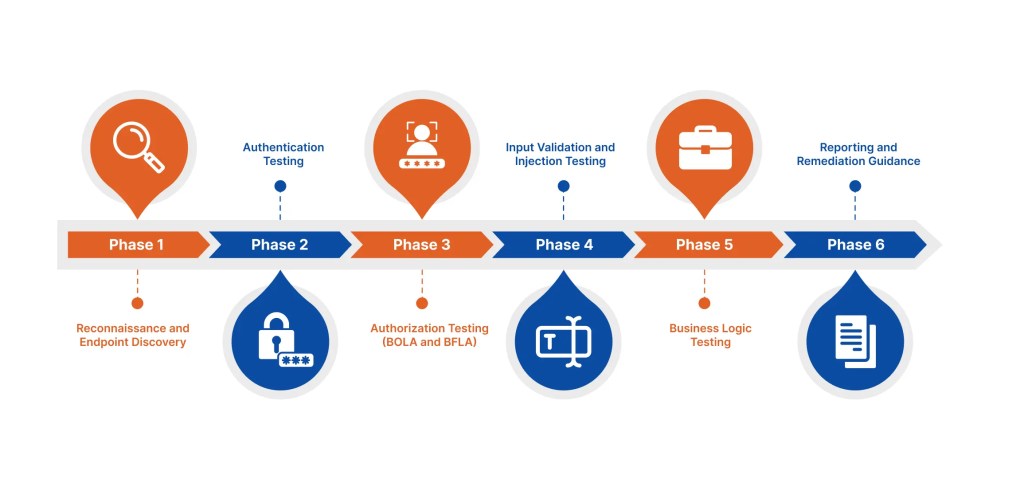
Phase 1 – Reconnaissance and Endpoint Discovery
Traditional approach: Pentesters manually review Swagger files, crawl the application, intercept traffic with a proxy, and use wordlists to brute-force undocumented endpoints.
With LLMs: Feed your OpenAPI specification or a sample of captured API traffic into an LLM and ask it to predict undocumented endpoints, identify naming patterns, and flag anything that looks like an admin, internal, or legacy route. An LLM can process hundreds of endpoints in seconds and produce a prioritized list of targets that would take a human analyst hours to compile.
More importantly, LLMs understand context. If they see /api/v1/users and /api/v1/orders, they will suggest testing /api/v1/users/export, /api/v1/admin/users, /api/v1/users/bulk-delete – routes that follow predictable developer conventions and are frequently left unprotected.
What changes: Endpoint discovery goes from a multi-hour manual task to a 15-minute AI-assisted exercise. Pentesters spend less time guessing and more time testing.
Phase 2 – Authentication Testing
Traditional approach: Manually test token expiry, weak signing secrets, JWT algorithm confusion attacks, API key leakage in headers and logs, and OAuth misconfiguration by hand. Each test requires specific knowledge of the attack pattern.
With LLMs: Paste a JWT token or an OAuth flow into an LLM and ask: “What are all the ways this authentication implementation could be broken?” The LLM will walk through algorithm confusion (RS256 to HS256), none algorithm attacks, weak secret brute-forcing, token reuse after logout, missing expiry validation, and scope escalation – generating specific test cases for each.
For API keys, an LLM can scan documentation, JavaScript source files, error messages, and response headers for leaked credentials with far greater coverage than a manual review.
What changes: Authentication testing becomes more systematic. Junior pentesters can run tests that previously required senior-level knowledge of specific attack patterns.
Phase 3 – Authorization Testing (BOLA and BFLA)
Traditional approach: Broken Object Level Authorization (BOLA) and Broken Function Level Authorization (BFLA) are the most common and most dangerous API vulnerabilities – and the most tedious to test manually. Testers have to create multiple accounts, map every object identifier, and try accessing each object as every other user. It is time-consuming and error-prone.
With LLMs: Given a set of API responses, an LLM can automatically identify all object identifiers (user IDs, order IDs, document IDs, account numbers), generate a matrix of cross-user access test cases, and flag which endpoints appear to lack ownership validation based on their response patterns.
Example prompt that produces real results: “Here are 20 API responses from this application. Identify every object identifier, list every endpoint that accepts one as a parameter, and generate test requests to check for broken object level authorization.”
What changes: BOLA testing coverage goes from sampling a subset of endpoints to comprehensive coverage of every object-bearing endpoint in the API.
Phase 4 – Input Validation and Injection Testing
Traditional approach: Testers run standard injection payloads – SQL injection, NoSQL injection, command injection, XXE – against input fields. Most automated scanners cover the basics but miss context-specific variations.
With LLMs: LLMs generate injection payloads that are tailored to the specific parameter, data type, and backend technology inferred from the API’s behavior. If an API appears to use MongoDB based on its error messages, the LLM generates NoSQL-specific injection payloads. If a parameter appears to be used in a file path, the LLM generates path traversal variants.
LLMs also excel at mass assignment testing – identifying which hidden fields a write endpoint might accept beyond what the documentation lists. Given a POST /api/v1/users endpoint, an LLM will suggest testing isAdmin, role, verified, subscriptionPlan, internalScore, and dozens of other fields that developers commonly add and forget to restrict.
What changes: Payload generation becomes contextually intelligent rather than generic. Test coverage improves significantly on complex parameter types.
Phase 5 – Business Logic Testing
Traditional approach: This is the hardest phase to automate and the one where human expertise has always mattered most. Business logic flaws are application-specific – they require understanding what the API is supposed to do and reasoning about ways to abuse the intended flow.
With LLMs: This is where LLMs provide their most surprising value. Given a description of what an API does – even a basic one – an LLM can generate a comprehensive list of business logic abuse scenarios that a pentester might miss.
For an e-commerce order API, an LLM will suggest:
- What happens if a coupon code is applied multiple times?
- Can a user cancel an order after it has shipped and still receive a refund?
- What if the quantity is set to zero or a negative number?
- Can a price be manipulated by modifying the cart before checkout completes?
- What if two identical requests are sent simultaneously – is there a race condition?
These are not generic payloads. They are reasoned abuse cases specific to the business domain. A pentester still needs to execute and validate them – but the ideation phase, which can take hours, is compressed dramatically.
What changes: Business logic test coverage improves. Less experienced testers can generate sophisticated abuse scenarios they might not have thought of independently.
Phase 6 – Reporting and Remediation Guidance
Traditional approach: Writing pentest reports is time-consuming. Documenting each finding, explaining the vulnerability, writing reproduction steps, and crafting remediation guidance often takes as long as the testing itself.
With LLMs: LLMs can draft finding descriptions, generate reproduction steps from raw request/response pairs, suggest CVSS scores, and write remediation guidance – all in seconds. The pentester reviews and refines rather than writing from scratch.
This is not about cutting corners. It is about freeing skilled pentesters from administrative work so they can spend more time on high-value testing.
What changes: Report turnaround time drops significantly. Remediation guidance becomes more detailed and developer-friendly.
How AI is reshaping API Penetration Testing?
Here is what the updated methodology looks like when LLMs are incorporated:
Step 1 – Feed documentation to LLM for attack surface mapping
Before touching the application, paste your OpenAPI spec, Swagger file, or Postman collection into an LLM. Ask it to identify high-risk endpoints, predict undocumented routes, and generate an initial test plan.
Step 2 – Use LLM to generate targeted test cases per phase
For each testing phase – auth, authorization, input validation, business logic – use the LLM to generate specific test cases rather than relying on generic wordlists.
Step 3 – Execute tests with standard tools
Burp Suite, Postman, and OWASP ZAP remain the execution layer. LLMs generate what to test. Your tools execute the tests and capture responses.
Step 4 – Feed responses back to LLM for analysis
Paste interesting or unexpected API responses back into the LLM and ask: “What does this response tell us about the backend? What should we test next?” This creates a feedback loop that continuously refines the testing direction.
Step 5 – Use LLM to draft findings
For each confirmed vulnerability, feed the request, response, and context to the LLM and ask it to draft a finding – title, description, impact, reproduction steps, and remediation. Review and finalize.
What LLMs cannot do in API Pentesting?
It is important to be honest about the limitations:
- LLMs cannot actually execute requests – they generate test cases, not run them
- LLMs hallucinate – every suggested vulnerability must be manually validated before it goes in a report
- LLMs have no real-time knowledge of the application’s state – they reason from what you show them, not from live interaction
- Business logic flaws in complex multi-step workflows still require deep human understanding of the application
- LLMs cannot replace the creative intuition of an experienced pentester who notices something feels wrong
The right mental model is: LLMs are a highly capable research assistant and test case generator. The pentester is still the expert making judgment calls.
Tools Combining LLMs with API Security Testing in 2026
Several tools now integrate LLM capabilities directly into API security testing workflows:
- Burp Suite AI extensions – community-built extensions that use LLMs to suggest follow-up tests based on responses
- OWASP ZAP with AI scan rules – experimental rulesets that use LLM-generated payloads
- Postman AI Assistant – helps generate test scripts and identify missing authorization checks
- Custom GPT-based recon scripts – many red teams now maintain internal LLM-powered scripts for endpoint discovery and payload generation
Key Takeaways
- The core API penetration testing methodology – recon, auth, authorization, input validation, business logic, reporting – remains the same. LLMs augment each phase, they do not replace it.
- The biggest gains are in endpoint discovery, BOLA test case generation, mass assignment payload creation, business logic ideation, and report writing.
- Every LLM output must be validated manually – hallucinations are real and a finding based on a hallucination destroys report credibility.
- Teams that adopt AI-augmented testing will cover more surface area, find more vulnerabilities, and deliver reports faster than teams that do not.
- The methodology is shifting from “human does everything manually” to “human directs, AI generates, human validates.”
Conclusion
API penetration testing methodology is not being replaced by AI it is being upgraded. The fundamentals of what makes an API secure or insecure have not changed. What has changed is how fast a skilled tester can identify weaknesses and how much surface area they can cover in a given engagement.
The pentesters who adopt LLMs as part of their workflow today will be significantly more effective than those who do not. And the security teams that understand how attackers are using these same tools will be far better prepared to defend against them.
Modern APIs demand comprehensive testing that goes beyond traditional vulnerability scanners. ValueMentor helps organizations identify authentication flaws, authorization gaps, business logic vulnerabilities, and hidden API risks through expert-driven penetration testing.
Schedule an API security assessment and gain confidence that your APIs are ready for today’s threat landscape.
FAQs:
No. AI assists with test case generation and analysis, but human expertise is essential to validate findings and identify complex security flaws.
2. How do LLMs improve API penetration testing?
LLMs speed up endpoint discovery, generate targeted test cases, assist with business logic testing, and help draft security reports.
3. What API vulnerabilities can AI help identify?
AI can help uncover authentication issues, BOLA, BFLA, injection flaws, mass assignment risks, and business logic vulnerabilities.
4. Are LLM-generated penetration test results always accurate?
No. Every AI-generated finding should be manually verified to eliminate false positives and hallucinations.
5. Which API testing tools support AI capabilities?
Tools such as Burp Suite AI extensions, OWASP ZAP AI rules, and Postman AI Assistant are adding AI-powered features.
6. Does AI make API penetration testing faster?
Yes. AI reduces manual effort by automating reconnaissance, test case generation, and reporting, allowing testers to focus on validation.
7. Can AI detect business logic vulnerabilities?
AI can suggest potential business logic abuse scenarios, but experienced pentesters must validate and confirm them.
8. Is manual API penetration testing still necessary?
Absolutely. Manual testing remains critical for verifying vulnerabilities, understanding business context, and identifying complex attack paths.
9. What are the biggest benefits of AI-assisted API security testing?
Better test coverage, faster assessments, improved reporting, and more efficient identification of high-risk API vulnerabilities.
10. Should organizations adopt AI for API penetration testing?
Yes. Combining AI-assisted workflows with expert-led testing helps organizations secure APIs more effectively against evolving cyber threats.