
Have you ever wondered what helps banks in the UAE keep customer money and data safe every day? It is not just about using the latest technology or offering great service. It also depends on following important rules set by the UAE Central Bank and other financial authorities. These rules guide how banks operate, prevent fraud, protect customer information and build trust across the financial system. In this blog, we explore the key compliance requirements that banks in the UAE follow and why they are essential in today’s dynamic banking environment.
What is Regulatory Compliance in Banking?
Regulatory compliance in banking means that banks must follow all the rules and laws made by governments and financial authorities. These rules are not just formal steps. They are meant to protect customers, keep money secure and stop banks from being used for illegal activities like money laundering or financing terrorism.
Banks need to follow both national and international rules to stay approved and trusted. This includes checking who their customers are, keeping personal information safe, offering fair services and reporting any suspicious activities. As banking has become more digital and new types of money like cryptocurrency have become popular, these rules have also become more detailed.
Today, compliance is more than just filling out forms or passing inspections. It means having strong systems to watch for risks, respond to problems quickly and adjust as the rules change. It helps banks stay safe, trusted and ready for the future.
Why Is Compliance Important in the Banking Sector?
Compliance is a key part of responsible banking. It ensures that banks follow laws, safeguard customer data and operate according to ethical and legal standards. Regulations such as Anti-Money Laundering (AML) and Know Your Customer (KYC) help banks prevent fraud, detect suspicious activities and stay transparent in their financial dealings.
Having a strong compliance system protects both the institution and its customers. It helps avoid legal penalties, reputational damage and the risk of losing the bank’s license to operate. It also ensures that customers and investors are not exposed to fraud or poor management.
Beyond legal safety, compliance improves how a bank runs its day-to-day operations. It supports better internal controls, reduces risks and increases overall efficiency. Banks that prioritize compliance tend to build stronger relationships with their customers, gain more trust in the market, and stay better prepared for regulatory checks.
Understanding the Key Regulatory Bodies and Rules
Banking compliance is enforced by regulatory authorities that ensure financial institutions operate legally, fairly and securely. These bodies safeguard customer interests and maintain the stability of the financial system.
In the UAE, the Central Bank of the UAE oversees banking operations, while the Securities and Commodities Authority governs capital markets. In free zones, the Dubai Financial Services Authority (DFSA) supervises the Dubai International Financial Centre (DIFC), and the Financial Services Regulatory Authority (FSRA) manages the Abu Dhabi Global Market (ADGM).
Other countries follow similar frameworks. In the United States, key bodies include the Federal Reserve, Office of the Comptroller of the Currency (OCC), Securities and Exchange Commission (SEC), and Financial Crimes Enforcement Network (FinCEN). In India, the Reserve Bank of India (RBI) regulates banks, SEBI oversees securities markets, and the Financial Intelligence Unit (FIU-IND) monitors financial crimes.
Beyond national bodies, banks also comply with global frameworks. Basel III sets international risk and capital standards. The Financial Action Task Force (FATF) issues guidelines to counter money laundering and terrorism financing. Privacy laws like the GDPR (Europe) and DPDP Act (India) ensure data protection in financial services.
Together, these authorities and frameworks create a strong compliance structure that helps banks act responsibly, reduce risk and build lasting public trust in an evolving digital landscape.
Best Compliance Practices Every Bank Should Follow
In a fast-changing regulatory environment, banks need clear and flexible strategies to stay compliant. Below in Figure 1, we can see the key strategies for building a strong and adaptable compliance management framework-
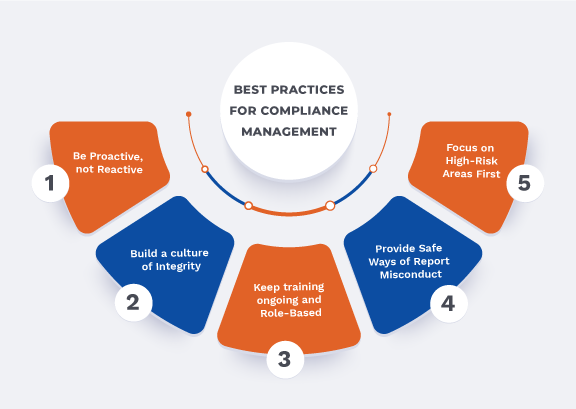
1. Be Proactive, Not Reactive
Waiting for problems can lead to costly consequences. Banks that stay ahead of compliance issues often set clear policies, assign roles and weave compliance into daily operations. Regular collaboration between legal, HR, audit and risk teams ensures faster detection and resolution of issues before they escalate.
2. Build a Culture of Integrity
Ethical behavior should be the backbone of any compliance program. A strong code of conduct aligned with company values helps guide employee actions. When operating across borders, policies should respect local cultures but stay consistent with core values. Automation can make policy distribution and acknowledgment smoother.
3. Keep Training Ongoing and Role-Based
Awareness is key to avoiding violations. Regular, role-specific compliance training helps employees understand their responsibilities. As rules evolve, training content should also be updated. Digital platforms like learning management systems can track participation and measure understanding effectively.
4. Provide Safe Ways to Report Misconduct
An anonymous whistleblower hotline encourages employees to speak up without fear. Even where not legally required, such systems are crucial for uncovering internal issues like fraud or discrimination. Linking the hotline to a central compliance system improves tracking and follow-up.
5. Focus on High-Risk Areas First
All risks are not equal. A risk-based approach helps prioritize serious threats and allocate resources wisely. By identifying critical areas, tracking controls and measuring outcomes, banks can strengthen compliance and show accountability to regulators.
How is Technology Helping Banks with Compliance?
Technology has become a cornerstone in reshaping compliance operations across the banking industry. The traditional, manual approaches that were often slow and error-prone are now being replaced by smarter, automated systems that increase speed, accuracy, and reliability in meeting regulatory demands.
One of the most impactful innovations is RegTech (Regulatory Technology). These tools make use of AI, machine learning and big data to simplify complex compliance workflows. From automatically gathering and analyzing data to generating reports, RegTech solutions significantly ease the workload for compliance teams and ensure quicker response to changing regulations.
Another game-changer is blockchain technology. Known for its transparency and security, blockchain creates tamper-proof transaction records that are ideal for audits and regulatory reviews. The built-in traceability and verification features help banks meet record-keeping and reporting obligations with confidence.
Additionally, data analytics plays a critical role in modern compliance strategies. With the ability to process large volumes of financial data, banks can detect unusual activity, uncover trends and flag potential compliance issues before they escalate. This shift toward data-driven insights supports a more preventive and responsive approach to risk management.
Key Banking Compliance Regulations in the UAE
The UAE has a strong and multi-layered banking regulatory system designed to promote stability, transparency and global alignment. Several authorities oversee different parts of the financial sector, across both the mainland and free zones.
1. Central Bank of the UAE (CBUAE)
The CBUAE is the main regulator for banks, finance companies, exchange houses and insurance firms in the UAE mainland. It manages monetary policy, licensing and compliance with Anti-Money Laundering (AML) and consumer protection laws. The CBUAE also ensures that financial institutions meet international standards such as Basel III and FATF guidelines.
2. Securities and Commodities Authority (SCA)
The SCA regulates the UAE’s capital markets. It focuses on investment and brokerage firms, enforcing rules on corporate governance, disclosures and investor protection. Its role supports banking compliance where financial markets and banking operations intersect.
3. Dubai Financial Services Authority (DFSA)
The DFSA regulates financial firms in the Dubai International Financial Centre (DIFC). It follows international best practices and enforces rules on AML, data protection, risk management and financial conduct. The DFSA operates under a legal system based on English common law, making it attractive to international institutions.
4. Financial Services Regulatory Authority (FSRA)
The FSRA oversees financial firms in the Abu Dhabi Global Market (ADGM). It ensures compliance in areas such as licensing, anti-financial crime, fintech and digital assets. The FSRA also promotes innovation while maintaining financial stability in the ADGM.
Key Banking Compliance Regulations in KSA (Kingdom of Saudi Arabia)
In Saudi Arabia, banking compliance is guided by the regulatory framework set by the Saudi Central Bank (SAMA). SAMA has established clear rules to strengthen the integrity and transparency of financial institutions operating in the Kingdom.
A major focus of SAMA regulations is Anti-Money Laundering (AML) and Counter-Terrorist Financing (CTF). The central bank introduced a dedicated framework to enhance how banks monitor, detect and report suspicious activities. This framework is designed to ensure efficiency in managing financial crime risks and to align Saudi banking standards with international compliance expectations.
Financial institutions under SAMA’s supervision are expected to apply rigorous compliance practices, conduct thorough customer due diligence and maintain strong internal monitoring systems. These efforts are part of a broader strategy to support financial stability and prevent misuse of the banking sector for illegal purposes.
Real World Compliance Failures in the UAE Banking Sector
Case Study 1: UAE Central Bank Fines AED 5.8 million for AML Failures
In early 2025, the Central Bank of the UAE (CBUAE) imposed a financial penalty of AED 5.8 million on an undisclosed bank for failing to comply with anti-money laundering (AML) and counter-terrorism financing (CFT) regulations. The fine was issued under Article 14 of Federal Decree Law No. (20) of 2018, following an inspection that revealed significant gaps in the bank’s internal AML/CFT controls.
This enforcement action reflects the CBUAE’s ongoing efforts to ensure strict adherence to compliance frameworks that safeguard the UAE’s financial system. It also comes on the heels of other regulatory actions, such as the March 2025 fines of AED 2.62 million against five banks and two insurance companies for failing to meet international tax reporting obligations under CRS and FATCA (Foreign Account Tax Compliance Act).
Case Study 2: UAE Central Bank Fines Bank AED 19.5 million for Compliance Failures
In November 2024, the Central Bank of the UAE issued a fine of AED 19.5 million to an unnamed bank. The penalty came after the bank failed to fix serious weaknesses in its anti-money laundering (AML) and counter-terrorism financing (CFT) systems.
The Central Bank first flagged the issues in August 2024. It then required the bank to hire an external consultant and take corrective steps. Despite this opportunity, the bank did not make enough progress. As a result, the fine was issued under Federal Decree Law No. (20) of 2018, which governs AML and CFT practices in the UAE.
This case highlights the UAE’s strict approach to financial compliance. Regulators are making it clear if banks fail to meet the country’s AML/CFT standards, they will face serious consequences.
Challenges in Banking Compliance
Financial institutions face mounting challenges to remain compliant. These hurdles are not just legal concerns but impact daily operations, resource management, and long-term strategic planning. Below are the key challenges in today’s compliance landscape-
- Overlapping and Conflicting Rules
Banks must comply with multiple local and global regulations, which sometimes contradict each other such as data privacy laws conflicting with anti-money laundering requirements - Frequent Regulatory Updates
Constant policy changes require banks to regularly revise their processes and documentation, demanding quick adaptability and strong internal coordination. - Remote Work Risks
With more employees working remotely, ensuring secure data access and ethical conduct without direct supervision has become a growing concern. - Rising Compliance Costs
Staying compliant involves significant spending on technology, staff training, and audits, which can limit flexibility, especially for smaller banks. - International Regulatory Differences
Banks operating across borders must align with various regional rules, which add complexity and require localized expertise. - Need for Ethical Culture and Accountability
Regulators now hold top executives more accountable. Clear responsibilities and strong ethical standards are essential to prevent internal misconduct. - Tech Adoption Without Clear Guidelines
While banks adopt AI and data-driven tools, the absence of clear compliance standards creates uncertainty in applying these technologies safely. - Shortage of Skilled Professionals
There is a growing gap in qualified compliance talent, making it harder for institutions to manage increasing regulatory demands effectively.
Conclusion
Banking compliance is more than just a legal requirement. It plays a vital role in maintaining trust, integrity and stability within the financial system. The rapid growth of digital transactions, rising cybersecurity threats and the complexity of international operations call for a smarter, more adaptive approach to compliance. By making compliance a part of everyday operations and using emerging technologies like RegTech and blockchain, banks can move beyond simply meeting regulations. Those that build a strong ethical culture, focus on data protection and stay transparent in their practices will be better prepared for the challenges ahead. In this fast-changing landscape, compliance is not a burden but a valuable strength that helps banks grow responsibly and earn long-term trust.
FAQs
RegTech, short for Regulatory Technology, is all about using tools like AI, automation and blockchain to make compliance faster and more efficient for banks and financial institutions.
KYC or Know Your Customer is a process banks use to verify who their customers are. It helps prevent fraud, identity theft and financial crimes by making sure the person opening an account is legitimate.
The Reserve Bank of India (RBI) is the main regulator, but others like SEBI (for securities) and the Financial Intelligence Unit (FIU-IND) also play important roles in enforcing rules and preventing misuse.
Skipping out on compliance can land a bank in serious trouble like big fines, legal action, losing its license and a major hit to its reputation.
AI is like a digital watchdog. It monitors transactions, flags suspicious activity and can even predict where things might go wrong, helping banks stay ahead of potential issues.
Not exactly. Every country has its own set of regulations, but banks that operate internationally also have to follow global standards like those from FATF or Basel.
AML stands for Anti-Money Laundering and CFT is Countering the Financing of Terrorism. Together, they help detect and prevent illegal financial activities.
Audits are usually done by internal teams or third-party experts who review the bank’s policies, transactions and systems to make sure they’re following the rules.
Cybersecurity and data privacy are front and center this year. With more banking done online, regulators are pushing for stronger digital security and tighter control over customer data.
Yes, it can. Blockchain creates transparent and tamper-proof records, which makes it easier to trace transactions and verify identities, especially useful during audits.
If they handle customer money, loans or payments, then yes, they are expected to follow many of the same compliance requirements as traditional banks.
At least once a year is standard, but employees in high-risk roles might need refresher training more frequently to stay updated with changing rules.