With the enactment of India’s Digital Personal Data Protection Act, 2023, organizations handling personal data must place greater emphasis on transparency and accountability. One of the most important compliance obligations under the law is issuing a clear and legally sound DPDPA privacy notice. Every business that collects or processes personal data whether through websites, mobile apps, SaaS platforms, or digital services must ensure its DPDP privacy policy and privacy notice align with the new legal framework.
A privacy notice under the DPDP Act is not merely a compliance formality. It is the primary way organizations communicate how and why personal data is collected, used, shared, and protected. When drafted correctly, it helps individuals understand their rights and builds long- term trust. This guide explains how to draft a privacy notice that meets legal requirements and follows DPDP transparency requirements.
Understanding the Digital Personal Data Protection Act (DPDP Act)
The Digital Personal Data Protection Act governs the processing of digital personal data in India. It applies to organizations operating within India and, in certain cases, to entities outside India that process personal data of individuals located in India. The Act introduces clear roles. The term Data Fiduciaries denotes organizations that make decisions as to how and why personal data gets processed. On the other hand, individuals whose personal data is being processed are called Data Principals. One of the most important principles in the DPDP Act relates to transparency; specifically, Data Fiduciaries are obligated to inform individuals in a clear manner about their data processing activities. This requirement is usually satisfied through timely and accurate privacy disclosures, in particular the privacy notice.
What Is a Privacy Notice under DPDPA?
A privacy notice is a formal disclosure that explains how an organization handles personal data. Under Privacy notice India requirements, the notice must be provided to individuals at or before the time their personal data is collected.
Under the DPDP Act, privacy notices must be clear, concise and intelligible to the reader. It is better for privacy notice to give useful Information and not use Legal jargon to help the individual make a more informed choice. The information should include what type of Data is being collected and why? How the Data will be used, & what rights does the individual have per the Law in relation to accessing & using their Personal Data.
Privacy Notice vs Privacy Policy in India
The DPDP Act requires Indian companies to ensure compliance by understanding the differences between a privacy policy and a privacy notice. A Privacy Notice relates to the specific data processing when you collect data from personal data, while a Privacy Policy defines the general nature of all data protection programs. The DPDP Act also states that privacy notices are more critical elements of a company’s transparency obligations.
| Basis of Comparison | Privacy Notice | Privacy Policy |
|---|---|---|
| Purpose | Informs individuals about how their personal data is collected, used, and shared at the time of data collection | Explains the organization’s overall data protection practices and governance framework |
| Audience | Data Principals (users, customers, employees) | Regulators, auditors, and internal stakeholders, along with users |
| Legal Requirement under DPDP Act | Mandatory under the DPDP Act to meet transparency requirements | Not explicitly mandatory, but supports overall compliance |
| Timing of Disclosure | Provided at or before the time personal data is collected | Usually published as a general document on the website |
| Level of Detail | Short, specific, and purpose-driven | Broader and more detailed |
| Focus | Transparency and informed consent | Data governance, security measures, and compliance commitments |
| Content Scope | Covers specific data processing activities and user rights | Covers organizational policies, controls, and legal obligations |
| Role in DPDP Compliance | Primary document fulfilling DPDP Act privacy notice requirements | Supporting document that complements the privacy notice |
DPDP Act Privacy Notice Requirements
To comply with DPDP Act privacy notice requirements, organizations must include certain mandatory elements in their privacy notice. Missing or unclear disclosures may result in non-compliance.
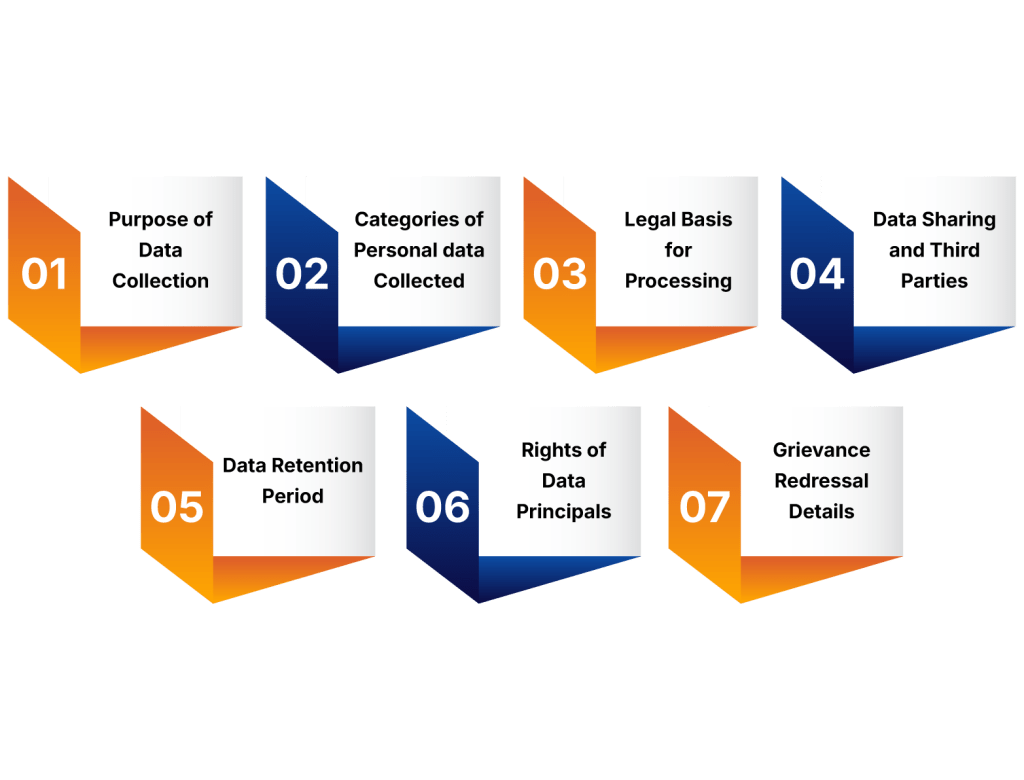
1. Purpose of Data Collection: Organizations must clearly state the purpose for collecting personal data. Each purpose should be specific, lawful, and easy to understand. Broad or ambiguous purposes should be avoided.
2. Categories of Personal data Collected: The notice should clearly describe the types of personal data collected, such as identity information, contact details, usage data, or financial information.
3. Legal Basis for Processing: The privacy notice must explain whether personal data is processed based on consent or under legitimate uses permitted by the DPDP Act.
4. Data Sharing and Third Parties: If personal data is shared with service providers, partners, or affiliates, this must be transparently disclosed. Clear disclosure of data sharing is a key part of privacy disclosures and DPDP transparency requirements.
5. Data Retention Period: Organizations should specify how long personal data will be retained or the criteria used to determine retention. Indefinite retention without explanation should be avoided.
6. Rights of Data Principals: Individuals must be informed of their rights, including the right to access personal data, request correction or erasure, withdraw consent, and seek grievance redressal.
7. Grievance Redressal Details: A compliant privacy notice must provide contact details for grievance redressal so individuals can raise concerns or complaints.
How to Draft Privacy Notice under DPDPA?
When considering how to draft privacy notice under DPDPA, clarity and relevance should be the top priorities.
- Link Data to Purpose: Each category of personal data should be clearly linked to a defined purpose. This demonstrates necessity, transparency, and accountability.
- Use a Clear Structure: Well-organized notices with headings, bullet points, and logical flow make it easier for users to understand key information.
- Ensure Easy Access: Privacy notices should be easily accessible on websites, mobile apps, and during onboarding processes. Accessibility is a critical compliance requirement.
DPDPA Compliant Privacy Notice Format
A commonly followed DPDPA compliant privacy notice format includes:
- Introduction and applicability
- Types of personal data collected
- Purpose and legal basis of processing
- Data sharing and third-party disclosures
- Data retention practices
- Rights of individuals
- Grievance redressal mechanism
- Updates and changes to the notice
Using a structured format helps organizations meet regulatory expectations while improving user understanding and trust.
Meeting DPDP Transparency Requirements
Meeting DPDP transparency requirements goes beyond listing information. Organizations must ensure that their privacy notice accurately reflects actual data processing practices.
To maintain transparency:
- Use plain and clear language
- Keep disclosures accurate and current
- Avoid misleading or incomplete statements
- Update notices whenever data practices change
Transparency is central to DPDP compliance and plays a major role in reducing legal and reputational risks.
Common mistakes to Avoid
Organizations often make avoidable mistakes such as copying generic templates, using vague purposes, or failing to update privacy notices when business practices change. Another common issue is treating the privacy notice as an internal compliance document rather than a user focused disclosure. Understanding the distinction between privacy notice vs privacy policy India helps avoid these errors and ensures proper compliance.
Conclusion
A compliant privacy notice as required by India’s Digital Personal Data Protection Act is an initial component for achieving lawful and responsible data processing. The DPDP privacy policy is designed to create transparency, respect the rights of individuals, and provide evidence of compliance with regulations through effective notices. It is important for an organization to comply with these requirements as well as choose a clear format to create a strong user trust, which will aid in developing a compliant privacy notice in accordance with the DPDP Act. A good privacy notice not only provides compliance but reflects the way an organization handles data responsibly.
Do you need assistance in developing a DPDPA compliant, clear and business-specific privacy notice? ValueMentor has expertise to assist you in developing legally compliant, clear and user-friendly privacy notices that meet all of the DPDP requirements. Start your compliance journey today.
FAQS
1. Do small businesses and startups also need a privacy notice under the DPDP Act?
Yes. Any business that collects personal data digitally, regardless of size, must provide a privacy notice under the DPDP Act.
2. Can one privacy notice cover multiple products or services?
Yes, but only if the purposes of data collection are clearly explained for each product or service to avoid confusion.
3. Is user consent valid if the privacy notice is difficult to understand?
No. Consent must be informed, which means the privacy notice should be clear, simple, and easy to understand.
4. How often should a privacy notice be reviewed or updated?
A privacy notice should be reviewed whenever data processing practices change and at regular intervals to remain accurate.
5. Can a privacy notice be displayed only as a link on a website?
It can be linked, but it must be easily accessible and visible at the point where personal data is collected.
6. Is it mandatory to show privacy notice in regional languages?
While not strictly mandatory, providing notice in relevant regional languages improves accessibility and supports transparency.
7. What happens if a business collects data for a new purpose not mentioned in the privacy notice?
The privacy notice must be updated, and fresh consent may be required before processing data for the new purpose.
8. Does the DPDP Act allow businesses to use a single global privacy notice?
Yes, but it must clearly address India-specific DPDP requirements and user rights to remain compliant.
9. Are offline data collection activities also covered by the privacy notice requirement?
If the data is later digitized or processed digitally, DPDP obligations, including privacy notice requirements, apply.
10. Can regulators penalize businesses for misleading or vague privacy notices?
Yes. Inaccurate, incomplete, or misleading privacy notices can lead to regulatory action and penalties under the DPDP Act.