Enterprises today are facing a growing challenge: they are expected to protect sensitive data and comply with evolving privacy regulations, yet many still lack clear visibility into where their data resides and how it is being used. As data continues to expand across cloud platforms, on-premise systems, and third-party environments, managing compliance manually is no longer sustainable. This is where BigID compliance plays a critical role. By leveraging BigID compliance services, organizations can identify, classify, and manage sensitive data across complex environments. It helps bridge the gap between data sprawl and regulatory expectations, enabling enterprises to move from reactive compliance efforts to a more proactive and automated approach.
In this guide, we break down how BigID compliance services support enterprise data privacy and governance. You’ll learn how organizations can streamline compliance processes, improve data accuracy, and reduce risk while maintaining control over their data ecosystems.
Simplify data compliance before it becomes a business risk.
With BigID compliance services, you can automate discovery, manage privacy rights, and stay audit-ready without manual effort.
What Is BigID compliance?
BigID compliance refers to the use of advanced data intelligence platforms to help organizations discover, manage, and protect sensitive data in line with global privacy regulations. With capabilities like BigID data discovery, enterprises gain full visibility into where personal data exists and how it is being used. Instead of relying on manual tracking, organizations can automate compliance processes at scale.
In today’s data-driven environment, organizations struggle with scattered data across cloud, on-premise systems, and third-party platforms. This makes compliance with regulations like GDPR or CCPA complex and error-prone. BigID helps solve this challenge by enabling accurate data discovery, classification, and governance at scale.
What problems does it solve?
Enterprises typically face several critical challenges:
- Lack of visibility into sensitive and personal data
- Difficulty in tracking data across multiple systems
- Manual compliance processes leading to delays and errors
- Inability to respond quickly to regulatory requests
- Poor data classification leading to compliance risks
BigID addresses these issues by providing automated data intelligence and centralized governance.
Who needs BigID compliance?
BigID compliance is particularly valuable for:
- Large enterprises handling massive volumes of data
- Highly regulated industries such as banking and healthcare
- Organizations operating across multiple geographies
- Businesses managing customer or employee personal data
Why enterprises need BigID for data privacy compliance?
Enterprises today are not just managing data; they are managing risk, regulations, and reputation. Traditional approaches to compliance are no longer sufficient because they cannot scale with modern data environments.
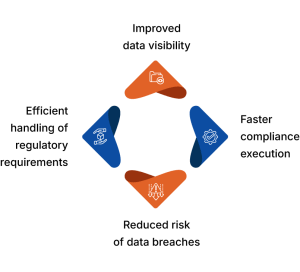
Key reasons enterprises adopt BigID
- Improved data visibility across structured and unstructured sources
- Faster compliance execution with automated workflows
- Reduced risk of data breaches through better governance
- Efficient handling of regulatory requirements
BigID enables enterprises to adopt a more proactive approach by combining automation, intelligence, and centralized control.
How BigID supports data privacy compliance programs?
BigID plays a crucial role as part of a broader data privacy compliance strategy. Rather than functioning as a standalone tool, it integrates into existing systems to provide centralized visibility and control over sensitive data. It enables organizations to automate data discovery, classification, and governance processes, reducing the reliance on manual effort. This automation not only improves efficiency but also ensures consistency and accuracy in compliance activities.
Another key advantage is scalability. As data volumes grow, enterprises need solutions that can adapt without compromising performance. BigID supports compliance programs by handling large datasets across multiple environments with precision.
BigID compliance automation explained
Compliance automation is one of the core strengths of BigID. It eliminates repetitive manual tasks and replaces them with intelligent workflows that operate at scale.
Instead of manually searching for sensitive data or tracking compliance status, organizations can automate these processes, ensuring faster execution and fewer errors.
Key benefits of automation
- Faster compliance processes with minimal human intervention
- Reduced operational costs by eliminating manual tasks
- Improved accuracy in data handling and reporting
- Scalability across large and complex data environments
This is especially critical in BigID DSAR automation, where organizations can streamline data access requests and reduce response time.
BigID data discovery and classification
BigID Data discovery and classification form the foundation of any effective compliance program. Without knowing where sensitive data exists, organizations cannot protect it or meet regulatory requirements.
Why data discovery matters
BigID data discovery helps organizations locate and categorize data across structured databases and unstructured sources such as emails, documents, and cloud storage. This visibility enables better control and informed decision-making.
BigID personal data discovery across systems
Modern enterprises store data across multiple systems, making it difficult to track personal information. BigID addresses this challenge by scanning diverse data sources and identifying sensitive data regardless of where it resides.
Data inventory mapping and classification accuracy
Accurate data classification is essential for compliance. Misclassified data can lead to regulatory penalties and security risks.
BigID enhances classification accuracy by using advanced techniques to correctly identify and tag sensitive data, enabling organizations to maintain a reliable data inventory.
BigID DSAR automation and privacy rights handling
Data Subject Access Requests (DSARs) are a key requirement under many privacy regulations. However, managing these requests manually can be time-consuming and complex, especially for large enterprises. Organizations must locate all relevant data, verify identities, and respond within strict deadlines. Without automation, this process can lead to delays and errors.
BigID DSAR automation simplifies this process by automating data retrieval and response workflows. This enables organizations to respond faster while maintaining accuracy and compliance.
Managing privacy rights at enterprise scale
Handling privacy rights requests at scale requires efficient processes and robust systems. As the number of requests increases, manual approaches become unsustainable.
BigID supports enterprise data protection services by enabling scalable privacy rights handling. It ensures that requests are processed efficiently, reducing response times and improving user trust.
BigID access governance and data use control
Access governance is a critical component of data privacy compliance. Even if organizations know where sensitive data exists, uncontrolled access can still lead to breaches and regulatory violations.
BigID helps enterprises gain visibility into who can access sensitive data and how it is being used. This enables organizations to enforce policies, reduce unnecessary access, and strengthen overall data security.
Why access governance matters
How BigID supports access control
With BigID access governance, organizations strengthen data security and compliance.
BigID retention and data lifecycle management
Data lifecycle management focuses on how data is stored, used, and eventually deleted. Keeping data longer than necessary increases compliance risks and operational costs.
BigID helps organizations define and enforce data retention policies, ensuring that data is only kept for as long as required. This supports compliance with regulations that mandate data minimization and timely deletion.
Key elements of data lifecycle management
Risks of poor data retention
By managing the data lifecycle effectively, enterprises can reduce risk and improve compliance efficiency.
Audit Readiness, Reporting, and Risk support
Compliance requires proof. BigID audit reporting helps organizations demonstrate compliance through detailed insights.
BigID supports audit readiness by providing detailed insights into data handling practices, making it easier to prepare for regulatory reviews and internal audits.
How BigID supports audit readiness
With BigID audit reporting, enterprises can confidently handle audits and regulatory checks.
Risk and Incident support
This proactive approach ensures that enterprises are always prepared for regulatory inspections and can quickly address potential risks.
Vendor and Third-party data governance using BigID
Third-party vendors often have access to sensitive data, which introduces additional compliance risks. Organizations must ensure that these external entities adhere to the same data protection standards.
BigID enhances visibility into third-party data usage, enabling organizations to monitor and manage risks effectively. It supports accountability and ensures compliance beyond internal systems.
BigID in hybrid and cloud environments
Modern enterprises operate in hybrid environments that combine on-premise systems with cloud platforms. This creates data sprawl, making compliance more complex.
BigID helps organizations maintain consistent data governance across all environments, ensuring that compliance policies are applied uniformly.
Challenges in hybrid environments
How BigID addresses these challenges?
With BigID hybrid environment support, data governance across cloud, on-premises, and hybrid setups, providing a unified approach to compliance. It helps organizations manage data sprawl and maintain control over their data assets.
BigID compliance services include data discovery and classification setup
So, our team helps you identify sensitive data, map risks, and streamline compliance workflows from the start. Most organizations achieve faster audit readiness.
BigID compliance implementation approach
Implementing BigID requires a structured approach to ensure successful adoption and long-term value. Organizations must align technology with processes and responsibilities.
A well-planned implementation helps maximize efficiency while minimizing disruption to existing operations.
High-level implementation steps
With BigID implementation services, enterprises can maximize efficiency while minimizing disruption.
Common challenges
A well-planned implementation strategy ensures smooth deployment and long-term success.
Why choose ValueMentor for BigID compliance?
We go beyond tool implementation; we deliver outcomes.
With deep expertise in BigID compliance services and BigID implementation services, ValueMentor helps organizations achieve scalable and automated compliance.

What sets us apart?
- Deep expertise in enterprise data privacy
- Proven implementation frameworks
- Strong understanding of regulatory landscapes
- Focus on automation and scalability
- End-to-end support from strategy to execution
Our goal is to help organizations move from compliance burden to compliance advantages.
BigID compliance use cases by industry
Different industries face unique compliance challenges based on the type of data they handle and the regulations they must follow.
BigID supports industry-specific use cases by adapting to various data environments and compliance requirements.

Financial services
- Managing sensitive financial data
- Meeting strict regulatory requirements
- Preventing fraud and data breaches
Healthcare
- Protecting patient data and medical records
- Ensuring compliance with health data regulations
- Managing large volumes of sensitive information
Technology
- Handling user data across platforms
- Ensuring privacy in digital products
- Managing global compliance requirements
Retail
- Protecting customer data and transaction details
- Managing data across e-commerce platforms
- Reducing risks associated with third-party vendors
By addressing industry-specific needs, BigID supports comprehensive data governance compliance.
BigID compliance vs Traditional compliance methods
Traditional compliance methods rely heavily on manual processes and limited data visibility. These approaches are often inefficient and prone to errors.
In contrast, BigID enables automated data discovery, classification, and governance, providing greater accuracy and scalability. This reduces operational overhead and improves compliance outcomes.
Automation allows organizations to handle large volumes of data efficiently, making BigID a more effective solution for modern compliance challenges.
Take control of your data compliance efficiently, securely, and at scale.
BigID compliance: full data visibility, automated workflows, and a team that helps you reduce risk and meet regulatory demands.
FAQs
1. What is BigID compliance used for
BigID compliance is used to help organizations identify, manage, and protect sensitive data in accordance with privacy regulations. It provides visibility into data assets and supports governance processes. It is commonly used for data discovery, classification, privacy rights management, and audit readiness, making it a comprehensive solution for enterprise compliance.
2. How does BigID support data privacy laws?
BigID supports data privacy laws by enabling organizations to locate personal data, manage consent, and fulfill regulatory requirements such as DSARs. It also helps enforce data protection policies and provides reporting capabilities needed for compliance verification.
3. Can BigID manage DSAR requests?
Yes, BigID can automate DSAR request handling by identifying relevant data and streamlining response workflows. This reduces manual effort, improves response times, and ensures compliance with regulatory deadlines.
4. Does BigID support cloud and on-prem systems?
BigID is designed to work across cloud, on-premises, and hybrid environments, providing consistent data governance capabilities. This flexibility allows organizations to manage compliance across diverse data infrastructures.
5. Is BigID suitable for large enterprises?
BigID is particularly suited for large enterprises that manage complex and high-volume data environments. Its scalability and automation capabilities make it ideal for organizations with extensive compliance requirements.
6. How does BigID help with audit readiness?
BigID enhances audit readiness by providing detailed reporting, monitoring, and documentation of compliance activities. This enables organizations to demonstrate compliance effectively and respond to audits with confidence.