Data Privacy is not only a regulatory requirement anymore but a business expectation. Businesses are now dealing with vast amounts of data related to customers, employees, vendors, and their own operations, spread out through cloud environments, software, hardware, and other third-party ecosystems. On top of that, there are more and more strict privacy laws such as GDPR, CCPA, India’s DPDPA, and HIPAA that require businesses to collect, process, store, and transmit data in a particular way. The difficulty for businesses here is not just compliance with one specific law. It is about creating a scalable privacy compliance program capable of adapting to different regions, technologies, and operational processes. And this is where data protection and privacy services come into play. They range from DPO as a Service and privacy risk assessment to employee training and product privacy review.
ValueMentor helps organizations build and strengthen privacy programs through certified consultants, global regulatory expertise, and practical implementation support across industries including healthcare, financial services, technology, retail, and manufacturing. With experience in GDPR compliance consulting, ISO 27701 alignment, privacy governance, and risk management, ValueMentor supports organizations through every stage of their privacy journey.
Book a Free Data Protection Consultation today!
Schedule a call with a certified privacy expert to discuss your organization’s compliance challenges, risk exposure, and privacy governance goals.
What is Data Protection & Privacy? Why it matters for your business
Data Privacy and data protection relate to the means used by organizations to protect personal information and ensure that it is processed in the right way. Unlike data security, which deals with protection against unauthorized access to data and IT systems, privacy is concerned with the processing of personal information in accordance with the law.
Privacy compliance is not something that only concerns multinational corporations today. Any business entity collecting, processing, transmitting, storing, and managing any kind of personal information must be able to adhere to a particular privacy law or laws, based on the geographical location and the type of personal information managed. Apart from the legal obligations, contemporary consumers expect businesses to act with openness and transparency.
The International Regulations and Laws Environment (GDPR, CCPA, DPDPA, HIPAA, among others)
In today’s world, businesses have to function in an environment characterized by the presence of multiple privacy laws and regulations. It is therefore important that companies do not view the regulations as just another set of laws but as control measures embedded within business operations.
| Regulation | Region | Primary Requirement |
|---|---|---|
| GDPR | European Union | Requires lawful basis for personal data processing and strong individual rights |
| CCPA/CPRA | California, USA | Gives consumers the right to opt out of data sharing and request deletion |
| DPDPA | India | Requires clear consent notices and responsible processing of digital personal data |
| HIPAA | United States Healthcare | Protects sensitive patient health information and mandates safeguards |
| LGPD | Brazil | Establishes lawful processing requirements similar to GDPR |
For example, GDPR compliance requires the presence of legal grounds for processing personal data, keeping logs of processing activities, and making personal data available to be deleted. The key challenges involved in CCPA compliance are related to transparency and consumer’s right to privacy, especially data transfer. Compliance with the DPDPA in India centers around the proper management of consents and notices.
The Business cost of getting privacy wrong
The financial and reputational consequences of poor privacy practices continue to rise every year. Regulatory authorities across the world are imposing significant penalties for privacy violations, while customers increasingly avoid organizations they perceive as careless with personal information.
Under GDPR, regulators can impose fines of up to €20 million or 4% of annual global turnover, whichever is higher. Several high profile organizations have already faced major enforcement actions. LinkedIn was fined €310 million by Ireland’s Data Protection Commission over issues related to behavioral analysis and targeted advertising practices.
Who needs data protection & privacy services?
Any company handling personal data can benefit from structured privacy services, but certain industries and business models face especially high regulatory exposure and operational complexity.
Organizations commonly requiring data protection and privacy services include:
SaaS and cloud service providers handling global customer data
Healthcare organizations processing patient and medical information
Financial institutions managing sensitive financial records
Ecommerce and retail businesses collecting consumer behavior data
Educational institutions storing student and faculty information
Technology companies developing data-driven products and platforms
Enterprises operating across multiple regulatory jurisdictions
Organizations processing employee and HR-related personal data
When businesses find themselves in situations where they are required to hire a Data Protection Officer, perform a privacy risk assessment, become compliant with GDPR regulations, deal with privacy requirements of customers, or implement a privacy compliance system, they usually look for external help.
DPO as a Service – What it is, who needs it, and how it works
With the development of privacy laws worldwide, businesses face increasing pressure from all sides and are forced to become accountable when it comes to dealing with private information about individuals. Hiring an adequate person for overseeing privacy-related activities becomes one of the crucial aspects of such business operations. However, it is not easy for many organizations to justify having an internal DPO.
That is precisely why many companies today opt for Data Protection Officer as a Service (DPOaaS), which enables companies to get experienced privacy experts without the burden of having an in-house privacy department.
What is DPO as a Service?
A Data Protection Officer as a Service model provides organizations with outsourced privacy leadership and ongoing compliance support. Instead of employing a full-time DPO internally, businesses partner with a privacy consulting provider that supplies certified experts who act as the organization’s designated privacy lead.
The role of a DPO is not limited to legal interpretation. The DPO assists in implementing privacy requirements within business operations, technology, third-party vendors, and personnel. The main duties of a DPO include:
Providing guidance to the management regarding privacy requirements of GDPR and other laws
Ongoing monitoring of compliance measures
Privacy auditing and assessment internally
Data Protection Impact Assessment (DPIA)
Processing of data subject requests
Reviewing third-party vendor privacy risks
Assisting with breach response and regulatory communication
Delivering privacy awareness training to employees
An outsourced DPO service allows organizations to access multidisciplinary expertise across legal, governance, security, and operational domains without relying on a single internal resource.
See How Our Outsourced DPO Service Works
Learn how ValueMentor helps organizations manage privacy compliance, data subject requests, risk assessments, and ongoing regulatory obligations through scalable managed DPO services.
In-House DPO vs. Outsourced DPO – A practical comparison
Organizations evaluating privacy leadership often compare the benefits of hiring an internal DPO versus using an external DPO service provider. While large enterprises may maintain dedicated privacy offices internally, many organizations find outsourced models more scalable and cost-effective.
| Area | In-House DPO | Outsourced DPO Service |
|---|---|---|
| Cost Structure | High salary and operational overhead | Flexible subscription or engagement model |
| Expertise | Limited to individual experience | Access to multi-domain consulting team |
| Regulatory Exposure | May lack global compliance coverage | Broader international regulatory expertise |
| Availability | Dependent on one employee | Shared team support and continuity |
| Scalability | Difficult during rapid growth | Easier to scale across business units |
| Training & Assessments | Often handled separately | Usually integrated into service delivery |
| Incident Support | Limited bandwidth during breaches | Dedicated incident response guidance |
For organizations operating across multiple regions or handling sensitive personal information, outsourced DPO services often provide stronger governance coverage and faster access to specialized expertise.
Core DPO Responsibilities Under GDPR and Global Frameworks
Under GDPR Article 39, a Data Protection Officer is responsible for monitoring compliance with data protection laws and advising organizations on their obligations. Similar expectations increasingly appear in global privacy frameworks and industry-specific regulations.
Core DPO responsibilities typically include:
Compliance Monitoring
The DPO oversees ongoing privacy compliance activities, ensuring policies, procedures, and operational controls remain aligned with applicable regulations.
Data Protection Impact Assessments (DPIAs)
The DPO advises organizations on when DPIAs are required and helps assess privacy risks associated with high-risk processing activities.
Data Subject Rights Management
Organizations must respond to requests involving data access, deletion, correction, portability, and consent withdrawal within defined timelines.
Vendor Privacy Oversight
Third-party processors and vendors handling personal data introduce significant privacy risks. DPOs help evaluate contracts, processing agreements, and vendor compliance posture.
Privacy Incident and Breach Support
In the event of a privacy breach, the DPO supports investigation, documentation, regulator notification obligations, and remediation planning.
Employee Privacy Awareness
Privacy compliance depends heavily on employee behavior. DPOs often oversee role-based privacy awareness training and ongoing education initiatives.
What does a managed DPO service actually include?
Many organizations assume DPO services are limited to periodic legal consultation. In reality, managed DPO services typically function as an ongoing operational privacy partnership.
A mature managed DPO service may include:
Privacy compliance assessments and audits
Policy and privacy notice development
Records of Processing Activities (RoPA) management
DPIA facilitation and review
Vendor privacy risk assessments
Incident and breach management support
Data subject request management workflows
Cross-border transfer compliance guidance
The goal is not only to maintain compliance but also to embed privacy governance into daily business operations.
How to choose the right DPO as a service provider
Selecting the right DPO service provider is critical because the DPO becomes a strategic advisor influencing governance, risk management, customer trust, and regulatory readiness.
When evaluating DPO consulting providers, organizations should assess:
Multi-Regulation Experience
Privacy obligations vary significantly across regions. Providers should demonstrate practical experience with GDPR, CCPA, DPDPA, HIPAA, and other applicable frameworks.
Industry-Specific Knowledge
Healthcare, fintech, SaaS, retail, and manufacturing sectors all face unique privacy risks and operational challenges.
Operational Delivery Capability
The provider should offer practical implementation support — not just high-level advisory services.
Incident Response Readiness
Privacy incidents require rapid coordination. Evaluate whether the provider can support breach handling, investigation, and regulatory communication effectively.
Scalable Engagement Model
As your business grows, the DPO service should scale across new regions, products, vendors, and compliance obligations without major disruption.
Privacy program development – building a framework that lasts
Privacy compliance initiatives in many firms have been reactive in nature in the sense that changes to privacy policies have come up in response to a directive from regulatory authorities, complaints from customers, or implementation of controls after a security breach. Although such efforts might help in dealing with a situation on an urgent basis, there will be no sustainability in terms of compliance.
The role of a privacy compliance program in ensuring that companies move from fragmented approaches to privacy compliance to adopting a repeatable approach cannot be overemphasized. This is because a privacy compliance program facilitates the development of consistency in the collection, use, storage, dissemination, and protection of personal data.
What is a privacy program and why does it need to be built properly?
Privacy programs are a collection of policies, governance, operations, technology, education, and other tools that organizations can use for the management of their responsibilities regarding data protection.
The function of a privacy program extends beyond compliance and also includes the implementation of privacy controls within regular business operations. Some benefits of having a proper enterprise privacy program include:
Identification and management of personal information
Mitigation of regulatory and operational risks
Increased transparency and accountability
Strengthen customer trust
Support secure digital transformation initiatives
Building consistency in handling privacy breaches and data subject access requests
Ensure compliance in various jurisdictions
It is an error for companies to assume that compliance means posting privacy policies. More than ever, regulatory agencies examine whether privacy controls have been integrated into operations.
The core components of a privacy governance framework
An optimal privacy governance framework involves strategy and execution. Although there is no one-size-fits-all privacy governance framework, here are some elements that exist in almost all privacy governance frameworks.
Privacy Governance Structure
A proper privacy governance framework should have clear roles and responsibilities. These include the executive sponsor, legal department, IT Security Department, Compliance Department, Human Resources Department, and the Privacy Champion or DPO.
Policies and Standards
Documented policies establish expectations around:
Records of Processing Activities (RoPA)
Maintaining Records of Processing Activities helps organizations understand:
RoPA management is a core requirement under GDPR and a critical operational control for broader privacy governance.
Risk Management and Assessments
Privacy programs require ongoing risk identification through:
Technical and Organizational Controls
Controls may include:
Training and Awareness
Employees play a major role in privacy compliance. Ongoing role-based training helps reduce human error and strengthen accountability.
Monitoring and Continuous Improvement
Privacy programs must evolve as regulations, technologies, and business operations change. Ongoing reviews, audits, and maturity assessments help organizations identify gaps and improve continuously.
How to develop a privacy program – step by step
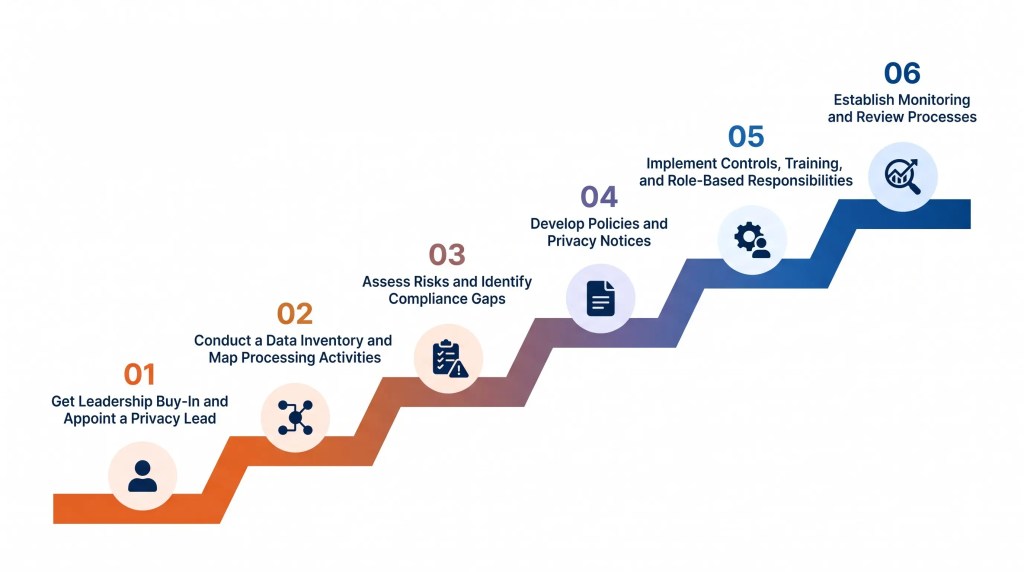
Creating a privacy compliance framework necessitates an implementation strategy. Organizations without one that try to address their privacy needs will result in piecemeal initiatives that will be hard to scale up.
Step 1 – Get Leadership Buy-In and Appoint a Privacy Lead
This step involves gaining executive buy-in since privacy compliance will impact several areas of the organization. They have to set up the governance requirements, provide the necessary resources and establish accountability. Many organizations appoint a privacy leader here.
Step 2 – Conduct a Data Inventory and Map Processing Activities
Organizations can’t secure what they don’t know. Start by:
This data mapping exercise forms the foundation for all future compliance activities.
Step 3 – Assess Risks and Identify Compliance Gaps
Conduct privacy risk assessments and regulatory gap analyses to evaluate whether current controls align with applicable regulations such as GDPR, CCPA, or DPDPA.
Step 4 – Develop Policies and Privacy Notices
Create or update:
Policies should reflect operational realities rather than generic legal templates.
Step 5 – Implement Controls, Training, and Role-Based Responsibilities
Deploy technical, administrative, and operational controls while providing role-based training tailored to different departments.
Step 6 – Establish Monitoring and Review Processes
Privacy compliance is ongoing. Organizations should implement periodic audits, KPI tracking, maturity reviews, and governance reporting processes to ensure continuous improvement.
Privacy program maturity – where does your organization stand?
Many organizations overestimate the maturity of their privacy programs. Having written policies alone does not mean privacy controls are functioning effectively in practice.
A privacy maturity model helps organizations evaluate where they currently stand and what improvements are needed.
| Maturity Level | Description |
|---|---|
| Initial | Ad hoc privacy activities with little formal governance |
| Developing | Basic policies exist but operational controls are inconsistent |
| Defined | Structured privacy governance and documented procedures |
| Managed | Metrics, accountability, monitoring, and reporting are established |
| Optimized | Continuous improvement and proactive privacy-by-design integration |
A common issue is the gap between policy documentation and operational execution. For example, an organization may publish retention policies but lack technical mechanisms to enforce deletion schedules consistently.
Vendor Privacy Risk Management Within Your Program
Third-party vendors, processors, cloud providers, and SaaS platforms significantly expand an organization’s privacy risk exposure. Even if personal data is outsourced to another provider, regulators generally still hold the original organization accountable for how that data is handled.
Vendor privacy risk management should therefore be integrated directly into the broader privacy governance framework.
Privacy Risk Assessment – Finding and Fixing Risks Before They Become Problems
Assumptions do not work when it comes to privacy compliance. It is important to know exactly how data flows in the organization, what possible risks there are, and if controls in place can be considered enough to safeguard people’s rights and information. This is the main objective of conducting a privacy risk assessment.
A privacy risk assessment is helpful as it allows the organization to spot any potential problems before they result in regulatory issues, operational disruptions, and ultimately, in data leaks. In other words, rather than addressing the problem after it happens, the organization will be able to evaluate the risks, address them, and limit their negative impacts on business.
Since regulations such as GDPR, DPDPA, CCPA, and HIPAA constantly change, privacy risk assessment has turned into a key operational task.
What Is a Privacy Risk Assessment?
A privacy risk assessment is a structured process used to identify, analyze, and evaluate risks associated with the collection, use, storage, sharing, and disposal of personal data.
The assessment examines:
The goal is to determine whether existing safeguards are adequate and whether additional controls are needed to reduce potential harm to data subjects and regulatory exposure for the organization.
Privacy Risk Assessment vs. DPIA – What’s the Difference?
Organizations often confuse a general privacy risk assessment with a Data Protection Impact Assessment (DPIA). While the two are related, they serve different purposes.
| Privacy Risk Assessment | DPIA (Data Protection Impact Assessment) |
|---|---|
| Broad operational privacy review | Formal regulatory assessment under GDPR |
| Can apply to any processing activity | Required for high-risk processing activities |
| Focuses on identifying privacy weaknesses | Focuses on risks to individuals’ rights and freedoms |
| Used across multiple regulations | Primarily associated with GDPR Article 35 |
| Often part of ongoing governance | Typically triggered before high-risk initiatives |
A privacy risk assessment can be conducted at any time to evaluate overall privacy posture, while a DPIA is legally required in certain scenarios where processing activities are likely to result in high risk to individuals.
The Privacy Risk Assessment Process – How It Actually Works

An effective privacy risk assessment follows a structured methodology designed to identify risks systematically and prioritize remediation efforts.
Step 1 – Map Data Flows
The first step is understanding how personal data moves through the organization. This includes:
Without clear visibility into data flows, meaningful risk analysis becomes impossible.
Step 2 – Identify Personal Data and Legal Basis
Organizations must determine:
This step ensures processing activities align with regulatory expectations.
Step 3 – Assess Likelihood and Severity of Harm
The assessment evaluates how identified weaknesses could impact individuals if exploited or mishandled.
Potential risks may include:
Both likelihood and impact severity should be considered.
Step 4 – Prioritize Risks by Impact Level
Not all risks carry equal importance. Organizations should categorize risks based on:
This helps teams focus remediation efforts on the highest-priority issues first.
Step 5 – Define Remediation Actions
Once risks are identified, organizations should establish:
Remediation may involve:
Step 6 – Document Findings and Monitor Progress
Assessment findings should be formally documented along with remediation status tracking and ongoing monitoring activities.
Documentation demonstrates accountability and provides evidence of due diligence during audits or regulatory reviews.
Privacy Risk Assessment Checklist – Key Areas to Cover
A privacy risk assessment should evaluate both governance and operational controls across the organization. While every assessment differs depending on business type and regulatory scope, several areas consistently require review.
Lawful Basis Validation
Data Minimization Review
Third-Party Processor Assessment
Data Retention and Disposal
Data Subject Rights Readiness
Technical Security Safeguards
Data Breach Readiness
Cross-border Data Transfers
A well-executed privacy risk assessment helps organizations strengthen compliance posture, reduce operational vulnerabilities, improve accountability, and build greater trust with customers, regulators, and business partners.
Privacy Regulation Gap Assessment – Know Where You Stand Before a Regulator Does
Organizations often assume they are compliant if they have put out privacy policies, have made some form of basic security measures or completed some compliance exercises. However, there is an increasing expectation from the regulators that organizations will demonstrate their compliance in terms of operations with respect to governance, processing, vendor management, employee training, and technology. Conducting a privacy regulation gap analysis allows organizations to determine the extent of their compliance with the laws and regulations concerning privacy in place.
What Is a Privacy Regulation Gap Assessment?
A privacy regulation gap assessment is a formal comparison between an organization’s current privacy practices and the requirements defined by applicable privacy laws, frameworks, or industry standards.
The objective is simple: determine where the organization currently stands, identify areas of non-compliance or weakness, and define what needs to be improved.
The assessment typically evaluates:
The output of a privacy gap assessment usually includes:
In practical terms, a privacy gap assessment answers one of the most important business questions:
“Are we actually compliant, and if not, what do we fix first?”
Which Privacy Regulations Should Your Gap Assessment Cover?
The scope of a privacy regulation gap analysis depends on:
where the organization operates
where customers are located
what types of personal data are processed
industry-specific obligations
Most organizations today must address more than one regulatory framework simultaneously.
Common regulations included in privacy gap assessments include:
GDPR for organizations handling EU personal data
CCPA/CPRA for businesses serving California residents
India’s DPDPA for digital personal data processing
HIPAA for healthcare organizations in the United States
LGPD for organizations operating in Brazil
Sector-specific privacy and security frameworks
Organizations expanding internationally often discover overlapping obligations across multiple jurisdictions. For example:
GDPR requires lawful processing and accountability measures
CCPA emphasizes consumer opt-out rights and transparency
DPDPA focuses heavily on consent notices and responsible processing
HIPAA requires administrative, technical, and physical safeguards for health data
Rather than managing each regulation separately, mature organizations develop unified privacy governance programs aligned to common operational controls.
The Gap Assessment Process – From Scoping to Remediation Roadmap
The privacy gap assessment process entails a phased methodology that aims at assessing not only documentation but also operational reality.

Step 1 – Scoping the Assessment
The first phase defines:
Clear scoping prevents fragmented assessments and ensures all relevant risk areas are covered.
Step 2 – Data Collection and Stakeholder Interviews
Assessors gather information through:
This phase helps establish how privacy controls function operationally rather than relying solely on documented policies.
Step 3 – Gap Identification
The organization’s current practices are compared directly against regulatory requirements.
Common gaps identified include:
Each gap is documented with clear references to the applicable regulatory requirement.
Step 4 – Risk Rating and Prioritization
Not every compliance gap presents the same level of exposure. Risks are prioritized based on:
This allows organizations to address critical weaknesses first.
Step 5 – Remediation Roadmap Development
The assessment concludes with a practical remediation roadmap outlining:
A realistic roadmap is critical because organizations rarely resolve all gaps simultaneously.
Step 6 – Executive Reporting and Ongoing Monitoring
Final reporting typically includes:
Privacy gap assessments must be performed by organizations at regular intervals as the dynamics of policies, technologies, and organizational processes change.
Privacy Framework Gap Analysis – NIST, ISO 27701, and GDPR Alignment
To ensure consistency and compliance with established standards, most organizations tend to organize their privacy management processes using well-established frameworks. These include NIST Privacy Framework and ISO 27701.
NIST Privacy Framework is useful for managing privacy risk by focusing on five key functions:
This framework is particularly useful for integrating privacy governance into broader enterprise risk management programs.
Privacy Training Programs – Building a Privacy-Aware Workforce
Even technology alone is inadequate in avoiding privacy issues. Organizational privacy issues can arise even where there is robust technological control. This is because some employees who do not have the capacity to deal with personal data issues in the right way can expose organizations to privacy issues when they reveal personal information, fail to deal appropriately with data subject requests, follow phishing links, or even process personal data at high risks.
This is the reason for including privacy awareness training in operational controls within privacy regimes. GDPR, HIPAA, and other privacy regimes now demand proof of consistent privacy training of employees.
Why Privacy Training Is Not Optional
Privacy breaches usually stem from human errors. Daily transactions with personal information occur in many areas, such as through emails, clouds, CRMs, HR applications, customer support processes, and business practices. Lack of knowledge makes employees prone to committing compliance violations without knowing about them.
Typical privacy risks associated with employees include:
Under GDPR Article 39, the Data Protection Officer is responsible for promoting awareness and training staff involved in processing operations. Many other frameworks also require organizations to maintain documented evidence of privacy training activities.
What a Good Corporate Privacy Training Program Looks Like
An effective privacy training program goes beyond generic presentations or annual checkbox exercises. Training should be practical, role-based, measurable, and aligned with how employees actually handle data within their responsibilities.
Role-Based Training Delivery
Different departments face different privacy risks. For example:
developers need guidance on privacy by design and secure data handling
HR teams manage employee records and sensitive personal information
customer support teams handle data subject access requests
marketing teams must understand consent and data sharing restrictions
Role-specific training improves relevance and retention.
Executive and Leadership Training
Senior leadership teams require focused training on:
regulatory accountability
governance obligations
breach reporting exposure
enterprise risk management
board-level oversight responsibilities
Privacy governance increasingly receives executive attention because privacy failures now create direct operational and reputational consequences.
Ongoing Refreshers and Updates
Privacy regulations, technologies, and threats continue to evolve. Organizations should provide:
Continuous reinforcement helps maintain awareness across the organization.
Completion Tracking and Reporting
Regulators often expect organizations to demonstrate:
who completed training
when training occurred
what topics were covered
assessment results and certification status
Tracking mechanisms provide measurable evidence of compliance efforts.
Assessments and Certification
Short quizzes, simulations, and certification exercises help validate understanding rather than assuming participation alone equals competency.
GDPR, HIPAA, and Multi-Regulation Privacy Training
Many firms operate within several privacy regimes at the same time. For instance, a healthcare firm dealing with European clients must be able to follow GDPR and HIPAA rules at the same time.
Rather than making their employees attend too many training sessions for each regime separately, organizations should consider developing combined privacy awareness approaches which are geared towards:
An integrated training approach helps employees understand:
Organizations with global operations often structure training into:
This layered approach improves scalability while keeping training manageable and relevant.
How to Train Employees on Privacy – A Practical Approach
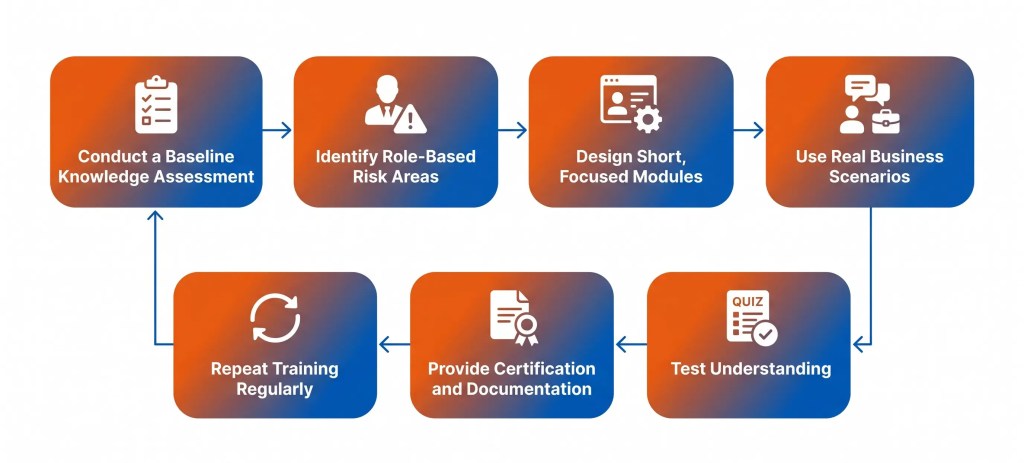
Privacy training programs are most effective when they are practical, concise, and aligned with real-world business scenarios.
Step 1 – Conduct a Baseline Knowledge Assessment
Start by evaluating current awareness levels across departments. This helps identify:
Step 2 – Identify Role-Based Risk Areas
Different teams interact with personal data differently. Training content should reflect actual operational responsibilities.
Step 3 – Design Short, Focused Modules
Employees retain information more effectively through short sessions focused on specific risks rather than lengthy compliance presentations.
Examples include:
Step 4 – Use Real Business Scenarios
Training becomes more effective when employees recognize situations they encounter in daily work activities.
Scenario-based exercises improve decision-making and retention significantly.
Step 5 – Test Understanding
Short quizzes or simulations help confirm whether employees understand key concepts and responsibilities.
Step 6 – Provide Certification and Documentation
Organizations should maintain records showing:
Step 7 – Repeat Training Regularly
Privacy training should never be considered a one-time project; refresher training and updates are required each year.
A well-developed privacy training course will make organizations more accountable, reduce risks, and increase the ability to handle privacy incidents effectively in the future.
Product Privacy Assessment – Getting Privacy Right Before You Launch
Today’s products are collecting and processing large volumes of personal data. From SaaS applications and mobile apps to connected devices, artificial intelligence (AI), analysis solutions, and cloud services, businesses today leverage personal data for functionality, personalization, and analysis purposes.
The problem with privacy, however, is that many companies do not consider privacy concerns until late into the development of their products. Instead, they pay much attention to the functionality, user experience, and time to market but little attention to how personal data is gathered, transferred, stored, and protected.
What Is a Product Privacy Assessment?
Product Privacy Assessment Definition
Product privacy assessment involves conducting an analysis that assesses how a product handles personal data and whether such handling practices meet privacy requirements or guidelines. The assessment looks at:
whether users maintain appropriate control over their information
The goal is to determine whether the product handles personal data in a lawful, transparent, secure, and proportionate manner.
Request a Product Privacy Review
Evaluate your product’s data handling practices, privacy-by-design controls, consent mechanisms, and compliance readiness before launch.
Product Privacy Assessment vs. DPIA – When Do You Need Each?
Organizations often confuse product privacy assessments with Data Protection Impact Assessments (DPIAs). While related, they serve different purposes.
A product privacy assessment is broader and may be conducted during:
It evaluates overall product privacy posture and operational risks.
The Product Privacy Assessment Process

An effective product privacy assessment follows a structured methodology integrated into the product development lifecycle.
Step 1 – Scoping and Regulatory Identification
The first step is determining:
Regulatory obligations vary depending on geography, industry, and user demographics.
Step 2 – Data Mapping and Processing Analysis
Organizations document:
This stage provides visibility into how personal information flows through the product ecosystem.
Step 3 – Privacy-by-Design Review
Privacy-by-design means privacy protections are embedded directly into architecture and workflows rather than added later.
The assessment evaluates:
Products should collect only the information necessary for clearly defined purposes.
Step 4 – Privacy Risk Evaluation
Identified privacy risks are evaluated based on:
This risk-based approach helps prioritize remediation efforts.
Step 5 – Remediation and Recommendations
The assessment concludes with practical recommendations to strengthen privacy controls before launch.
Common remediation activities include:
Addressing these issues early is significantly more efficient than redesigning systems after release.
Product Privacy Assessment Checklist
A practical product privacy assessment checklist helps organizations evaluate whether privacy requirements are operationally embedded into product functionality and governance processes.
Lawful Basis Validation
Consent and Transparency
Data Minimization
Third-Party SDK and API Assessment
Cross-Border Data Transfer Compliance
Security and Access Controls
A mature product privacy assessment process helps organizations reduce compliance risk, strengthen customer trust, improve regulatory readiness, and integrate privacy into product innovation from the very beginning.
How ValueMentor Delivers Data Protection & Privacy Services
The establishment of a privacy compliance strategy goes beyond assessment and generic policy implementation. A need arises for a partner who understands the intricacies involved in ensuring privacy compliance while managing corporate governance, cybersecurity, operations, cloud, vendor management, and product development.
ValueMentor is a data protection and privacy consulting company, providing a full spectrum of consulting services to help its clients improve privacy compliance and build their capability to grow and sustain themselves. ValueMentor offers its clients all-round support in everything they do with regard to data privacy and protection such as DPO as a Service, privacy risk assessment, training, gap analysis, and product privacy review.
Certifications and expertise
Privacy compliance needs people who are experts in many areas like interpreting privacy laws, governance, cybersecurity, operational issues, and risk management.
Relevant certifications and expertise areas include:
CIPP/E (Certified Information Privacy Professional – Europe)
This certification demonstrates practical knowledge of European privacy regulations, including GDPR obligations, lawful processing requirements, cross-border transfers, and data subject rights.
CIPM (Certified Information Privacy Manager)
CIPM focuses on operational privacy program management, governance structures, accountability frameworks, and privacy lifecycle management.
CIPT (Certified Information Privacy Technologist)
CIPT certification emphasizes integrating privacy controls into technology environments, cloud systems, applications, and product development lifecycles.
ISO 27001 and ISO 27701 Expertise
ValueMentor can assist businesses in achieving compliance with international standards for their privacy governance program.
Industries We Support
Different industries face different privacy challenges depending on the type of personal data processed, regulatory obligations, operational complexity, and customer expectations.
Healthcare
Healthcare organizations manage highly sensitive patient information subject to regulations such as HIPAA and GDPR.
Financial Services and Fintech
Financial institutions process large volumes of confidential financial and identity data while facing strict regulatory scrutiny.
Technology and SaaS Providers
Technology companies frequently process global customer data through cloud platforms, APIs, analytics systems, and AI-driven applications.
Retail and Ecommerce
Retail businesses collect significant amounts of customer behavioral and transactional data.
Manufacturing and Industrial Organizations
Manufacturers increasingly process employee, operational, and connected-device data across digital supply chains and smart manufacturing environments.
Education and EdTech
Educational institutions manage student records, learning platforms, and digital collaboration tools.
Our Delivery Model – How we work with you
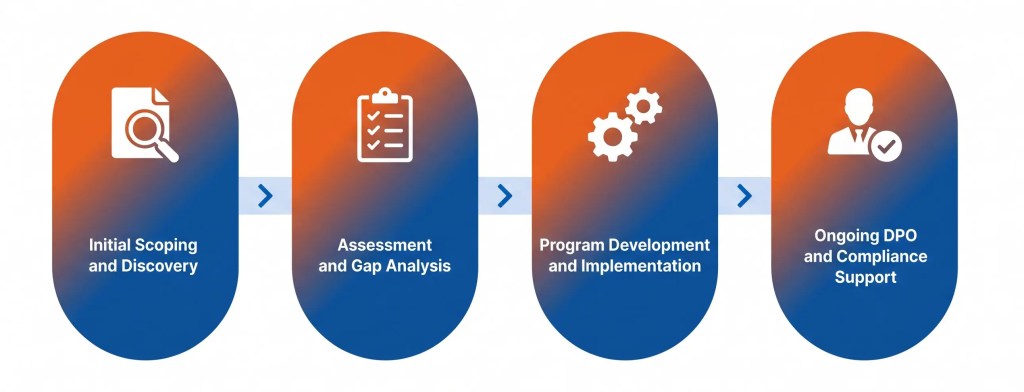
ValueMentor follows a structured delivery approach designed to help organizations move from uncertainty to operational privacy maturity in a practical and measurable way.
Step 1 – Initial Scoping and Discovery
The engagement begins with understanding:
This helps define the scope of assessments, compliance obligations, and implementation needs.
Step 2 – Assessment and Gap Analysis
Depending on organizational needs, ValueMentor conducts:
The objective is to identify operational weaknesses, compliance gaps, and high-risk areas requiring remediation.
Step 3 – Program Development and Implementation
Following the assessment phase, ValueMentor supports organizations with:
Step 4 – Ongoing DPO and Compliance Support
Privacy compliance is not a one-time initiative. Organizations often require continuous support through:
This continuous engagement model helps organizations adapt to evolving regulatory expectations while maintaining operational accountability.
Frequently Asked Questions About Data Protection & Privacy
What is DPO as a Service and who needs it?
DPO as a Service is an outsourced privacy leadership model where an external expert or consulting team performs the responsibilities of a Data Protection Officer. It is commonly used by organizations that process personal data but do not require or cannot justify a full-time internal DPO. Businesses operating under GDPR, handling sensitive customer data, or expanding globally often benefit from outsourced DPO services.
How is outsourced DPO different from a DPO consultant?
An outsourced DPO acts as an ongoing operational privacy lead responsible for monitoring compliance, advising leadership, supporting audits, and managing privacy governance activities continuously. A DPO consultant, on the other hand, is typically engaged for short-term advisory or project-based support such as policy reviews, assessments, or remediation initiatives.
What does a privacy risk assessment cover?
A privacy risk assessment evaluates how personal data is collected, processed, stored, shared, and protected within an organization. It reviews data flows, lawful processing bases, retention practices, vendor involvement, technical safeguards, and potential risks to individuals’ privacy rights. The goal is to identify weaknesses and prioritize remediation actions before incidents or compliance failures occur.
What is the difference between a privacy risk assessment and a DPIA?
A privacy risk assessment is a broader operational review of privacy risks across systems, processes, or business activities. A DPIA (Data Protection Impact Assessment) is a formal GDPR requirement specifically used when processing activities are likely to create high risk for individuals’ rights and freedoms. Organizations often conduct a general privacy assessment first to determine whether a DPIA is necessary.
What is a privacy regulation gap assessment?
A privacy regulation gap assessment compares an organization’s current privacy practices against the requirements of applicable laws and frameworks such as GDPR, CCPA, DPDPA, HIPAA, or ISO 27701. The assessment identifies compliance gaps, prioritizes risks, and provides a remediation roadmap to improve regulatory readiness.
How long does a privacy gap assessment take?
The duration depends on organizational size, complexity, number of regulations involved, and the scope of processing activities reviewed. Smaller organizations may complete a focused assessment within a few weeks, while enterprise-wide multi-regulation assessments can take several months. Factors such as vendor ecosystems, global operations, and product complexity also affect timelines.
Do employees legally need privacy training?
In many regulatory frameworks, employee privacy training is either explicitly required or strongly expected as part of organizational accountability obligations. Under GDPR, the Data Protection Officer is responsible for promoting awareness and staff training. Regulators increasingly expect organizations to maintain documented evidence of privacy awareness programs and employee participation.
What is a product privacy assessment?
A product privacy assessment evaluates whether a software application, platform, device, or digital service processes personal data lawfully, securely, and transparently. The assessment reviews data collection, retention, third-party sharing, consent mechanisms, access controls, and privacy-by-design implementation before or after product launch.
What is privacy by design and why does it matter for product development?
Privacy by design is the practice of integrating privacy protections directly into systems, applications, and development processes from the beginning rather than adding controls later. It helps organizations minimize data collection, improve transparency, strengthen security, reduce regulatory exposure, and build customer trust more effectively.
How much does DPO as a Service cost compared to hiring in-house?
DPO as a Service is typically more cost-effective than maintaining a full-time internal DPO because organizations gain access to multidisciplinary expertise without salary, training, recruitment, and operational overhead costs. Pricing depends on organizational size, regulatory exposure, geographic scope, and required support levels.
Which companies need a Data Protection Officer under GDPR?
Under GDPR, organizations may need to appoint a DPO if they conduct large-scale monitoring of individuals, process large volumes of sensitive personal data, or operate as public authorities. Many businesses also appoint DPOs voluntarily to strengthen governance, demonstrate accountability, and manage growing regulatory complexity.
How do you build a privacy program from scratch?
Building a privacy program typically begins with leadership alignment and appointing a privacy lead. Organizations then conduct data inventories, map processing activities, assess risks, identify compliance gaps, develop policies and governance controls, train employees, implement monitoring processes, and establish continuous review mechanisms to maintain long-term compliance maturity.