CCPA & CPRA compliance means following California data privacy laws that control how businesses collect, use, and protect consumer data. These laws apply to companies handling personal data of California residents and require transparency, consumer rights management, and strong data protection practices. Data privacy has become a critical priority for businesses that collect, process, or store consumer information especially when dealing with residents of California. Regulations like CCPA & CPRA compliance have transformed how organizations are expected to handle personal data, making transparency and accountability non-negotiable. The California Consumer Privacy Act compliance (CCPA) introduced a new standard by giving consumers greater control over their personal information. Building on this foundation, the California Privacy Rights Act compliance (CPRA) was later enacted to strengthen these protections, close regulatory gaps, and introduce stricter enforcement mechanisms.
Despite their importance, many businesses struggle to fully understand what these laws require. Questions such as what is CCPA compliance, how CPRA enhances existing rules, and whether an organization falls under these regulations often create confusion for both growing companies and established enterprises. This guide breaks down everything you need to know about CCPA & CPRA compliance including key differences, requirements, checklists, and compliance services helping your business navigate regulations with confidence, reduce risk, and build lasting customer trust.
Don’t risk penalties get CCPA & CPRA compliant today.
Identify gaps, strengthen data protection, and meet regulatory requirements with expert support.
What is CCPA & CPRA Compliance?
CCPA & CPRA compliance is the process of ensuring that businesses meet California data privacy laws by managing personal data responsibly, enabling consumer rights, and maintaining secure data practices
Understanding what is CCPA compliance and how it evolved into CPRA is the first step toward building a strong privacy framework.
What is CCPA Compliance?
California Consumer Privacy Act compliance refers to the process of ensuring that a business follows the rules set by the CCPA, which came into effect in 2020. This law was designed to give California residents more control over their personal data and how businesses handle it.
Under CCPA, businesses must:
- Inform users about what personal data is being collected
- Disclose how the data is used or shared
- Provide consumers the right to access and delete their data
- Allow users to opt out of the sale of their personal information
In simple terms, CCPA compliance is about transparency, accountability, and user control over personal data.
What is CPRA Compliance?
California Privacy Rights Act compliance builds upon CCPA by introducing stricter regulations and additional consumer rights. Effective from 2023, CPRA enhances data protection standards and addresses gaps that existed in the original law.
Key additions under CPRA include:
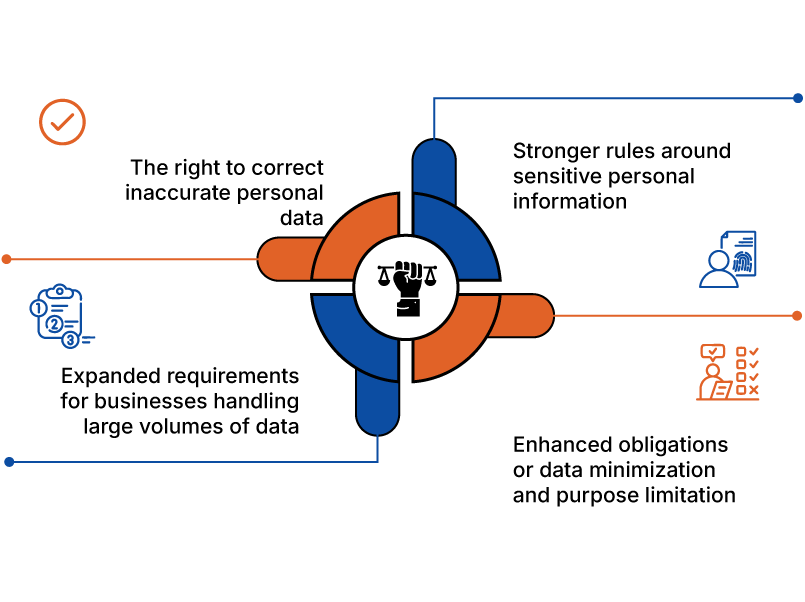
- The right to correct inaccurate personal data
- Stronger rules around sensitive personal information
- Enhanced obligations for data minimization and purpose limitation
- Expanded requirements for businesses handling large volumes of data
Why did CPRA replace parts of CCPA?
While CCPA was a strong starting point, it had limitations in enforcement and scope.
CPRA was introduced to:
- Strengthen consumer rights
- Introduce stricter compliance obligations
- Improve enforcement through a dedicated regulatory body
- Address evolving data privacy challenges
Essentially, CPRA doesn’t replace CCPA entirely; it amends and strengthens it, making compliance more robust and comprehensive.
Who needs to comply?
Both California Consumer Privacy Act compliance and California Privacy Rights Act compliance apply to businesses that:
- Operate in California or target California residents
- Meet certain revenue or data processing thresholds
- Collect, sell, or share consumer personal data
This means even global companies outside the U.S. must comply if they handle data of California residents.
CCPA vs CPRA – Key differences explained
Understanding the CCPA vs CPRA difference is critical for businesses looking to update their privacy strategies and remain compliant with evolving regulations.
| Aspect | CCPA | CPRA |
|---|---|---|
| Consumer Data Rights | Provides rights to access, delete, and opt out of the sale of personal data | Expands rights by adding the ability to correct inaccurate data and limit the use of sensitive personal information |
| Enforcement Body | Enforced by the California Attorney General | Introduces a dedicated authority the California Privacy Protection Agency (CPPA) for enforcement and oversight |
| Data Scope & Definitions | Covers personal information but with limited categorization | Introduces sensitive personal information with stricter rules on collection and usage |
| Penalties & Enforcement | Standard enforcement with defined penalties for violations | Stricter enforcement requirements, especially for minors’ data, with increased accountability for repeated violations |
Why businesses must update compliance?
With the introduction of CPRA, simply relying on existing CCPA frameworks is no longer enough.
Businesses must actively upgrade their compliance strategies because:
- CPRA is stricter than CCPA, with expanded consumer rights
- It requires better data governance and documentation
- Enforcement is more structured and proactive
- Non-compliance can lead to higher penalties and reputational damage
In short, organizations must shift from a basic compliance mindset to a proactive privacy-first approach to meet modern regulatory expectations.
Who needs CCPA & CPRA Compliance?
Understanding whether your business falls under California privacy compliance laws is essential to avoid legal risks and financial penalties. Many organizations assume these regulations only apply to companies physically located in California but that’s not the case.
Both CCPA and CPRA apply to any business that collects or processes personal data of California residents, regardless of where the company is based.
Key eligibility criteria
A business must comply with California Consumer Privacy Act compliance and CPRA if it meets one or more of the following conditions:
1. Revenue threshold
- Businesses with annual gross revenue exceeding $25 million are required to comply
- This applies even if data processing is not the core business activity
2. Data volume conditions
- Companies that buy, sell, or share personal data of 100,000 or more consumers or households annually
- Includes online platforms, e-commerce businesses, SaaS companies, and ad-tech firms
3. Revenue from data selling
- Businesses that earn 50% or more of their annual revenue from selling consumer data
- These organizations face stricter scrutiny under CPRA
Global companies must also comply
One of the most important aspects of California data privacy compliance services is understanding the global impact of these laws.
Even if your business is located outside the United States, you must comply if:
- You offer goods or services to California residents
- You track user behavior (e.g., through cookies, analytics, or targeted ads)
- You collect any form of personally identifiable information (PII)
This means startups, tech platforms, and multinational corporations all fall under California privacy compliance if they engage with California users.
Not sure if your business meets CCPA & CPRA requirements?
Our specialists review your data practices, highlight risks, and provide a clear path to compliance. Many companies gain clarity within days.
CCPA & CPRA Compliance requirements
To achieve full compliance, businesses must follow a structured set of rules covering data collection, user rights, and data protection. Understanding both CCPA compliance requirements and CPRA compliance requirements is critical for building a legally sound privacy program.
Data Collection and Disclosure Rules
Transparency is the foundation of both CCPA and CPRA.
Businesses must:
Under CPRA, organizations must also follow:
This ensures users are fully aware of how their data is handled, strengthening trust and compliance.
Consumer Rights (Access, Delete, Opt-Out)
A core part of CCPA & CPRA compliance requirements is enabling consumers to exercise their rights over personal data.
Key Consumer Rights Include:
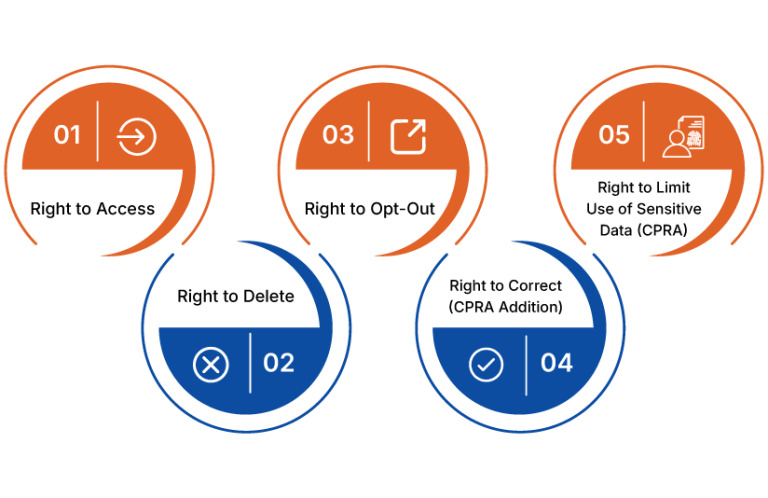
Right to Access
Right to Delete
Right to Opt-Out
Right to Correct (CPRA Addition)
Right to Limit Use of Sensitive Data (CPRA)
Businesses must provide clear mechanisms (like “Do Not Sell My Personal Information” links) to support these rights.
Data protection and security expectations
Beyond transparency and rights management, businesses are expected to implement strong data protection measures.
Key requirements include:
Failure to meet these CPRA compliance requirements can result in:
CPRA places greater emphasis on proactive data protection, meaning businesses must not only respond to issues but actively prevent them.
CCPA & CPRA Compliance checklist for businesses
Implementing compliance can feel complex, but breaking it down into a clear CCPA compliance checklist and CPRA compliance checklist makes the process manageable.
Below is a step-by-step, practical checklist that businesses can follow to meet key requirements:
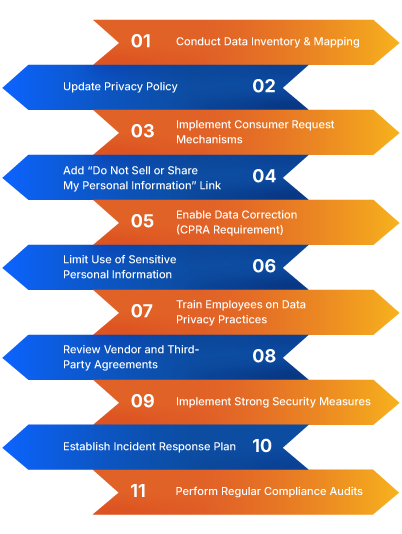
Conduct Data Inventory & Mapping
Update Privacy Policy
Implement Consumer Request Mechanisms
Add “Do Not Sell or Share My Personal Information” Link
Enable Data Correction (CPRA Requirement)
Limit Use of Sensitive Personal Information
Train Employees on Data Privacy Practices
Review Vendor and Third-Party Agreements
Implement Strong Security Measures
Establish Incident Response Plan
Perform Regular Compliance Audits
This CCPA compliance checklist is not a one-time task; it requires ongoing updates as regulations evolve.
CCPA & CPRA Audit and Monitoring
Compliance doesn’t end after implementation. Continuous monitoring through a CCPA CPRA audit ensures your business stays aligned with evolving regulations.
What is a Compliance Audit?
A CPRA audit and monitoring process is a structured evaluation of your organization’s data privacy practices. It helps identify:
Audits ensure that your policies are not just documented but also actively followed in practice. Regular CCPA & CPRA audits help businesses identify hidden risks, fix compliance gaps, and stay aligned with changing regulations. Without regular monitoring, even compliant systems can become outdated and expose the business to penalties.
How Often Should You Audit?
There is no one-size-fits-all answer, but best practices suggest:
Regular CPRA audit and monitoring helps businesses stay proactive rather than reactive.
Common Gaps Found in Audits
Many organizations struggle with similar issues during compliance assessments. Common gaps include:
Incomplete Data Mapping
Missing or Outdated Privacy Policies
Ineffective Consumer Request Handling
Weak Vendor Management
Insufficient Security Measures
Regular audits not only ensure compliance but also strengthen your overall data governance and security framework.
CCPA Data Subject Rights Management
Managing user data requests efficiently is a critical part of CCPA data subject rights management. Businesses must be prepared to handle requests accurately, securely, and within legal timelines.
Handling User Requests
Under CCPA and CPRA, businesses must provide clear channels for consumers to submit requests, such as:
Once a request is received, organizations must:
Timelines for Response
Businesses are required to respond within:
Failure to meet these timelines can lead to compliance violations and penalties.
Automation Challenges
As request volumes increase, manual handling becomes inefficient. Common challenges include:
To overcome this, many organizations invest in:
Effective CCPA data subject rights management requires a balance of technology, processes, and trained personnel to ensure smooth and compliant operations.
Challenges businesses face in CCPA & CPRA compliance
Achieving and maintaining California privacy compliance is not a one-time effort. Many organizations struggle with ongoing operational, technical, and regulatory challenges.
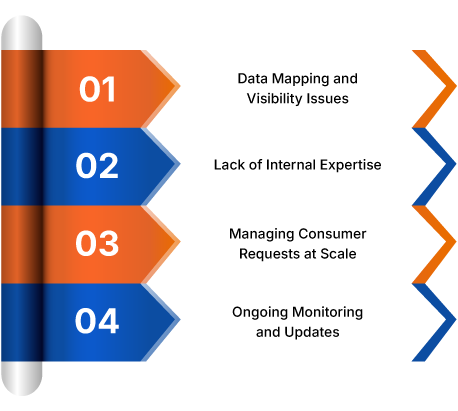
Data Mapping and Visibility Issues
One of the biggest hurdles is understanding:
Without proper data mapping, businesses cannot fully meet CCPA & CPRA compliance requirements, especially when responding to user requests.
Lack of Internal Expertise
Data privacy regulations are complex and constantly evolving. Many organizations:
This makes it harder to maintain consistent California privacy compliance across departments.
Managing Consumer Requests at Scale
Handling requests for access, deletion, and opt-out becomes challenging when:
Delays or errors in handling these requests can lead to compliance risks.
CCPA & CPRA compliance services explained
Businesses often rely on CCPA compliance services and CPRA compliance services to manage complex regulatory requirements, reduce risk, and ensure continuous compliance with California privacy laws. To simplify compliance, many organizations turn to professional CCPA compliance services and CPRA compliance services that provide end-to-end support.
What Do Compliance Services Include?
Comprehensive CCPA and CPRA compliance services typically cover:
These services ensure businesses meet both CCPA compliance requirements and CPRA compliance requirements effectively.
Consulting vs Managed Services
Understanding the difference helps businesses choose the right support model:
Consulting Services
- Provide expert guidance and strategy
- Help design compliance frameworks
- Ideal for organizations with in-house teams
Managed Services
- Handle execution and ongoing compliance
- Monitor systems and manage requests
- Ideal for businesses lacking internal expertise
Tools vs Expert Services
Many organizations rely on tools, but tools alone are not enough.
Tools
- Automate processes like data mapping and request handling
- Improve efficiency
Expert Services
- Provide strategic insights
- Ensure regulatory alignment
- Address complex compliance challenges
Why businesses choose CCPA & CPRA consulting services
With increasing regulatory pressure, businesses are actively investing in CCPA compliance consulting and CPRA consulting services to streamline their compliance journey.
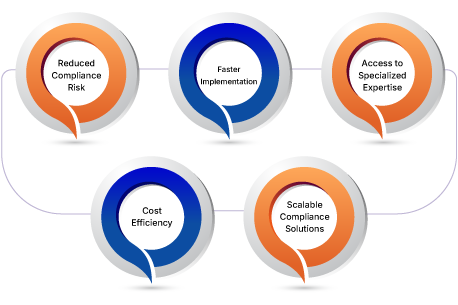
Key Reasons Include:
Reduced Compliance Risk
Experts help identify and fix gaps before they lead to penalties
Faster Implementation
Proven frameworks speed up the compliance process
Access to Specialized Expertise
Stay updated with the latest regulatory changes and best practices
Cost Efficiency
Avoid costly mistakes and reduce long-term compliance costs
Scalable Compliance Solutions
Adapt compliance strategies as your business grows
Professional CCPA CPRA consulting services enable businesses to move from reactive compliance to a proactive, strategic approach.
How to choose the right CCPA compliance service provider
Selecting the right CCPA compliance service provider or CPRA compliance service provider is critical for long-term success.
Key Factors to Consider:
Proven Experience
Industry Expertise
Comprehensive Service Offering
Technology Capabilities
Customization and Scalability
Ongoing Support
Choosing the right partner can significantly reduce your compliance burden and risk exposure.
How ValueMentor supports CCPA & CPRA compliance
When it comes to reliable California privacy compliance services, ValueMentor offers a structured and results-driven approach to help businesses achieve and maintain compliance.
Our Approach
ValueMentor follows a comprehensive lifecycle model:
1. Assessment
- Evaluate current data practices
- Identify compliance gaps
2. Audit
- Conduct detailed CCPA CPRA audit
- Analyze risks and vulnerabilities
3. Implementation
- Deploy required policies, controls, and processes
- Align with CCPA CPRA data protection services best practices
4. Monitoring & Optimization
- Continuous compliance tracking
- Regular updates based on regulatory changes
Why businesses trust ValueMentor
With ValueMentor’s California data privacy compliance services, businesses can confidently navigate complex privacy regulations while focusing on growth.
Conclusion
As data privacy regulations continue to evolve, achieving CCPA & CPRA compliance is no longer optional; it is a critical business requirement. From understanding legal obligations to implementing strong data protection practices, businesses must take a proactive approach to safeguard consumer data and maintain trust. This guide has covered everything from what is CCPA compliance to detailed requirements, checklists, audits, and compliance services. By following a structured strategy and leveraging expert support, organizations can not only meet regulatory expectations but also strengthen their overall data governance framework.
Are you ready to get started? Talk to our compliance experts or request a compliance assessment today.
Stay ahead of CCPA & CPRA regulations with confidence.
Expert-led support, transparent processes, and compliance strategies designed to protect your business and customer data.
FAQs
1. What is CCPA compliance in simple terms?
CCPA compliance means following rules that give California consumers control over their personal data, including the right to access, delete, and opt out of data sharing.
2. What are the key requirements of CPRA?
Key CPRA compliance requirements include data transparency, consumer rights management, data minimization, and protection of sensitive personal information.
3. What is the difference between CCPA and CPRA?
The CCPA vs CPRA difference lies in stricter rules under CPRA, additional consumer rights, and the creation of a dedicated enforcement authority.
4. Who needs to comply with CPRA?
Any business that meets revenue or data processing thresholds and handles data of California residents must comply, including global companies.
5. What are the penalties for non-compliance?
Penalties can include fines per violation and legal actions, especially in cases of data breaches or repeated non-compliance.
6. Is CPRA stricter than CCPA?
Yes, CPRA introduces stricter regulations, enhanced enforcement, and additional consumer rights compared to CCPA.
7. How do businesses start CCPA compliance?
Businesses can begin by conducting a data audit, updating privacy policies, and implementing systems to manage consumer rights requests.
8. What is included in a CCPA compliance checklist?
A CCPA compliance checklist includes data mapping, policy updates, user rights mechanisms, employee training, and regular audits.
9. Do global companies need CPRA compliance?
Yes, if they collect or process data of California residents, they must meet California privacy compliance requirements.
10. How long does CCPA compliance take?
The timeline varies depending on business size and complexity but typically ranges from a few weeks to several months.